
 End-to-end outreach workflow




Table of Contents
- Agency-sent email addresses have ~15% higher open rates, largely due to more effective subject lines and pitch content.
- Brand email addresses drive ~60% more replies, likely due to built-in authority and perceived credibility.
- Best performance came from agencies sending from brand domains.
- Click-worthy subject lines using urgency and emotion strongly impact open rates across campaigns.
If you’ve spent any time in digital PR, you’ve probably come across this question.
What address do you send your pitch emails from?
Send from a branded email address, and you might be more recognizable. But that’s not always an option.
Send from an agency email address where you’ve built a relationship, and you may have a foot in the door.
Either way, our data shows that the sending address significantly affects whether the journalist interacts with the pitch.
In this piece, I’ll try to help answer these questions once and for all.
Quick notes on methodology
We analyzed more than 16,000 PR campaigns and 5 million emails sent through BuzzStream over the past two years, comparing agency-run outreach to in-house brand outreach.
List quality is another major confounding factor. I limited this to agencies and brands running very similar digital PR campaigns, such as data studies and reactive commentary.
To minimize this bias, I filtered out massive blasts, affiliate pushes, and outdated lists so we were comparing real PR outreach rather than database dumps.
We calculated both weighted and unweighted open and reply rates across all remaining campaigns.
Weighted rates reflect actual inbox performance across all emails sent, while unweighted rates reflect the typical performance of a single campaign.
Let’s get into it.
Overall Results
Overall, 92% of campaigns are sent from agency email domains.
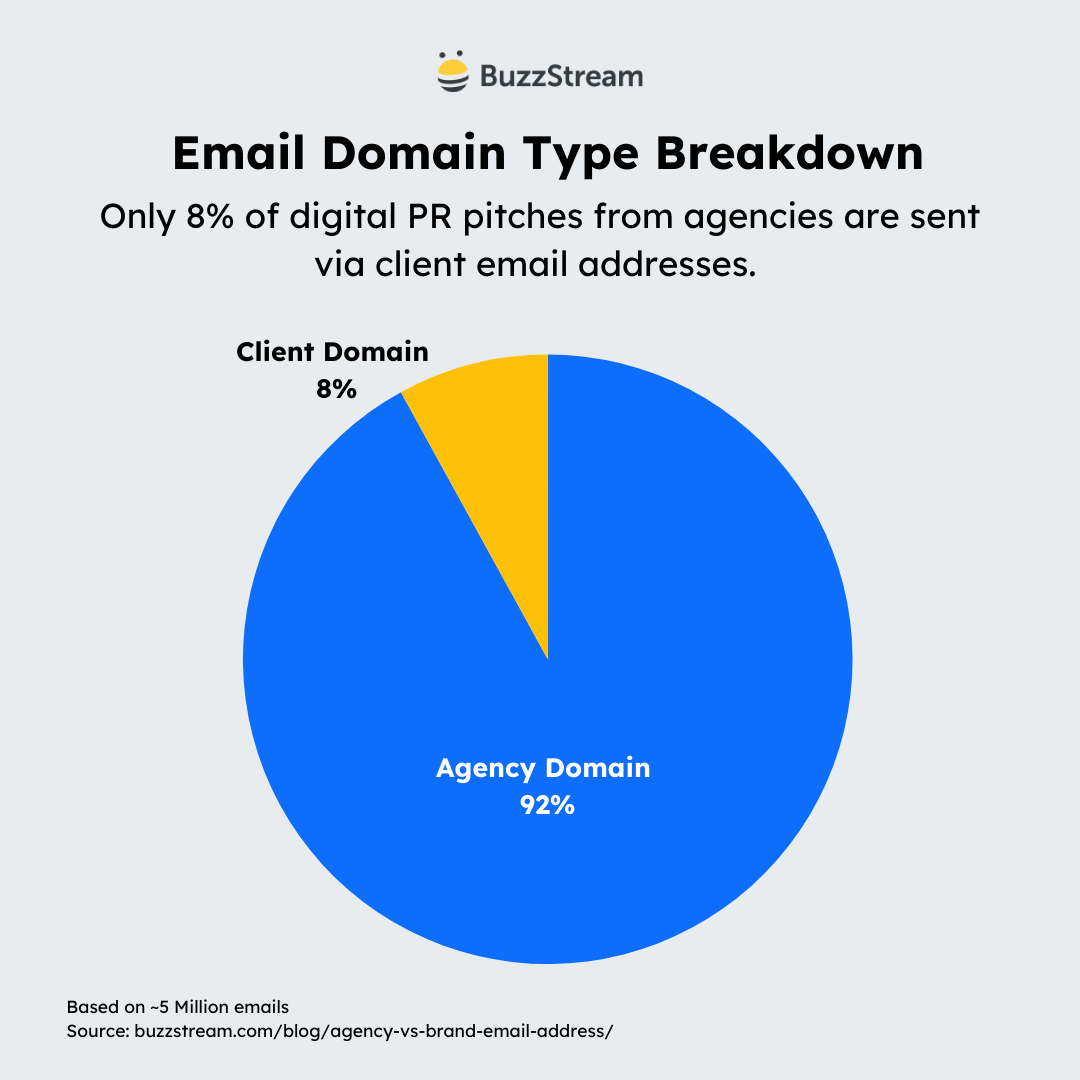
Here is a table of the overall results:
| Metric | Agency Domain | Brand Domain |
|---|---|---|
| Total Campaigns | 14,582 | 1,881 |
| Total Sends | 4,105,240 | 946,944 |
| Open Rate | 41.54% | 35.68% |
| Reply Rate | 0.67% | 0.86% |
However, when we dig into the data, we find some surprising differences in how they perform.
Emails From Agency Addresses Get Better Open Rates
Overall, emails from agency addresses have about 15% higher open rates than those from brands.
- Agency address: 41.54%
- Brand address: 35.68%
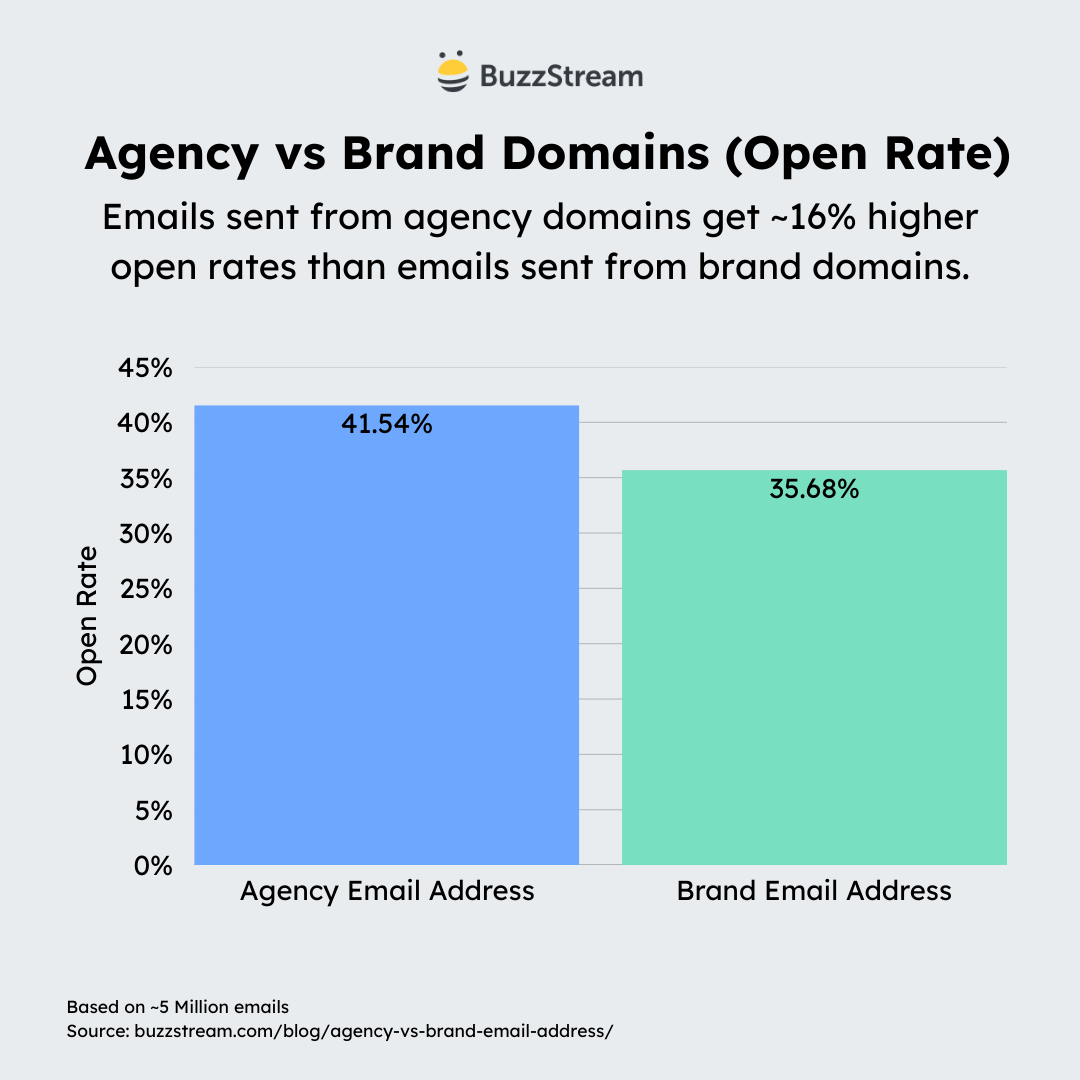
Because agencies tend to send larger campaigns, weighted open rates will naturally skew higher for them. That’s why I compared both weighted and unweighted rates.
Interestingly, the directional difference held in both cases.
There are potentially many reasons for this, but the main one that comes to mind is that agencies are just better at writing clickable subject lines.
Also, agencies can typically choose whom they work for and decline brands that may not have “news-worthy” content, giving them an advantage by potentially having better content to pitch. (It can also potentially impact brand recognition, which we’ll see may play a role in replies.)
The easiest way I thought to test this was to compare open rates between agencies sending from their own addresses vs agencies sending using brand emails.
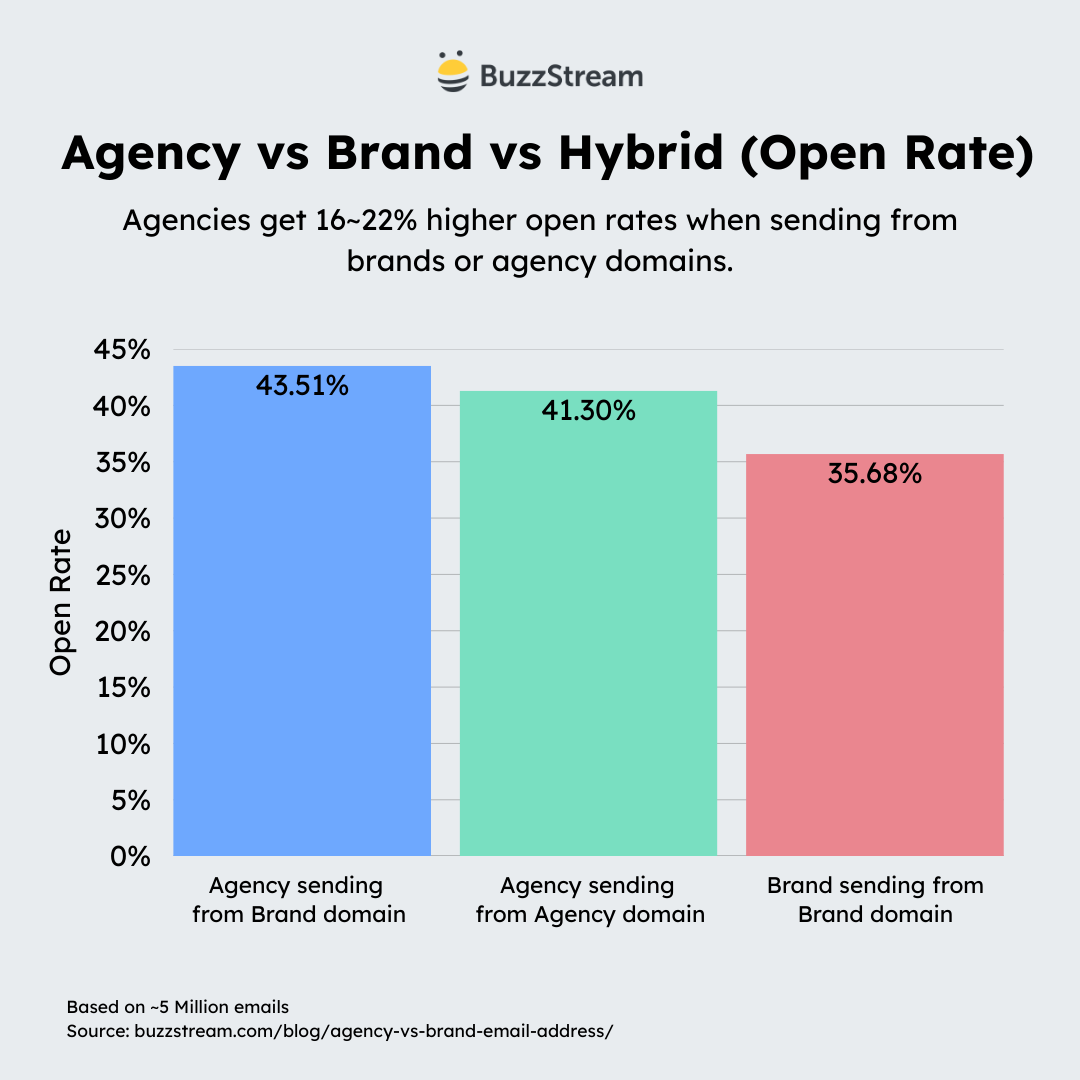
This agency impact appears to hold: emails sent by agencies have higher open rates than those sent by brands.
Here’s the table:
| Sender Type | Campaigns | Total Sends | Weighted Open Rate |
|---|---|---|---|
| Agencies sending from BRAND domains | 1,156 | 442,672 | 43.51% |
| Agencies sending from AGENCY domains | 13,426 | 3,662,568 | 41.30% |
| Brands sending from their own domains | 1,881 | 946,944 | 35.68% |
So, why do agencies get better opens?
I think it is because of better subject lines.
When I manually reviewed a sample of the subject lines, I noticed some trends.
For instance, here are some of the agency subject lines that illustrate the broader trend we saw in the subject-line data (slightly edited to obscure them a bit):
- “Exclusive: 1 in 3 people say the ‘worst gift’ is getting nothing at all…”
- “Event ticket costs — the price gaps are surprisingly extreme”
- “Urgent: Last-minute tips students are using to secure better course placements”
I see many of the same takeaways from our subject line study that directly connect to those written by agencies.
Concepts like urgency and emotion can go a long way towards helping an email stand out.
Compare that to subject lines sent from brands’ addresses:
- “Regional Connectivity Performance Index – Quarterly Update”
- “New survey: Health symptoms linked with day-to-day caregiving demands”
- “Digital Habits Report – Annual Findings”
Consider a subject line like this: “Regional Connectivity Performance Index – Quarterly Update”.
Give it the urgency/emotion agency glow up, and you’ve got something like this:
“Fresh Data: Regional Connectivity is Up a Surpising 85% in Q3.”
The simple addition of the adjective “surprising” makes it more clickable.
But opens aren’t the only metric we care about, so let’s look at reply rates.
Emails From Brand Addresses Get Better Reply Rates
Emails from brands generate ~60% more replies per email sent than those from agency emails.
- Brand address: 1.07%
- Agency address: 0.67%
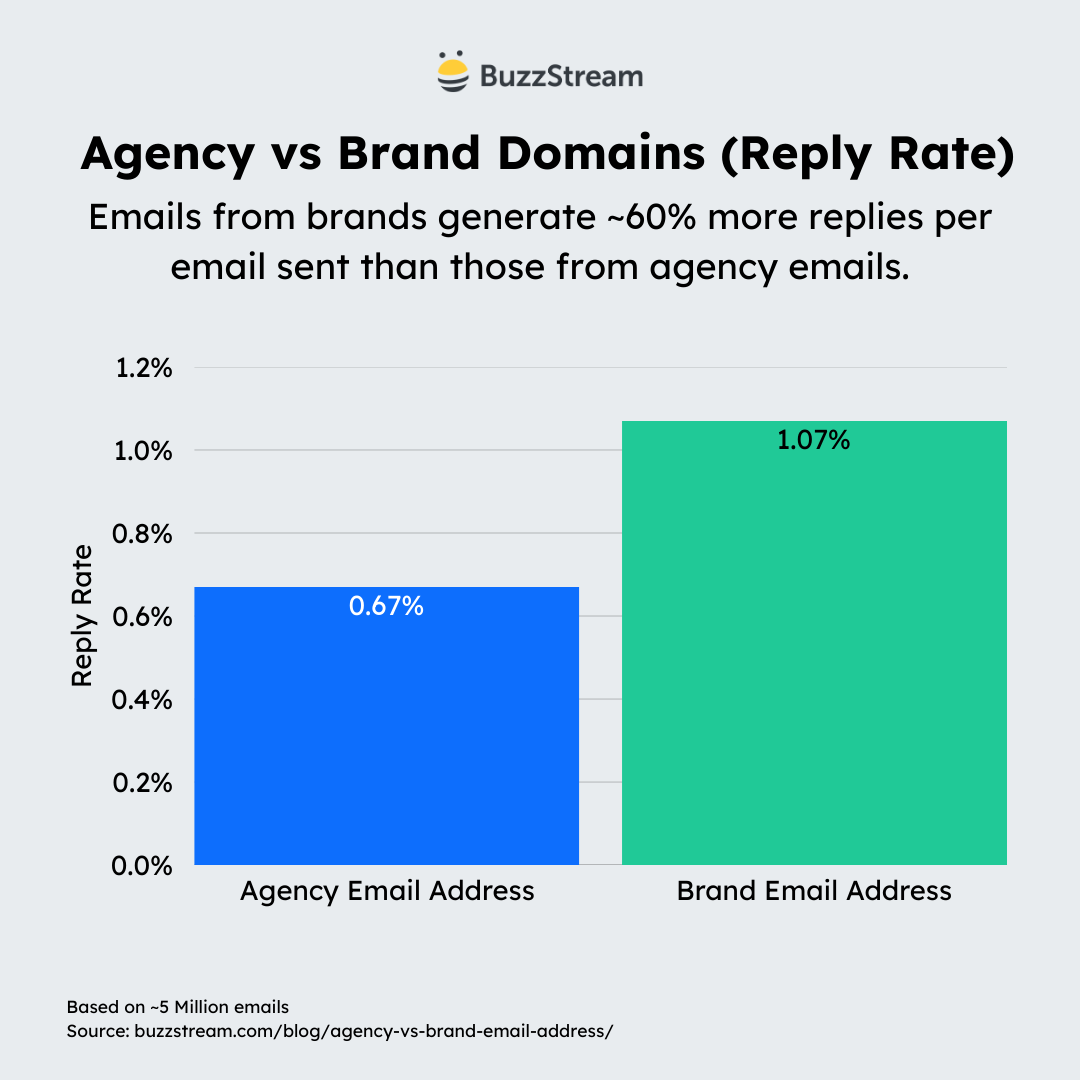
Reply rates at this scale are tiny by nature — according to Muck Rack, about 50% of journalists never respond to pitches (good or bad) — so the more important thing to look for is whether a pattern consistently shows up across thousands of campaigns.
In this case, the brand-domain advantage held steady even when slicing the data multiple ways.
Some may look at low reply rates as a non-issue.
But, I think there is something more to this, because even when agencies send from brand email addresses, they get better reply rates:
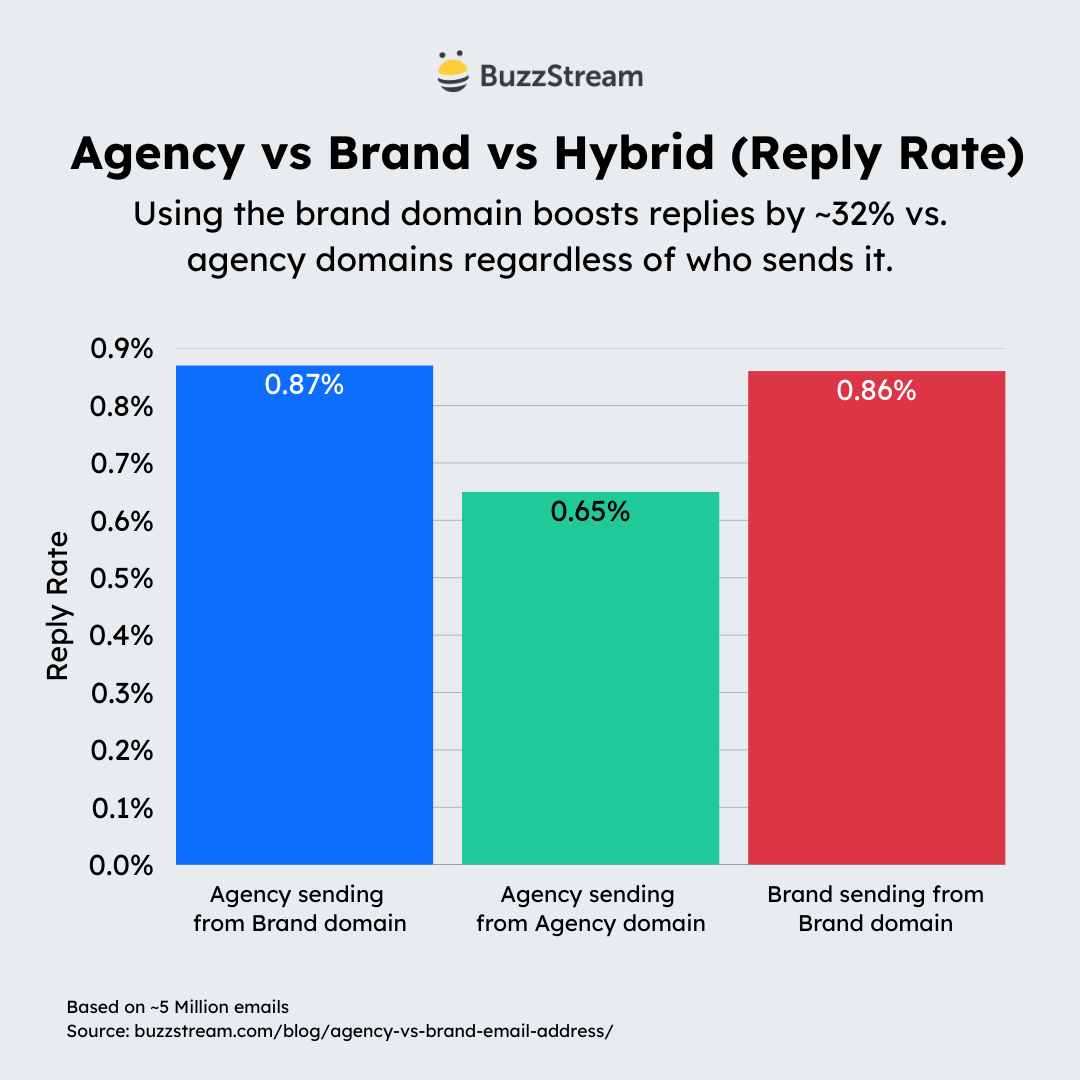
Here’s the table:
| Sender Type | Campaigns | Total Sends | Weighted Reply Rate |
|---|---|---|---|
| Agencies sending from BRAND domains | 1,156 | 442,672 | 0.87% |
| Agencies sending from AGENCY domains | 13,426 | 3,662,568 | 0.65% |
| Brands sending from their own domains | 1,881 | 946,944 | 0.86% |
As you can see, the reply rates for anything brand-related are about 0.86-0.87%.
So what’s the deal here? Why do brands get better replies?
I think brands get better replies due to a mix of two things:
1. Brands have built-in authority and recognition—as evidenced by the fact that agencies get better opens and replies when sending from brand domains.
2. Brand domain emails typically provided less information than agencies and left things open-ended with lines like:
- “I can connect you with one of our experts if you need further details.”
- “Would you like the full dataset or additional commentary?”
Should you do this when emailing journalists?
Our experience indicates it’s probably not the best strategy.
You should always aim to provide the journalist with all relevant information in a single email.
In fact, in a fantastic conversation with Hannah Smith, she outlined a process where you attempt to write a story based on everything you provide in your pitch. If you can’t, you’re not providing enough information.
Does Campaign Type Matter?
Another theory I had that was contributing to this increase in response rates was that reactive campaigns and commentary pitches elicit more responses.
In that case, both the agency and the brands would have similar reply rates for reactive campaigns.
But when I dug into that, that wasn’t really the case.
| Metric | Agencies (Reactive Only) | Brands (Reactive Only) |
|---|---|---|
| Open Rate | ~55% | ~35% |
| Reply Rate | ~0.1% | 0.71% |
Brands once again had a higher reply rate than agencies.
Therefore, I don’t think it has to do with reactive.
What About Sending From Gmail?
But wait! A third option has arrived.
What if we send from Gmail or a personal email? Won’t that make us seem cooler and more relatable?
Unfortunately, Gmail accounts were used in only 8 of our 16,500 total campaigns, or about 1,797 emails sent.
Open rates were 24%.
(This is extremely small, so it’s not statistically reliable enough to draw strong conclusions. I’ve included it here mainly for completeness, not as a recommendation.)
With that out of the way, let’s wrap this up.
The Best Course of Action? Think Like an Agency
No dataset like this perfectly isolates every variable — industry, story format, list sourcing, and domain authority all play a role — but when the same directional patterns appear across thousands of campaigns and multiple slices of the data, they become difficult to ignore.
Based on our data, the best of both worlds seems to be sending an agency-optimized email but from a brand domain.
Those get the highest open and reply rates.
| Sender Type | Open Rate | Reply Rate |
|---|---|---|
| Agencies sending from BRAND domains | 43.51% | 0.87% |
| Agencies sending from AGENCY domains | 41.30% | 0.65% |
| Brands sending from their own domains | 35.68% | 0.86% |
However, it’s easy to take away from this study that simply changing who you are sending from will get you better results.
That is not the case.
I think the story here is that agencies are better at writing more clickable, actionable email subject lines, which helps increase email opens.
That said, sending from a brand email address as an agency may give you an added edge in response rates as well.
We also didn’t get into the industry or type of content being pitched, which can affect open and reply rates as well. If that is something you’d want to see, let me know!
Want some more tips on sending better subject lines?
Check out this data study, guide, and podcast episode:
- The Art of Writing Subject Lines That Journalists Will Love
- 6 Million Subject Lines Analyzed: What Actually Gets Journalists to Open
- Optimizing Subject Lines with Helena Maniglia
Happy emailing!

 Check out the BuzzStream Podcast