 End-to-end outreach workflow



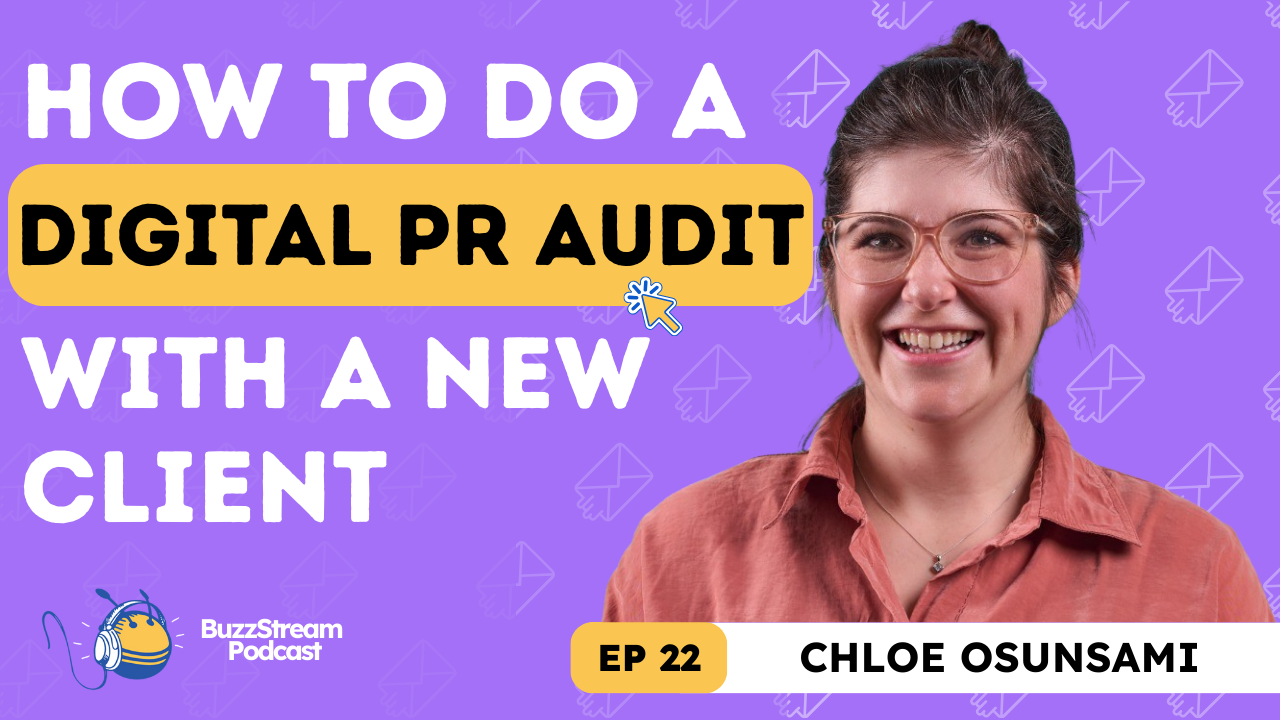
Table of Contents
- Start audits with brand immersion, then benchmark against 3–5 direct or challenger competitors.
- Prioritize backlink quality, relevance, and link intersections over sheer quantity.
- Incorporate AI Overviews (AIOs) and LLM citations into audits, but report cautiously due to evolving tools.
- Use tools like Ahrefs, Moz, and GSC, but tailor audits to available data and always sense-check AI outputs.
- Leverage existing content for timely, expert-led pitching—especially for quick wins like thought leadership.
- Refresh PR audits at least annually, with quarterly or monthly competitor scans to adapt to fast-moving industries.
One of my favorite questions to ask PR pros is simple: Where do you start?
When a new client comes in, those first steps matter more than people think.
In this episode, I sat down with Aira’s Head of Digital PR, Chloe Osunsami, to walk me through her digital PR audit process.
She talks about how she understands a brand, sizes up competitors, and turns all that data into a real strategy.
This isn’t just something you should do at the start of a client engagement; you should repeat this process throughout the engagement to ensure your strategy stays on point.
If you or your team feel like your digital PR strategy is wavering, you might want to give this a listen!

What are some of the first things you do to get your bearings with a new client?
Great question Vince. So I first start with making sure I really understand the brand and the client.
So I like to understand where they’re at, how they’re doing, their objectives and any particular focuses before I jump in and why they believe PR should be a part of that puzzle.
Once I really know that I can then start to look at specifics to do with them. However, can’t look at that bigger picture in a vacuum.
because we as buyers don’t really operate in that way either. So we need to make sure we’re looking at them versus their competitors.
So I will start by pulling out maybe three to five top competitors that I will benchmark them against during an audit and make sure that they are either direct competitors or challenger brands that are coming up through the ranks.
Because you can’t compare apples or oranges to a whole fruit bowl, so we need to make sure we’re comparing our product-specific competitors when we’re doing this.
So I’ll pull those out and then I’ll start to look at the bigger picture.
So I will start by looking at things like these things really interest me to start with things like organic traffic versus paid traffic to see where they’re getting their traffic from.
I will look at keywords in top positions and I will look at backlink profiles as well as inventions and PR in general.
Then I’ll really start to dig down.
So I have a look at that bigger picture basically to almost check the playing field, right?
To see how they’re doing versus those compressors, which ones are doing well?
Then dig into the PR-specific details to see what correlates with those doing well.
Once I’ve had a look at that, I will then go into the referring domain profile in more detail.
I will review quality, relevance, quantity, and link intersections.
So, where competitors have links that my client or brand doesn’t.
I will review brand mentions and volume, where they sit, and the content and stories that are helping them land them.
I start broadly and ensure I take their objectives and what they’re looking for into account. I then narrow it down and look at, say, the bigger picture versus competitors, and then I go even more granular with the PR, the stuff that we can kind of have an impact or an influence on.
How important is it to consider SEO metrics?
Well, if you are doing work for a client and they do have search objectives, you’re tied into those search objectives.
You really need to make sure that they have a really strong foundation and website from an SEO perspective too.
And so I’ll work, I don’t necessarily do all of that stuff myself. I’ll work with someone from the SEO team to make sure that they have that stable foundation and everything is in working order.
Equally when it comes to things like keywords and focus areas, it’s really good for us to know which brands might be focused on the particular focus areas that our brand is focused on.
They might have more keywords around specific topics where they rank highly, in those top traffic-driving positions.
And then I might look at their activity a bit more to see what they’re doing and what might be helping them to get those positions, because that’s what we want to do around those topics.
So it kind of helps to shape questions and then what I look into to be able to see what we could potentially be doing to get where they are essentially.
How often do clients’ PR goals coincide with SEO goals?
We have a mix. I think one important point is that one size doesn’t fit all.
So I can’t say that like for one brand who comes to us because they want coverage and that is their main objective that like I would look exactly the same things for them as I would for someone who we need to make sure that we are tied in with our search. So we are taking a blended search approach.
However, I still do take an interest in those things. I think it’s just the way I am inclined.
I still take an interest in those things because I know even if we’re targeted and we need to get coverage, they’re still that bigger picture.
We’re still trying to that brand get that coverage because they want to, they want to improve their search visibility and at the end of the day, their traffic and their sales.
And so I’m always going to have a little look even if it’s not as in-depth as say for a client who really is into the search side.
What are some of your go-to tools for people doing an audit?
I’m not sure there’d be many that people don’t know about from what I currently work with, but I will say like you can shape your audit to fit what you have access to.
So I currently use Ahrefs and Moz.
I do lot of manual research and we have an internal tool that I can use when it comes to search and keywords.
Obviously Google Analytics and GSC is great help for your own brands and clients.
But I try to keep a consistent view because I don’t have access to that for the other brands.
I try to make sure I look at them through the tools.
I have used other tools previously that do a great job too. Comparisons like Ahrefs, Semrush, etc., are also great.
So you can shape what you look at.
They all work slightly differently, but at the end of the day, they do very similar things.
Obviously AI is a very hot topic about when people do and don’t use it.
I do occasionally use ChatGPT or Gemini to speed up part of the analysis, but I would never use it to pull the data.
And one of the things I would say if people are looking to do that is just make sure your brief is really hot and you make sure it delivers an output that you can then sense check.
So whether that’s in a table with all the sources or it’s working out.
Make sure you can really thoroughly check what it’s done for you because it can lie.
What if a client comes to you wanting to show up in AI citations?
Yep. So I do look at AIOs and LLM features as part of the audit now.
But in my opinion, and I think a few people share it, I don’t think anyone’s really got it nailed just yet with the reporting on it.
So it’s quite, it’s quite difficult one to do.
The numbers go up and down because it’s not like a linear view.
It’s like you’ve increased this much and the percent split is really helpful.
So, how much you appear versus your competitors, but equally, you have to be so careful because it doesn’t always take into account the right sentiment yet or the types of mentions.
We use an overview and an internal keyword tool to assess visibility versus competitors for relevant queries.
But I’m just very careful when we do obviously report on anything like that at the moment or look into that.
But it is an area that I’m really excited about because I do think it’s really going to develop and quite quickly in the coming months.
So I’m saying now they don’t have it nailed, but it might not be that long, really, before, like, we’ve got a much stronger way of looking at that and reporting back on that too.
Do you measure backlink relevance in your audit?
We do try to quantify relevance.
Again, I think it’s a really difficult one and I don’t think there’s a set way that anyone does it, which I think is a common theme in PR, right?
It’s not a set way that anyone seems to do it. But we do try to quantify relevance.
It’s more important than quantity, and just as important as the quality of backlinks plays into that quality, right?
We make sure to review the backlink profile and don’t just focus on the numbers, because those numbers aren’t going to make as much difference as they used to.
How much of your insights come from your own research vs what the client tells you?
I think that lot of our clients come to us for our expertise.
They’ll look to us for our strategy and recommendations on how to execute it.
That said, we always do take into account their expertise.
Obviously they are the ones in the brand every single day. We make sure to pick their brains and identify who they consider their competitors. So we can make sure we’re looking at those, even if we’re also looking at other competitors too.
Any product-focused company might have a new launch coming, and we might need to make sure we’re shifting in that direction.
So that might shape the strategy or the direction of the strategy and then we would shape everything around that direction that they’re going to go because it aligns to the broader business goals.
But when it comes to things like drilling it down to tactics and things the team would pretty much direct that and what works best for that industry as long as obviously it worked with what the client could also approve and deliver.
Is it OK to ask your clients questions?
I would ask as many questions as you want. When we first start with a brand, we conduct a brand immersion session so the team can ask every question they have to get under the skin, because your client works at that brand and lives and breathes it every single day. And you’re not going to know them as well, know the brand as well as they do from doing your own research because you don’t work there.
And that’s okay.
I think it’s totally okay to be asking questions, and if you don’t get them all asked at the beginning, it’s also, I believe, okay to go back and ask them questions later on, because at the end of the day, you’re going to deliver better work for them.
And as long as they’re positioned in the right way, then it’s absolutely fine.
How important is it to involve everyone who will be working on that client early?
So it’s so important to get the team working on it on those initial calls.
You’re so right, Vince, because otherwise they don’t get the same understanding that the others who’ve been on those calls have.
And it allows them to ask the questions too.
At the moment, we do have quite a senior team at Aira.
However, we’ve always tried to make sure that whoever is in the team and whoever is potentially going to work on that client is involved in the conversations.
And when we start to pull together what we think is going to work for them and the way that we want to go based on the audit that’s been carried out, which they might be involved in parts of as well, then we make sure that they’re involved in those conversations so that we all shape what we think is going to work in terms of tactics and ideas as well. So they’re always involved in things like brainstorms too.
What advice do you have for junior team members who are afraid to ask questions?
So I used to do quite a few things actually with my team. So I would use Google Forms.
Google Forms are great because they can be anonymous.
So if people really don’t want to speak up in a team environment, so internally not in front of the client, you could use a Google Form and get people to submit their questions, which you could then answer in a team meeting.
And then, when we answered them, we made sure everyone realized it wasn’t a silly question. If people start to realize that those aren’t silly questions, there are no silly questions.
It’s all about learning and shaping what we’re going to do; then the confidence starts to build.
We did a lot of mentoring, and that wasn’t just with more senior team members, like really senior team members, but maybe from other teams as well, so they could get to understand the bigger picture on what they’re doing or how that feeds into other things, which helped them to feel confident with the questions they were asking.
And that helped because I think it made them feel they weren’t being judged for their knowledge; it wasn’t someone more senior on their team, so they could ask questions from someone at a similar level. So that helped too. And then in one-to-ones, just really trying to, I guess, build that bond and make sure that people felt comfortable enough to bring up something if they weren’t quite sure.
We’ve always been a pretty open culture where you could just say “I’m not sure on this” like “can we talk about this” or “I actually think we need to do a little session on this”.
I think that’s really important because then it should help them to grow and understand more, and equally understand that, yeah, no question is a silly question because it’s gonna help you develop.
Has AI drastically changed the way that you do things at Aira?
Chloe Osunsami (21:19)
So obviously, I think because of the increase in AI, digital PR has become really popular again because it is what’s going to help if that is the objective to get included in AIOs and on LLMs, because of obviously brand mentions, highly correlating with appearances there.
I think that, in terms of the audit, not much has really changed in digital PR.
If you’ve got a solid PR strategy where you’re trying to get your client coverage to increase visibility, which could include coverage and links, then that is what’s going to work.
Not much has changed regarding the audit, as you’re still aiming to proceed with it.
I’m still aiming to get them in the right places in front of their target audience to increase brand visibility.
The only thing that’s really changed is that we were talking about looking at inclusions in AIOs and LLM features, and if they are currently there or if they have what kind of split they have versus their competitors, and so things like tha,t but I wouldn’t say it’s changed strategies all that much.
What can you learn from a client’s referring domains?
When I’m reviewing their referring domains, I’ll likely include brand mentions as well, since we prioritize coverage and links overall.
We look at where they’re sourcing them and then dig into the quality and relevant places we think are similar to where we want to target for our brand, based on the target audience and the product.
And then what is being covered in those spaces?
So how are they getting that coverage in those spaces?
Are they doing big data led campaigns or are they doing more reactive thought leadership?
Are they really like on brand stories or have they got less relevance so that they can get into some of these places? What is it that’s grasping the journalist’s attention and getting them in front of their target audience?
And is it something that we would want to be doing?
Is it something that our client is possibly missing or just haven’t been doing enough of?
And then I’d also have a look to see if there are any quick-win opportunities.
So from those, is there anything that we could be doing immediately to make sure we’re in similar spaces?
What would be a quick-win example?
If we have a client who works in a space that can deliver expert commentary on a topic that is really relevant to them.
So we might have spotted them talking about something.
We might have a slightly different spin on it.
Or if we know it’s currently a popular topic, we might look for more and start monitoring reactive opportunities around certain topics for expert commentary.
That would probably be one of the best quick win opportunities, which would be thought leadership if the brand has someone who is authoritative and can talk about those subjects.
So yeah, that’s probably what I would go for.
What is the conversation with clients like about quality vs quantity in links?
We get a lot of those questions. I feel like, and this might just be me and the people I’ve spoken to, we’ve had a lot of questions recently about guest posting as well.
It almost feels like it’s coming back around for some industries and brands.
And we might get asked, say that, our competitors are doing it though.
Like, is it not something we can do?
And it’s always a hard conversation, especially if the brand brings it up.
But I would say that there are some, there are definitely some tactics and I think when you see types of coverage, I think, I don’t even think you need to be a PR to really see that something is relevant.
You’d go, oh yeah, it makes sense for that brand to be there versus, oh, I’m not sure why they’re featuring in that place or I’m not sure why they’re talking about that story.
Essentially, it comes down to where their target audience is, so we always want to be there as well, because we want to be on that journey as well.
Ssome tactics don’t just don’t fare well for that and a lot of time, like the newer digital PR tactics versus like the older school SEO tactics.
The newer digital PR tactics tend to sit better within getting us in front of the target audience because you’re shaping it more, and it’s getting you into those quality relevant websites rather than the—I’m trying to position it carefully— directory of blogs that are potentially in a similar space but not quite as relevant.
How much does relevance play into this?
Definitely needs to be a front-end target audience.
Like you were saying about the example of your guest post with Ahrefs, for instance.
Like that’s relevant, and yes, that is an end of the guest posting scale, which would be yeah, thought leadership, and would be more appropriate, and something we would consider, whereas it’s probably the other end, where you’re just trying to get the brand out there to anyone and anywhere.
And things are starting to be picked up and ignored, I believe.
And I think that it’s going to go more in that direction.
Just like back in the day when people were using forums and comments to build links, it’s going to start to be kind of like just pushed out.
And I think as long as we’re focusing on the things that will make a difference and are the right thing to do moving forward, you’ll put yourself in a better position.
It’s always been about the audience?
Google wants to show the audience what they want to see.
So they’re going to get their information from where that audience is.
So in my mind, and I believe in many others, we need to be where that audience is, because that’s why Google is getting their information from, because they want to be showing their audience what they want to see.
Can you talk a bit about using existing content for pitching?
Absolutely.
So we’ll always have a look through their existing content to see what they currently have.
And there are three things we tend to look for.
First of all, if it’s a topic which could be of interest to the target audience currently or moving forward.
So is it unique or different or extremely timely?
And it’s really important that it’s of interest to the target audience because then it’ll be of interest to the media or the websites that you then want to feature on.
Number two is if it’s got expert or thought leadership or data behind it to make it more credible and give it a unique angle.
Or can some of it be turned into a quote?
If it is unique and different and it’s from the brand on their website, can some of it be turned into a quote potentially from someone?
I say from someone, from a real person at the brand.
I know there has been a lot conversation around that recently from a real person at the brand who has authority to talk about these things.
And then finally, like, is it up to date or new or can it be refreshed to make it that way?
And as long as it hits those three things, we will we will try to try to use it.
Do you repeat this kind of audit?
Yeah, I’d say it varies so much as to how regularly I need to do it because it depends on how quickly the industry is moving.
Some industries are much slower.
I would say you don’t need to keep looking all the time.
I’d say definitely try to redo it once a year. And I would jump into insights monthly at a top level.
⁓ Just to keep an eye on say if there’s a new competitor, a challenger brand, we don’t know how quickly a challenger brand can move up with their ranks and then you want to make sure you are keeping an on them and if not monthly then definitely quarterly. ⁓ But yeah I’d redo the whole thing every year just to make sure that you’ve got the right strategy for the following year.
Vince: Is this a deliverable that you offer to clients too, or is this something you just recommend as a PR, you know, freelancer or agency, you’re just kind of doing consistently?
Chloe Osunsami:
So I have delivered it before and some clients really find it interesting. Some brands just don’t have the time for it. They’re not as fast about seeing all the data and the graphs and things. They just want to know what you want to do and a couple of top level reasons why you’ve picked those things. So having the data to back it, to be able to say, we’ve done this and this is why, they’re happy just to see that bit.
Is this a formal process internally?
Yes, yeah, we make sure that we review everything. So we have annual reviews, so we’ll make sure we work it around those and what the plans are for the next financial year. And yeah, just make sure we rerun it so that we’ve got that new data to back all our decisions.
What is something that I haven’t asked you that would be good to cover?
I think that there’s a couple of things that I’d probably add would be just don’t be afraid to evolve.
It’s not necessarily something you’ve missed Vince, but I would just say don’t be afraid to evolve the audit over time.
Nothing stays set.
It’s totally okay for it to change. And that’s definitely one of my favorite things about it. You might say present it internally to someone and someone might ask you a question and you’d be like actually, I really should look into that.
I’m gonna keep, I’m gonna start looking into that moving forward.
That’s quite a good thing.
And like, don’t think that that kind of feedback or that questioning is bad against the work you’ve done so far.
And then I would say always think about the story as you go too.
So it kind of feeds into that really. What are the data points actually saying? And what is the story helping you to shape? So I say to everyone in my team who does an audit, like put yourself in the client’s shoes.
If someone wants to show this to you, like what would you ask based on what you were presented?
Are you interested in seeing something else from that or interested in finding out a little bit more and then just dig more into that? There’s no real, not really like a this is finished point, which is annoying, but equally it’s almost like you can then delve into and shape the bits to be able to form.

 Check out the BuzzStream Podcast