 End-to-end outreach workflow



- Digital PR and traditional PR serve different goals: SEO and link-building vs. long-term trust and credibility.
- Digital PR often reports to SEO or marketing, while traditional PR reports directly to the C-suite.
- Mislabeling SEO-focused tactics as “PR” creates market confusion and erodes trust in true communications strategy.
- Successful PR and digital PR collaboration hinges on shared messaging, strategic alignment, and keyword integration.
- Creating news via surveys or expert POVs is essential when brands lack timely announcements or earned media angles.
- With 7 PR pros per journalist, poor media etiquette—especially from digital PR—threatens industry-wide credibility.
Right before Thanksgiving 2025, PR consultant Jon Amar posted this to LinkedIn:
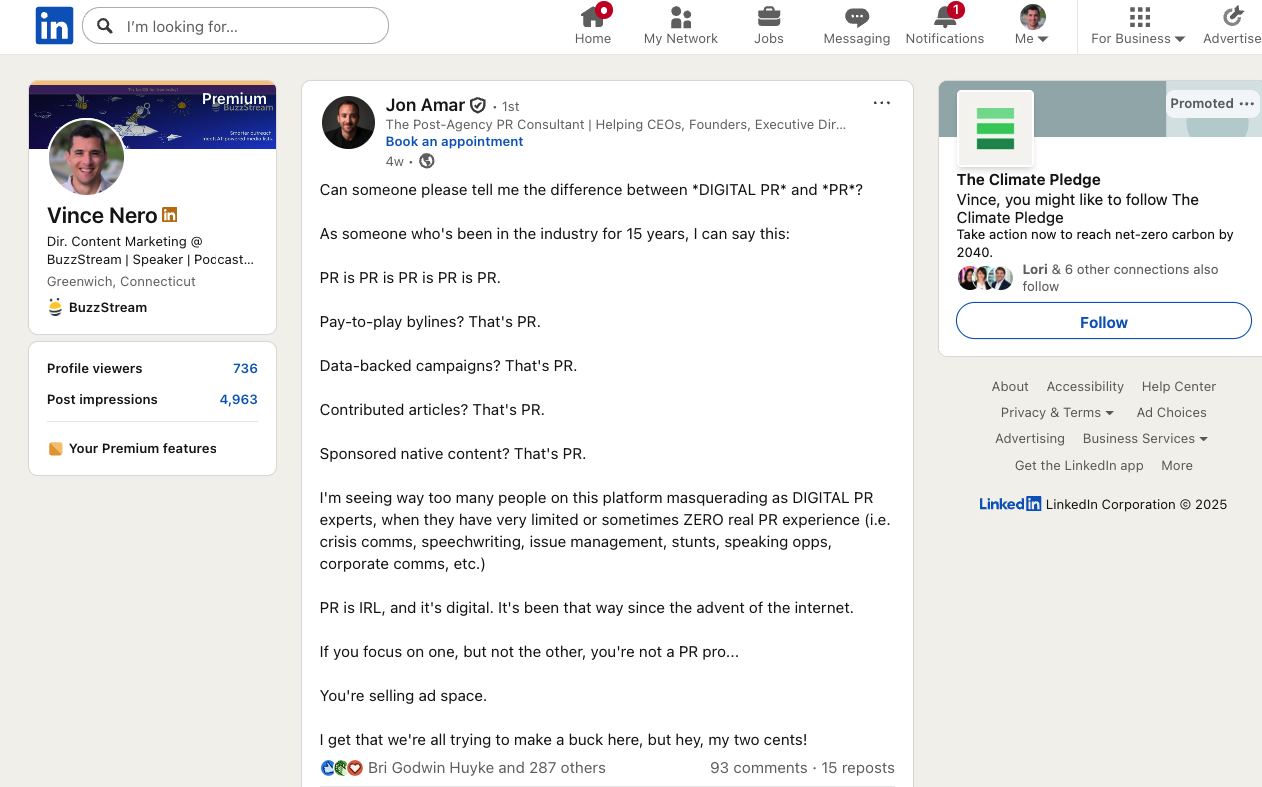
And this really sparked spirited conversation and responses in the PR and digital PR community.
Some weren’t super thrilled, others were open to conversation.
The need to address these two communities separately underscores the challenges we face as we enter 2026. I wanted to use this podcast to discuss the obstacles, frustrations, and confusion Jon mentioned in his post as well as help us all work towards some better collaboration in the future.
As far as I see it, we are all working towards the same goal, so the more we communicate, the more we can learn from one another.
Both sides still have a lot to learn to succeed in this business, as PR, SEO, and branding converge in 2026.

Transcript
Note: Usually, I format these posts with questions, but since this was much more of a dialogue, I kept the transcript pretty verbatim.
Vince Nero:
Yeah, so we’re recording this right after Thanksgiving, so I’m going to do my best to, you know, we’re working our way out of our turkey comas.
But let’s start here, Jon:
I came across you, I think, because there was a dialogue on LinkedIn kind of just straight up asking what the difference between digital PR and PR is. And I think I want to start with having you kind of define what PR is. Because we talked about this briefly right before this, and we’re talking about clients, and sometimes you get clients on that are either saying they don’t like PR because they’ve been burned in the past by some shady agency masquerading as digital PR, or maybe they just don’t know the full extent of what PR is. So I wanna start with explaining PR and then we’ll get into digital PR and then we’ll kind of go from there. So Jon, what is PR?
Jon Amar:
Sure, yeah, so, well, I first off, I put out this LinkedIn post a week or a couple weeks ago, and it really struck a chord, or maybe struck a nerve with some people, generally liked by many, many, many, many PR people. I had a couple digital PR people kind of calling me out, challenging some of the things on there, which I love.
I love when people like I’m happy to change my mind, right? Like I’m not, I’m not a stick in the mud kind of kind of person.
So it was really cool to engage with a lot of digital PR folks from really around the world, know, UK, Germany, Australia, people were really chiming in.
But, you know, from my perspective, public relations, you know, it’s, like a over 100 year old industry. And it’s all about building trust, specifically through third party credibility and third party validation. So that takes a lot of different forms.
Like public relations, it sits under the communications umbrella, right?
Like who are we communicating to, why are we communicating to them, and how does all of this ladder up to our business objectives or our organizational goals? And trust compounds over time.
And with consistency, consistently building trust, consistently getting third party credibility, third party validation, it leads to things like better employees, more employee retention, more sales, better sales, high quality reputation in industry. You get invited to speak on panels, maybe you get invited to keynote some event.
You get invited to comment on stories. So you’re no longer just pitching stories to the media; they’re calling you because your reputation kind of precedes you, and they have this perceived trust in your organization. you know, public relations, we could talk about the different tactics, but I, you know, I think high, high level, it’s four buckets, right?
There’s earned media, which is milestone announcements. You have something that you want to say. have something that’s potentially newsworthy to your stakeholders. and you pitch that out as a story to a reporter and they write about you, or you have some, you know, opinion, ideally a differentiated opinion or point of view on what’s happening in the world or in your industry, and you write an op-ed or a byline and get that pitched and placed in an outlet that’s meaningful to your stakeholders.
Then there’s owned media, right?
So that is, you know, your website, typically, your newsletter, the channels that you fully, entirely own, you fully control.
Social media falls into that bucket as well, though some PR pros kind of break out owned and social. I tend not to do that because they are essentially the same thing. Although the specific tactics are slightly different.
And then there’s paid media, which I think is often misunderstood, right? It’s not just buying your way into an article through, you know, sponsored native content, for example, or like getting into like a buying, you know, a holiday gift guide or something, which typically involves like affiliate marketing links and things like that.
But from my perspective, paid media is like commissioning a survey and doing like a data driven campaign based on this, on those survey results.
So you’re working with a third party to get third-party survey data that you are then branding and pushing out as part of a larger trend story or trend piece.
It could also be like paid webinars with media outlets. It could be, you know, sponsoring a conference and then in return getting a speaking opportunity. Things like that, and when all three or four of these buckets, you know, earned, paid, owned social are working together.
Like I said earlier it creates this situation where trust and credibility are compounding.
And the more you do that, because PR is not a light switch, like digital marketing and advertising, it takes many months, sometimes more than a year to see the results from a good holistic PR program. You start to see things like increased share of voice, more media mentions, more invites, more partnerships coming through, more inbound just in general. So that’s my kind of long-winded way of explaining PR.
Vince Nero:
No, that’s great. mean, I took a few notes here.
I think there are some things, like let’s talk now about kind of digital PR, because I think there is kind of an overlap that I see.
Like, let’s start here because I think to me, digital PR kind of spun out of the SEO game, right?
People saw an opportunity to utilize PR, specifically earned media, to raise the domain authority and domain rating of a website, which would help them rank better for keywords.
So there was this kind of through line into SEO, organic traffic, and this ability to sort of, let’s say, measure it in a more, let’s say, tie a specific PR type of tactic to more consistent like revenue triggers.
So, for instance, if you could get your shoe company ranking for the best running shoes, then you could attribute all of that marketing work that you have done, that PR work, that link building work, that SEO work to the revenue seen from that digital channel. go ahead.
Jon Amar:
I completely get that. And I think attribution is really difficult with earned media because, and this is sort of my challenge to digital PR people, what journalist out there, what self-respecting, like high integrity journalist is gonna use a UVM link, right? In your, or not a UVM link, I’m sorry, a UTM link in their article.
They’re not, and most media outlets have policies against that.
So while they may link to your website, or they may link to the press release related to the thing that you’re talking about, they’re not going to use your tracking code. in there.
So just want to sort of clear that up because I get this from potential clients all the time. They’re like, can you reach back out to this reporter and have them update their link and use this very specific code in there?
And that is that’s like how you get blacklisted by by journalists. So I do want to make that sort of clarification. But yes, like getting your brand name into the news organically through earned media is an incredible way to boost traffic, to boost credibility, to climb up the Google rankings, to get recommended in ChatGBT or Claude or whatever AI tool you’re using. So yeah, 100 % agree that earned media is a major, major driver of SEO.
Vince Nero:
Yeah, and I think maybe we have to put some guardrails in place here when we have this conversation because it sounds like, like I don’t think I would ever, any of the digital PR agencies that I know and have worked with or like the ones that I know are doing really good work would ever do anything like what you’re saying, where it’s like ask for a UTM link, especially from a journalist.
Like, yeah, I think we’re all in agreement there.
I mean, there’s easier ways to show attribution from there, you know, you’re looking at referral traffic from a specific, but I think for the most part, SEOs and like digital PRs, when they go in reporting, it’s more about general trends.
Like, you know, they will look at a handful of metrics, be it, or, you know, increase in organic traffic, increase in traffic, you know, domain rating, domain authority, increase in rankings for.
Specific campaigns or specific keywords that they build around a campaign.
If you want it to rank for “best shoes” or “black running shoes,” it’s not necessary to go out and get that specific page linked. It’s creating campaigns around that, with the idea being you get links to these supportive pages, which then link in to your running shoes page nd that increases the ranking.
And that’s been a tried-and-true, tested hypothesis and workflow within the digital PR space.
Where this gets really, where it goes off the rails, I think, Jon, and what you feel probably, not to put words in your mouth here, but like is when people just do this wrong and it’s… when they’re trying to shoehorn a product into a news story that doesn’t make sense or the shoehorning their own brand into a new story or a topic that doesn’t make sense.
And there are tons of people out there trying to do this kind of thing, especially now.
We’ve seen an influx, I think, in the digital PR space of, call it just like link builders who are trying to use some old school kind of spammy tactics to this idea of like spray and pray, but like not only that, but just kind of getting too far away from what makes logical sense for a journalist to cover.
Jon Amar:
Well, mean, let me ask this, like public relations, right, been around for over 100 years. It’s all about trust, credibility, things like that.
Does digital PR build trust and credibility or does it just give you links so you can rank higher on Google and get more traffic?
Like, is the goal? What are the ultimate goals between PR, public relations, and digital public relations from your perspective?
Vince Nero:
That’s a fantastic question.
I would say the ones that do it right do it in the way that you’re saying like they are building trust and brand awareness in the places that their customers are actually spending their time.
And I’ll give you a couple of examples. Like, I can think of one of the examples that got blasted, for instance. This is how not to do it.
There’s kind of one of the big tactics I think that a lot of agencies use is this like expert commentary piece where it’s, you know, there’s news breaking and you pitch out, you know, my so-and-so expert from this company has this to say about it.
And it was about air quality. It came from a casino company, and it was a casino website, and it was like you know so and so from this casino says you know this is how you can fight off like allergies, and this spring or something, and it was just like you know, like I had nothing.
Jon Amar:
Okay. It’s inauthentic, know, and it’s like purely opportunistic. Yeah.
Vince Nero:
Well yeah, that’s a nice way,y exactly that’s a nice way of saying it has nothing to do with it, but you know, there are flip sides of this.
Say a jewelry company.
Say it’s a, I’ve seen this a handful of times, somebody gets engaged, a celebrity gets involved, and a jeweler, jewelry company online, you come to a jewelry site, will say, I, you know, based on our data and like our inventory, this ring looks like it probably costs X amount of money.
If you’re looking for alternatives, here are a couple on our site.
That to me is a one-to-one connection that makes logical sense for a customer, it’s a nice story for a journalist, and it gives them something to write about.
That, to me, can build trust because it provides value to someone. But what’s your take on something like that?
Jon Amar:
Yeah, so I mean, I want to say like for the record, I don’t hate digital PR pros.
I think that, and I know it might seem like that I have like an axe to grind.
Like I think the work that they do is very important to companies that are primarily in like selling things to consumers.
I see a lot of value in digital PR for those direct-to-consumer companies, maybe some B2C, probably some B2B, right?
Especially like SaaS companies. It’s a crowded space.
Differentiation is hard.
And so you want to be included in these buying guides or these holiday guides.
You want to be mentioned in a roundup of the top whatever best. B2B SaaS for aerospace articles.
I completely get that. The objectives are different though.
And I think when you’re calling yourself a digital public relations person and marketing yourself as this public relations expert, when in reality, it’s from my perspective, it’s mostly… SEO and link building, which is fine.
Like that is a, those are useful tactics to a lot of companies.
But I do question whether, and this could be just like semantics here, but like is public relations the right term for that?
I get, get prospects who come to me and they say, I try to, I’ll say like, hey, have you ever worked with a public relations person before?
And they’ll say, yes, we tried a digital PR person, but it didn’t really work out.
And I said, well, you know, how did that go?
Like what did you expect?
How did that digital PR engagement work out?
And they’ll walk me through like the tactics. And as I’m listening, this happens to me more often than not, like those are not public relations, like those are not like classic public relations tactics, right?
And I’m not, maybe I’m a little bit of like a PR purist, but that doesn’t mean that I wouldn’t like, if a company came to me and said that, we want, we just want more links. or our competitors are outranking us, I’m gonna kick them over to an SEO agency, or maybe I’ll kick them over to a digital PR person who specializes in like increasing SEO or in getting, you know, backlinks for the sake of climbing rankings.
Public relations is not about getting backlinks for the sake of climbing rankings.
It’s getting recognition in outlets where your stakeholders live and consume content so they can not just learn about you, but trust you.
It’s about long-term trust, not short-term sales or even like quarterly sales and quarterly traffic, traffic bumps.
Like the metrics are completely different.
And so when you have digital PR people out in the market, calling them, like using PR, public relations in their sort of pitches, they’re confusing people who then come to people like me and say, well, I’ve already done digital PR.
So what’s the difference?
And there’s a lot of, and I’m glad that you and I are talking, because I there’s a lot of confusion in the marketplace.
Like on the buyer’s side, like what is PR?
What is digital PR?
Do I need an SEO person?
Should I just be gathering links instead of aiming for a really beautiful, comprehensive piece of coverage in Fortune or the New York Times?
Vince Nero:
Yeah, and I think there’s a lot of the confusion stems too from this idea that, and maybe this used to work back in the day where this idea of just amassing links was the way to success.
And I think what we’re seeing in the past year or two is Google is starting to award more people, and this might be a lot.
This might have been the case for a longer time, but I think Google is starting to prioritize quality over quantity in link building.
So I think the idea is here. Where my head goes when we have these types of conversations is like, we should be aligned. Like digital PR should be thinking about it from the perspective of the stakeholder?
What is going to make the biggest impact?
And I think there are those subcases where, like, the goals just aren’t aligned, and people are trying to use digital PR when they shouldn’t be, actually.
And I think to your point, like there’s plenty of pretenders out there who are like, yeah, we’ll do, you know, PR like what, and they’re just basically trying to make a buck, right?
Like, like they are.
Jon Amar:
And there’s nothing wrong with that either, Vince, like, but like that’s what I said in my post that when, you know, a little mini virals, as I said, as I get we’re all trying to make a buck out here, but like let’s also not bullshit ourselves or the market, right?
A true PR pro will be working on leadership transitions and crisis communications.
They’re going to be writing speeches for executives.
They’re going to be creating briefing memos for, you know, the C-suite.
They’re going to be compiling, you know, not just coverage reports, but like competitor analysis and share voice analysis.
From my perspective, based on my interactions with digital PR folks, they don’t do that type of work. which is fine, but, you know, maybe digital public relations is not the right term here.
But, you know, I’m not in the business of trying to change, you know, an entire industry. It’s a big industry.
Vince Nero:
No, yeah, and I don’t, know, like, I don’t think you have to feel like you’re free to, this is a free speech, you know, podcast.
I don’t feel like you’re, you know, under attack or, and I don’t think the people listening to this are, you know, are open-minded.
I have found the digital PR community is one of the most open and kind of transparent communities which has been great and really fun to work in.
Yeah, like I think the thing again, like getting back to this is like there’s a lot of pretenders out there, and there, so there’s that which is happening on one end, right?
Like, there are a lot of people, especially now with the AI thing, like everywhere, you know, there are studies that show that if you get brand mentions, you’re going to show up in AI, and that’s what every brand wants right now.
Jon Amar:
Even a news wire like getting out on Business Wire or PR Web, like AI, is gonna rank that within minutes, I’ve seen it.
Vince Nero:
Right.
So what I think is happening, we’ve seen this, is like people who have never called themselves digital PR ever are all of a sudden digital PR agencies because it’s just easy for them to do it, right?
Like you make that little change on your website and like people who, customers who don’t know enough about it will go right to you if that’s the goal.
So there’s a lot more noise in the space.
Now that’s like the short-term thing.
I think long-term, you know, over the years, like, you and talking to Paul, our CEO, like this conversation has been going on for years and years.
And yeah, I do think, you know, having been in it for about 10 years myself, it’s like the nomenclature is probably a problem.
And, know, you’ll see these types of posts online too, where it’s like, we should just call digital PR branding, or you should, you know, like, or we should just call it all, you know, or there’s the flip side of your argument.
You see, Jon, like you’ll hear people be like, it’s all like digital PR should just be PR, you know, like why are we calling it digital PR?
In the same way that like, you know, crisis, like you, maybe it’s like specialized PR agency, like you do this one specific type of PR, whereas like, you know, there are agencies that just do crisis comms or internal comms.
Jon Amar:
Totally.
I worked at a crisis comms firm in DC back in the day and that’s how they got their start and then they expanded into reputation and corporate communications and rapid response and things like that.
But yeah, I get that everyone has their specialty.
I do find that the most successful PR pros and I’m curious what this is like for the digital PR space, but I think the most successful PR pros are the ones who are generalists.
Right there.
They’re the ones who know a lot about different sort of exactly they they are not just strategists, but they’re tacticians as well and it’s not just the same tactic right it’s not just like I’m gonna get you into the news although that’s what the majority of new clients come to me for and other PR pros come to you for.
Vince Nero:
That’s the big sexy thing, right?
Jon Amar:
Of course, like who doesn’t want to be on the cover of New York Times or, you know, in a Fortune article that gets picked up by, you know, Yahoo and, and Google and Apple News and AOL, like in a single day and you’ve just reached millions of people for a fraction of the cost compared to, you know, advertising.
But, you know, I think the real value for people, for digital PRs and PR, like traditional PR folks is the way we communicate and the guidance and counsel that we provide our clients, right?
It’s not just about the types of coverage that we’re getting or the types of links that we’re able to get for our clients.
It’s what is the message that we’re getting out there.
Like, how could we think beyond the keyword so we’re actually moving the needle for our clients, right?
Helping them stand out in crowded markets, helping them get recognized for their unique point of view, for the way that they speak about issues.
To me, that is the real driver. of success and it’s not always felt immediately, right?
And it’s not always seen either.
And for the longest time, you know, the PR, the traditional PR and industry didn’t have its shit together with like measuring, with measurement and you know, and metrics and things like that.
It’s like, well, it’s just like nebulous thing where like, you kind of, you feel it, right?
And I still feel, I still believe that to a certain extent.
I do think that metrics, are incredibly important.
Know, like the number of articles and the estimated reach.
I think that stuff is important to some people.
I’ve also talked to clients who don’t give a single shit about metrics and analytics.
They just want an always on communications program. where everyone’s singing from the same songbook, they have tight relationships with reporters, they get quoted in the news or featured in the news monthly or quarterly, and that every part of the communications engine is working together.
And so, you know, I think… you know, after posting about this on LinkedIn, about digital PR and PR, and even with this conversation, I think what’s becoming clear to me more than ever is that there just needs to be more collaboration with our industry, right?
Like if someone like me were to get together with a digital PR pro who is like a total ace at… I don’t know, in a particular industry, I have a pretty big client in the impact investing space.
With our two services combined, we could be incredibly dangerous together and do really, really awesome work.
I do think that there is a bit, though, about knowing your audience, knowing the client, what are they looking for, and knowing our lanes.
Like I’m not gonna sit here and sell SEO and link building services, even though it’s a bit of a gold rush right now.
That’s not what I’m interested in, but I will happily work with an expert who’s like, Jon, this client could absolutely benefit from your communication expertise, helping them set communication strategy, like long-term communication strategy, helping them prepare for 10 points moments for milestone moments and being this like always on communications partner and not just like a link building vendor which is again super important in some cases but yeah that that’s all I have to say about that.
Vince Nero:
Yeah, I know I that. I one of the things that we ran last year was a State of Digital PR survey.
And we asked, you people who worked in digital PR agencies and who have had services, what what teams they worked with most closely in-house or, know, with a client.
And it was something like 60 or 75 percent said the SEO team, right, versus.
And like the brand team and the PR team were like, you know, 10 % or 8 % or something really, really small.
Jon Amar:
That does not surprise me at all.
Actually, I thought that you were going to say marketing, but SEO typically reports to marketing.
I don’t report to marketing. Traditional PR does not report to SEO or to marketing.
They report to either the director of communications, the chief communications officer, or the CEO, or a combination of all three. And I think that’s a key distinction between our two industries and an opportunity to kind of create the bridge between those two sides of the business.
Vince Nero:
Yeah, 100%.
I know, working in an agency for so long can say, you know, there were so many times when we could have benefited from, you know, media relationships that the PR team had insights into, you know, what campaigns they’ve tried before, tactics, strategies that were going on in it.
And again, there are digital PR agencies, digital marketing agencies out there that are crushing this kind of stuff because they are thinking from bigger picture it is not just like you’re saying Jon where it’s like we’re just getting links and and even to the people that are hiring agencies just to do that hiring a digital PR agency just because you want to get brand mentions I just I don’t think that is the best play.
I do think there needs to be more involvement, like there’s so much that digital PR can give to the other areas as well, for instance, take a campaign you’re doing and that can become a social campaign, and that can become, you know, email marketing, you know, assets or collateral.
And so, and then from the flip side, like I was saying, like the, the preexisting relationships that the internal PR teams have are invaluable to a PR team.
So, I want to ask you to, so like, say you are working with a client, your investment client.
They have a digital PR team.
Well, you know what the first thing is you want to have with them so that you can get aligned. What does that look like?
Jon Amar:
That’s a great question.
I do know that the my that this impact investor client of mine, they have an SEO, either a person or consultancy or something.
I have not been put in touch with them, surprisingly.
But if I were to ask all the digital PR pros out there, the first question I’d ask is: What are your recommended keywords?
What are the American keywords that need to be in every piece of external communication?
Because public relations pros work on internal communication and external communication.
Most of the stuff that I work on never goes outside of the boardroom, right?
Like it’s high, high level executive level communication.
But for the content that does go out, I would love an SEO guide I can reference whenever I’m putting together an op-ed.
Whenever I’m putting together a press release that’s gonna go out over the wire or even on the website, whenever I’m putting together maybe even a LinkedIn post for the executive, give me a couple of keywords that you’re working on this month or this quarter, and I’ll weave them into the messaging.
That would be extremely helpful.
Vince Nero:
Yeah, I love that. mean, that that speaks to this idea of like, you know, if you want to get SEO, get your SEO speak together, it’s like this, you know, the semantic language around the keywords and like Google looks at the words surrounding an anchor tech.
Like that is like always best practice.
Even the digital PR communities where it’s like, if you are BuzzStream, like any, anytime I mentioned BuzzStream externally, I try to say, you know, email outreach platform or digital PR. platform, comma, BuzzStream, you know, because they do look at that kind of stuff relevance, know, it says semantic relevance within the contextual relevance within the snippet, I guess, that they look at.
Okay, so we’re looking at that.
You’re talking with the teams kind of SEO-wise.
Put yourself in the seat of digital PR, okay?
You are trying to compete right now in the space, differentiate yourself as an agency.
You don’t wanna just be an agency that gets links.
You wanna start providing more value.
How do you do it?
What tips do you have?
What advice do you have for them?
Are there specific tactics that you would recommend they kind of employ?
Jon Amar:
I would, the first thing that I would do is find a way to stop reporting to the SEO person on the client side, stop reporting to marketing, start reporting to the C-suite.
You want to get linked into business decisions.
You want to get linked into the organizational objectives of that month or that quarter.
You don’t want to be the last person to know.
When something is about to roll out or has already rolled out, you want to be in the room when announcements are being formed because that’s where people like me sit and that’s where the real value is, right?
That’s when you move from vendor to true partner.
So yeah, I would do that.
I would then shift my mindset and start thinking like an owner, right?
If I owned this business, which my client, you know, is running.
How would I communicate my value?
What are the outlets that I would want to be in?
What are the communications channels and levers that I could pull, you know, immediately?
What are the blind spots that I need to be talking about? So a big part of PR is helping clients identify their blind spots and being very candid with them about that. about those blind spots.
So yeah, would say, yeah, just to reiterate, like stop reporting to SEO, like as soon as possible.
And then work with someone like me who can help create a PR program that complements the digital PR work, right?
We don’t need to necessarily, I’m not, I don’t find myself competing with digital PR, it’s a very different space.
I don’t dabble.
I actually recently turned away a piece of business that was referred to me by an SEO buddy of mine who runs a really, successful SEO consultancy here in Denver.
I spoke to this person, said VC-funded startup, and they’re like, yeah, we want articles.
And I was like, okay, cool.
What kind of articles, what news do you have? And they didn’t have an answer to that. They just wanted links, nothing more.
And I talked them through my process. Here’s how we get you into the news. Here’s how we position your executive.
Here’s how we tell the founder story, because it’s not always about the company, right?
It’s about positioning your spokesperson to create trust, like top-down trust for the whole organization. and her eyes just completely glazed over, she wasn’t interested in it.
She just wanted the quick dopamine hit of links, which I get. And so we shook our hands and said, you know, good luck.
This is probably not gonna work out.
And you know, it’s a startup, so a very high chance that they’re gonna fail.
But I do think that they made a mistake, right? Like… If you’re going to be successful, need to be thinking in PR, whether it’s digital PR or traditional PR, you have to think holistically.
You need to move beyond the vendor mindset and the quick-hit mindset, and think more long-term about this.
What are the long-term communications goals?
What are sort of like the pie in the sky, like moonshot type of things you could aim for?
And how do you create momentum along the way that will create that, that will clear a path? towards these like moonshot goals.
And then how do you keep iterating, right? And how do you have a direct line with the decision makers at the organization?
Like if you’re a digital PR person and you’re reporting to an SEO manager, you don’t have much leverage.
You’re not really a partner to the organization. You’re a line item on their vendor sheet. sure that may be making you money right now. Maybe that’s all fine and good, but if you’re trying to make a real big impact on the company and expand your scope with that company instead of trying to find new clients every single month.
Maybe you’re like churning and burning a bit, get your tentacles into the company and really find ways to reposition yourself as a communicator.
Vince Nero:
Can I ask one more question because you touched on this to this idea of, and I know I’m cognizant of your time, we’re gonna let you go right after this, but this idea of creating news when there is no news.
So, like, if you want, like your last client, right, we just wanna get in the news.
And I think that is one of the benefits of this approach where it’s like you’re creating news, you’re creating supplementary content that can be newsworthy that will drive eyeballs to your website or help certain content rank drive links to it.
So like creating a survey around investment.
What is it? What’s the investment impact investing?
Creating a survey around how people feel about impact investing, for instance.
And then, you know, you come up with some headline where it’s like Gen Z thinks thinks whatever about impact investing.
You don’t have news about like nobody wants to hear that you just released this brand new product because no one even knows who you are.
So how do you generate news when there is no news? What does that conversation look like?
Jon Amar:
Great. Yeah, that’s a great question. you know, think, do monthly strategy sessions with my clients where we’re just, well actually, we’ll call them strategy sessions, we’ll call them POV sessions, point of view sessions.
So I’ll get with, you know, the head of comms or the CEO, and I’ll just say, what’s on your mind?
What are you thinking about these days?
Here are some trends that I’m seeing as your PR pro in the industry.
You know, this company is doing or has said that this reporter, you know, has said or is reporting on that.
What’s your, what’s your take on all of this?
What do you see, you know, coming, coming around, around the bend that maybe other people’s don’t see?
What, are some contrarian things that you could say? what are some, you know, highly differentiated views.
The whole point of these POV sessions is to get a differentiated view.
So you’re not just sort of like screaming into an echo chamber, but you’re instead becoming a bit of a magnet, right?
And so, you know, if I get some great POV from this session, I’ll turn it into an op-ed, you know, a byline that could be pitched to a legitimate outlet. Here’s just an example from this impact investing client.
They put out a LinkedIn post. The CEO put it out on their own with the help of their comms people.
I was not involved in this, but it went viral for them. know, virality is so nuanced, but it went viral for them.
We discussed and agreed this could be an op-ed. And it was a slow news month.
We had a really, really big news month in October.
We turned it into an op-ed, pitched it to a top tier outlet, it got picked up, and then it got syndicated across multiple news aggregators.
That’s the kind of stuff that comes from being a communications partner and not just a vendor.
So that’s a tactic that I use across pretty much all my clients. In the absence of… milestone announcements or differentiated POV, I will look to paid media, like low dollar paid media. I’m going to name drop here and I’m not getting any commission from this, but the Harris poll, I use them a lot.
At least once, sometimes twice a year for my clients. I’ll commission a survey through them. I’ll create the survey design or work with the client on the potential storylines that we want to get out of this survey. thousand bucks a question typically do at least three questions you get results back in like ten days analyze the data boom you got a press release boom you got social media content you got blog content you got newsletter content website content and maybe if you’re lucky your results are newsworthy enough for a proper story but it’s a gamble but yeah in slower slower months I’ll typically do something like that
Vince Nero:
My conclusion from this talk is there are so many things that I think both sides do really well.
There’s so much crossover.
I do think there probably is a lot of stuff that is a we need to just communicate better like the we meaning digital PR teams need to communicate better with PR teams who are in the loop, who are, you know, in the loop with the higher ups.
I do think you’re doing yourself a disservice if you are just thinking of yourself as a link vendor, although I know you might be hired for that.
Like it’s probably not going to last as long as you think, to your point, Jon.
I think there are plenty of great digital PR agencies doing a lot of these tactics that you’re saying.
And it’s just really interesting to me that they you know have to be thought still thought of as separate things.
Like, there are total agencies that do this, like the Harris Poll.
There are plenty of agencies that do that type of stuff, you know, but it’s maybe packaged differently or just thought of in a different way when you know, we can all kind of Learn from one another. It’s like we talk about this kind of stuff in our newsletter all the time.
It’s like how to make a survey, how to ask questions so that it will be newsworthy, how to work backwards from headlines that get stuff that journalists will like.
And like you highlight, you focus on a specific instance or a specific publication that your client really wants to get involved in. You look at the type of things they cover, so that you’re trying to create content in the same way, so that when you pitch, you kind of increase your chances of getting covered.
There’s so much for us to learn from one another.
I hope that these conversations like this are hopefully break down walls more than they put up barriers because I do think, especially now that earned media is becoming such a highly competitive market, there’s just a lot more noise and there’s fewer journalists.
Jon Amar:
The ratio is gross—seven PR pros to every one journalist.
That’s the latest data.
And with more more digital PR pros getting into the space, and from my perspective, a lot of them don’t know proper media etiquette.
The same media etiquette that’s been around for like decades.
It’s making all of our jobs harder.
And so to your point, it’s like, if we can work together, if we could collaborate, if we could have more open lines of communication, where we’re both, where I’m better able to understand the value and the tactics and the strategy of digital PR pros, and then they’re able to better understand the strategy and the tactics of more traditional PR comms folks, like we could do really good work together and we can really chart like the next chapter of like the comms industry.
Forget digital PR, forget like, PR, like I’m talking the whole communications industry. There are agencies out here that have done that, that have merged the two, but I think at the client level we need to be like way more in sync, and I think the results could be fantastic for our clients and for us.
Vince Nero:
Yeah, I love it. Let’s leave it there, Jon. I know you have to jump off. I really appreciate all your time. People can find you, Jon, on your website, jza-pr.com. Definitely check out all of Jon’s work. Find him on LinkedIn. He’s also active there, as he said. And I’ll link to all this stuff in the show notes. Jon, I’m going let you go.
I know you got something to pop off for, but let’s keep the lines of communication open.
I hope to see you again on the podcast, and you know, when we’ve totally revolutionized the comms industry, we can meet again in a year.
Jon Amar:
Yeah, we’re on our way. One conversation at a time.
Vince Nero:
Yeah, thanks again, Jon. Take care and good luck, everybody.
—
You can find more about Jon at his site.

 Check out the BuzzStream Podcast