 End-to-end outreach workflow



Table of Contents
- Over 50% of journalists rarely receive relevant pitches — hyper-targeted outreach is essential for digital PR success.
- Use layered Google search tactics (e.g., allintitle:, site:, date filters) to find journalist-written content by format and topic.
- AI tools like ChatGPT work well for finding *relevant sites*, but are unreliable for identifying specific journalists.
- Always validate journalists for topic relevance, content format, recency, and whether they link to brands.
- Tools like ListIQ drastically reduce journalist evaluation time — from 10 minutes per person to under a minute.
- Freelancers reply more often than in-house journalists but require different outreach strategies and pitch framing.

Below is the full transcript of our webinar, but you can also jump down to the slide deck here.
I feel like most of you listening probably know this, but some significant changes are happening, and I think it is getting more challenging to find relevant journalists. We saw this in our State of Digital PR Report last year.
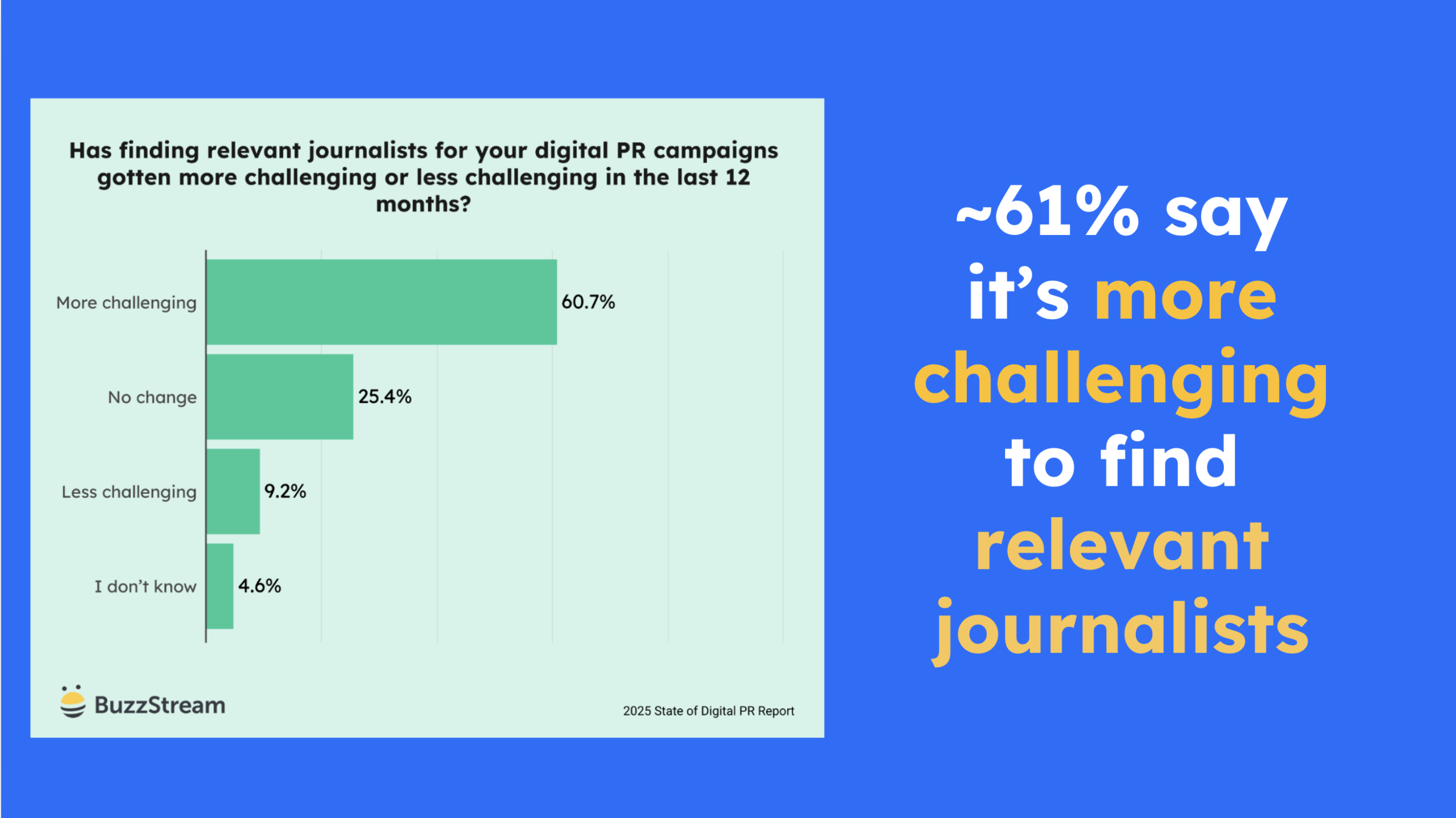
I’m thinking this will get even worse.
For those of you who saw my last webinar, it covered a little bit more of this and why, but it’s essentially that there, you know, layoffs are happening.
More people are getting into digital PR, so there’s just kind of like a shrinking audience and a lot more crap going out to these journalists.
And you can see this in the data. Muck Rack did a great study, and I’m like, “They’re going to redo this in 2026.”
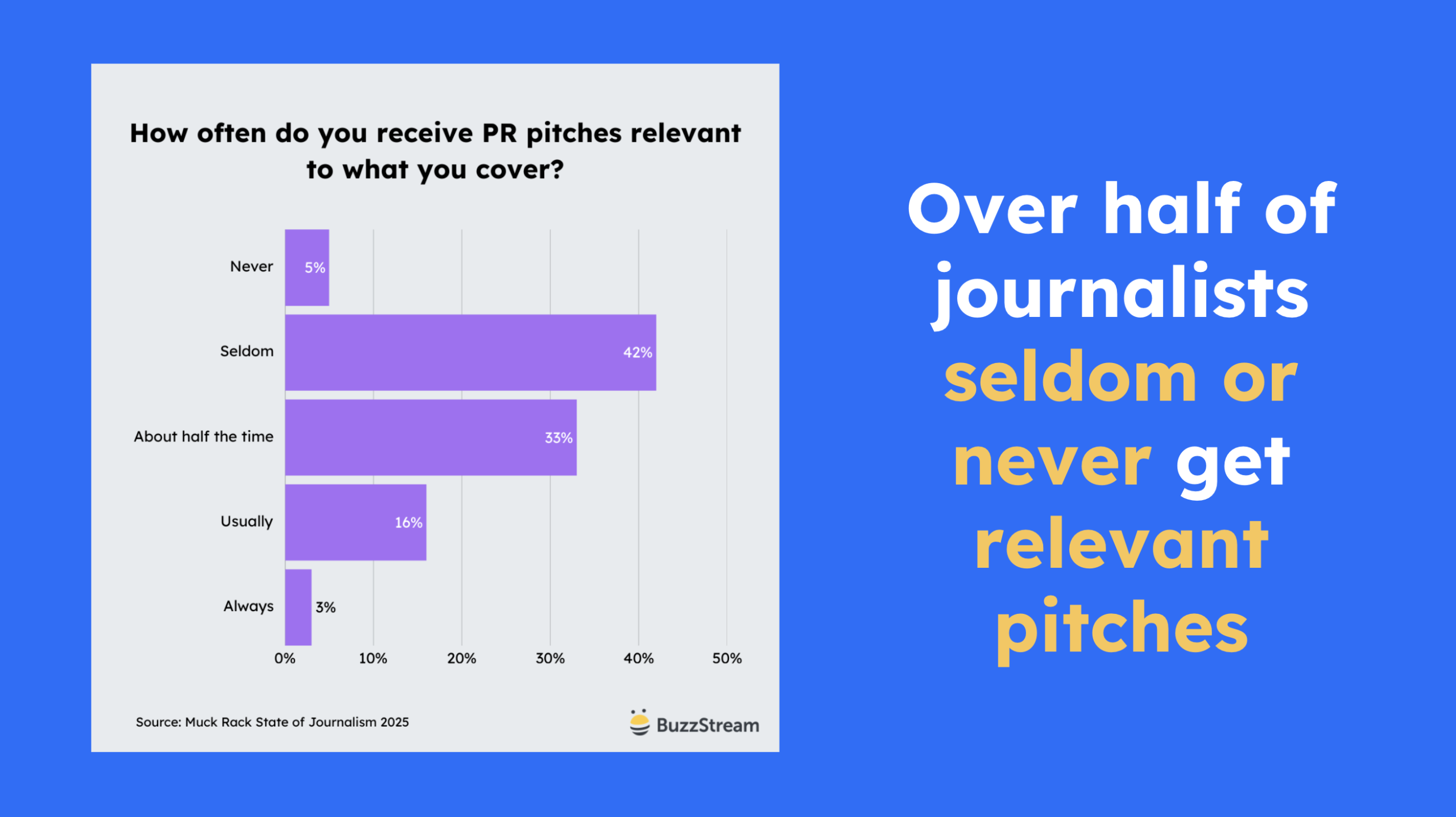
I would assume this will get worse, but over half of journalists seldom or never receive relevant pitches.
So that’s what we’re going to be talking about today, which is not just finding pitches or finding relevant journalists because they clearly are overwhelmed.
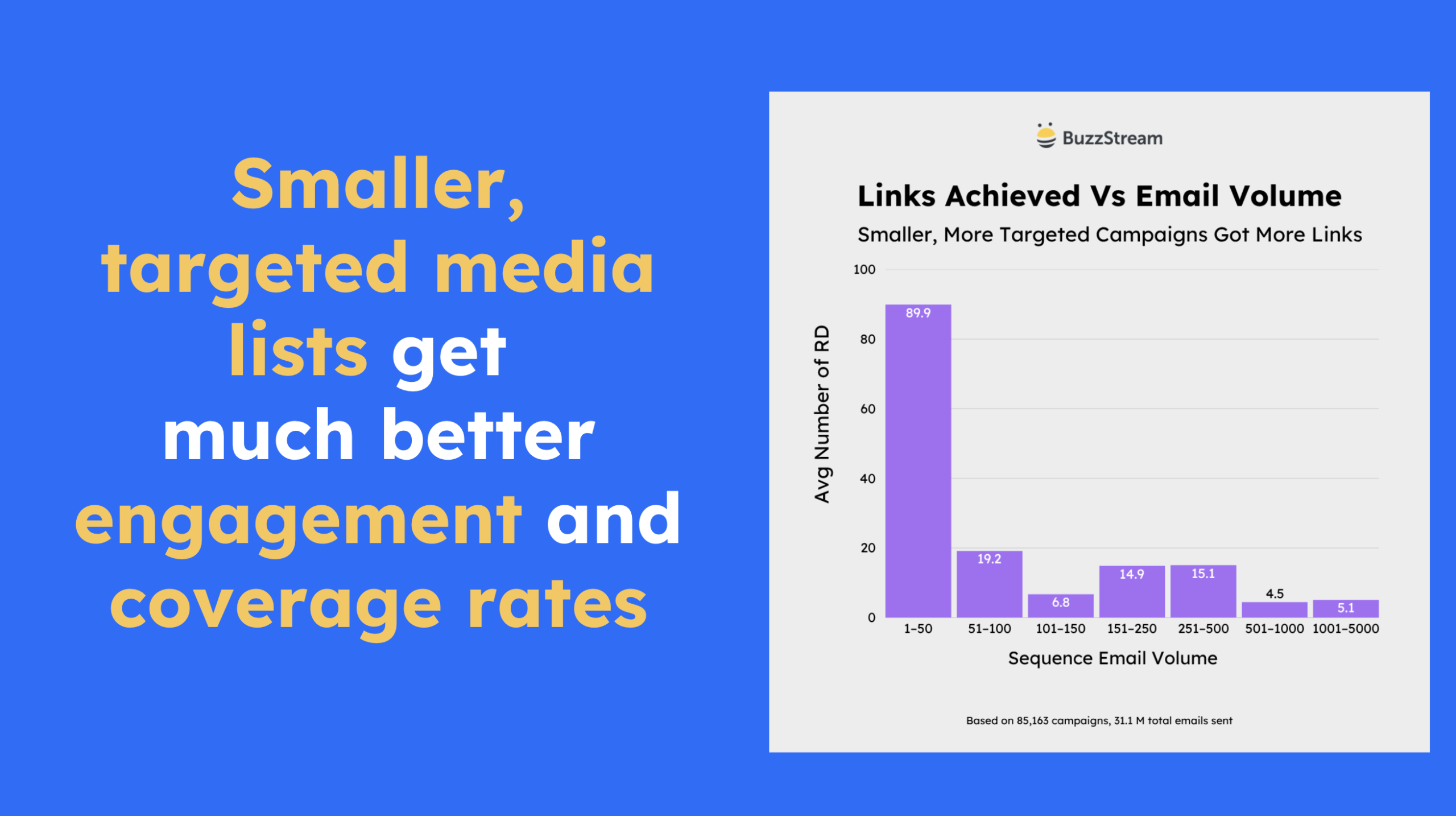
And again, this was what my previous webinar was all about. Still, we have found that the smaller, more targeted media lists, the targeted, like relevant ones, are the ones that get you better open rates, better reply rates, and most importantly, for what everybody cares about is the links and coverage.
So part one, just some kind of tactics for thinking about finding relevant journalists, starting in the site level.
Finding Relevant Journalists at the Site Level
These are the things we used to go through with anyone joining a digital PR team.
Google Search for Sites
If you’re trying to kind of come up with seed sites, potentially good old Google search for the industry, something like tech sites is gonna, it’s getting easier and easier.
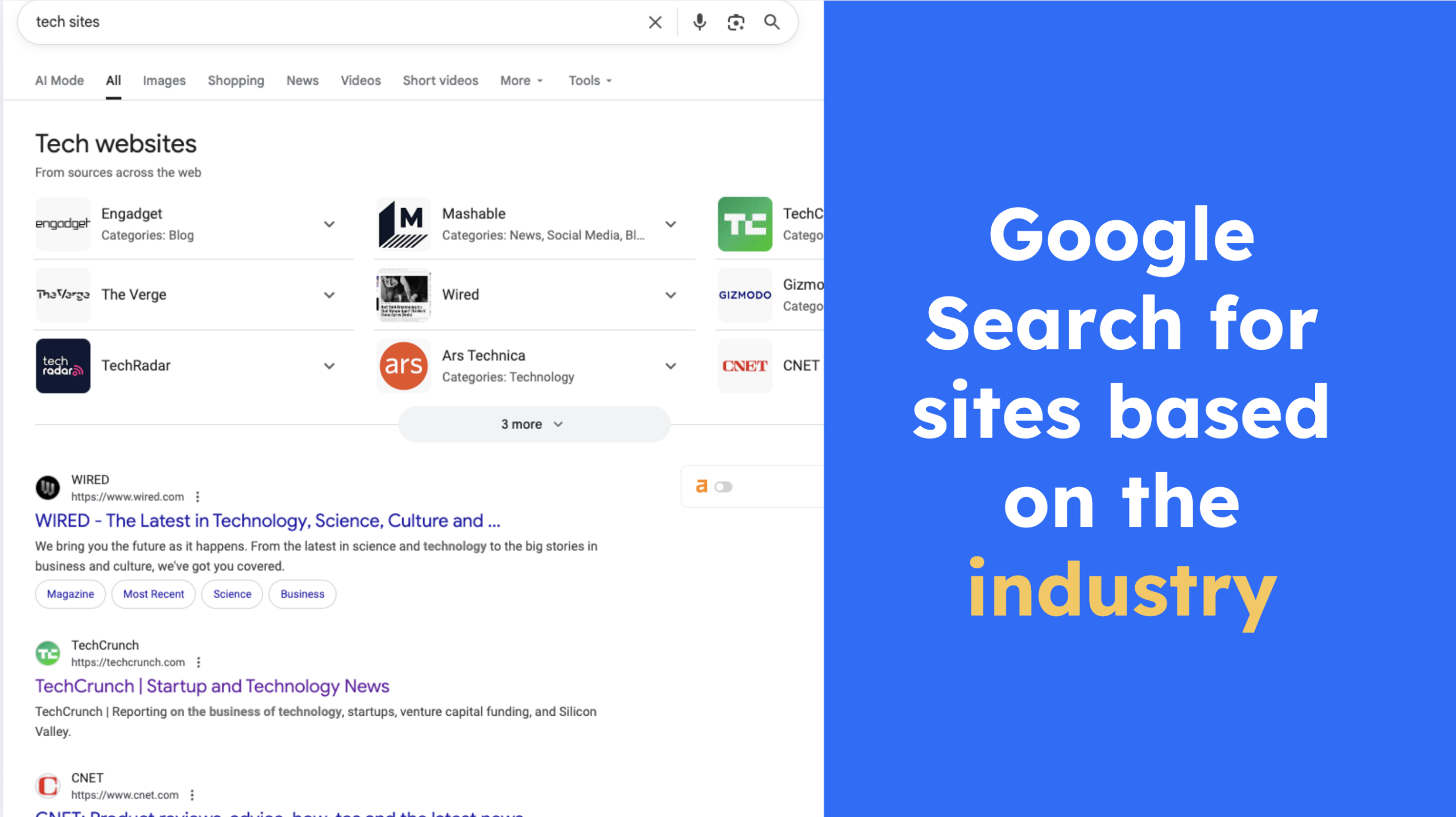
Google has these modules within its search results. But I also think it’s essential to start very specifically and then get broad.
So, you know, if you’re looking for a piece about Apple computer trends, you want to start as specific as possible before you begin to open up the range here.
Google Search for Headlines Similar to Your Story
I think it’s a good kind of inroad way to find the types of sites that you’re gonna find specific journalists.
The reason I don’t love this is that you’re kind of having to do two searches.
Say you’ve created a marketing report, you search for “marketing report,” and you’re going to find sites that tend to cover this type of stuff.
But then you have to evaluate the site one more time and identify the right journalist at the publication. You’ll evaluate the site, which I’ll cover next.
Google Search for Listicles
This is actually one of the easier ways to do this.
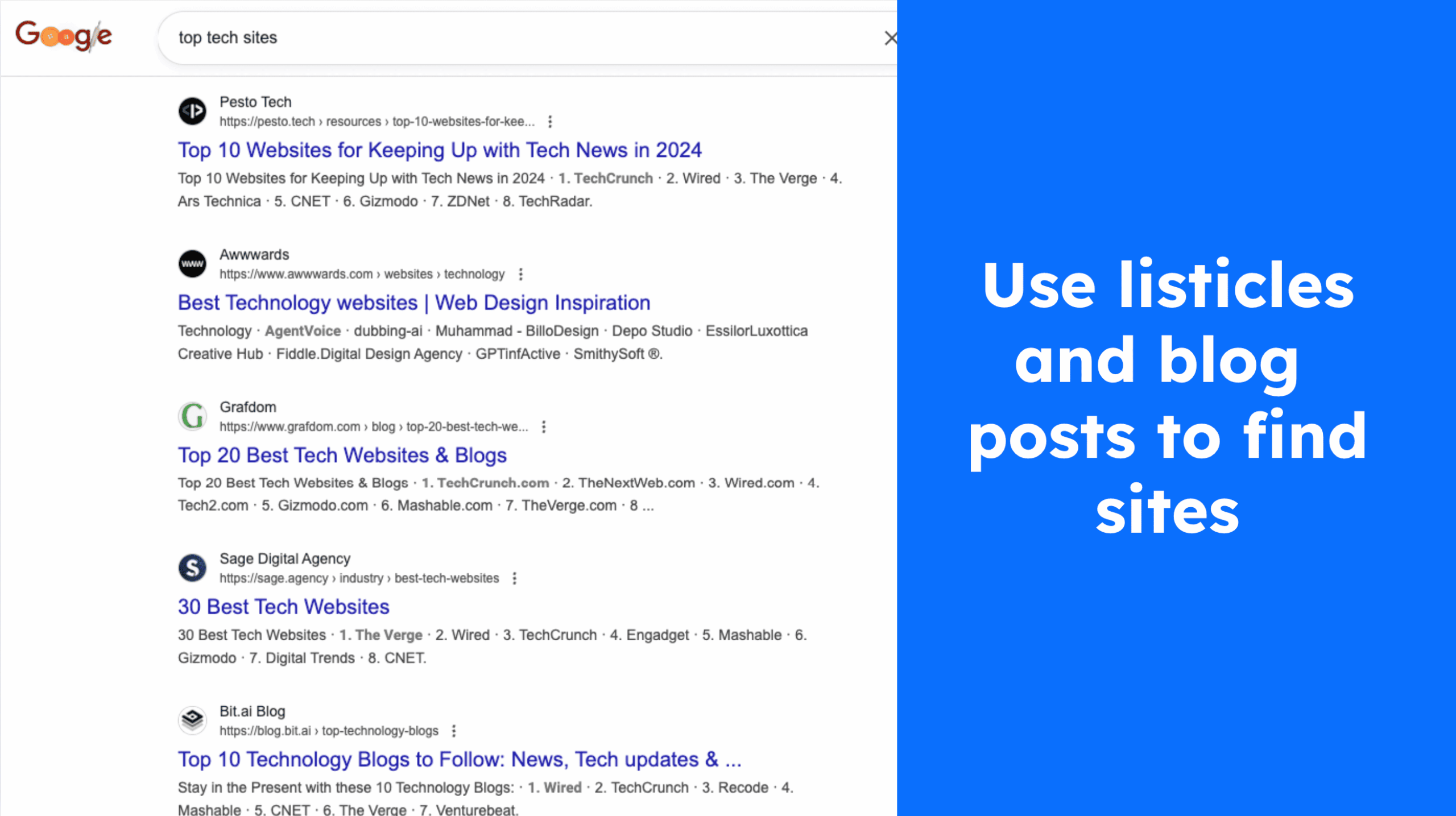
Listicles and blogs, like people love this, especially nowadays.
So for instance, we had a client back in the day. It was like a construction rental company. And one of the first pieces of content we did was like the top HR blogs for our HR software client.
We did a piece on HR blogs because they had search volume.
But this also allowed me to build relationships with the people who own those blogs. After I published the post, I reached out to everyone and said, “Hey, just wanted to let you know I featured you on this site.” people are genuinely, as long as you are genuine about it and you say nice things about it, it’s a good kind of inroad.
That kind of can lower the friction and lower the barrier entry for some people.
Use AI to Find Relevant Sites
AI is getting very good at this. I think this is probably one of the better use cases for this type of thing.
So I found it’s best to give them a specific type of site.
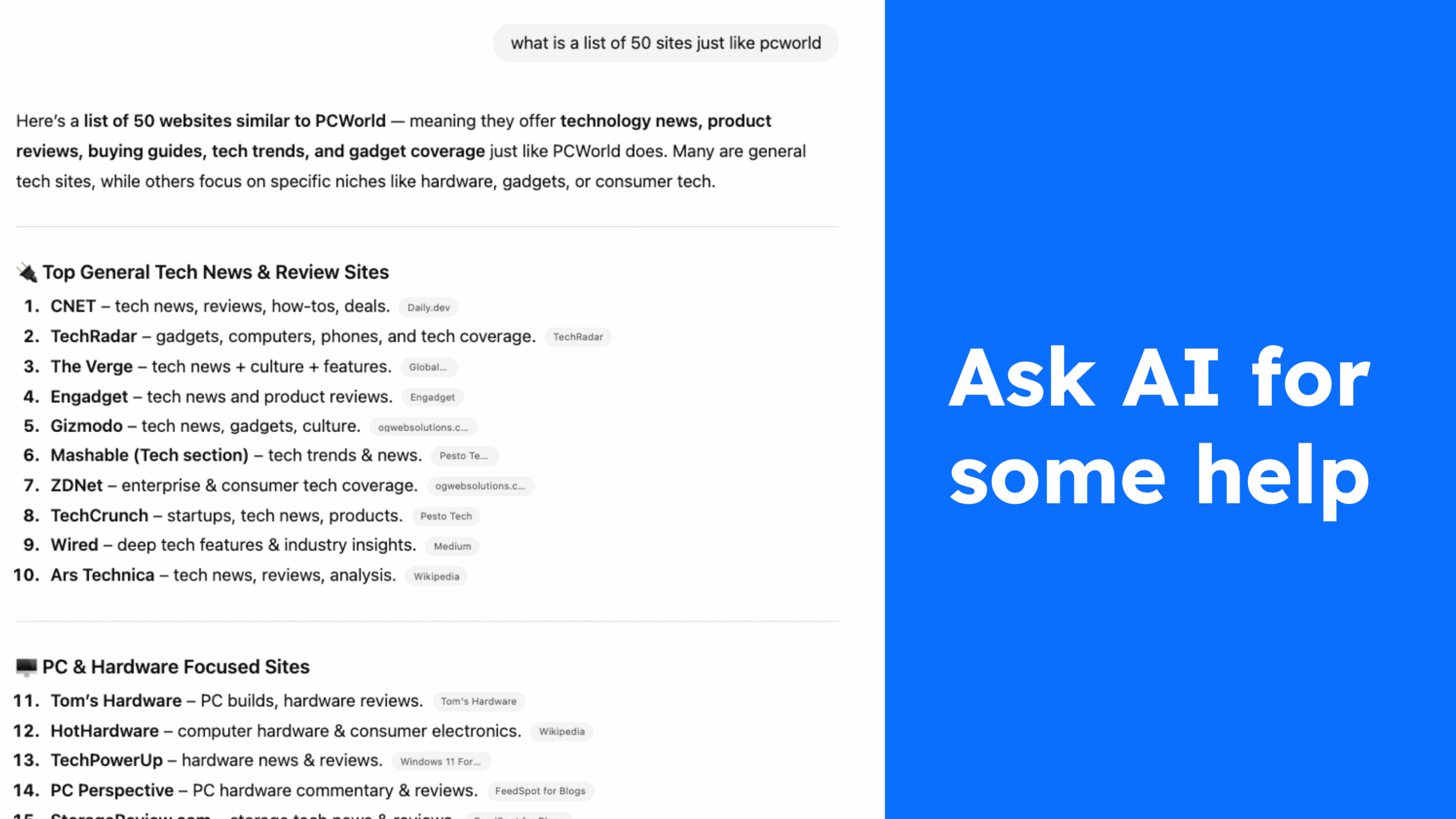
For instance, if PCWorld is the publication type that you’re maybe searching for, ask ChatGPT for relevant sites.
Use Similar Sites Chrome Extension
There is a Chrome extension called Similar Sites that I know many people in the digital PR space also use.
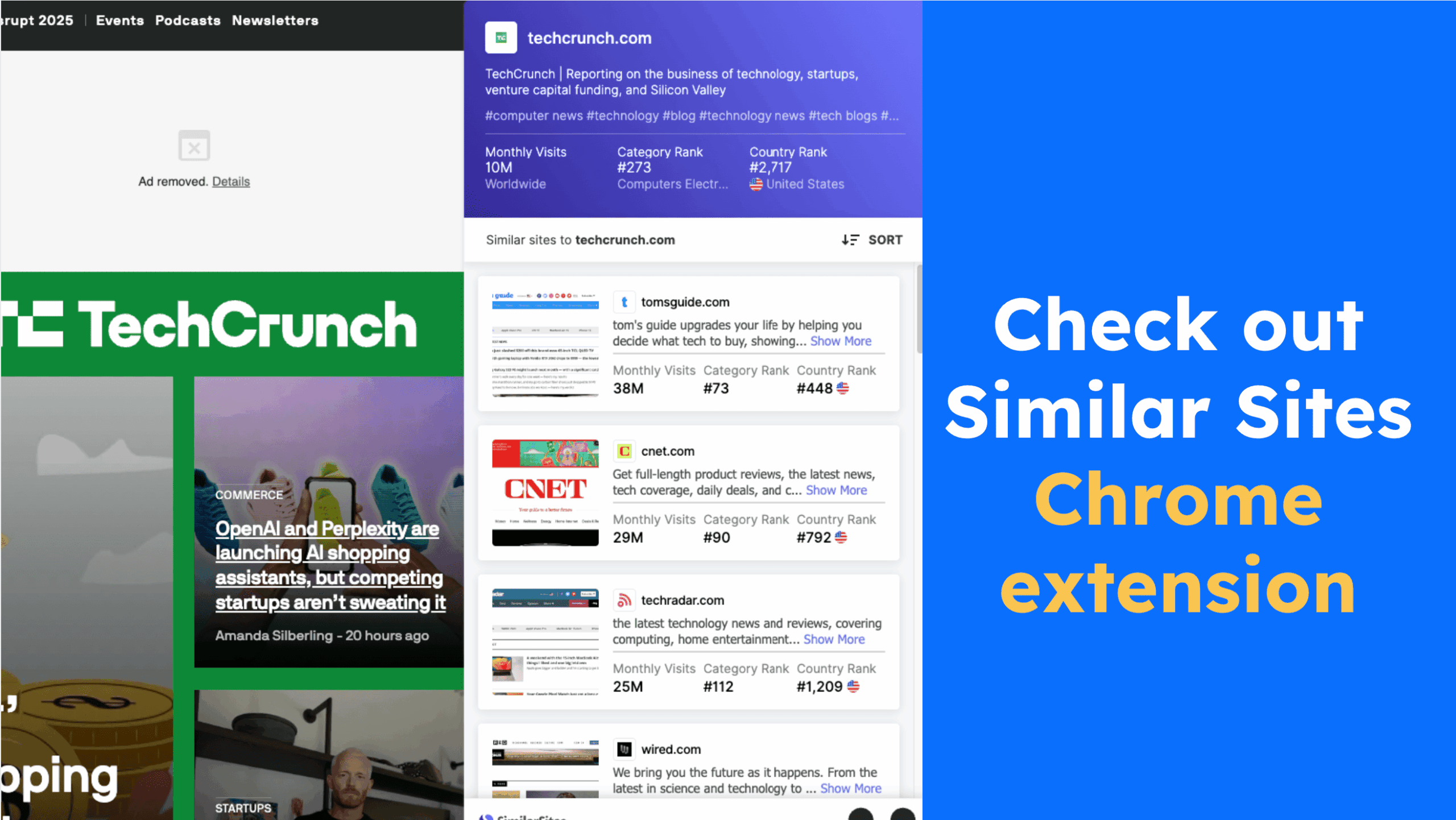
I found that it’s not 100%, but it’s still pretty helpful.
Let Your Pitch Angles Lead You
You can kind of sometimes hit walls quickly, especially in a weird industry.
Make sure you’re thinking about your story or pitch from all angles, as that can open up new search avenues.
So, for instance, here’s a site, the most popular breakup food in every US state.
Lean into the different areas. So dating, lifestyle, obviously, since it’s breakup food.
There are food sites that may be open to this stuff.
And there’s definitely a way to do this where you’re reaching different angles and different industries that are complementary to your own. You don’t want to go too far outside of the realm.
Finding the Right Journalists at a Site
I would prefer to do it this way.
If you found a site, you can do Google searches for the type of content, but I’d rather be very specific.
Search for Titles Similar to Your Story
If you’re using Google search to find journalists who are covering the same types of articles that you’re pitching, search for very similar titles.
So, I was doing a city study around our city index study that found Austin was the best city, I would do a specific search for “Austin named best city.”

Make sure you set date parameters on all of your searches starting from the past month.
Some people like to start the past week, but it depends on the campaign you’re running.
(You’re probably not going to find many in the past week unless you’re doing some like newsjacking, and you’ll want to do some extra commentary for some trending news story.)
But always start small and then expand.
Use Allintitle: In Google News
In Google News, if you want to run a campaign, find journalists who write similar pieces to what you are pitching, use the allintitle:
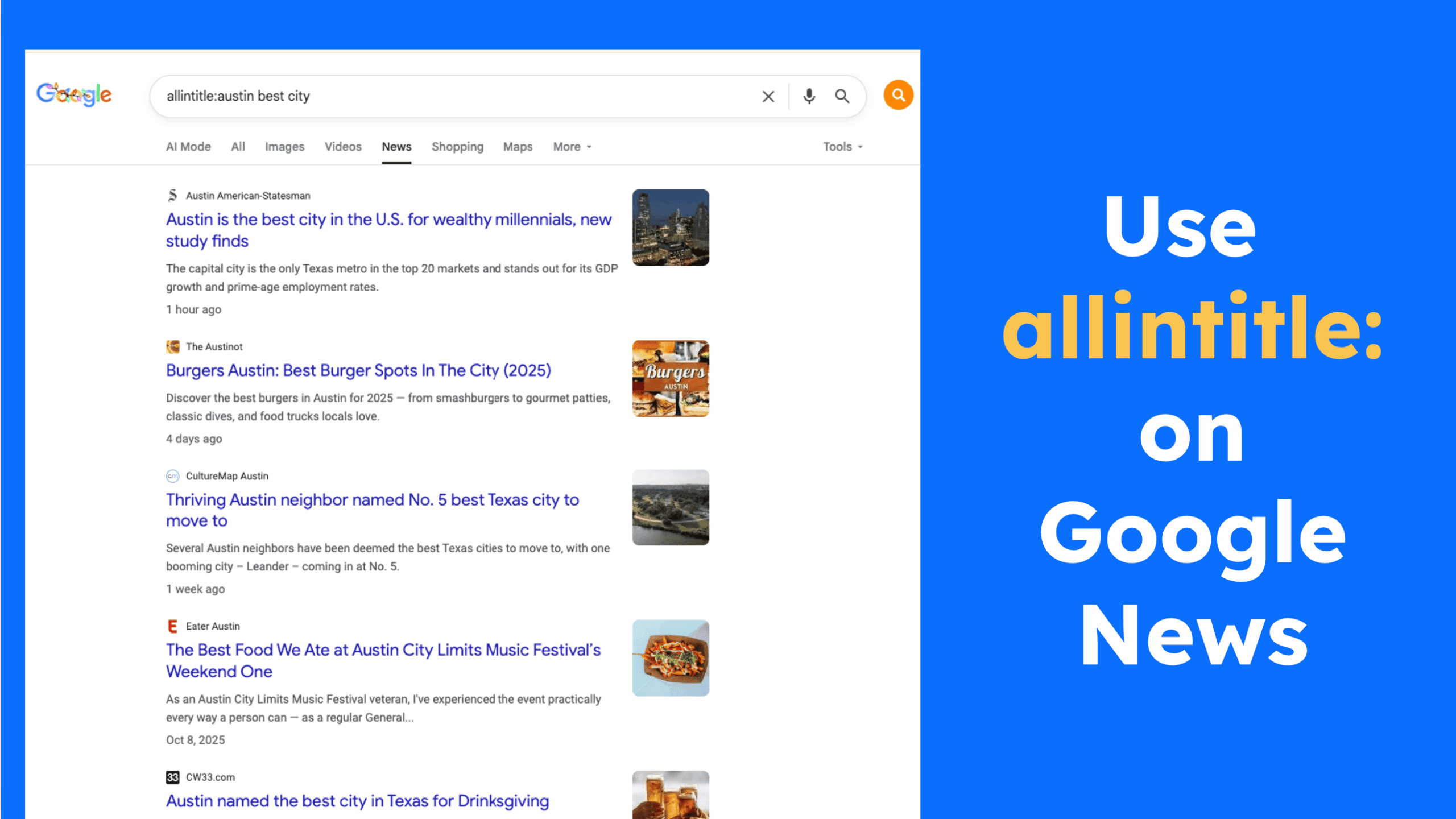
So you see “Austin Best City” here, and you can see in all these cases there are articles we’ve found about Austin getting named as best city.
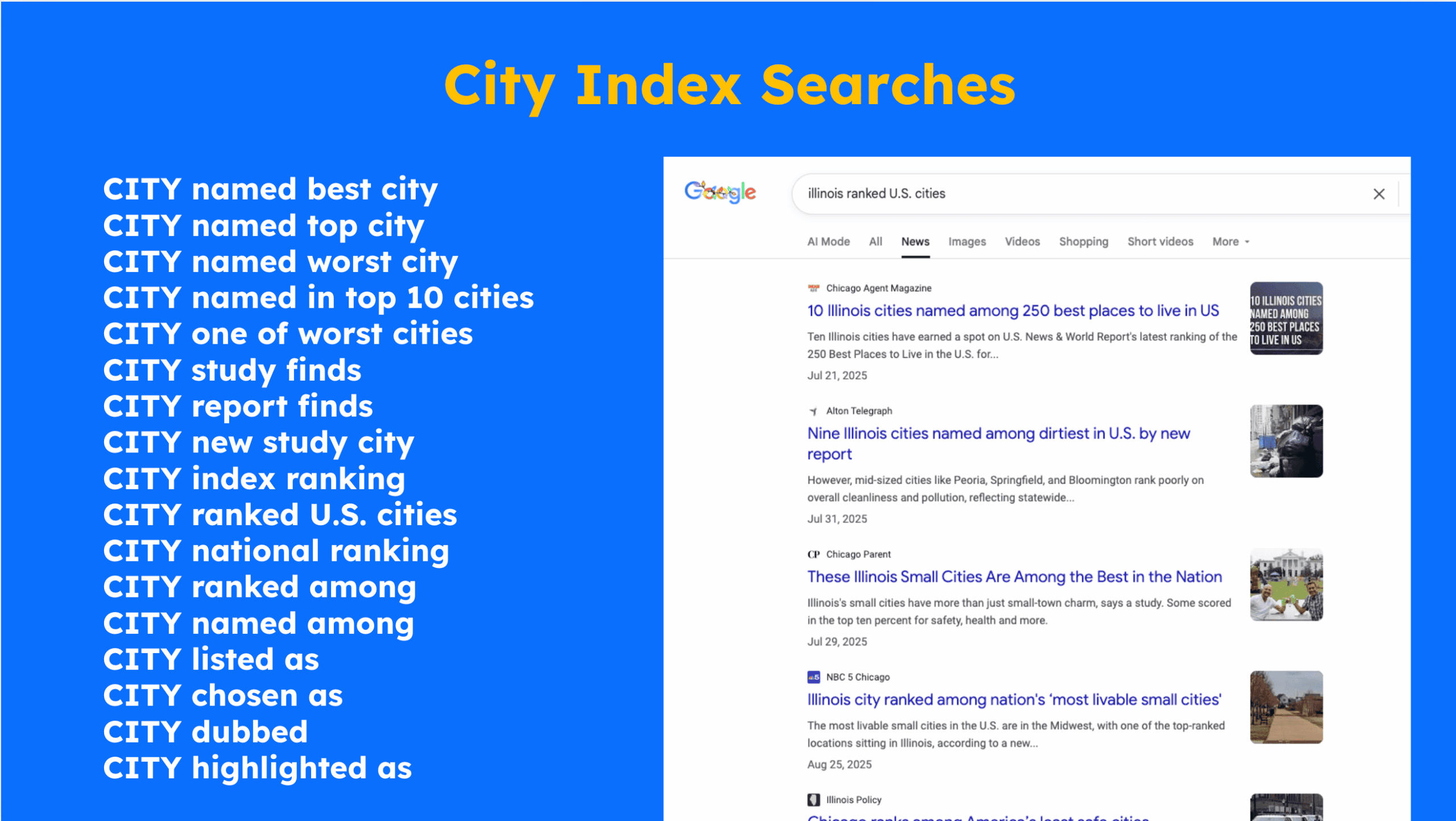
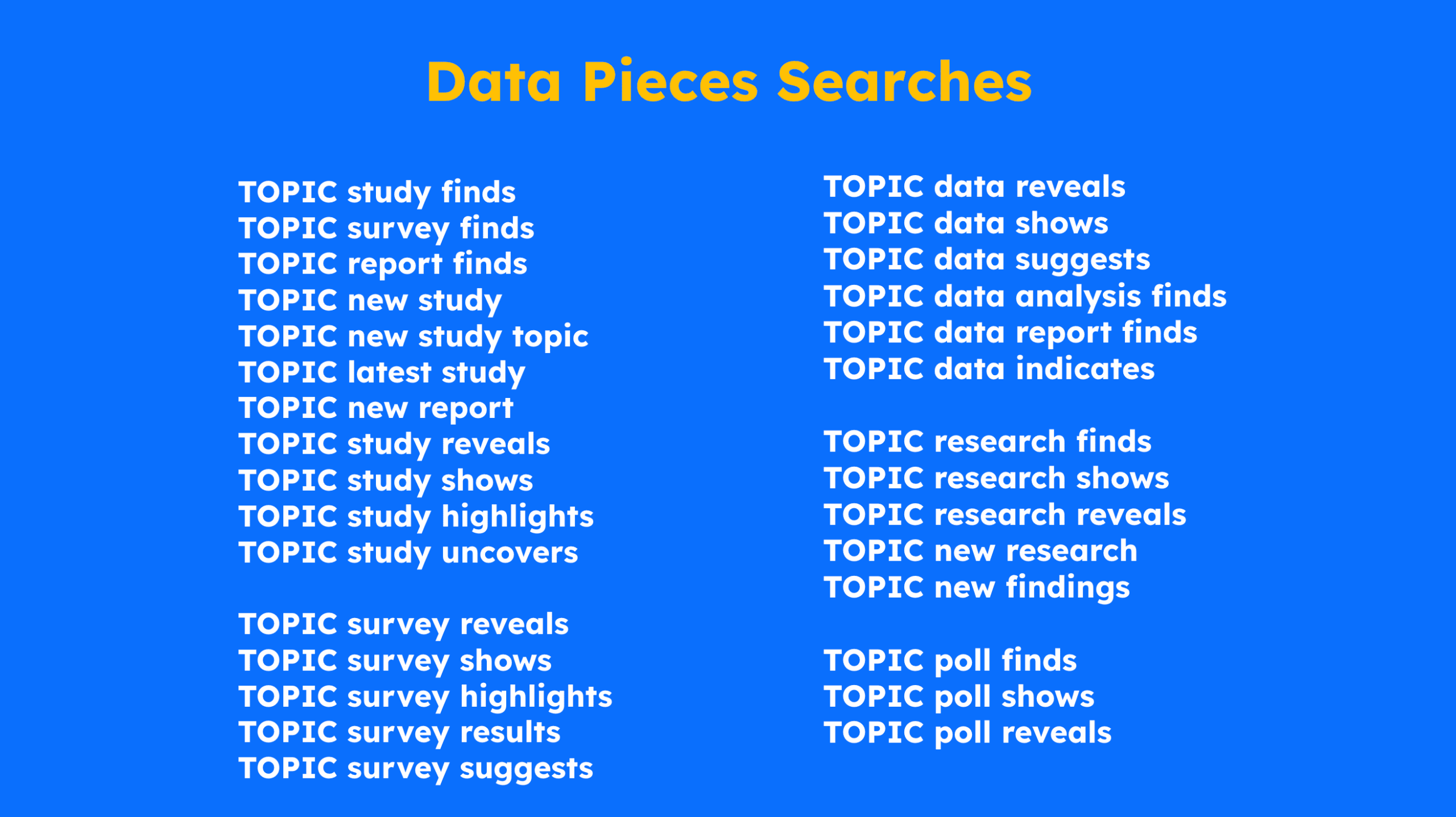
Use Specific Search Operators to Surface Content Types
Here are some searches to find journalists covering city indexes.
These next will find you journalists covering surveys and data studies:
Here are some suggestions for finding journalists who accept expert commentary (though these are less reliable).
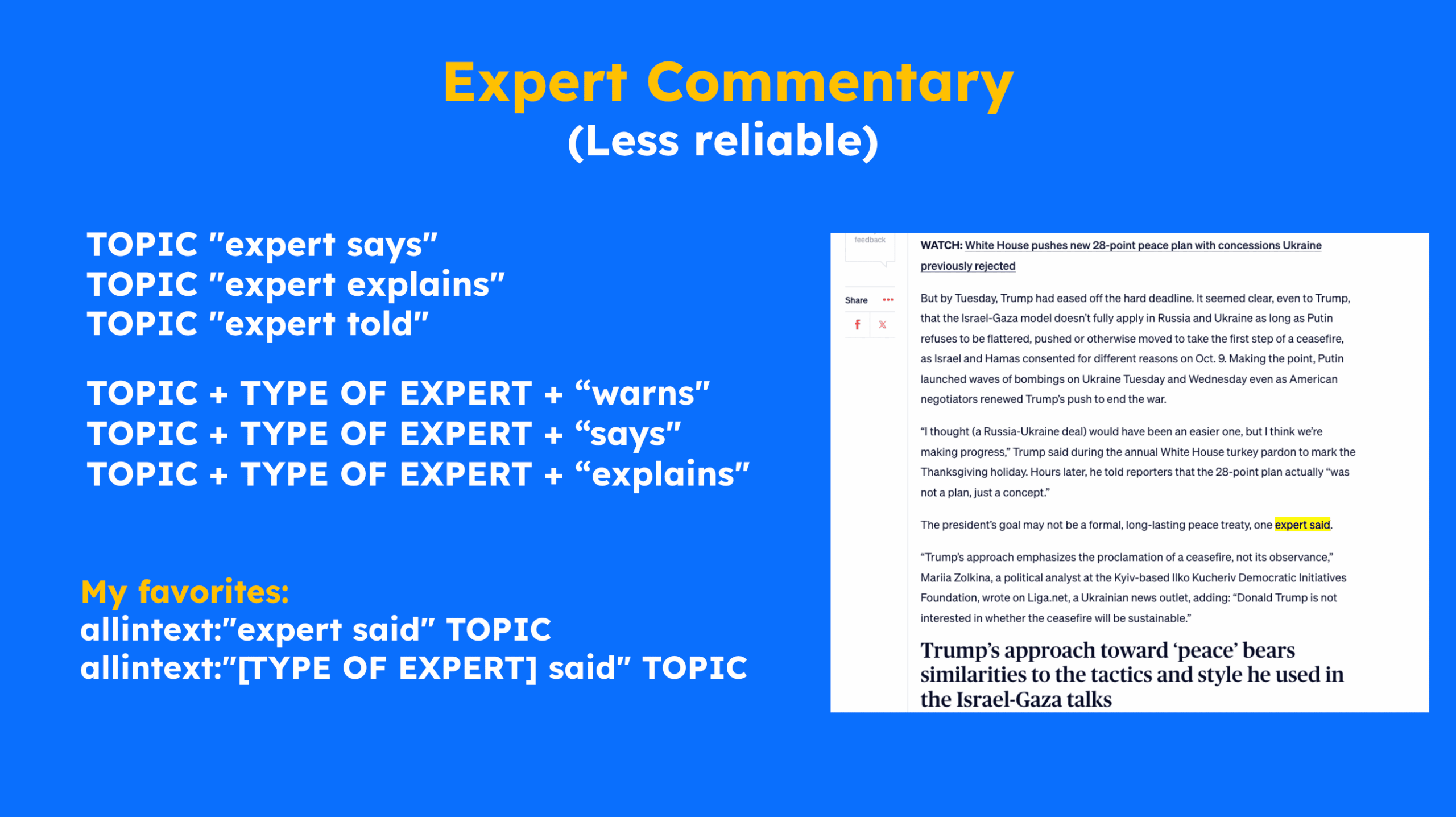
My favorites here: allintext: search operator, then “expert said,” then your topic.
Say you’re reaching out on behalf of a nutritionist, you would search “nutritionist said”.
AI is Not Good At Finding Journalists
I just wanted to note that this is one area where AI is not effective.
For instance, I was trying to find journalists in Illinois who would be interested in a post about the most popular breakup food in every state.
It gave me these five journalists, and none of them were correct.
The first one it gave me was Steve Dolinsky:
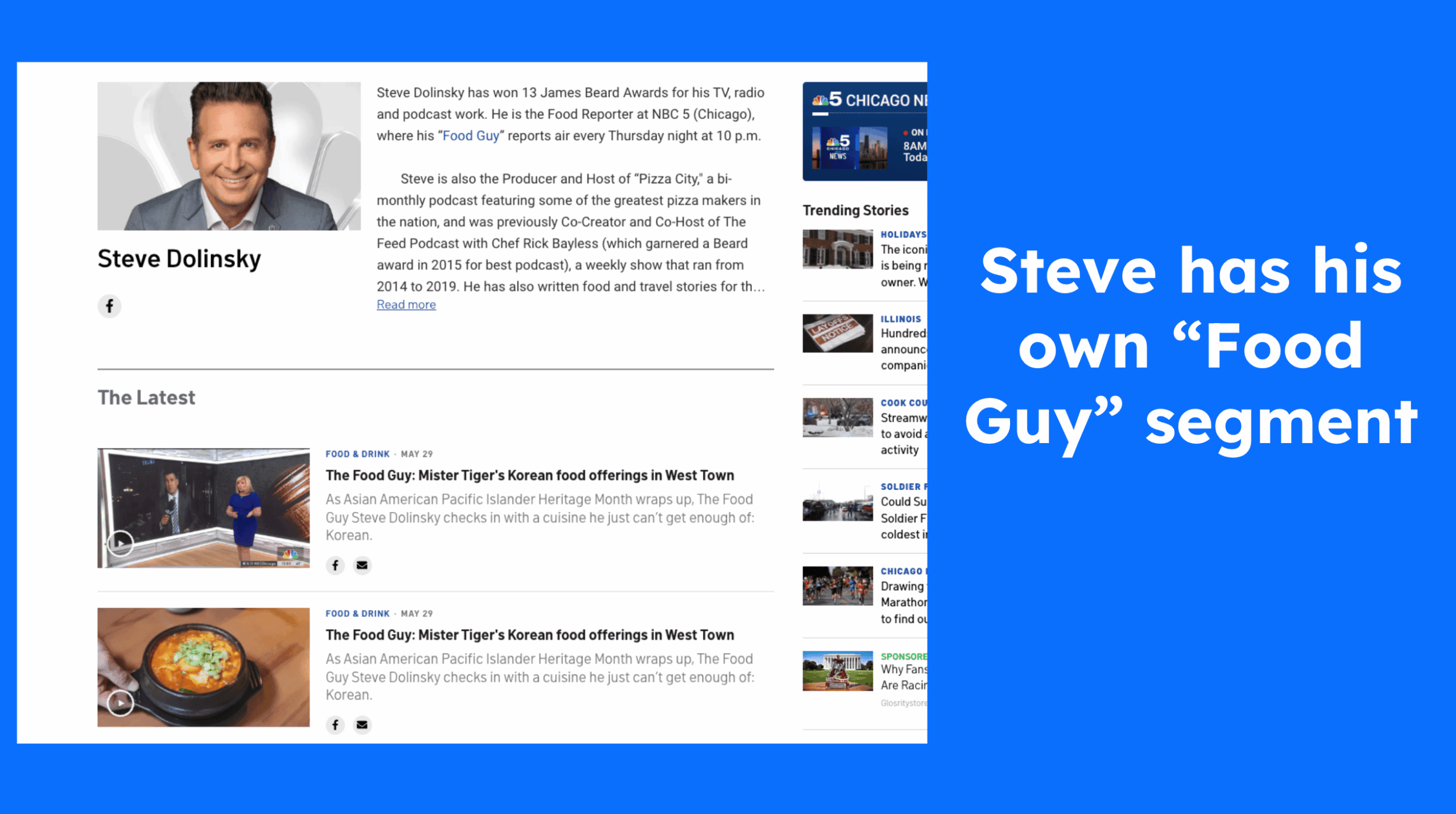
He is a reporter, but he has a The Food Guy segment, so he is not necessarily what you’re looking for if you’re pitching like a best cities type of index study.
He is not going to be your guy to cover this.
Here’s another one:
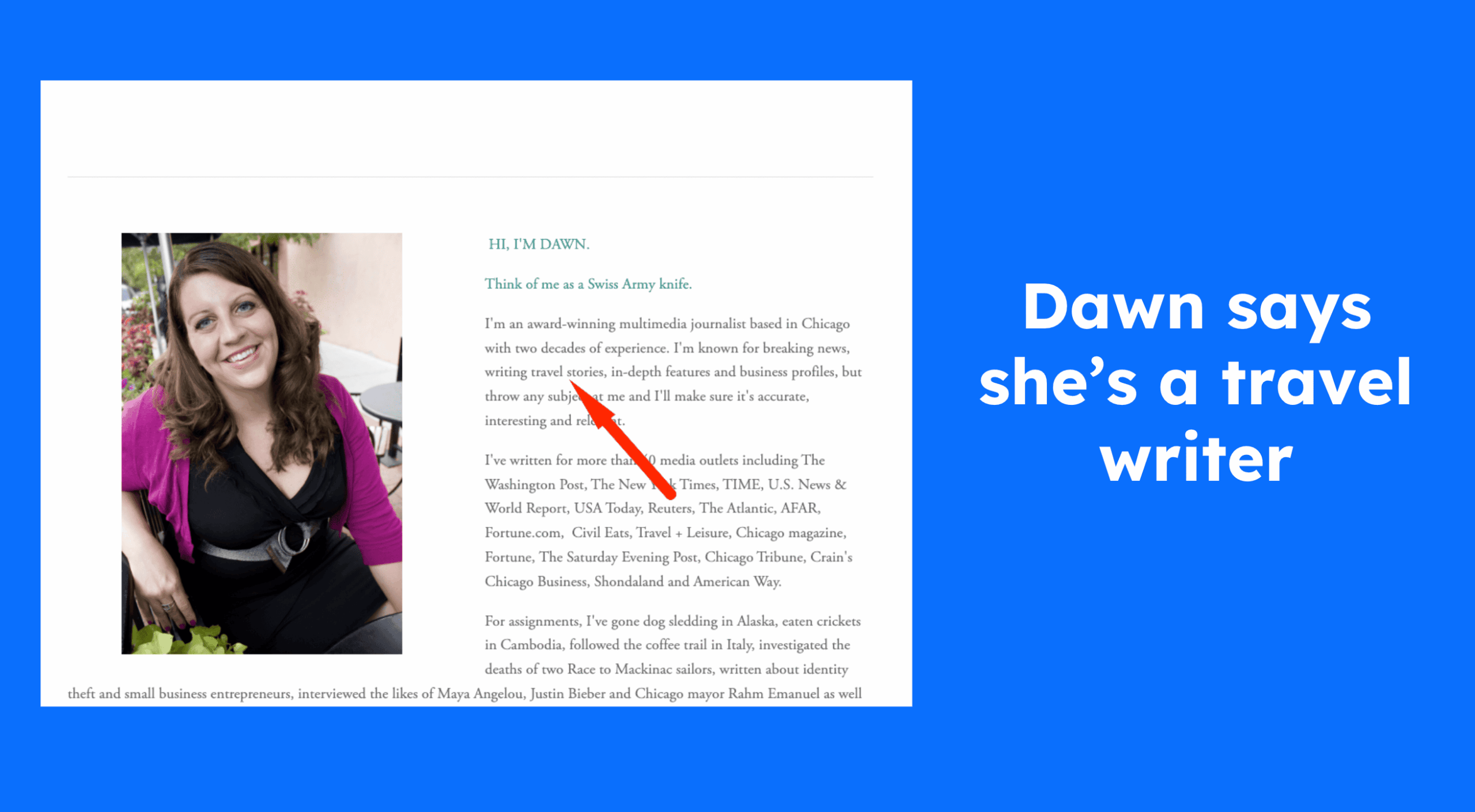
ChatGPT said that Dawn was a food journalist.
But when you look at her bio, she’s a travel writer.
And I’m showing you this for two reasons:
- One, because it’s just to show you that AI is not great at this.
- Two, is to point out that \these are the kinds of things that you have to look for when you are evaluating a journalist.
OK, let’s keep going.
Search for About Us Page
So if you know your site, you’ll want to look for an About Us or Meet the Team page (which you’ll find a lot on local news sites in the US.)
Say you’re looking at Fortune.
Here would be writers and editors.
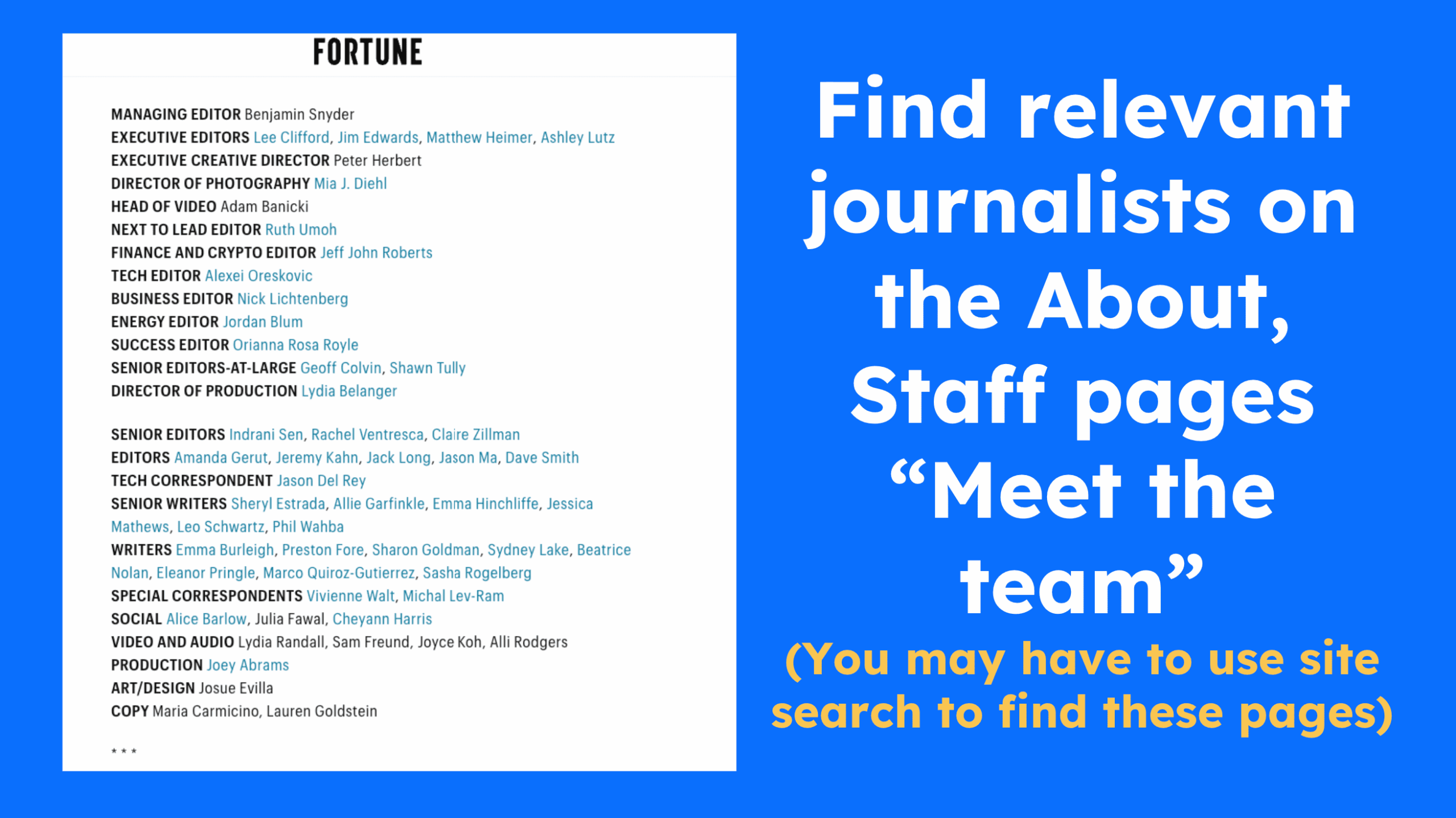
This isn’t as specific. You’ll find other staff pages that have clear roles like food reporter or breaking news reporter.
Site Search for Specific Journalists’ or Job Titles
If you know you want Fortune.com and you know you need to find a finance reporter, you can search site:fortune.com and then the word “finance reporter.”
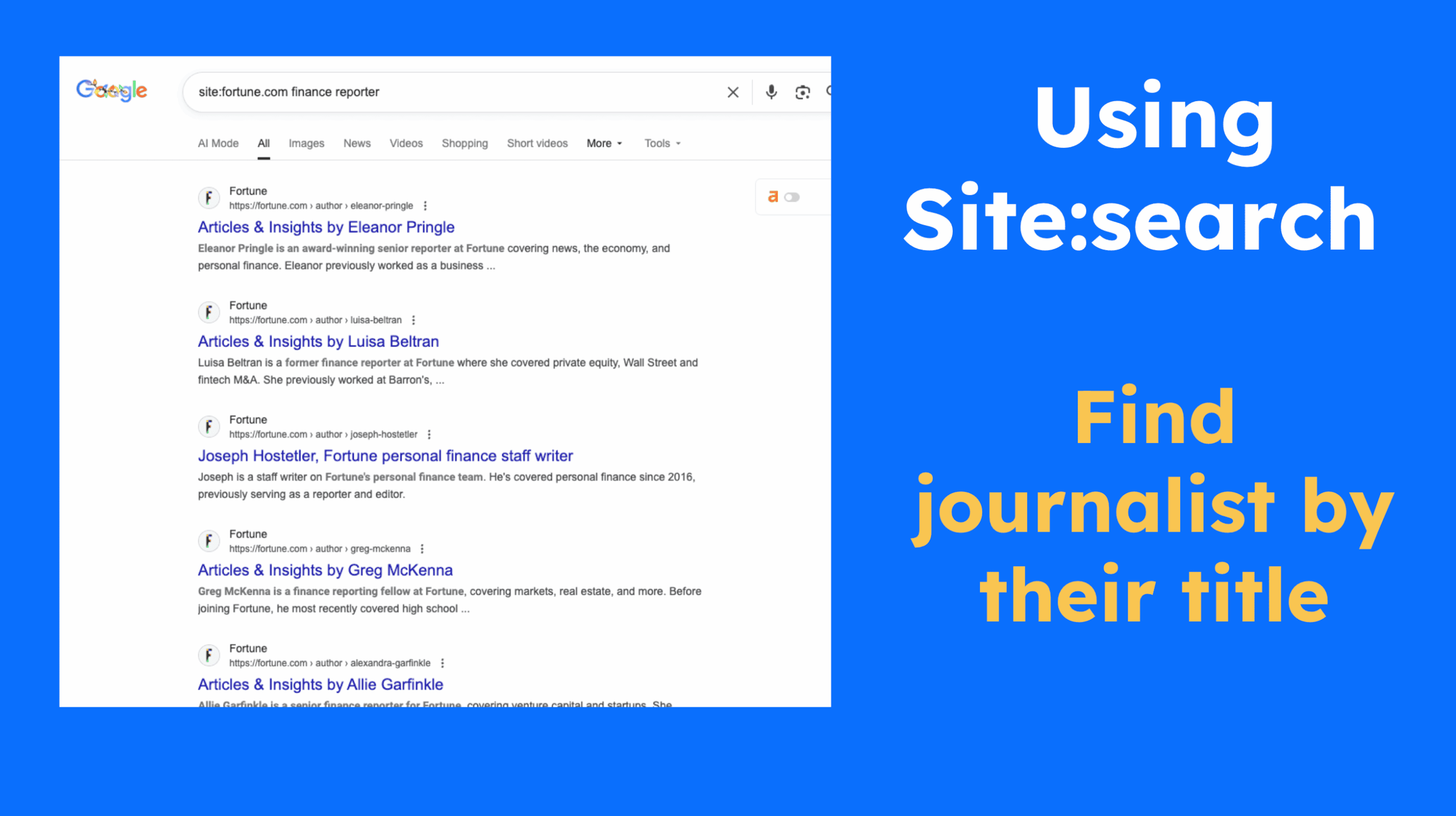
Then you’re going to dig in to make sure they are a fit by further researching the topic.
For instance, if I’m looking for a finance reporter, Eleanor Pringle is the first person on my list.
Then I can say, OK, now I want to find articles that Eleanor wrote about mortgages.
I do a search for “Eleanor Pringle” and “mortgages”.
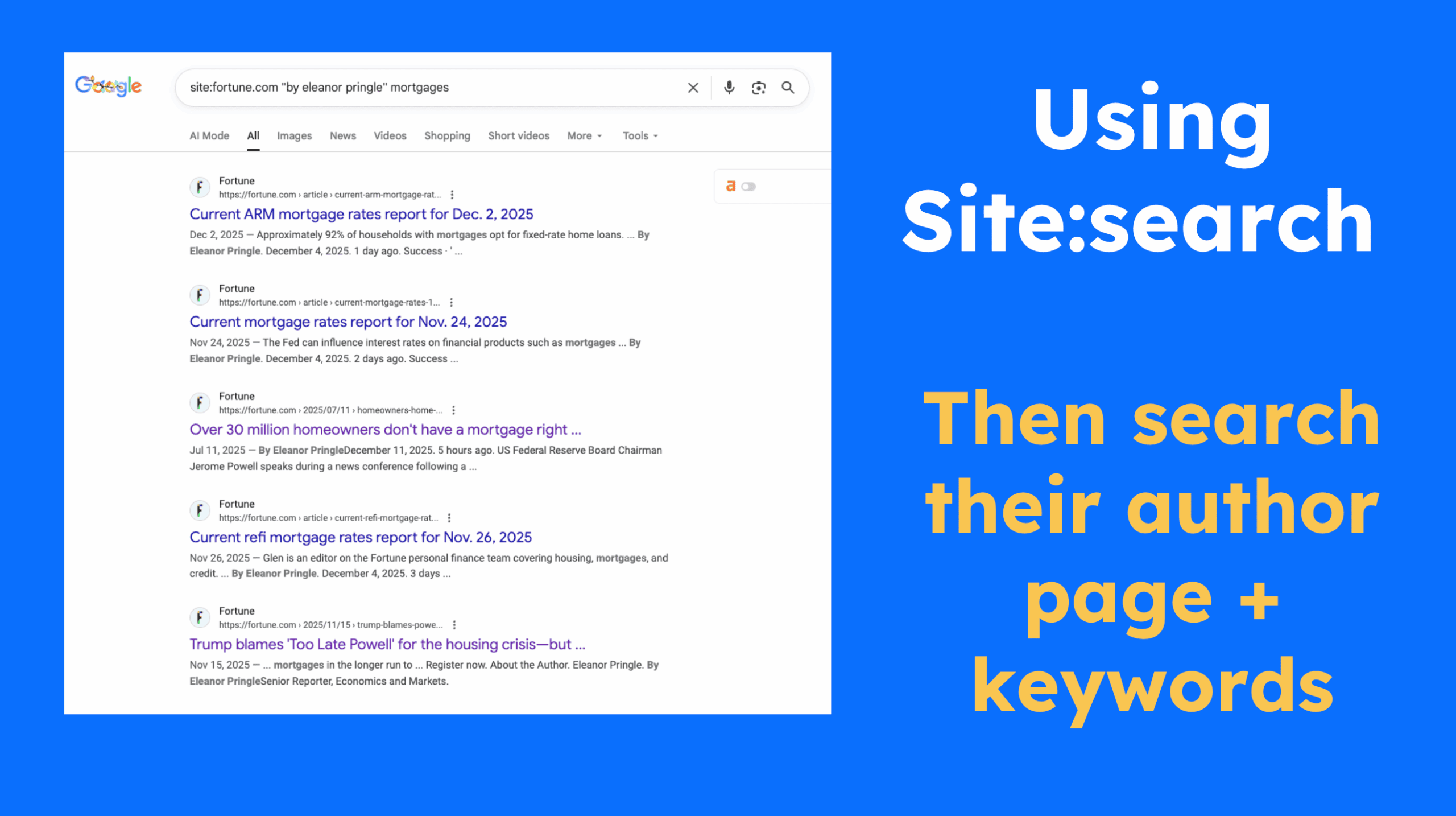
I also want to note that the publisher’s site search bar is not always the best way to find articles. Some of them work well, but most don’t have the best logic, So I would err on the side of using Google search for this kind of stuff.
What About Using Media Databases?
I realized I haven’t mentioned one key element: using media databases.
Historically, I never used a media database.
I always found them to be a bit bloated and you can get lost spending a lot of time qualifying of the journalists and digging.
And I find it’s just way easier to look at the site you’re looking for and find journalists this way.
How to Evaluate a Journalist for Fit?
So if you’re looking at evaluating a journalist for fit, you can usually find everything you need on their bio or the recent articles.
Note, I have a more in-depth post about evaluating a journalist for fit.
Let’s go through these.
So, say you’ve found a journalist, you’ve identified maybe an article they’ve written that is relevant to what you’re doing. You always, always still want to make sure you’re validating the journalist and making sure they are a good fit.
Are They Still Active at the Publication?
First, confirm they’re still active.
You do this by reviewing the publish dates. If it’s been more than 30 days and they haven’t published anything, they most likely aren’t active.
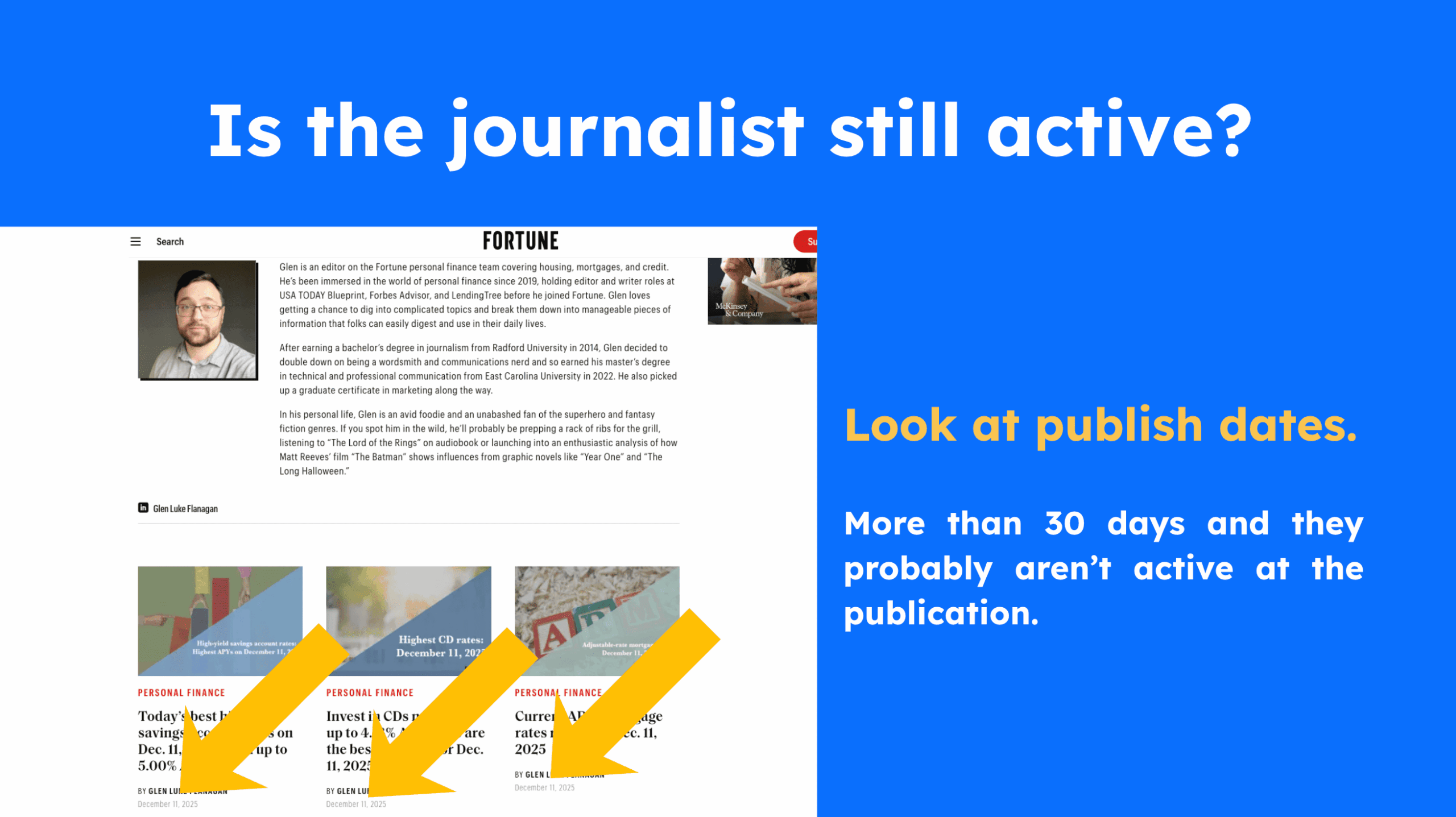
There are extenuating circumstances. Maybe somebody’s out sick. Perhaps they’re on maternity leave, paternity leave.
Check their Bio for Beat/Industry
Then you want to dig into their bio.
Again, this is a great example because every fortune is doing a good job of showing everything we need.
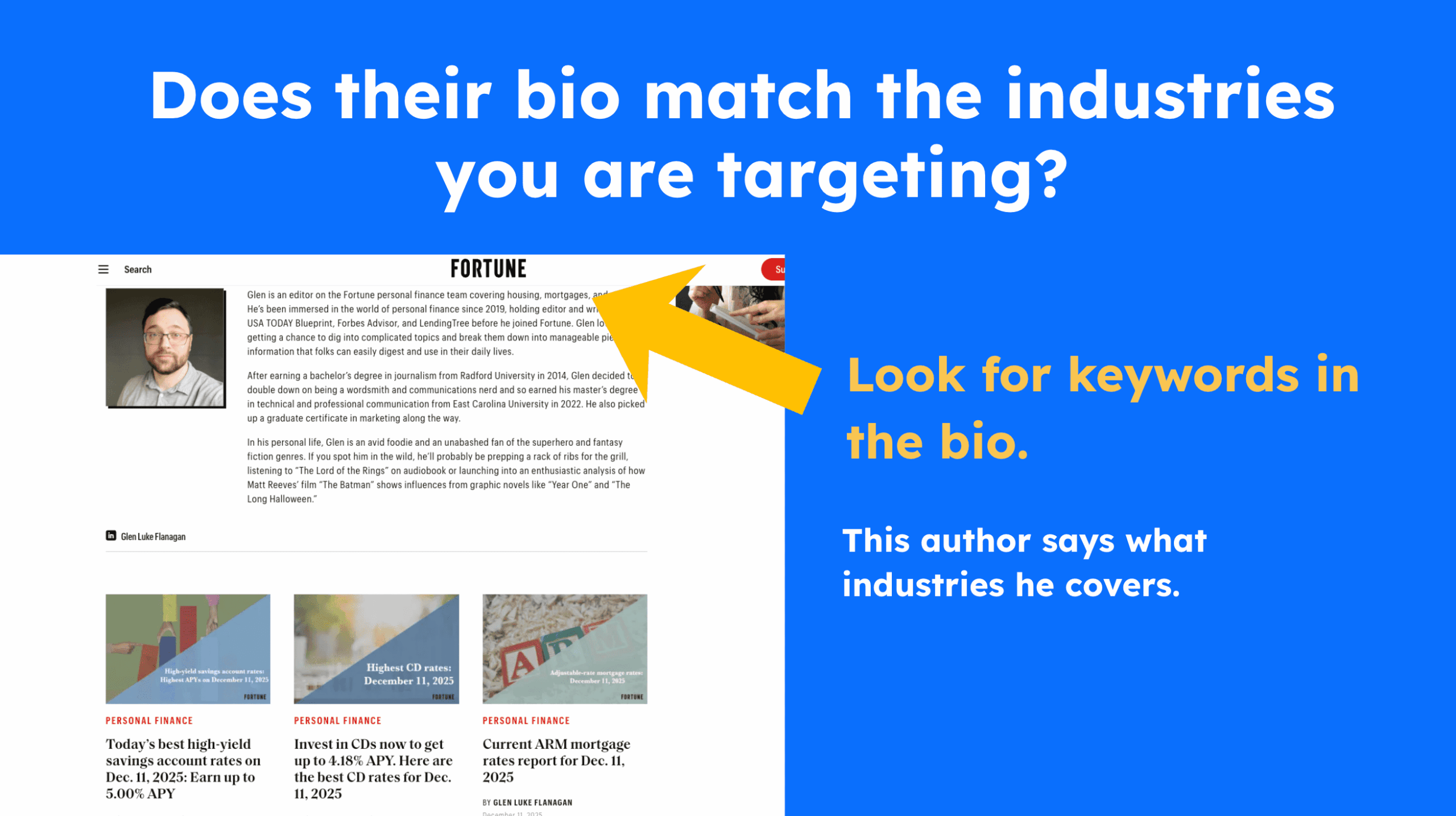
But you want to look for your keywords in the bio to ensure it aligns with your target industry.
So in this case, say we wanted to pitch mortgages, mortgage pricing, or something, get a study or report.
I see that this person is a personal finance editor who covers mortgages.
Ensure They Cover the Same Format
The most important thing you’re going to take away from this whole webinar is the format of the article.
You might find what seems like the perfect fit in terms of someone covering tech and they write for PCWorld.
But if they’re not writing in the same format that you are pitching, you are not going to connect with them.
This is one of the most common mistakes people make.
Journalists will write in various formats.
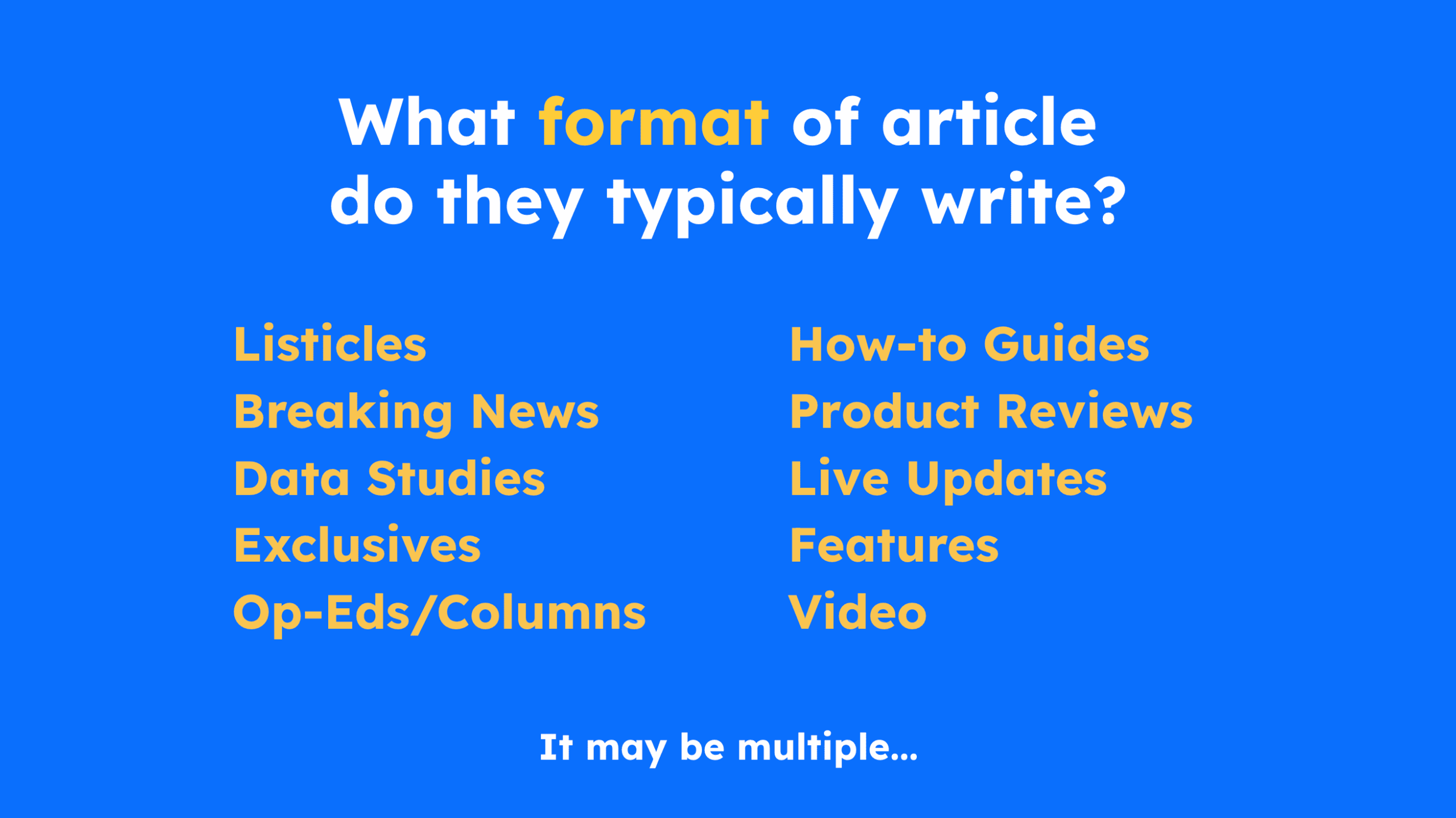
They will write listicles, SEO articles, data studies, exclusives, and op-eds.
Let’s look at some examples:
Glenn Luke Flanagan on Fortune: although he covers mortgage rates, this’s a very specific type of article he writes.
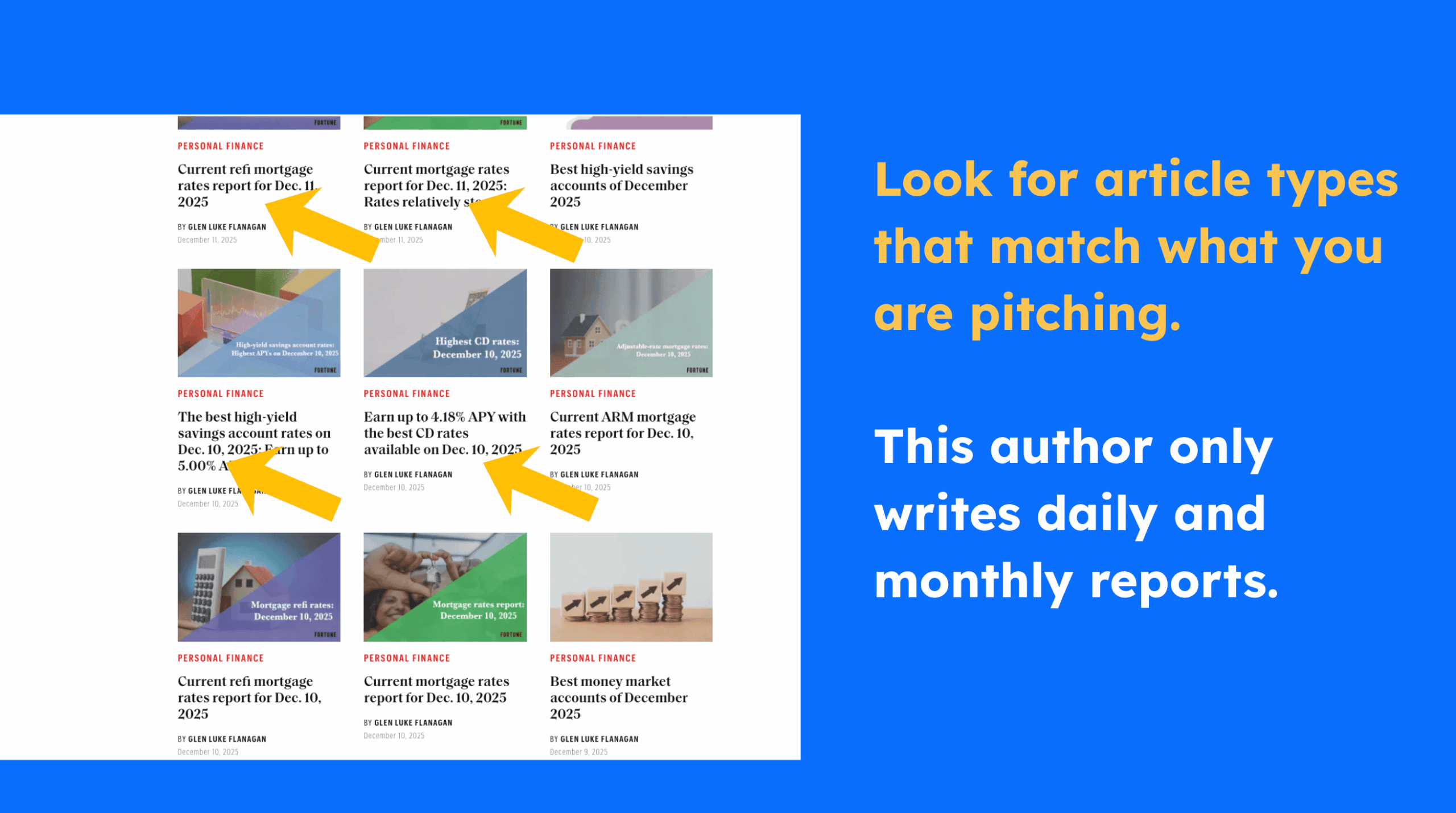
He is not a breaking news reporter. You’re not going to be pitching him your mortgage trends piece and expect him to write about it because that’s not what he does.
Here’s Laurie Roberts. It says that she’s a columnist here.
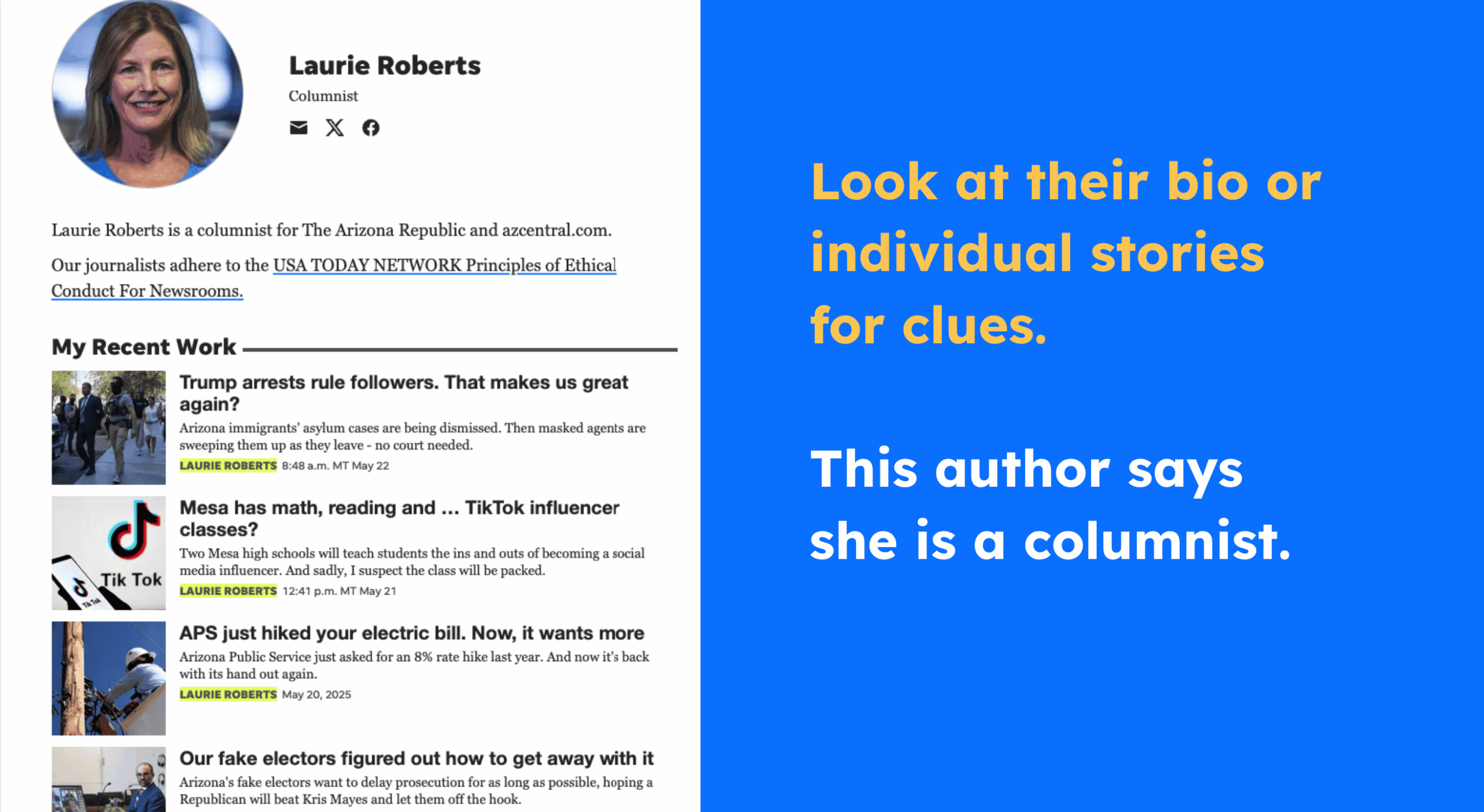
These are the types of details we often gloss over, and media databases may not capture them.
But if you’re not digging into the recent articles, you’re not going to see that this person is writes an op-ed, right?
Here’s another journalist who writes affiliate posts.
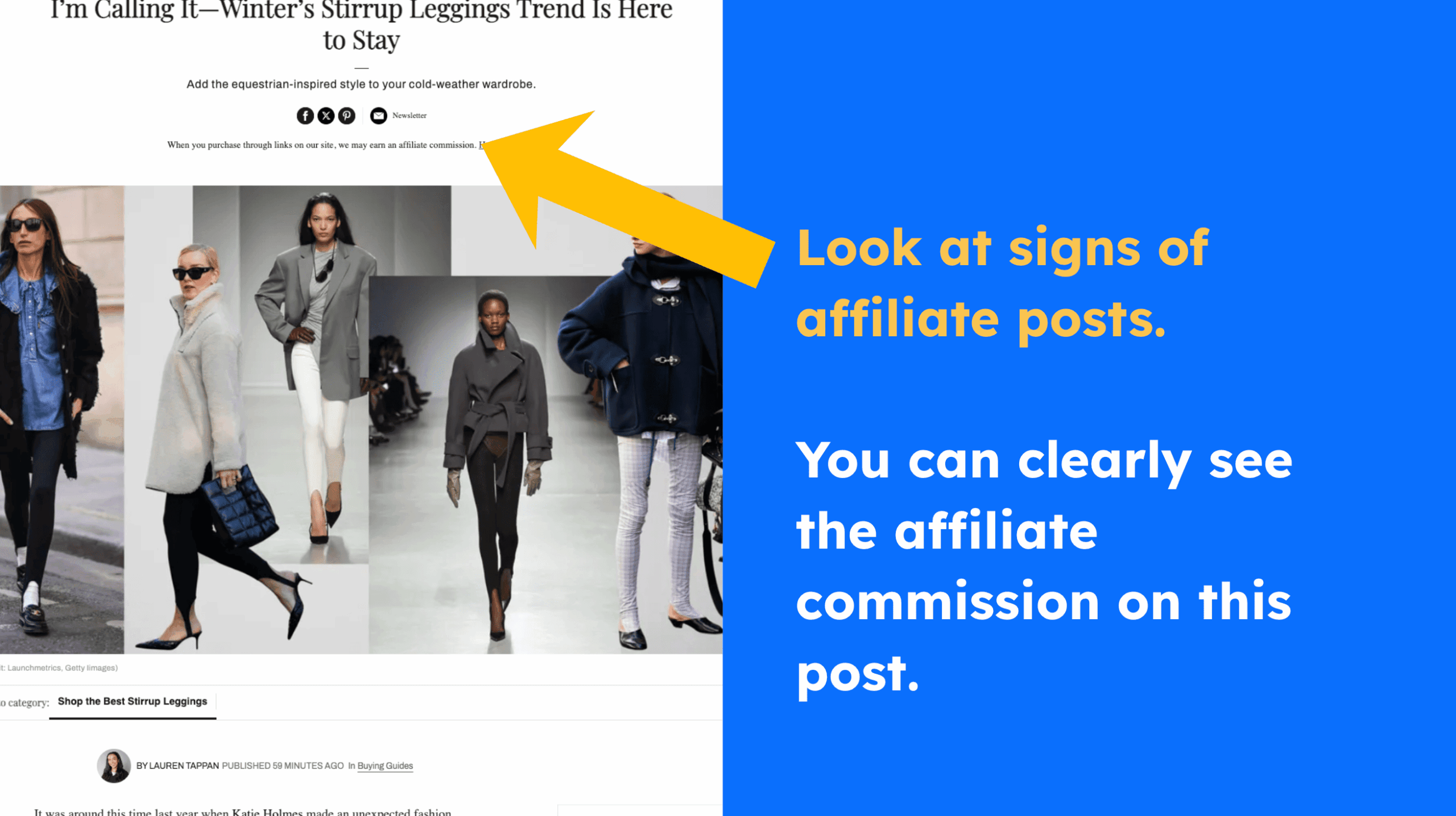
I lean toward skipping journalists who write affiliate posts, as these are unlikely to be valuable from a search perspective.
That said, if you’re doing a product launch or something and you wanna get your product out there, by all means, do it.
Has the Author Published Something Relevant Consistently?
This is also key. You want to look at recent post titles.
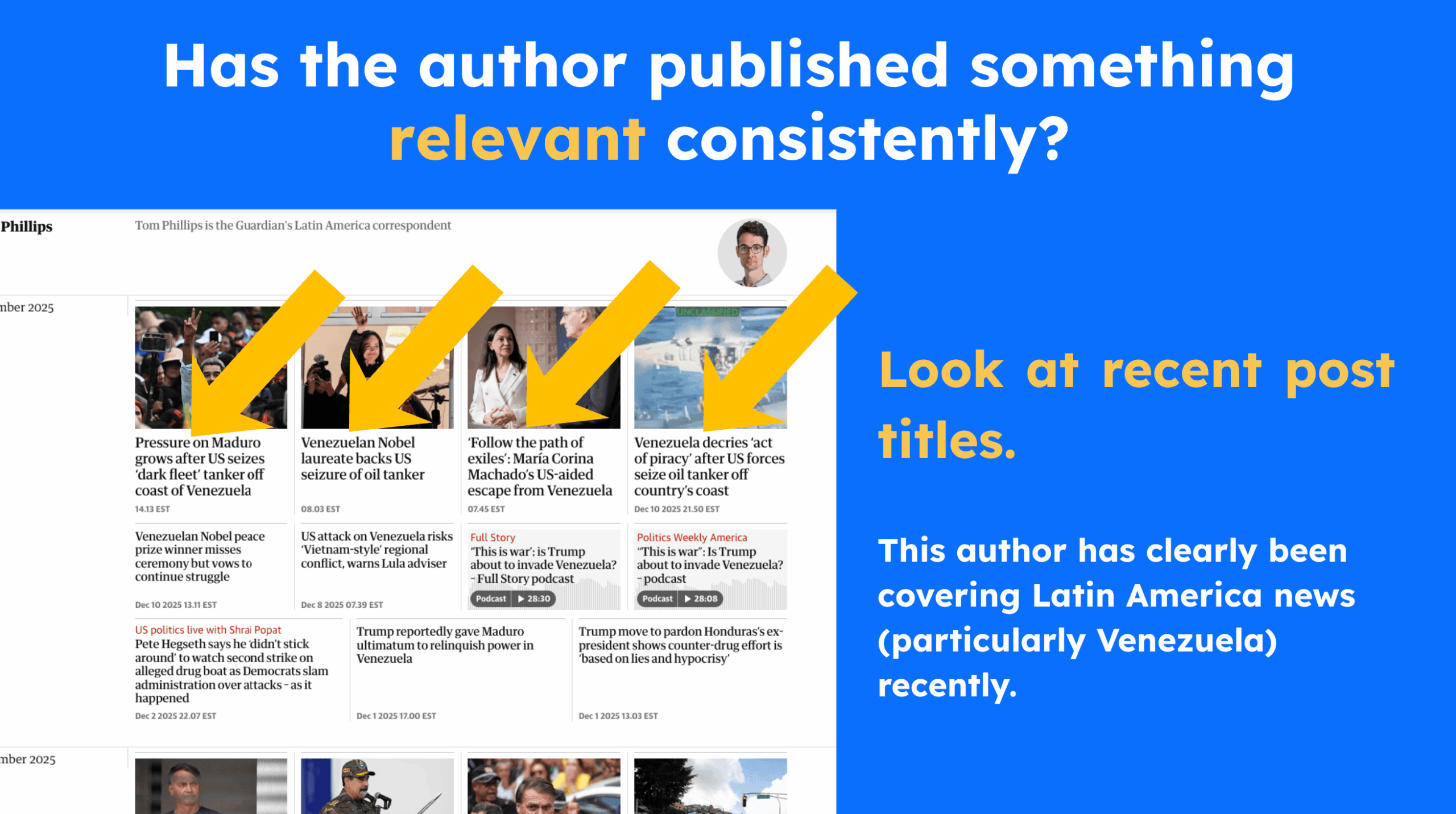
These days, you’ll see journalists jumping around a lot more. So you might find one recent article that a person wrote that is relevant to you, but then you dig into their backlog of recent posts and you realize the journalist isn’t writing about your topic at all consistently.
Is the Story New to the Author?
Another check is if your story is new to the author.
Here’s an example, for someone who covered Austin as the best place to live.
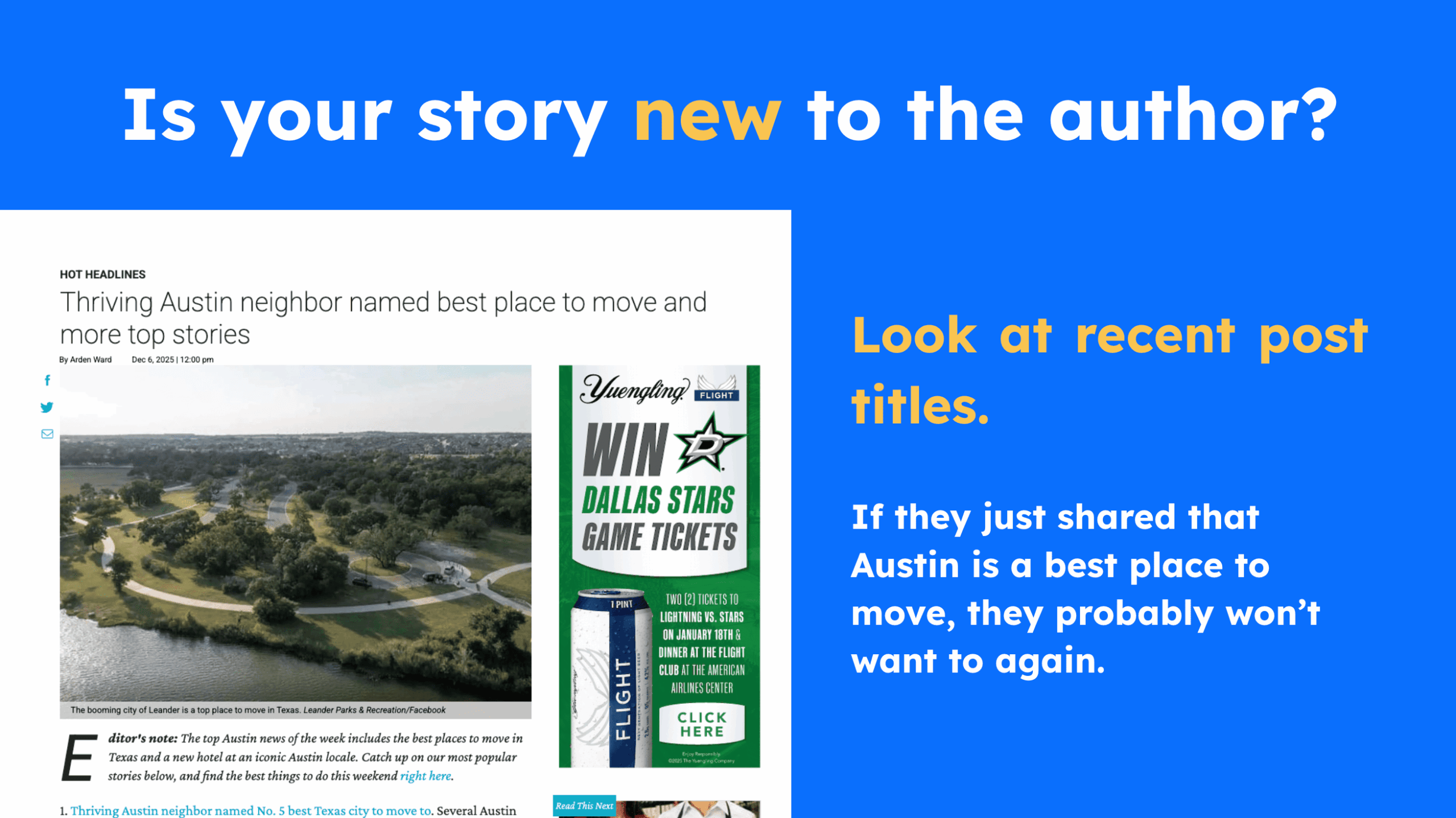
If we try to pitch this to them, they won’t be interested because they have just written about this.
The chances that they’re going to be open to sharing two studies back to back within 10 days from one another is very slim.
Is the Author In-House or Freelance?
Usually, it’s stated in the bio.
You can usually check LinkedIn to see where they are as well.
Check whether they’re present in this specific publication.
The author being in-house or freelance can sometimes change the way that you reach out and can change the outcomes, which I’ll get to in the Q &A section later.
Does the Author Link to Brands?
This is a critical point because, in some cases, the news site itself doesn’t link to brands.
Usually, the easiest way to do that is to check the links themselves.
For instance, The Conversation is one that popped up.
If I were to pitch someone here, I realize they only link to .govs, .orgs, and other academic sources, not brands.
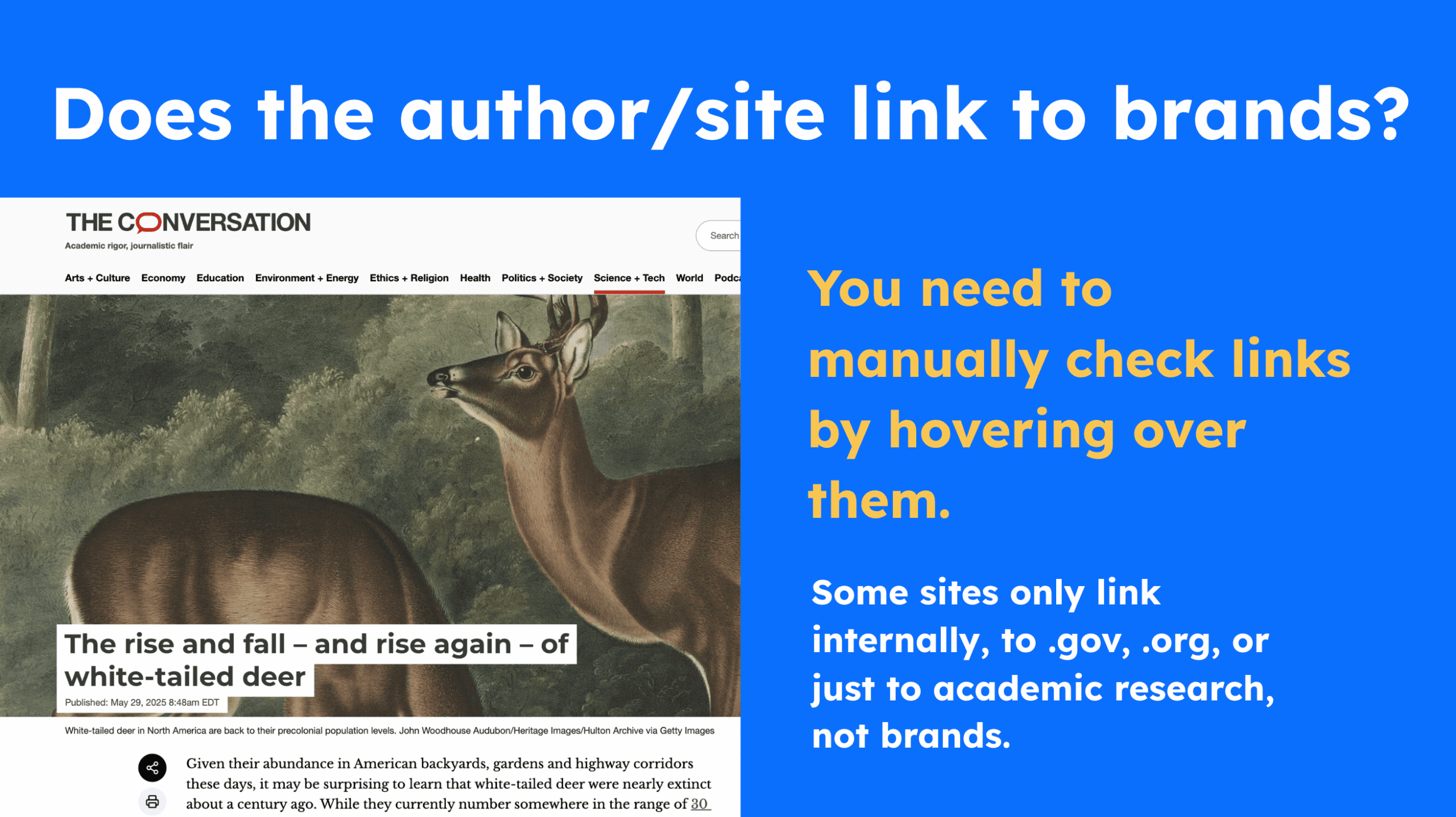
There might be journalists who only specifically link out to certain brands.
Are There External Events Happening in the Area?
This is another big one. Weather events and tragedies, as you know, can disrupt communities, specifically if you’re doing local news.
Journalists will sometimes jump into specific areas when time is needed.
So, like if there’s a weather event, for instance, the traffic reporter will now cover the road conditions, but also the sports writers or the writers who write about tech, normally like they’re going to jump on because it’s kind of an all-hands-on-deck type of situation in a lot of these cases.
For example, when the Skagit River was flooding, every journalist was covering it.
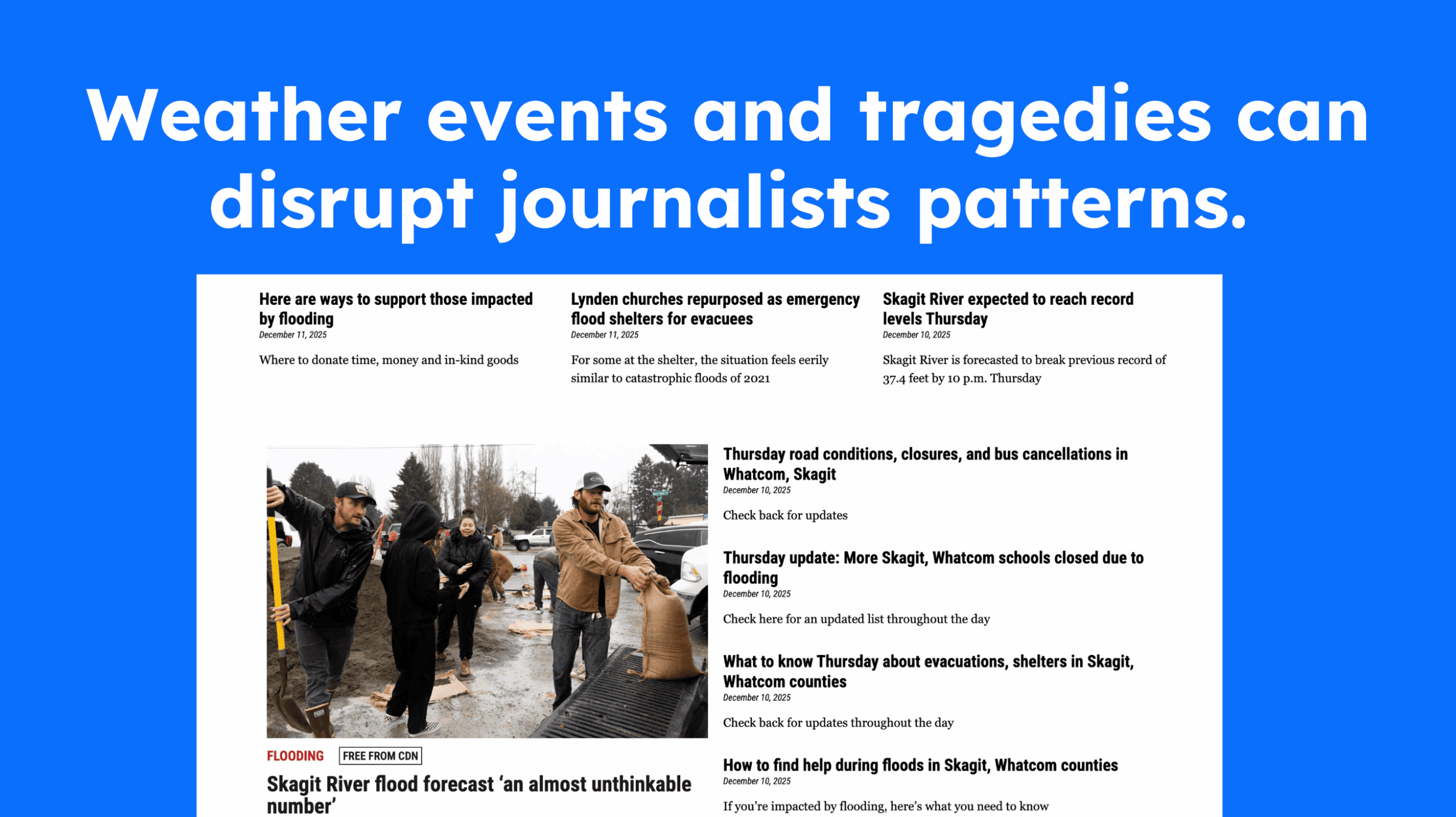
So if you’re evaluating a journalist, sometimes you might need to go to the homepage and take a bigger step back and be like, OK, what’s actually happening? Is this news for them right now? Should they be pitching this?
How Can ListIQ Help Speed Up This Process?
We built ListIQ to handle much of this for you, making the process easier. Obviously, manually searching through all these takes a long time.
Here’s how ListIQ can speed it up:
Say I was doing a post about flight cancellations.
I could do a Google search, Google news search like this:
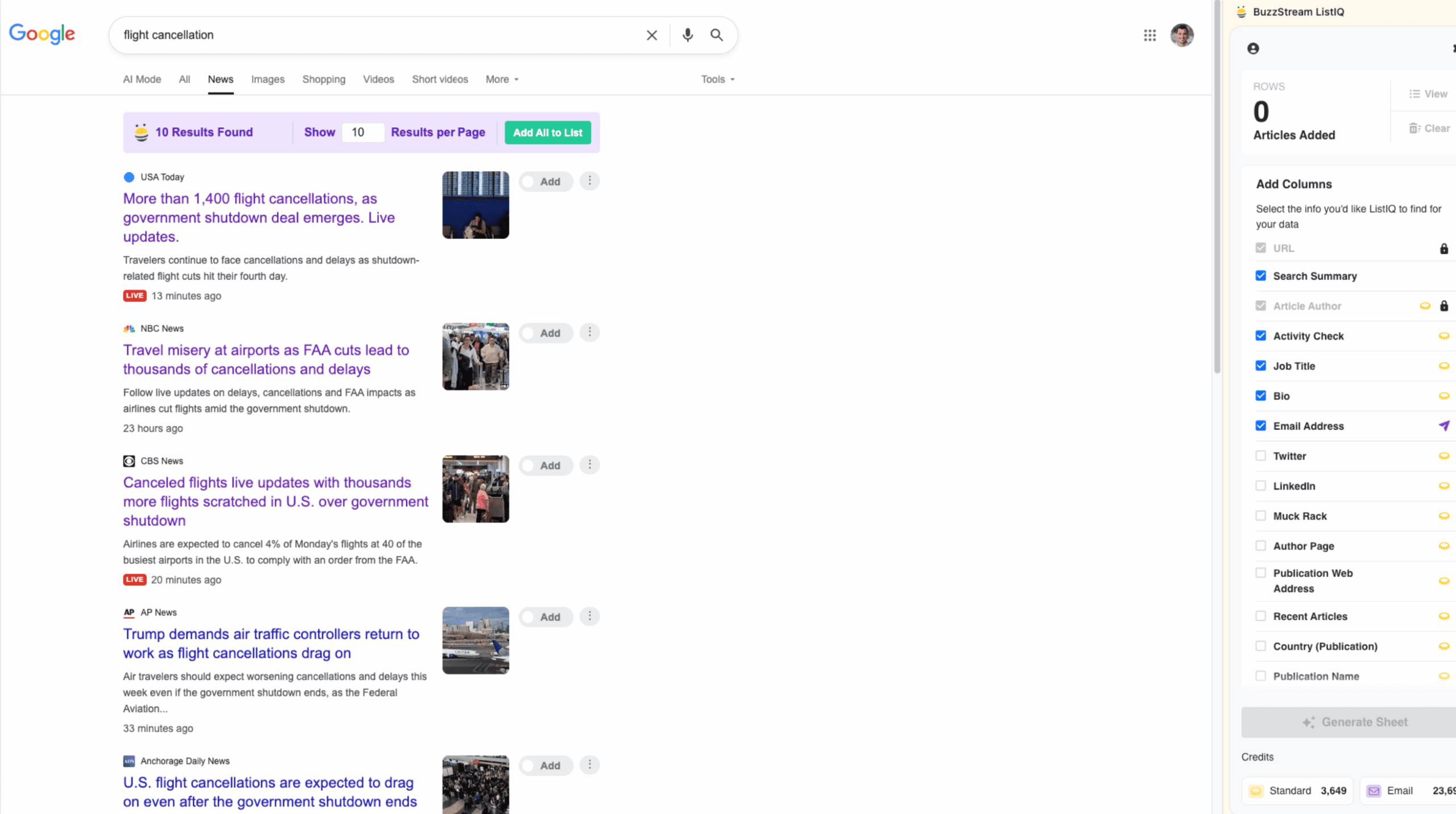
Instead of clicking into each article, digging into the journalists, and learning everything I need to evaluate them, I can ask ListIQ to add all these people to my list for evaluation.
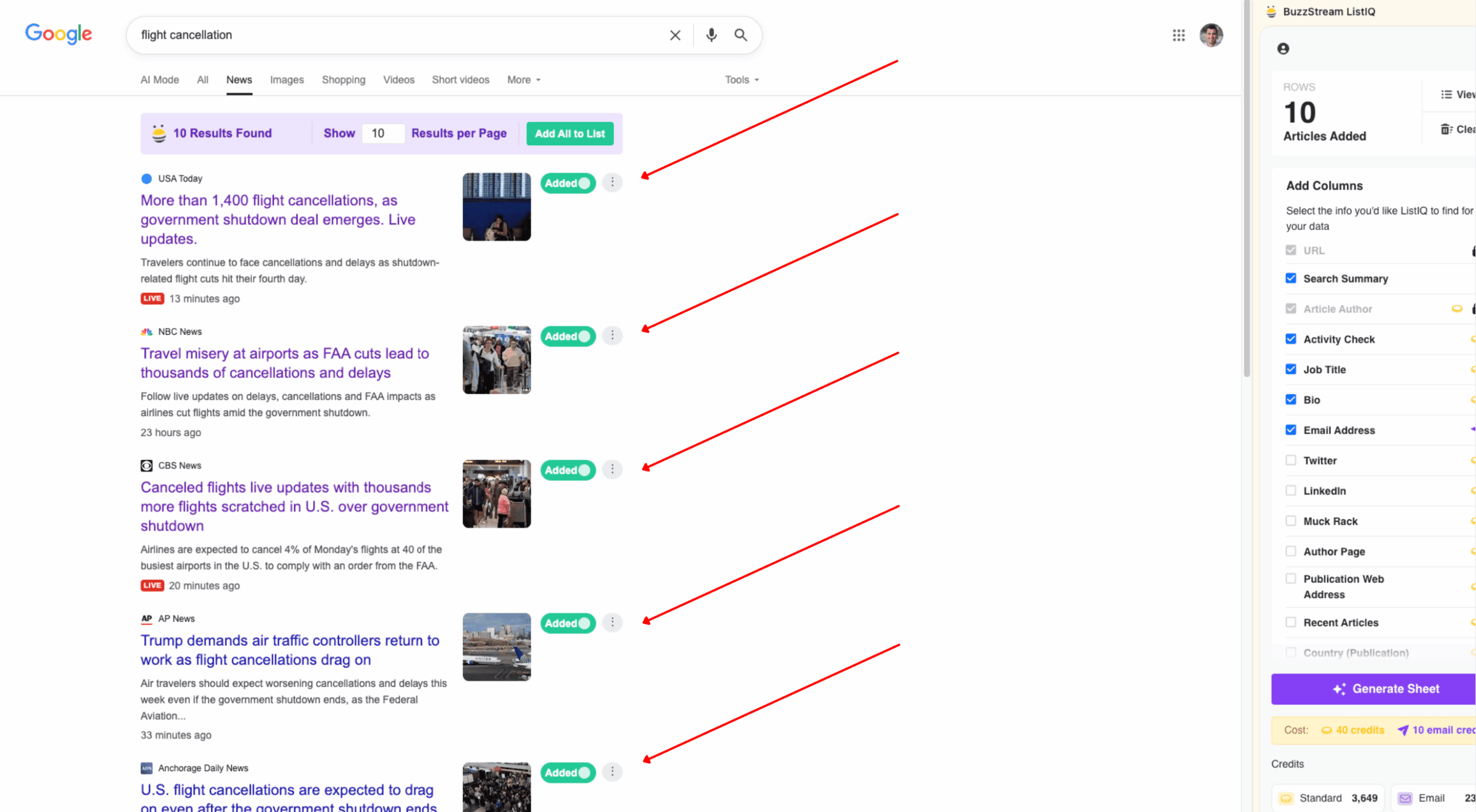
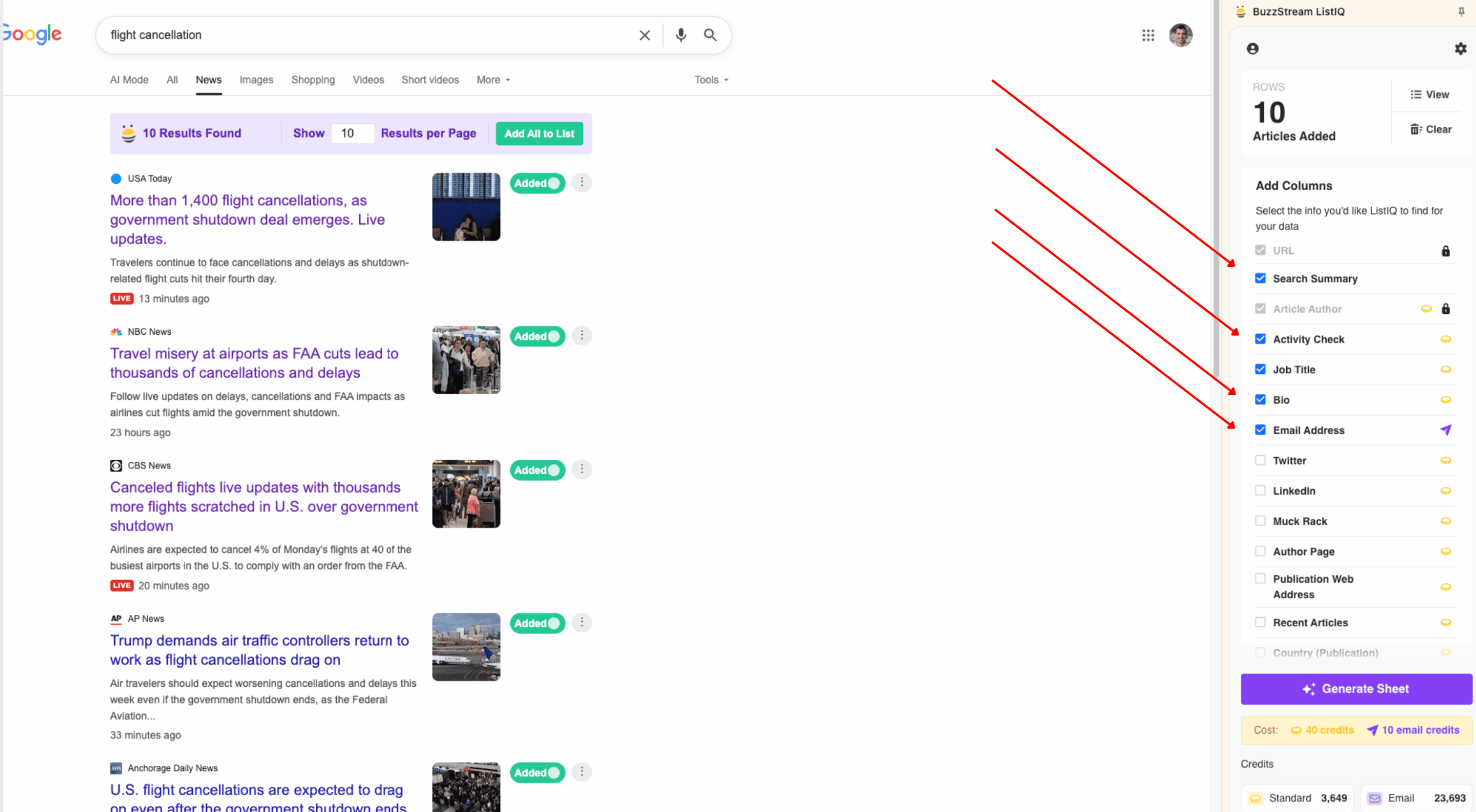
Then, I’ll ask ListIQ to give me a search summary, tell me if they’re still active at the publication, tell me their job title, bio, email address, recent articles, and then it’s gonna go and do that in a few seconds, and then you get all of this information that’s gonna help you speed up this process.
You see authors, verified email addresses, activity check, bio, etc. All of which allows you to evaluate more quickly.
- Alex covers breaking news.
- Josh Funk, he’s the transportation guy.
- Leslie Josephs also does travel issues.
- Marco Hernandez, visually driven stories, so if you have some visuals or something.
Then you can review the recent articles and ask whether they’re writing the same types of things.
Like, are they, know, does this look like it’s an op-ed? Do they only write listicles? Or are they covering news, breaking news?
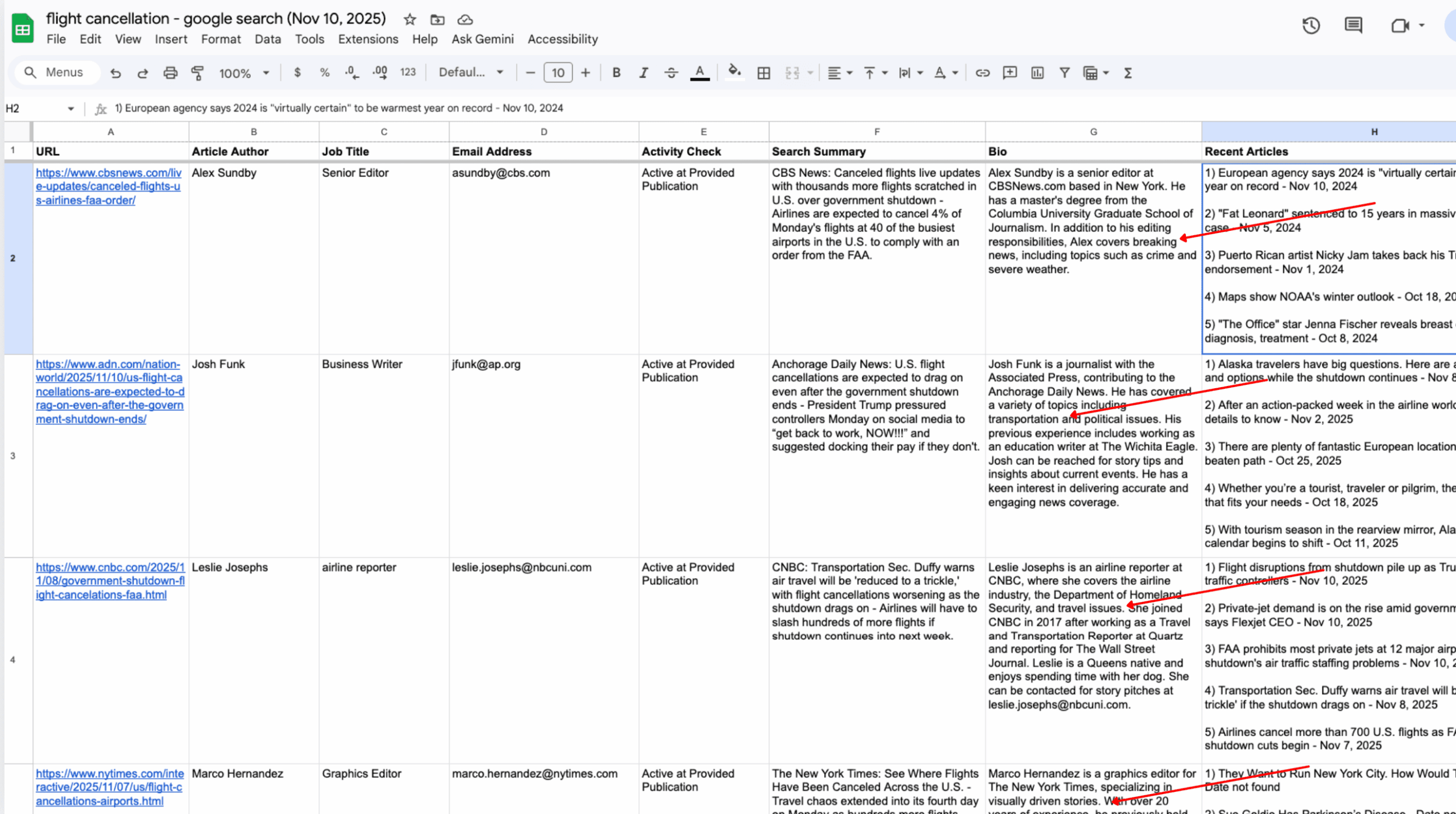
So all this stuff at a glance, it speeds up this process in an immense way.
Typically, to do all those steps I was talking about before takes about 10 minutes per journalist. Whereas with ListIQ, I can get it down to a minute, sometimes a few seconds.
Frequently Asked Questions
The last section here is some frequently asked questions.
Should I Pitch a Journalist or Editor?
I would always aim to reach out to the journalist. I think the only times that I would go for an editor is if you really know the editor.
But, you know, there’s potential that if the leading journalist is out of the office, they will say, reach out to my editor
Should I Pitch Freelancers vs In-House Journalists?
Okay, freelancers versus in-house journalists.
On the one hand, I always prefer in-house, but there are pros and cons: an in-house journalist is more likely to get you into that publication.
IMAGE
But that said, the flip side is like, they’re gonna be a lot busier, so it can be harder.
And you might wanna approach it differently.
You really want to give them everything they need to write the article in your pitch.
You wanna give them their quotes and data. This is especially relevant for in-house journals, because they are so time poor.
With freelancers, they take your pitch, repackage it, and pitch it to the editors they work with.
So it opens up the door for potentially more potential coverage or widens the net on the different publications you get from.
But they also, as Rosie Taylor mentioned on our podcast, have a vested interest in getting your story picked up by a site, so they can do more of the heavy lifting for you.
That’s not to say like you shouldn’t give them everything that they need to cover the story, but like, you know, I just think there’s there’s pros and cons to each.
If you have a great relationship with a freelancer, that’s awesome.
As I recommend to everyone on this call, every digital PR team has their go-to freelancers, which can increase the range of coverage you get.
One note is when we did this study, freelancers do tend to reply more, but they also tend to open a lot less.
IMAGE
So just keep that in mind, and it kind of speaks to this. Again, they have this vested interest.
So if they are interested, they’re going to reply and probably follow up and ask for more details and that sort of thing so they can mold their pitch to their editors how they want.
Do You Have Specific Journalist Requests That You Follow?
Journal requests were something I didn’t even cover in here. I feel like it deserves its own webinar. Maybe I will do that.
Responding to journalist requests are definitely an easy way to find journalists because you’re catching them where they need you rather than just pitching out of the blue.
There’s a tool called PressPulse that consolidates many of these journalist requests into a single centralized location.
I recommend checking it out.
But we did this whole study on journalist requests and where they come from, which I recommend checking out as well.
How Do You Find Journalists Internationally?
Unfortunately, I don’t have much reliable data on this.
I would say one of the podcasts we had featured Ellie Sumner, a digital PR from Australia. She said Australia is a little different because it’s almost behind the UK.
She said there’s a lot more to it, like taking the journal south of coffee, meeting them, and one-on-one time.
So there’s definitely going to be a lot of nuance, I think, depending on where you’re reaching out to people and where you’re trying to find journalists.
But there are also dedicated media databases for some of these other areas. I would still rely on Google searches as much as possible, given the limitations I mentioned regarding media databases.
Telum is great for Australia and the Western region of the world.
Roxhill for Uthe K.
Cision, I’ve heard, is pretty good in terms of international, but I think still Muckrack is probably the best coverage worldwide, regardless.
Is the Process For Finding Podcasters the Same for Finding Journalists?
It’s just the same process. I think there are a couple of tools for finding podcasters out there.
Looking at Podchaser, there are a lot of these tool, but I would still go through and say, you know, what is the “Thoughtful Entrepreneur”? For instance, they’ve written about, they got PR person in here, but like, do they cover that all the time?
Then, instead of viewing the bio, you’re viewing the podcast description.
Instead of looking at the recent articles, you’re looking at recent episodes.
You don’t want to pitch yourself if they’ve already covered the same exact topic that you’re pitching.
It’s the same thing.
I also have a post on pitching to podcasts, Karen.
I can share, but the mindset is the same.
You want to make sure it’s the best relevant fit for what you’re doing.
How often should you update your list?
That’s a great question. Thanks, Colin. You know, with so much turnover these days, from everybody I talked to, people still do it, like I’d say a majority of the agencies that work with BuzzStream do it about every month.
That was one of the main reasons we built ListIQ: you can import your media list into ListIQ and run an activity check on it.
That will show you whether they’re still active. Like that’s the easiest way to do it. And it takes, you know, seconds rather than hours sometimes to make sure they’re still relevant and active for your publication. These days, I’d say once a month, though it varies by industry.
How Do you Speed Up the Evaluation Process?
Hopefully I answered that. ListIQ is the way to speed that up, just because it does take forever.
But keep in mind that, like, I think the reason that smaller, more relevant targeted media lists tend to do well overall is because it takes more time to do it.
So it’s not like you can just take a media list and cut it in half and you’re get better results.
And I think there’s this mindset that, like, you have to reach out to 100 people for every post, every story ⁓ but quality always is going to trump quantity in these cases.
Getting one or two pieces of coverage, think, is normal these days.
Last year, stories that used to get 100 links are getting 10 links, so if you feel the burn, it’s not just you.
I would err on the side of spending more time care building these relevant media lists.
Where can I find these videos and webinars?
I have them on the blog and buzzstream.com/blog
But you can also sign up for our newsletter. You’ll also see them there.
I post them on LinkedIn. Follow me on there.
Full Slide Deck
How to Find the Perfect Journalist for Your Story by Vince Nero

 Check out the BuzzStream Podcast