
 End-to-end outreach workflow




Table of Contents
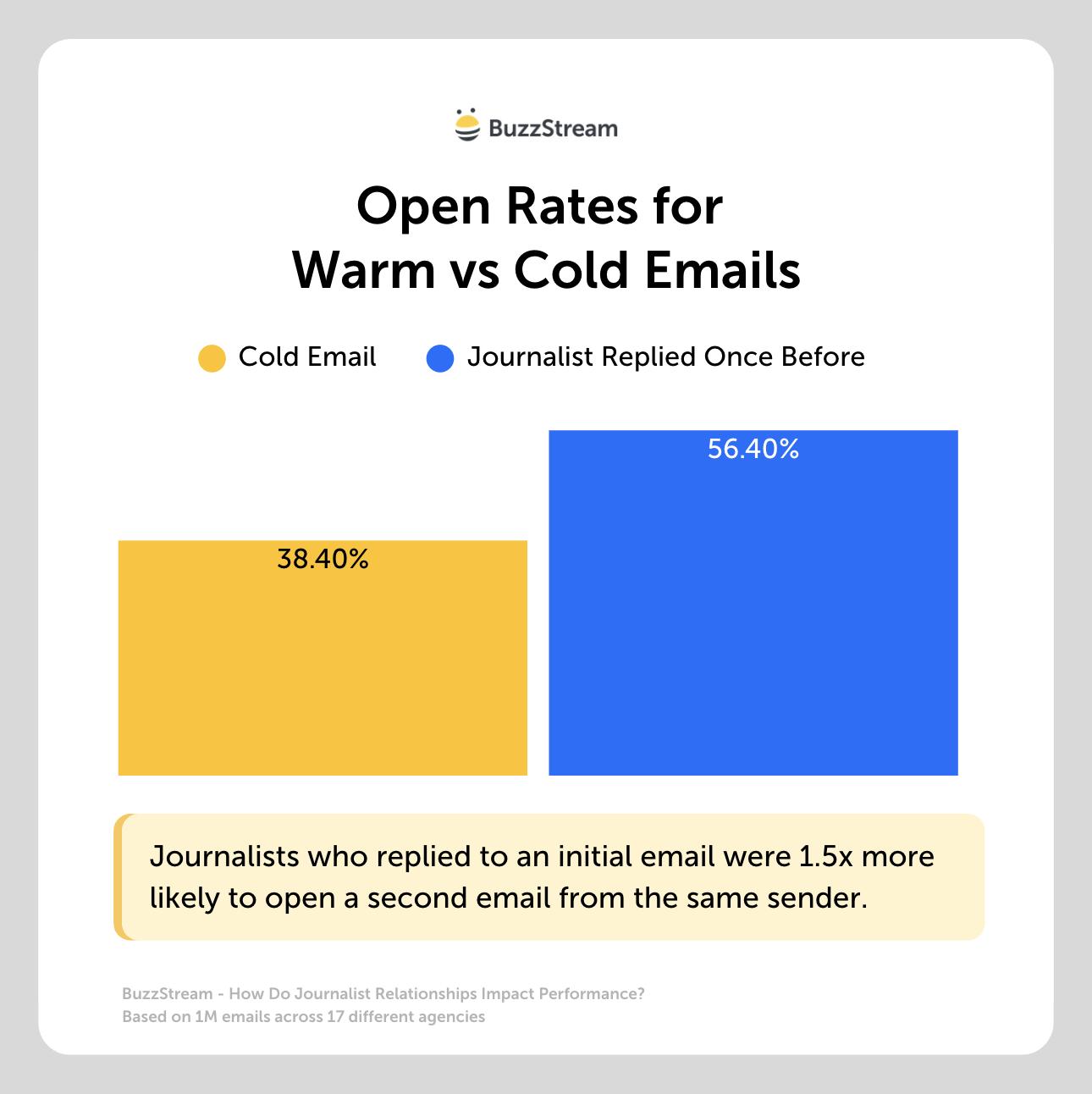
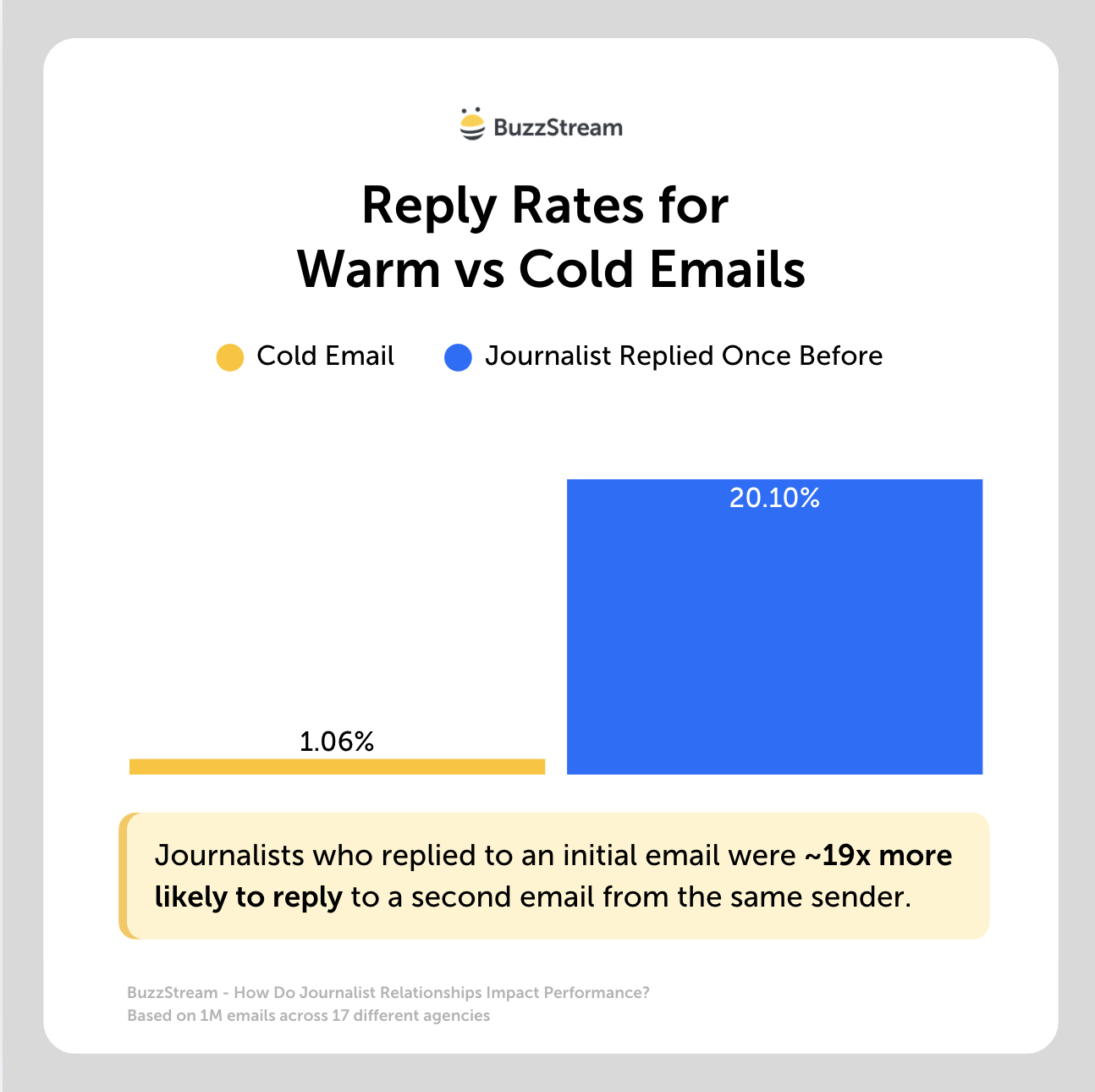
- Relationships drive results: prior replies lead to 1.5x more opens and 19x more responses
- A single reply isn’t just engagement—it’s a relationship trigger that compounds future outreach success
- Recency matters: journalist relationships decay significantly after ~90 days
- Even after 6 months, warm contacts still outperform cold outreach by ~8x

At BuzzStream, we often talk about the importance of building relationships and trust with journalists.
And that makes sense in theory: if a journalist knows and trusts the PR pro emailing them, they’ll be more likely to open the email.
But I wanted to test this theory in real life.
Using over 1 million emails, I examined sending patterns over a two-year period from 17 different agencies to determine whether journalists are more likely to open and reply to emails from PR pros who have already responded.
I’ll fully admit this isn’t a foolproof method, and the idea of warm leads vs. cold leads isn’t new, but running through this exercise with actual outreach from PR pros confirmed my theories about the power of relationship building.
However, what may be even more important is looking into how long these relationships last.
Here are all the findings from our studies on how building relationships affects journalist outreach.
Methodology
We analyzed 1,321,232 anonymized emails sent by PR teams across 17 agencies, focusing primarily on digital PR across a two-year time period.
For each email, we looked at a simple question:
Had this journalist replied to the anonymized sender before this email was sent?
That allowed us to split outreach into two groups:
- Cold outreach (no prior reply)
- Warm outreach (at least one prior reply)
From there, I went on to slice and dice the data.
Relationships Led to 1.5x More Opens
Journalists who replied to an initial email were 1.5 times more likely to open a second email from the same sender.
But even though the BuzzStream data I use for this (and all of my studies) excludes auto-opens, many PRs remain reasonably skeptical of open rates.
So, let’s also look at reply rates, because that’s where we see the biggest impact anyway.
Relationships Lead to 19x More Responses
Journalists who replied to an initial email were about 19 times more likely to respond to a second email from the same sender.
Here’s the look side by side:
| Cold Outreach | Warm Outreach | Difference | |
|---|---|---|---|
| Open Rate | 38.4% | 56.4% | 1.5x |
| Reply Rate | 1.06% | 20.1% | 19x |
This is clearly the bigger impact.
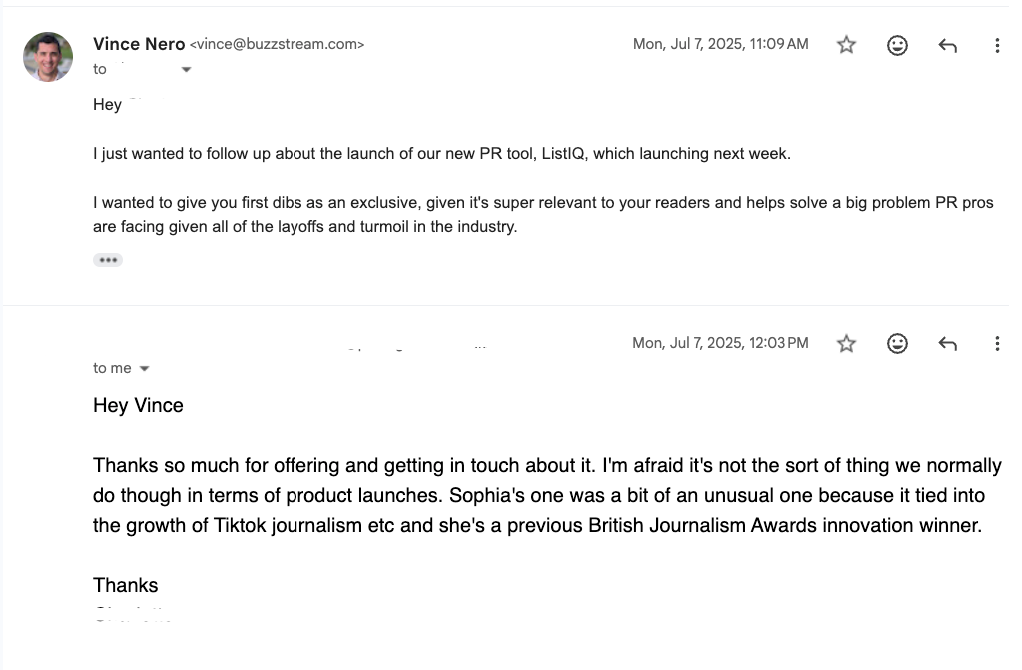
And even if you consider that replies from a journalist aren’t always saying they would cover, they can still provide invaluable insight and feedback for your future pitch.
For instance, a reply from a friendly journalist helped me understand why they don’t normally cover product launches:
Not only that, but as we’ll see, a response almost acts as a relationship touchpoint, which is key.
Journalists who replied in the last 90 days are about 30 times more likely to reply again than those reached via cold outreach.
But after 90 days, there is a steep drop off, so the good times won’t last forever.
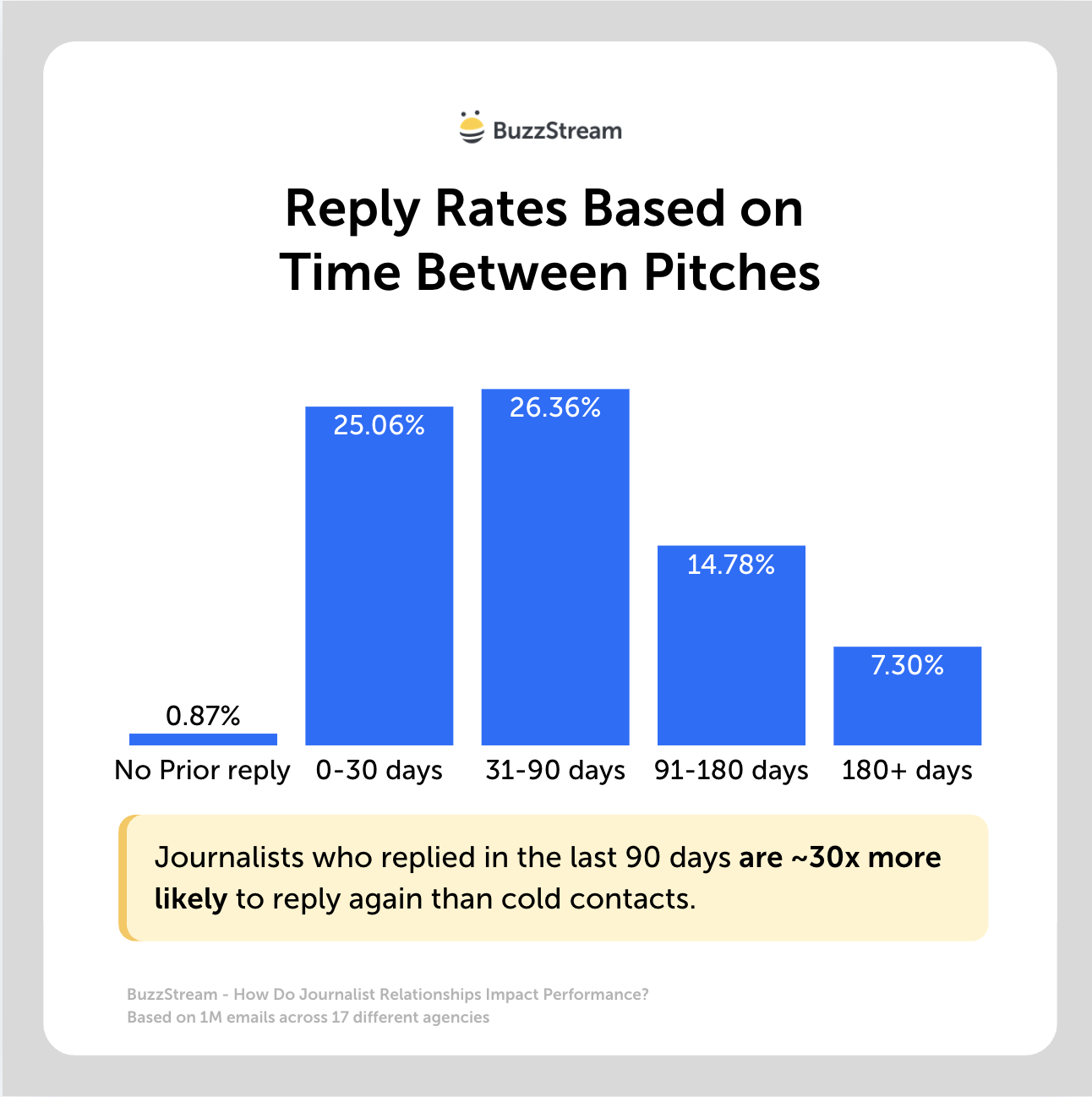
Then there is an even larger decrease after 6 months. (Although previously engaged journalists are still 8x more likely to respond than cold outreach.)
And if there is any concern that these trends are a one-off phenomenon, they are not.
This pattern was consistent with all of the digital PR agencies we looked at.
All Digital PR Agencies Felt a Lift in Reply Rates From Journalists Who Recognized Them
As you can see, the lift in reply rates from 11 times up to as high as 20 times (one agency that was especially adept at managing relationships saw a reply rate 40x higher).
Here’s a look at four random, anonymized agencies from our dataset:
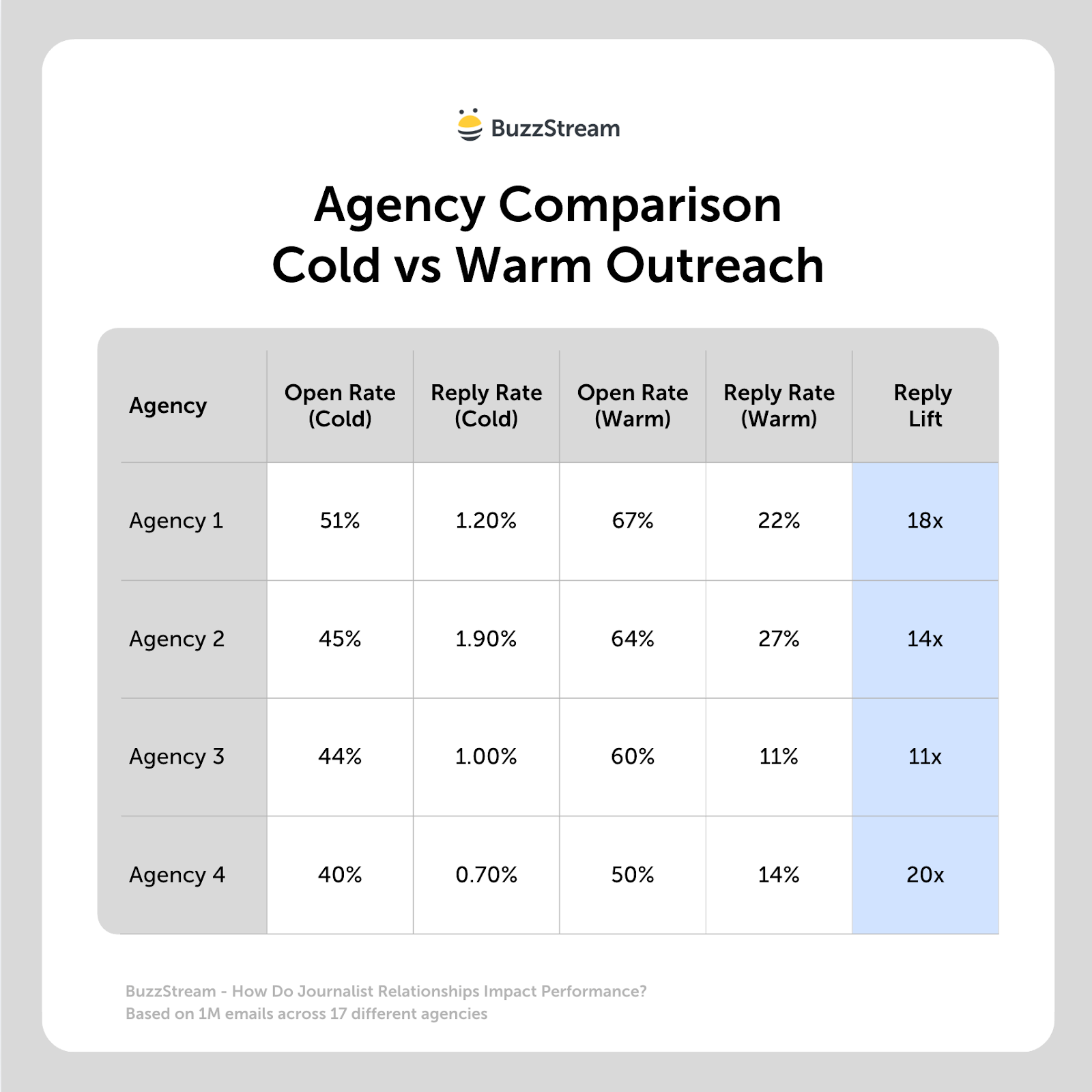
So there is clearly an advantage to developing media relations.
What are some ways to do it?
How to Develop and Maintain Relationships with Journalists
We covered our 10 tips for building relationships with journalists, but here are some highlights.
There are some proactive approaches and reactive approaches.
1. Reach Out to Journalists With No Ask
One simple suggestion that keeps coming up is to email a journalist with no specific ask.
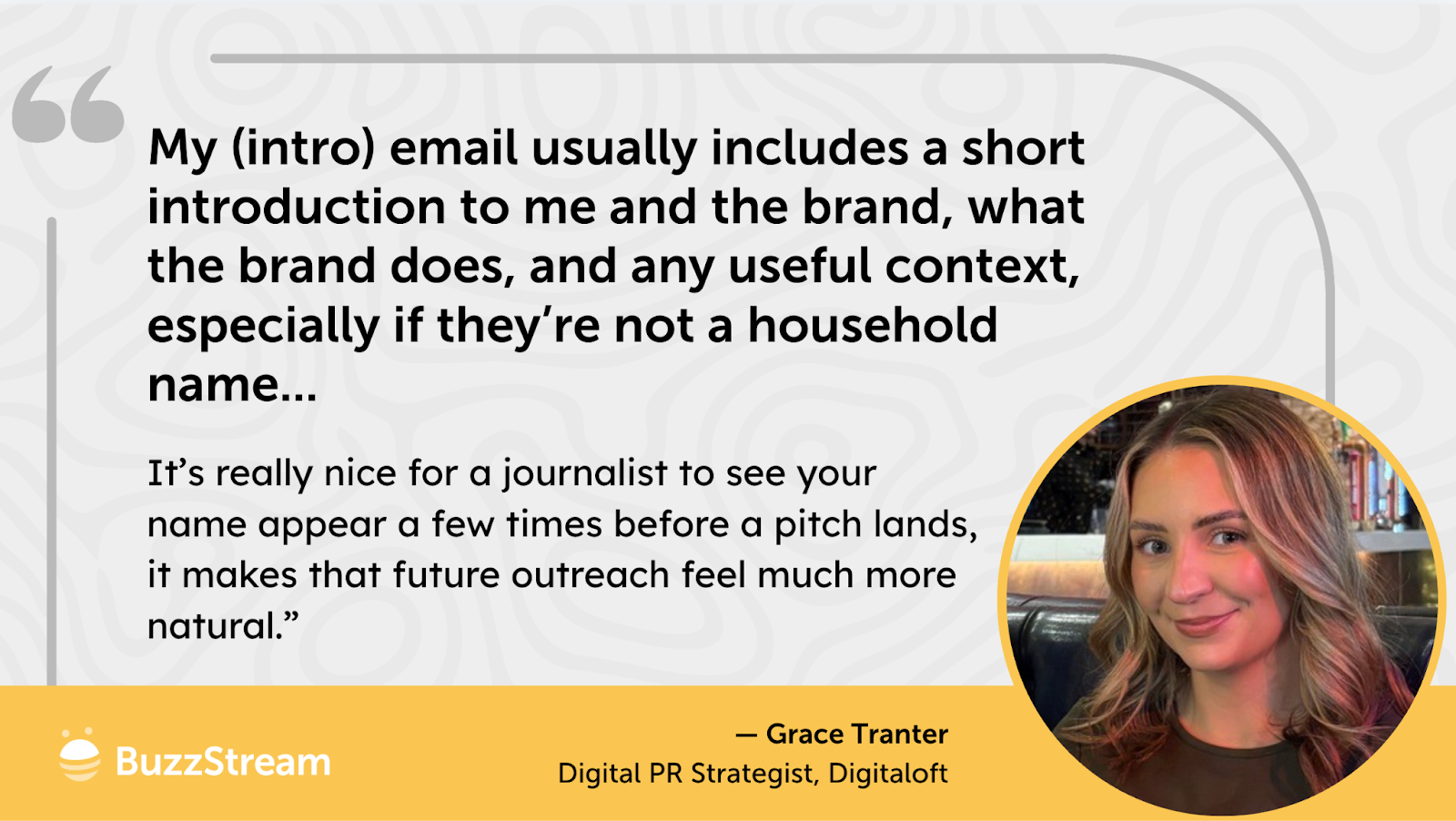
Grace Tranter, a digital PR strategist with Digitaloft, told me,
“It’s really nice for a journalist to see your name appear a few times before a pitch lands, it makes that future outreach feel much more natural.
Plus, when they recognise your name and who you represent in a busy inbox, it instantly builds familiarity and credibility. You’re no longer just another unknown sender, they already know what kind of stories or experts you can provide.”
This totally tracks with the journalists I’ve spoken to.
But Grace is based in the UK, and we know that digital PR practices vary between the US and the UK.
So, I reached out to the Director of Public Relations with Journey Further, Domenica D’Ottavia, who is based here in the US.
She told me: “We do media intros fairly often.
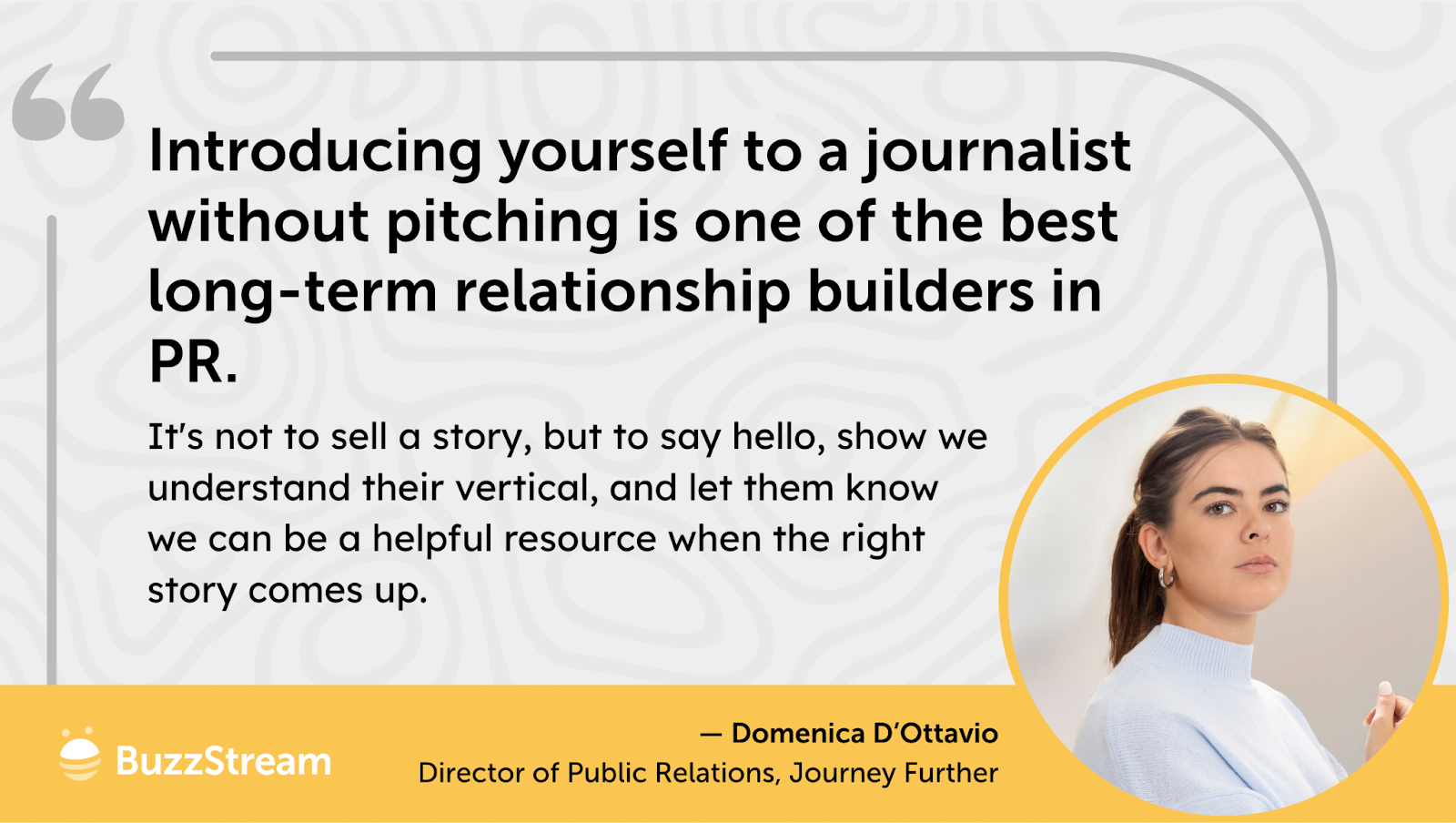
Almost for every client actually once we begin a new client relationship. Introducing yourself to a journalist without pitching is one of the best long-term relationship builders in PR.
It’s not to sell a story, but to say hello, show we understand their vertical, and let them know we can be a helpful resource when the right story comes up.”
“It humanizes the relationship before you ever need anything.
When a relevant story opportunity does come up, you’re already on their radar, and if not, they can search their inbox any keywords that you might have mentioned and use you for a source.
It also capitalizes on the mere exposure effect – the next time you do email them they will be more likely to remember your name in their inbox, and thus more likely to open it and respond.”
In terms of what to put in your email, here’s what Grace told me:
“My outreach email usually includes a short introduction to me and the brand, what the brand does, and any useful context, especially if they’re not a household name.
For e-commerce clients, I’ll often include bestsellers, USPs (like being made in the UK), or what they can offer, whether that’s expert commentary, insights, or internal data. If there are any upcoming events or product launches, I’ll add those too.”
Domenica added:
“It’s short, personal, and service-minded.
Typically, it’s personalized. We don’t send out loads and loads of media intros, we only select for the most relevant journalists. This sets a tone of helpfulness, and ensures we know their beat inside and out. We’re hoping to create a natural way to follow up later with a relevant story.
Also, be human.
Polite, brief, relevant, and conversational wins every time. I will always recommend a personalized approach, but I know that it’s not always possible.”
Here’s a template from Grace:
Hi [X],
I wanted to introduce [BRAND], [COMPANY POSITIONING], now available to provide insights, commentary, and guidance on [CONTENT TOPICS].
Whether you’re working on a feature about [TOPICS], [BRAND] is uniquely positioned to provide exclusive insight and practical advice for your readers.
We can provide:
- Expert commentary on [X] from [EXPERT /JOB TITLE] (link author page / LinkedIn where possible)
- Tips for [X]
- Exclusive internal data and insights on [X]
[ADD SEASONALITY HERE – E.G. TRAVEL SEASON FOR TRAVEL CLIENT, EASTER HOLIDAYS FOR PARENTING CLIENT ECT]
We’d be happy to align with your content plans and can work together on expert quotes or relevant topics. Let me know if you’d like us to share some ideas based on your editorial calendar. Looking forward to hearing from you!
Thanks so much,
–
She told me she’s used this and gotten replies from journalists at pubs like Grazia, Harpers, Bazaar, Vogue, and others.
2. Pitch Relevant Content
The quickest way to endear yourself to a journalist is to pitch them relevant content.
This may sound obvious, but Muck Rack reported that about 50% of journalists seldom or never receive pitches relevant to their beats.
Our State of Digital PR Report found similar takeaways, with about 48% of digital PR pros always personalizing their emails. And when we asked what “personalization” means, most agree that it means pitching relevant content.
This comes down to spending more time on building highly relevant media lists.
In one study on the effectiveness of highly targeted outreach lists, we found that coverage rates skyrocketed when digital PRs spent time building better media lists.
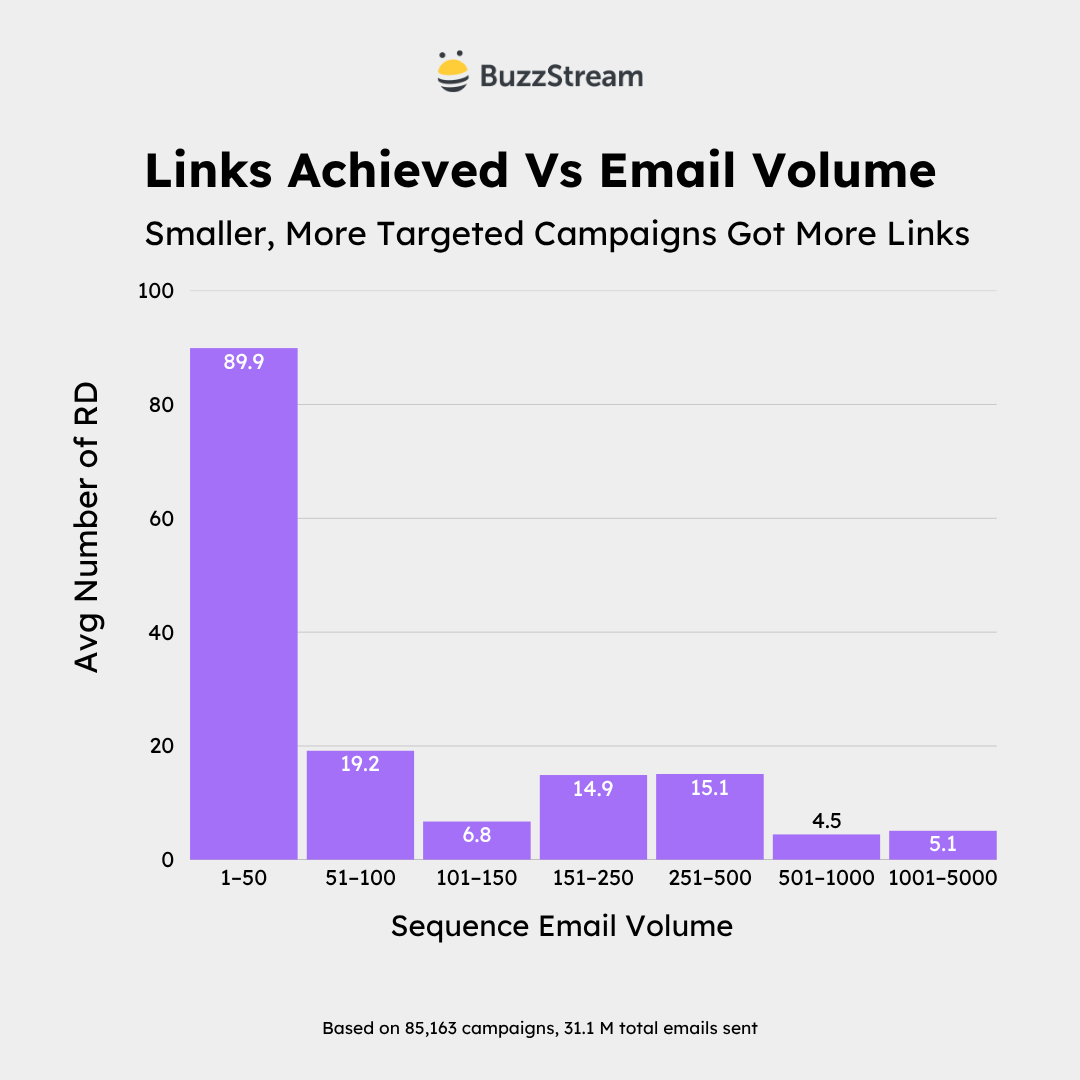
The spray and pray era of PR pitching is over.
3. Be Quick
Another tip that comes up frequently in our podcast is the need to respond quickly — especially when you say you can deliver.
As journalist Joni Sweet told me in our podcast about media pitching, “I’ve sometimes put out a call for pictures for someone in the health space, and a PR person will email me saying, ‘I have this amazing client who can speak to X, Y, and Z for your story. Do you want to set up an interview?”
I’ll say, ‘yes, I need answers by noon on Friday.’
Then it’s 4 p.m. on Friday and those answers still haven’t come in, I’m in a real bind because I have to find somebody over the weekend and convince them to give me the time of day so I can meet my deadline on Monday, make my editor happy, and get paid, right?”
If you commit to helping a journalist, you need to come through.
4. Be Truthful and Transparent
Again, another obvious-sounding tip, but considering how much negative press is out there around fake experts, like this report by Rob Waugh at PressGazette, this can seriously come back to haunt you.
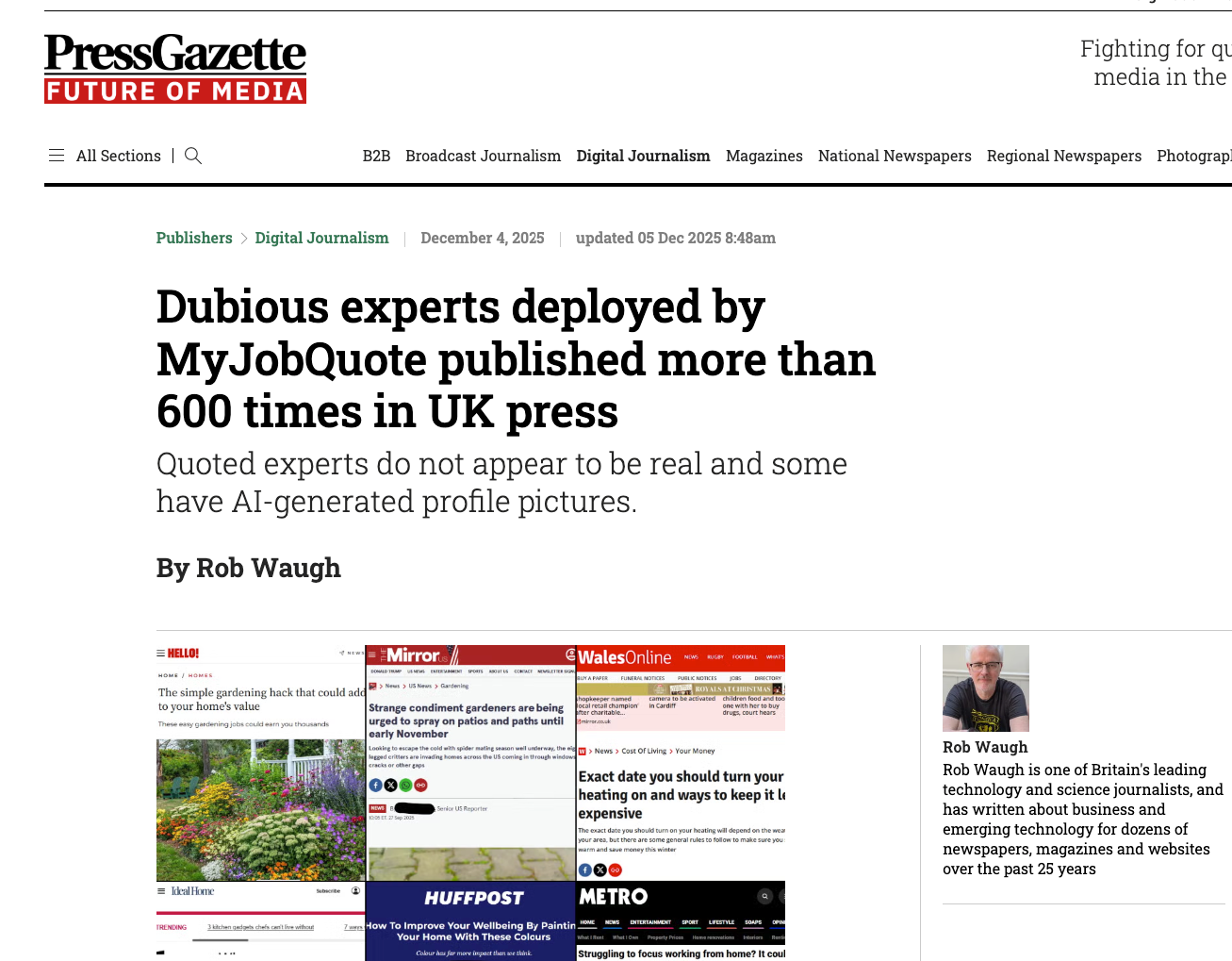
I asked Rob about this issue of transparency in providing commentary for journalists:
“Since before I started reporting on fake experts, I was aware there was a big gulf between experts who deliver quotes via email which smell strongly of corporate messaging, and experts who actually deliver quirky and interesting copy.
Today, thanks to AI, that problem is far bigger than it’s ever been, with fake experts and fake expertise everywhere.”
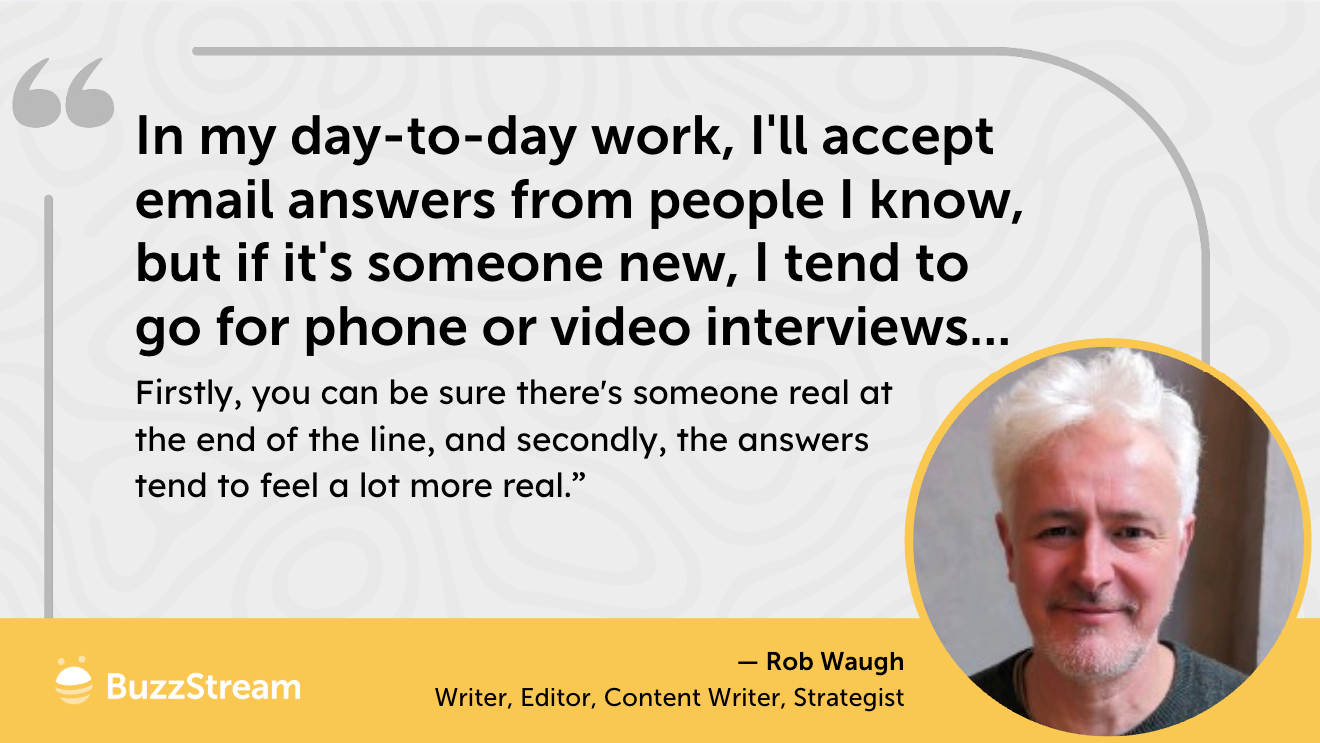
Things have gotten so bad that journalists are looking for alternative ways to get comments rather than relying solely on what’s written in an email.
“I always think if you’re dealing with a real expert, they’ll surprise you with some of their answers, because they inhabit a world you don’t fully know.
In my day-to-day work, I’ll accept email answers from people I know, but if it’s someone new, I tend to go for phone or video interviews – firstly, you can be sure there’s someone real at the end of the line, and secondly, the answers tend to feel a lot more real.”
My takeaway here is that you should try to make yourself (or your client) available for phone or video calls whenever possible—especially on the first contact with a new journalist.
5. Track Your Relationships
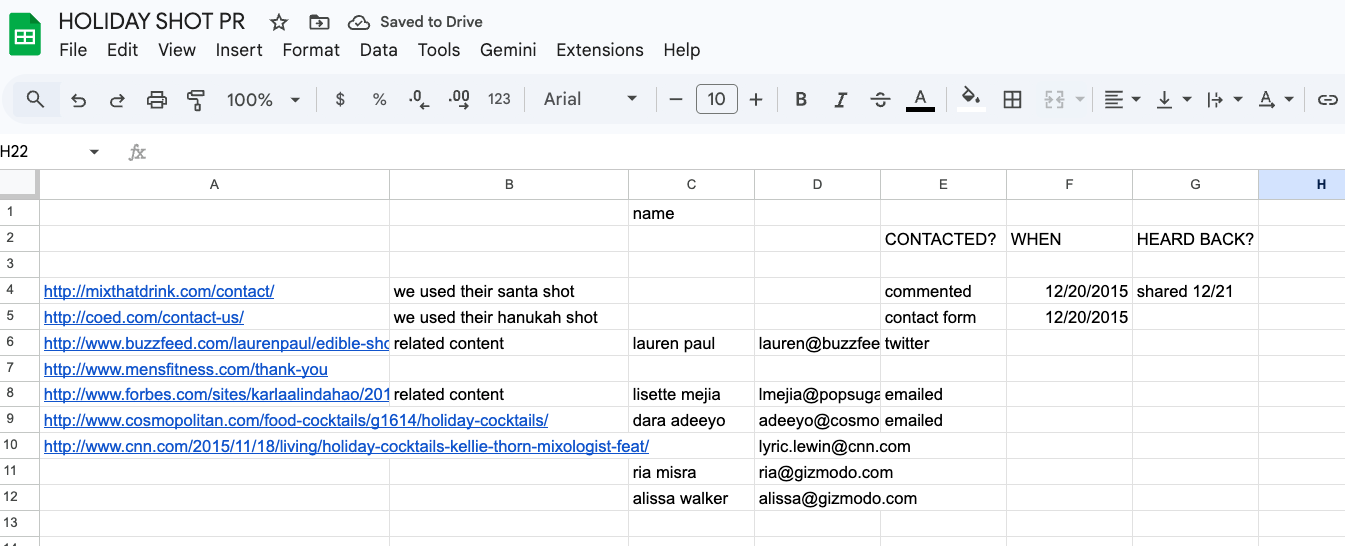
When I started my career in digital PR, I was tracking journalist relationships on a Google spreadsheet.
In fact, here’s what my very first PR outreach campaign looked like (yes, I thought I could get CNN to cover my infographic about holiday-themed shots.)
One of the top reasons users switch from sending outreach emails in Gmail to a CRM like BuzzStream is to track relationships across campaigns and clients.
The ability to see contact history across clients and teams is one of the things that makes BuzzStream different than any competitor tool.
I see email conversations, relationship stage changes, notes, links, and more.
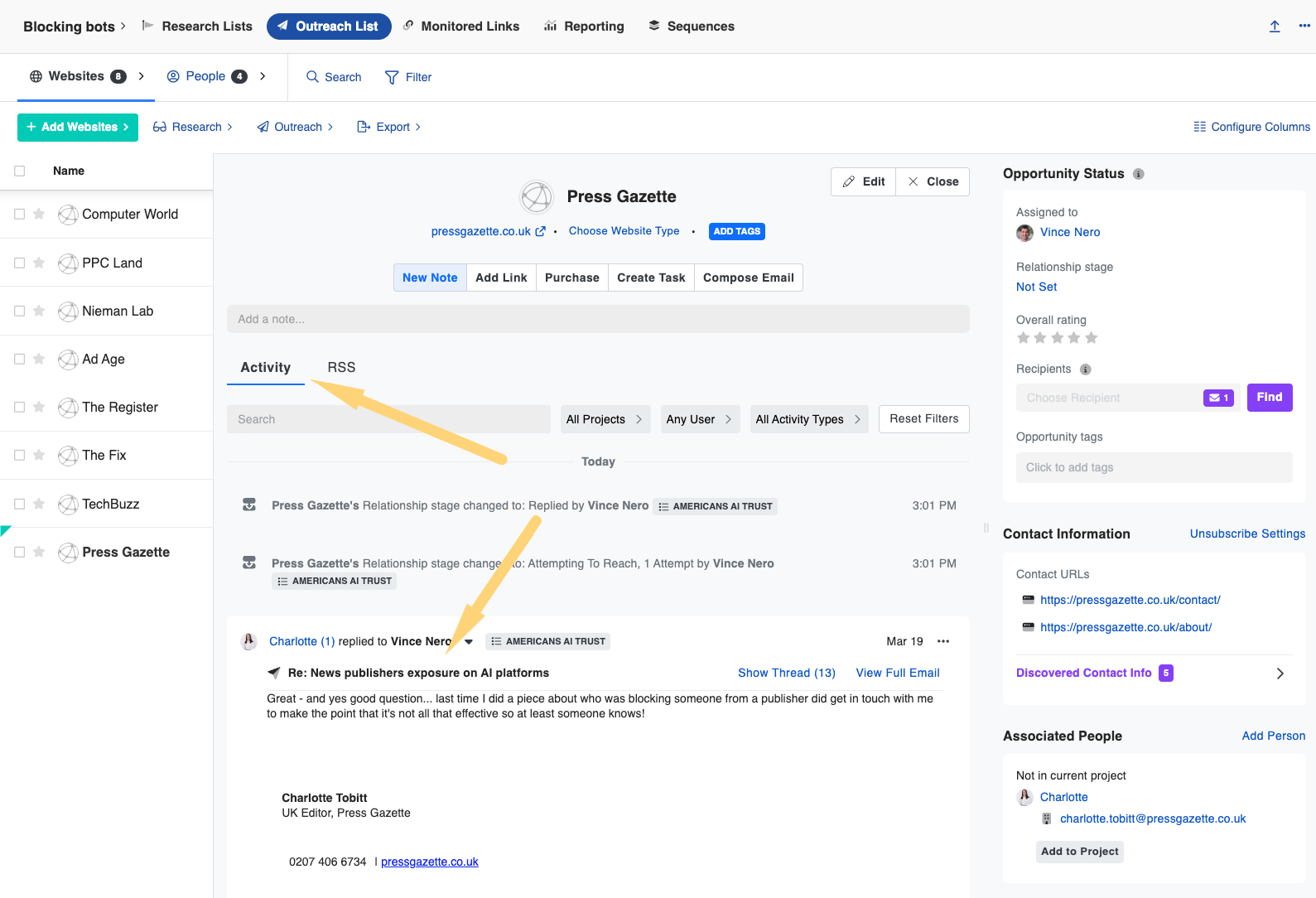
I can see the same info in BuzzStream’s Chrome Extension, BuzzMarker, which lets me view contact history, add people to lists, and find their contact information without leaving the web page.
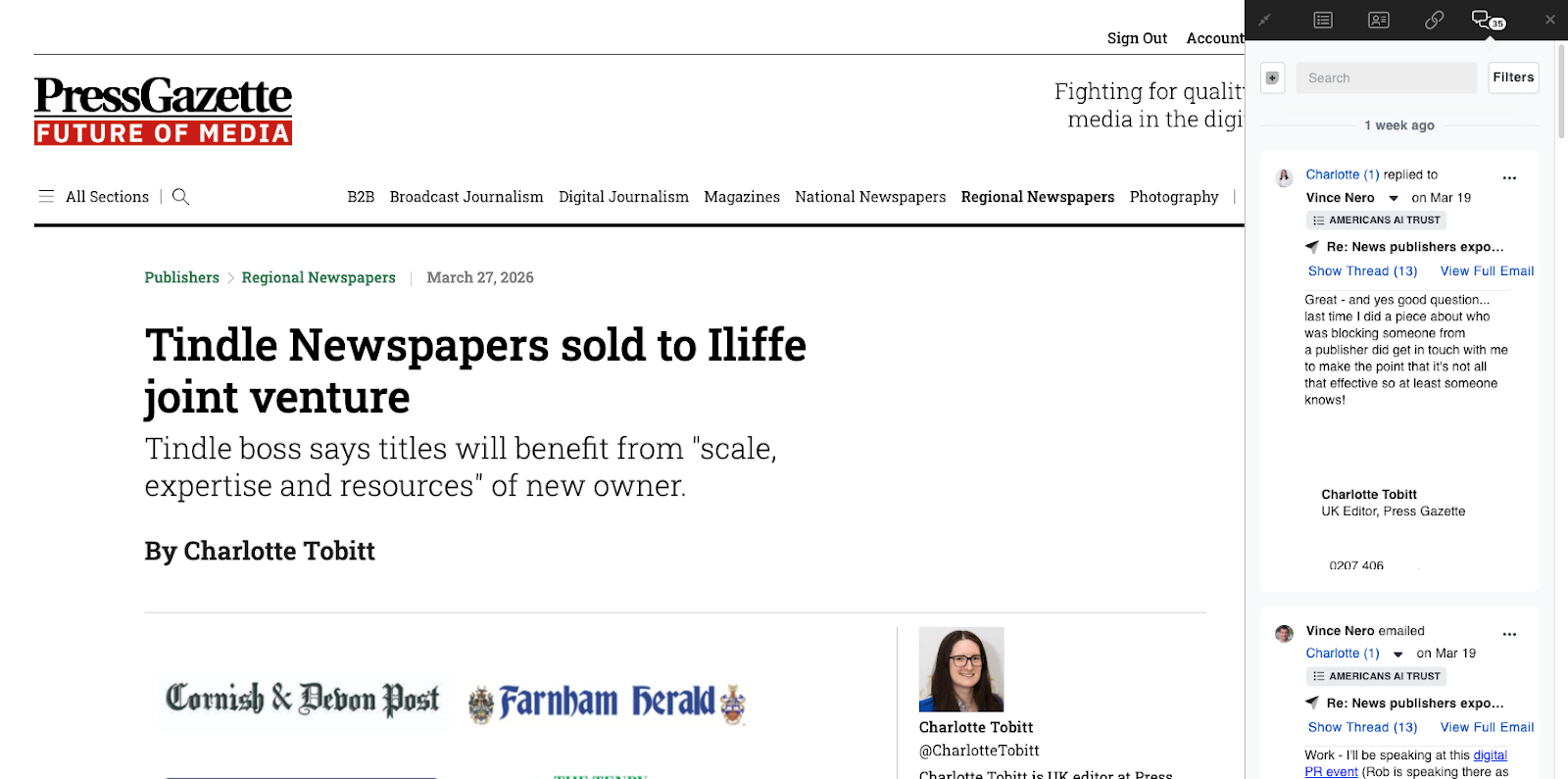
More importantly, you can also add journalists to a DO NOT CONTACT list so no one from you or your team bothers them again.
Seeing all of the information at a glance allows me to make easy decisions about whether or not I should reach out to someone.
For instance, in the agency realm, you may want to slow your outreach to ensure the same journalist isn’t hit multiple times per day.
Final Note
I’ll be the first to admit that this study is far from iron-clad. It’s tough to measure relationships based solely on open and reply rates.
And just because you have a relationship doesn’t mean you are guaranteed coverage.
Yet, seeing and recognizing a name in an inbox has proven to be a game changers. That’s why relationship building is still one of the most-recommended practices from digital PRs and journalists alike.

 Check out the BuzzStream Podcast