 End-to-end outreach workflow



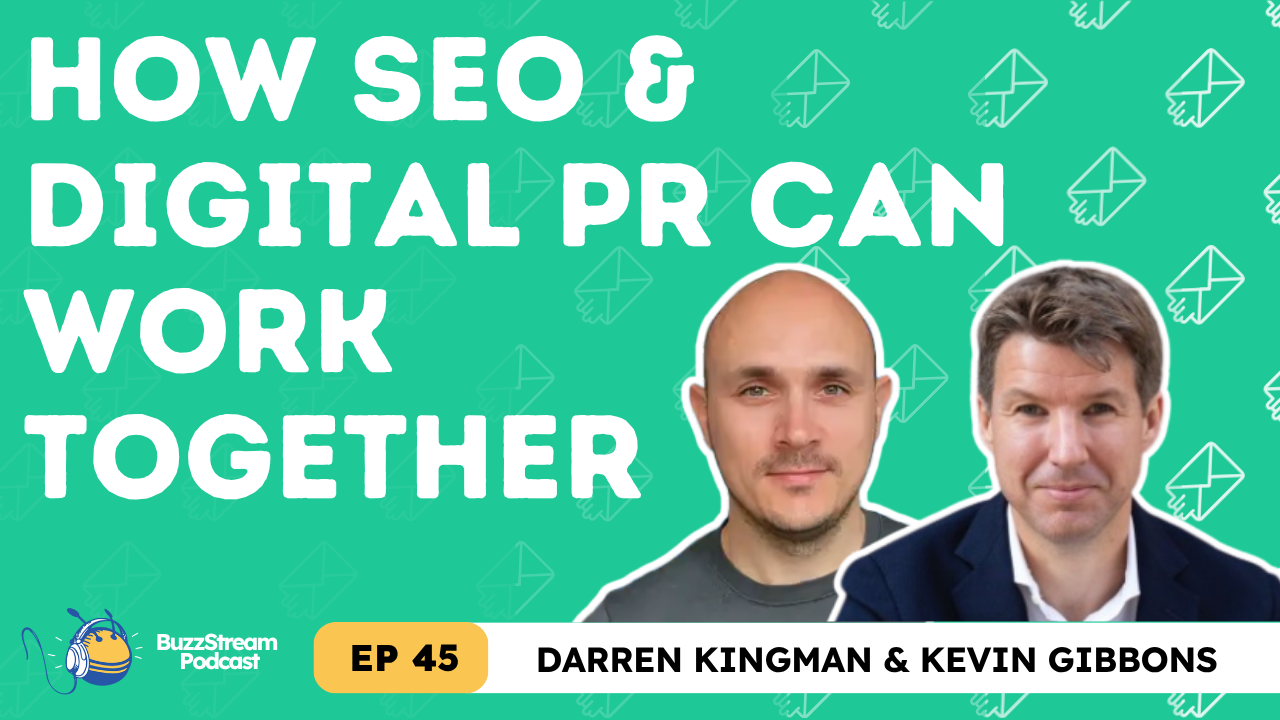
Table of Contents
- SEO and digital PR work best together—not in isolation.
- Think “three legs of the stool”: technical SEO, content, and link reputation.
- The best campaigns have all three—a commercial angle, a PR hook, and SEO value.
- Tie campaigns to specific products to draw a clear line from coverage to revenue.
- Avoid vanity metrics—raw link counts and domain authority don’t tell the real story.
- Start with research, not a fixed budget split. There’s no cookie-cutter formula.
- Steer clients toward revenue as the KPI to stay defensible and prove real ROI.
I’m thrilled to be joined by two guests this week: Kevin Gibbons, founder of Re:signal, and Darren Kingman, founder of Root Digital. Darren’s no stranger to the pod—this is his second time around—but there’s a new wrinkle this time: Re:signal has acquired Root, and I wanted to get both founders in the room to talk about what that actually means.
We get into the questions I keep coming back to in my own conversations about SEO and digital PR, like :
- Do campaigns need to be tied to specific products to really move the needle?
- When is a link just a vanity metric?
- And how do you prove the revenue impact of coverage to a client who’s only looking at the bottom line?
Kevin and Darren walk through the “three legs of the stool” approach to balancing technical SEO, content, and link reputation, Darren shares a brilliant case study (the Paris Syndrome campaign that lifted product-related queries by 160%), and they’re both refreshingly honest about what it takes to merge two agencies without breaking what made each one work.
If you do digital PR, lead SEO, or live somewhere in between, I think you’ll get a lot out of this one. Let’s get into it.

Kevin, why did you expand your SEO services into digital PR?
Kevin Gibbons (02:19) Yeah, I think we’ve gone through different waves. Interestingly, it’s 20 years since I originally set up an SEO agency. In the early stages it would have been a mix of paid search, SEO, and a mix of niches that we served. Over time that got more refined. We decided to focus purely on SEO because that’s the area we felt strongest at. Then we focused further down the line on specific sectors—B2C, which later became predominantly e-commerce.
We actually used to do quite a lot of digital PR.
Going back about eight years, we had Expedia as a large client, plus a few others, and we were doing a lot of creative digital campaigns for them. I felt that was really good work and we felt really strong at it. But the market changed a lot around 2018. We were doing big creative campaigns, and a new wave of agencies came in that were frankly quite a lot cheaper than us at the time.
Changing our whole model to do less big creative didn’t sit well with us as an agency. From a business sense, it just didn’t feel like something we could deliver at those price points.
Secondly, it was something we struggled to make a profit on.
Any client relationship has to be win-win—we’re doing great work for our clients and it makes business sense for us as an agency. So we took a backseat and focused more on strategic SEO, technical SEO, and content strategy. We had some digital PR for clients, but it was more light touch.
I’ve always preferred to call it link reputation or brand reputation rather than purely looking at link metrics, and I’ve always been aware that reputation is an important factor in how you perform in organic search. But like I say, we put our focus and effort more behind the strategic and technical side.
Then we saw an opportunity. We hadn’t done this for a while, but we still understood its importance, and we were in a position where doing an acquisition felt like the right next step. Rather than growing purely organically, it felt like a really good opportunity to team up. There are more clients, more people.
In digital PR you need a certain level of velocity to make it work. When you’ve got a small team it’s really hard to do both good work and make it profitable. So it was a good opportunity to say: rather than going slow and steady—one or two clients, one or two people at a time—how do we bring in a team, bring in clients, and look at growth and cross-sell opportunities to fast-track where we want to be?
Darren, why did you make the jump?
Darren Kingman (05:58) Yeah, I spoke about this on the video around the launch as well, but it’s the opportunity. We’ve been running successfully and growing steadily, but I never wanted to push a thousand miles an hour like some agencies. We’ve steadily been moving upwards, and this felt like the next natural step. Kevin and everyone at Resignal have a fantastic marketing machine. They’ve got a bigger brand than us, they work with bigger clients, and they’ve gone through that graft of building that cycle. Being able to supercharge and feed into that, and showcase our digital PR capability to their clients on a bigger stage, leads to the opportunities that make this kind of a no-brainer, to be honest.
Where can digital PR made more effective through SEO?
Darren Kingman (07:48) I suppose when you get into more competitive search—the types of clients Resignal works with—there are big budgets and a lot of competition.
Digital PR and technical SEO fundamentals need to be there. If your site isn’t set up to be accessible and efficient for search engines, you’re fighting a losing battle from the get-go.
You also need very strong content to have that 10x approach that Rand was talking about all those years ago. But digital PR is the next stage of being fundamental for big brands to operate and compete in highly competitive search environments.
From a partnership perspective, that’s why it works for the bigger brands we’re now working with and hoping to attract in the future. If you really want to get to the higher revenues and the higher-competition keywords they’re competing in, you need the collection of those three cornerstone elements within a search marketing strategy.
Kevin, were you seeing a gap with many of your clients who wanted news coverage?
Kevin Gibbons (09:17) Yeah, we did. We also surveyed our clients, because at the point of saying “we want to launch a new service,” we asked what they’d be most receptive to. We gave them the obvious options: digital PR, paid search, conversion optimization. What we found was similar to what you were saying—the closest fit was digital PR. That goes back to the “three legs of a stool” analogy I remember from when I started doing SEO: technical, content, and links being really important.
So it was: there’s stuff we’re doing that’s really strong from a content and technical perspective—it’s working, it’s getting results. It wasn’t that we couldn’t get results without this, in the same way that Darren and Root can’t get results on their own just doing digital PR. It’s more that you can elevate what you’re doing overall by combining the approaches.
For a lot of our clients, some of what we were doing was generating links naturally without outreach. We might have a content strategy that creates a useful resource that gets mentions, ranks in Google, and then snowballs into more traction—that’s really solid. But there are other pieces where you want to do something more creative, with a news hook, to get press coverage, and that’s where you need a PR approach.
The benefit from an SEO perspective is pretty clear, so it’s a natural fit.
We always knew that. Our approach over the last few years has just been a bit more consultative—working with clients’ internal PR teams rather than doing hands-on creative campaigns. We’ve done a few, but it’s been more about improving the frequency and quality and making it a real key strength behind our offering.
Vince Nero (11:17) I’m curious—when you talk to clients, sometimes the goal is just to get links, with no real tie into the brand itself.
Resignal works specifically with e-comm brands, so to me there’s a clear match, or there should be, to the product.
If you don’t have that through-line from the digital PR campaign to the product, you’re maybe doing yourself a disservice. Do you think there’s a space for just getting links for links’ sake, or news for news’ sake? Kevin, you can start.
Do you think there’s a space for just getting links for links’ sake?
Kevin Gibbons (11:59) I think it depends.
There’s a PR benefit and a brand awareness benefit. If you’re getting attention in the right places in front of the right audience, that’s valuable.
If you’re getting a link where there’s no traffic and no eyeballs on the page—it’s there purely from a link perspective—there’s arguably some value, but I don’t think it’s ever going to maximize that value.
Whenever I’ve been involved in a sales process for this, I’ve sold it as a double benefit.
Benefit number one is the brand awareness you generate, which is really important. Benefit number two is the SEO value. If you can bring both, that’s the sweet spot, and that’s the way we’d approach it. So there is benefit outside of SEO, absolutely, but it depends on how you’re doing it and whether it’s for the right reasons.
If it’s a campaign that’s totally off-brand and getting coverage in places where your customers aren’t going to read—and maybe no one else is either—that has very limited benefit. It has to be central to the brand. Topical authority gets spoken about a lot from an SEO perspective, but it matters for brand awareness too.
If you’re completely off-piste with the audience you’re targeting, it’s not really going to do much for your brand anyway.
Darren, do you agree?
Darren Kingman (13:36) 100%, yeah.
From a digital PR perspective, why would you create a campaign that doesn’t appeal to the target audience of the client you’re working with?
It makes absolutely zero sense. I’ve posted about this before, but the gambling industry stands out in my mind—they do this quite a lot.
There was a “best fish and chip shops in the UK” campaign a while back for a gambling company.
I won’t say which, but it stood out to me at the time.
It’s a good piece of content and people are going to write about it, but why would that brand do it? That’s the disconnect. You might have some crossover with the target audience, but it’s not a massive amount, so what’s the knock-on effect from an SEO and performance perspective?
There needs to be that connection between the two.
There’s no point in just getting links.
As Kevin mentioned, if you’re just getting a link on a page published in Forbes four years ago—your brand was mentioned, but you never got a link at the time, and you follow up now and get one—that’s not going to be as valuable.
The page doesn’t get traffic and it’s not current.
You need to build something that creates a conversation, gets eyeballs and engagement in the right places for the target audience. That’s what leads to the knock-on effect.
Do you think these digital PR campaigns have to be tied to specific products to get the full effect?
Darren Kingman (16:08) I think it has to—it kind of depends on the client you’re working with—but a well-rounded digital PR strategy includes different elements and tactics that target different parts of the business.
If you have the capability within the budget to do newsroom-style activity, where you’re following up on PR requests from journalists about the best products in a particular area, then you can hook into it that way and be hyper-focused on product. With a creative campaign, I think you have to broaden it a little.
If you focus purely on the product, where’s the hook?
What’s the data point you can go out with that’s going to appeal to a large pool of journalists and their target audience—and yours as a result?
So you can broaden out a little when it comes to creative campaigns, but if you’re doing newsroom-style activity or evergreen assets, you can probably talk a bit more specifically about what your target audience cares about, plus data points journalists will hopefully use. The number of marathons in the world, how many steps you take running a typical marathon—you might be able to tie in a bit more niche that way. But it depends on the tactic and the outcome you’re looking to achieve. That dictates how closely to product you want to be.
Kevin, what’s your take?
Kevin Gibbons (17:28) I actually just scribbled something down in terrible handwriting—a diagram, essentially.
You’ve got a commercial angle, a PR hook, and SEO value.
The sweet spot is having all three linked together, or at least two, but ideally all three.
To Darren’s point, you might have your brand campaign versus a more tactical, product-focused campaign, with different expectations. The brand campaign might be where you want to get more links and coverage; the tactical one might be where you want links to the right place but aren’t expecting as many.
There’s a lot you can do in general—whether it’s business strategy or PR strategy—but start with the end in mind. What does that press release really look like at the end of what you’re doing? If you can nail that story and work backwards—if the press release is data-driven, exciting, new, fresh—people are going to pick up on it and you’ll get quite a bit of coverage. If it looks like “we’ve launched a new product, version eight, slightly different from version seven,” then unless you’re Apple, it’s probably not going to go very far. If it doesn’t have that PR hook—say it’s got a commercial angle and some SEO value but no PR hook—in my mind that’s not a PR campaign. That’s almost wasting your time trying to get coverage for something that just isn’t going to fly.
Vince Nero (18:43) Right. Do clients push back on either of you about this? Where it’s like, “well, then it’s just a vanity metric”—if it’s not tied to the product, is it just a vanity metric? It sounds like the messaging is that it’s important to have a big mix, because you want a mix of different types of links in different places, and different links do different things for you as a brand.
Kevin, have you gotten into those conversations about vanity metrics?
Kevin Gibbons (19:35) Yeah, I can think of a few examples. One in particular: they were very commercial—”we have to link to these products directly”—and it just hindered the performance of those campaigns to the point that we were restricted in all our ideas and unable to create anything newsworthy. There are others where it’s more indirect.
You might create something you think can get coverage, and that goes to a creative asset, and then you pass internal link equity.
I’m thinking of a travel brand, for example. We had a city guide—again, around that 2018 timeframe when everything was a map—interactive, and we could get lots of links and coverage to that asset. But then how do you pass link equity through to a travel brand’s key pages, key itineraries, the stuff you can actually measure from an SEO performance perspective?
Sure, this is the asset that generated a lot of coverage, but the SEO measurement is the knock-on effect of passing link equity through to those key landing pages. What’s the uplift to those compared to similar pages in isolation that weren’t included? Then you can try to show a bit more of the value from an ROI perspective.
Darren Kingman (20:57) I’m going to agree.
With a creative campaign, you’re trying to be a bit broader. You still want to be on topic, still relevant, still of interest to the target audience.
We’re building a landing page and publishing it on the client’s website—that’s the one we’re outreaching to and sending to journalists. I know other companies do it in various ways, typically a press release, but if we’ve got a landing page, we can sculpt where the link equity flows through to. We want it to go to relevant product landing pages. That’s the knock-on effect; that’s where the ROI comes in.
We’ve got a bunch of case studies stretching back years on how that process works, and we know it can have a huge upside for clients when it’s done that way.
Off the top of my head, we did a campaign for a long-standing client who do baggage storage across the world. They’ve got key cities, and Paris was one of them.
We did a campaign called the Paris Syndrome. You and I actually spoke about it before, Vince.
Paris Syndrome is a real-life medical condition where people experience nausea and depersonalization when they go to Paris—how disappointed they are with the reality of the city compared to the lifelong ideal they had of what it would feel like. So we flipped that into the world’s most disappointing cities.
We scraped a bunch of reviews—about a hundred thousand—and Paris came out top, which led to a bunch of headlines about Paris being the most disappointing city, here’s this real-life syndrome, and so on.
We measured three months after the campaign went live, and all Paris-related queries—and we’re talking “Paris baggage location” and everything more product-driven—were up over 160% compared to the three months before. There was a knock-on effect to the rest of the domain too: an 80% increase on other pages, and 160% specifically to Paris.
That’s the knock-on effect for product.
Vince Nero (23:07) That makes a lot of sense. It does have that prerequisite, though, of doing it in a smart way—you went down the Paris lane, so you could clearly see the Paris keywords had gone up. Whereas if you’re doing a general “cities where people have the most baggage” campaign, that through-line gets a little muddy.
You just have to look at the macro trends and say organic traffic was up in general while we were running it, so maybe there’s some correlation.
That’s kind of what I’m getting at in conversations I have with people—drawing the through-line between digital PR and SEO, this idea of the knock-on effect.
When there’s a clear product or service-line tie, that’s where you can really clearly see it. But if you’re not getting that micro with your strategy, that’s where it gets muddy and we lose the thread, and digital PR gets looped into “you’re just looking at the graph going up and to the right.”
Kevin, have you had instances where you’re doing a broader campaign and have to walk a client through that knock-on effect to help them understand the benefits of a link building campaign?
Kevin, have you walked clients through the benefits of link building?
Kevin Gibbons (24:42) Part of the reason for doing this deal with Root is so we can do more of that—bringing it together.
But speaking for the last two or three years where we’ve been more consultative, it’s been more a case of a mix of clients. Some are doing very good PR—they’ve got a strong team and brand. ASICS is one that springs to mind, and I’m sure they wouldn’t mind me mentioning them. They have a very strong internal team, and I think they use agencies on the PR side too.
ASICS actually means “sound mind, sound body,” and they’ve leaned into the mental health angle for the last few years—what that means for fitness and running, and the knock-on effect mentally, not just physically. Their PR is great and they get a lot of attention. They’ve done campaigns and sponsor a lot of well-known athletes—Novak Djokovic is a good example in tennis.
There’s so much they do that’s great from a brand awareness and PR perspective.
Our role has been: how do we leverage this more from an SEO perspective?
If you’re getting coverage, the traditional PR approach isn’t always to turn that into a link. So for us it’s been about giving them—not just one client, but a lot of clients across the board—an SEO steer: what you’re doing is already really good. They might be creating new content that naturally attracts attention, and then it’s understanding, okay, when you get coverage, how do you turn that into a link?
Sometimes publishers won’t link to your homepage if you haven’t got the data on a landing page itself. So how do you create a link asset that publishers can reference? They don’t want to link out commercially—they might not link directly to your homepage or product, but they will link to a reference for a study being talked about.
In that case it’s more consultative, supporting what they’re already doing so we can get the SEO benefit out of work that’s already happening. That’s an example of where it can go well.
Then there might be more tactical SEO campaigns to fill a gap alongside that. But in general, there are a lot of opportunities like this where people are doing good PR but not making that SEO link—basically, you’re leaving money on the table by not getting the full value and benefit.
Vince Nero (27:36) Yeah, I think that’s a great way to put it. When you get into monetary gains, that’s where you can probably make the sell a little easier.
Kevin Gibbons (27:45) Yeah, and that’s our angle for everything—it’s part of where we’re coming from on this.
Our KPI is quite often revenue, and our niche being e-commerce makes that very measurable. We know how much organic revenue we’ve made for our clients yesterday, which means when we look at year-on-year comparisons, we should be making a significant return on investment on a revenue basis.
That’s what we’re here for, and that’s what makes us defensible as an agency.
If we’re delivering against that, there’s a strong reason to retain and grow with that client. Whereas if we’re not performing at a business level, especially when times are hard, that’s the type of thing clients look at—”we can shave a bit of budget off here.” It doesn’t necessarily mean it’s the right thing, but you’re much more defensible if you can prove what you did pre- and post-, and the benefit of your work.
You’re not always going to be able to say “here’s the full benefit of absolutely everything we did,” because some of it is more holistic—a site-wide technical change will have a benefit across the board, and if you make ten of those changes, it’s hard to pinpoint which one did it.
But the overall uplift before and after is very measurable.
Digital PR is similar. You’ll have a benefit that can be measured in the form of products, and you’ll have some that’s more indirect—you’re strengthening your overall domain and the direction of travel is positive, so hopefully there’s a correlation that this is working.
It’s never 100% accurate, but it should be enough to prove the value of your work.
Vince Nero (29:26) Right. That makes a lot of sense. Darren, have you had instances where revenue tied to it specifically?
The message I always try to give people is: if you’re not paying attention to the bottom line—and you do that by getting near the target audience and hitting the right people and publications—you’re going to do yourself a disservice. Even if your goal isn’t revenue and you’re just getting hired for links, if the links aren’t moving the needle for the brand, you’re out of a job regardless.
Have you had instances where you’ve had to have those conversations about how links can generate revenue?
Darren do you talk about how links can generate revenue?
Darren Kingman (30:24) Absolutely, yeah. You get a ton of different briefs, and they go down that vanity-metric road you mentioned earlier.
Is it just links? Is it moving our domain authority or domain rating? Then you can turn the conversation around: what are we hoping to get out of improving your domain authority?
And if you keep peeling the onion, it’s revenue. Okay, cool—let’s start there.
If we have that underpinning data, which Resignal are fantastic at—understanding what the ROI looks like for the different products and URLs across the site, and how we can make those more competitive—and if digital PR is an answer to that, then we’ve got a starting point, and we know what we’re trying to get to in terms of revenue.
So yes, having those conversations regularly.
Hopefully you can guide them down the revenue route, but not all will want to.
They might have their own reasons for saying they need 60 links in the next six months, with their own idea of why that’ll impact their business.
And like Kevin mentioned, there are other indirect benefits off the back of digital PR—LLMs, AI citations, brand awareness, knock-on effects with direct traffic. We’ve improved newsletters by 4,000 signups for a campaign in the past. There are many other benefits, but the ideal starting place is revenue.
If you can guide the conversation there, fantastic; if not, then how else are we going to impact the bottom line for you in an indirect way?
Vince Nero (32:02) Yeah, I love that—steering the conversation. I remember one of the agencies I worked at went out for an RFP—I forget, the website was in senior care or something—and they wanted a thousand links per month, a thousand unique root domains per month. It was like, first of all, how is that even possible, and second, why?
Darren Kingman (32:21) And the budget…
Kevin Gibbons (32:23) And why? Yeah.
Vince Nero (32:28) Needless to say, we didn’t get it. Alright.
Kevin Gibbons (32:31) I remember with stuff like that almost being quite sarcastic with a prospect—”sure, we’ll just go to Fiverr and get you a load of links, they’re terrible, that’s fine.”
Obviously you wouldn’t do that, but my point is: why do you want this? It just doesn’t make any sense.
Vince Nero (32:41) Yeah, “if that’s what you want.” I’ve had those conversations a lot.
I did a roundtable a while back, and people were like, “I know my competitors are out there buying links—I can see them buying a hundred links a month—so I know I need to go do that.”
Trying to challenge their thinking on that: just because they’re getting links doesn’t mean you need them, and the value of those links isn’t equal. It’s tough to quantify—if you’re getting a hundred links, maybe there’s one actually moving the needle, but it’s hard to tell.
Where I was going with that: are there instances where people come to you and say “we want digital PR, we want links,” and you look at the brand and industry and think, you don’t actually need a lot of links, or you might not need link building because you get a ton naturally?
ASICS, for instance—sure, you’d love to have them as a client, but they’re generating so much press on their own and everybody knows the brand. Are there instances where brands don’t need it?
Are there instances where they don’t need links?
Kevin Gibbons (34:11) Yeah, I think there are—or there are instances where brands are performing so well in terms of brand reputation that they don’t need it. The angle we come at this from is that everything starts with a strategic conversation.
We try to move ourselves away from being a vendor—an order-taking waiter.
We want to be at the table to discuss where we’re going and why.
So we always ask strategic questions: who’s winning, why are they winning, and what do we need to do to catch them? Once you’ve answered each of those, you’ve got the starting point of a strategy.
Sometimes—actually more rarely than often—I’ll say “this is an SEO goldmine.” What I mean is you have an amazing brand with a really strong link reputation, but their technical SEO is terrible or their content isn’t very good.
The brand deserves to be number one—maybe they’re the market leader offline—but online they’re just not doing themselves justice.
That’s a good example of when you don’t really need link reputation; that’s not your weakness right now. Going back to the three legs of the stool, your brand and link reputation is the strongest of the three.
Maybe once you’ve fixed your technical and content you want to get to another level, and if that’s on the table and you’ve forecasted the opportunity and value, revisit it—but fix the fundamentals first.
Other times it’s the flip side: they might be very strong technically with a great content strategy, but their brand reputation versus a competitor is the reason they’re number three or four in the market while someone else is number one or two. In that case, you’ve got a gap and you need to close it as much as you can.
And it’s not just a case of copying what they’ve done—they could be buying links left, right, and center, so be careful about copying what you think is working. Look at what you need to do to move the needle. In that instance, that’s the biggest gap and the biggest opportunity, so that’s where you focus your effort and budget.
That should influence your answer. You should be flexible—it should never be one-size-fits-all.
Saying 33% technical SEO, 33% content, 33% digital PR is complete cookie-cutter.
It should be focused around where the opportunity is and where you’ll get the most bang for your buck.
Vince Nero (37:06) Yeah, I love that. Darren, do you have thoughts on when a brand doesn’t need links, link building, or digital PR? What’s your thought process?
Darren, what about you?
Darren Kingman (37:19) Kind of similar to Kevin, to be honest. It starts with the research.
Find out where your biggest ROI opportunities are and why you’re not currently making the most of them. The answer might be in one of those three areas.
Then dial up what your budget needs to look like to invest more in technical SEO, content, or digital PR.
It might be evenly spread, but it’s probably going to be one of those areas you’re weaker in than others, and that might change year to year.
Don’t just go in saying “we need to spend 100% of our budget on digital PR” when digital PR might not be the problem.
Do the research, get the data, and underpin your decision-making from there.
But digital PR might not just be about links. Take a big brand like Nike—they’re probably building links for the threat in the centre, and they might not all be where they think their target audience is.
Say they’re trying to shift toward targeting young men—is mental health a target topic among that group, and are they in those conversations at the moment with their assets or not?
In that case digital PR still might be an answer, even though the quantity and quality of links might already be there.
Are they in all the conversations they want to be in from a brand perspective? So it’s yes and no, I suppose—but start with the research and go from there.
Vince Nero (38:50) Yeah, that makes a lot of sense. It sounds like you two are very much on the same page with a lot of this.
I’m curious—with two agencies coming together, are there things you’re still on different pages about? Do you disagree on certain concepts or strategies?
It’s maybe a personal question, and I don’t want to get too far into it, but I’m curious: in a merger or acquisition like this, when two founders come together, how do you navigate that? Kevin, you go first.
Are there concepts or strategies where you disagree with each other?
Kevin Gibbons (39:29) I’m trying to give you a better answer than “not really.”
One thing we’ve tried to use as a compass is what’s in the best interest of the client.
I see two sides to the same coin with SEO and digital PR. You can look at everything through your own lens—what’s the saying, “to a hammer, everything’s a nail”? From our perspective the answer to “how do you grow” might be SEO, because that’s our strength, background, and unconscious bias.
From Darren and Root’s perspective the answer might be digital PR.
But the reason we’re doing this is to bring those together, and the compass being “what’s right for the client” feels like the right way to navigate it.
Going back to those three legs: if you’re doing well at digital PR, let’s do more technical SEO, because that’s the best way to hit your business-level objectives.
If we’re doing that, we’re more defensible as an agency because we’re doing great work that’s hugely valuable to clients. It’s a win-win, and sometimes the flip side is there too. So it’s about removing the lens of “this is where we’re coming at it from” and getting to the level above—what’s most important for the client right now? That might not even be long-term; it might just be the short-term thing they need to fix.
We’ve had examples of clients we’re working on collaboratively, and it’s still early stages, where we’re looking at: there’s a budget to achieve an outcome, and how we split that budget should be based on what’s best for the client. If we do that, we’ll grow with that client over the long term.
If we’re only doing one of the three things, there’s a ceiling on what we can achieve and what the client will pay. But if we’re doing all three—if that’s what the client needs—it’s much more valuable to them, and we can all grow the pie rather than fighting over a slice in one area.
So that would be my answer, and there’s a learning curve behind it in terms of how it works in real-world situations.
Darren Kingman (42:17) Like Kevin mentioned, it might be a very boring answer, but we were talking for more than a year before things went through. During that time you get a really good opportunity to understand how everyone thinks on both sides—not only about the clients you work with and how you do the job, but culturally across the businesses.
We’re very aligned in the way we run our individual companies and think about search. Both completely remote companies, with flexibility for employees—those are things Kevin and I individually value, and that’s the knock-on effect in the companies we run.
From a work perspective, we’re collectively plugging holes that each other had before. We didn’t have anywhere near the technical SEO capability Resignal do, and likewise on their digital PR front. Both of us have worked in environments where you have all of those boxes ticked, so we know what that looks and feels like.
And we’re both very bought into the idea of doing your research at the start, and revenue being the most important metric. If you’re starting from there, things are much easier to work through. Bringing two teams together is trickier—making sure there’s parity across the board and everyone’s happy—that’s a bit harder. But from a workflow perspective, there’s a very good natural fit of two really good agencies in their individual areas coming together for the best of the clients they’re already servicing and hopefully will continue to. So it’s a bit of a boring answer for you,
Vince. I wish I had something juicier—”no, we’ve really disagreed here”—but I think it really is that way.
Vince Nero (44:09) No, that’s great. I think an important takeaway for me is the time and effort you put into this. It’s not something you can just do overnight in terms of the collaboration—and if you do do it overnight, you’re probably going to run into more problems.


 Check out the BuzzStream Podcast