 End-to-end outreach workflow



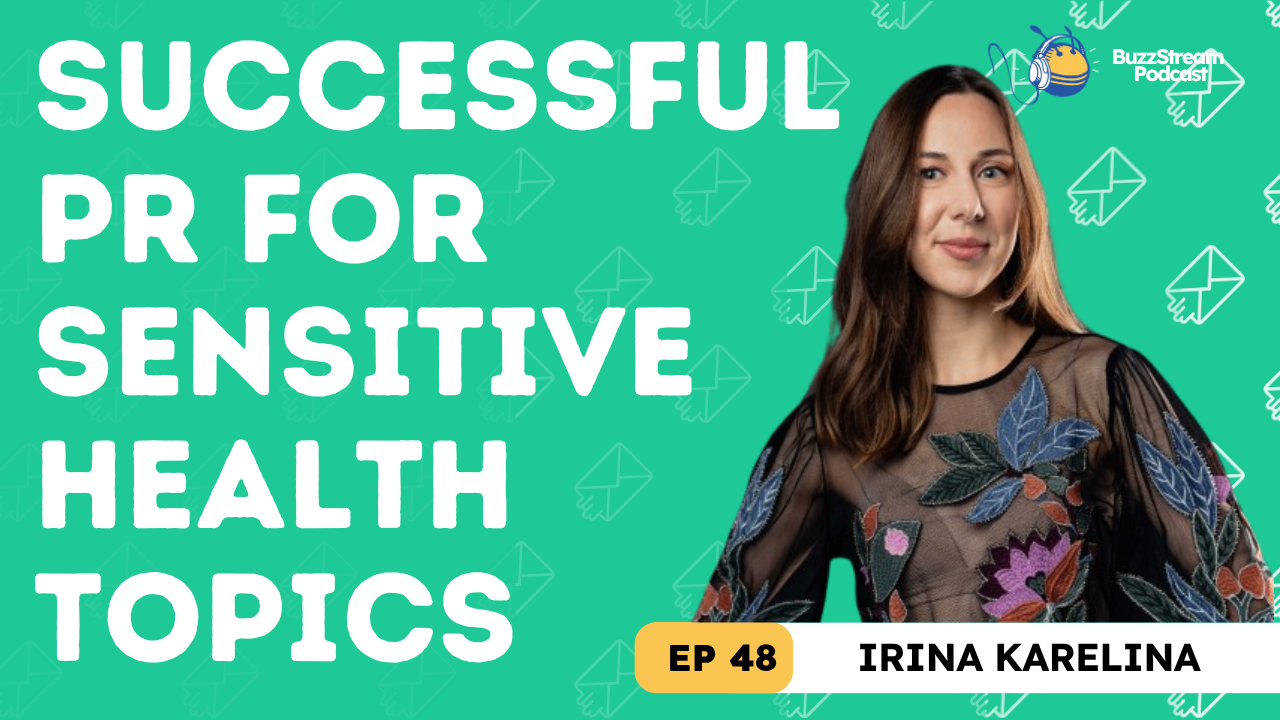
Table of Contents
- Pitch the shift, not the problem. An evergreen issue (“women don’t understand their hormones”) isn’t news on its own.
- Chase counterintuitive data, not confirmatory data. The “obvious” result typically doesn’t work.
- Write for the consumer, not the journalist. What would the target audience would actually want to read?
- Keep the product out of the headline. Position it as part of the solution to a bigger story, not the center of the pitch.
- Vet real stories for exploitation risk, not just newsworthiness.
- Build the marketing-PR pipeline deliberately. Explain why you need a story or data point before asking for it.
The Health & Wellness industry has consistently been one of the hardest to get coverage in over the last two years of our State of Digital PR Report.
So, I recently sat down with Irina Karelina, founder of Fungi PR, an agency that’s spent the last decade focused solely on health and wellness.
Much of her work has been around the topics everyone else avoids: sex education, hormones, infertility, infant mortality.
So in this post, I’ll break down exactly how Irina’s team reframes stigmatized health topics into stories journalists actually want, including the surprising survey insight that outperformed the “obvious” one, why she tells her own team to stop researching journalists first, and how she balances real user stories with the very real privacy line you can’t cross.
Below is a slightly-edited transcript:
I take it you’re not from Charlotte originally?
Irina: No, definitely not. I’m originally from Belarus, an Eastern European country, and I moved to the US six years ago. I first moved to Boston and lived there for five years.
Then after moving to Charlotte, I started my own agency. I’d actually been doing PR as a freelancer for almost five years before that, but I officially launched my agency, Fungi PR, after the move.
Can you give listeners a broader sense of the kinds of brands you work with at Fungi PR?
Irina: Sure. My agency specializes in health and wellness clients — and honestly, this is a topic I’m personally passionate about. I’m a millennial, so I’m very wellness-savvy and always looking for ways to improve my health, which is part of why I gravitated toward these clients.
My first client as a PR freelancer was Mira, a home hormone tracker, and it’s still my client today — a very sensitive team and topic, because the tracker helps women conceive, but it’s not just for women. It’s also used by transgender individuals and same-sex couples. Mira actually launched during the pandemic, and the tool was incredibly helpful for people continuing fertility treatment at home while clinics were shut down.
That’s probably our flagship client at the agency, but I’ve also worked on infant health, menopause, period health, and DNA testing for path — all mission-driven, scientific, complex topics that are hard to pitch.
Can you speak to what actually makes this hard to pitch?
Irina: It was honestly surprising to me, when I first took on these clients, how something so important could go uncovered for so long.
What I’ve figured out is that journalists aren’t looking to cover a problem that’s existed for years — they’re looking for change, a trend, some kind of dynamic shift in society.
So just having a client who addresses, say, the ongoing issue of women’s health ignorance isn’t enough on its own.
You need a news hook.
You need to frame it strategically and make it feel timely.
That’s part of what makes these topics hard — they’re evergreen.
They’ve existed for years, so they often lack surprising data or a clear entry point the way, say, dating apps naturally have data insights to pitch. On top of that, mission-driven topics are usually emotionally sensitive, so you can’t joke around.
You have to be careful with how you frame everything.
Vince: That resonates.
We did a big study on YouGov — they publish hundreds of surveys a day — and we analyzed about 2,500 of their top-performing pieces. The common thread was timeliness and emotional connection: the content that performed best usually elicited some strong emotion, often fear or doubt.
It sounds like those two hooks — timeliness and emotional resonance — are exactly the hardest things to manufacture in your space if the angle isn’t already there.
Let’s flip it, though. I want to give listeners a sense of who’s doing this well.
Have any brands really nailed this?
Irina: Definitely.
I really admire how modern women’s health companies handle PR around stigmatized topics like infertility, miscarriage, menopause, or postpartum depression.
Carrot Fertility, an employee benefits company, is a great example — they reframed menopause as a workplace issue.
Instead of positioning it as a personal health matter, they found that menopause-related productivity loss costs the US economy almost $2 billion a year.
They pitched that ahead of Menopause Awareness Month in October — which we’ve also done with clients, so we ended up competing for coverage with a similar angle.
But it was a great example of tying into a bigger context: this isn’t just a “women’s issue,” it’s an economic one, because women are leaving the workforce or taking time off due to symptoms.
Another one — Evvy, a vaginal microbiome company, turned the lack of women’s health research into a movement by establishing “Equal Research Day” on June 10th. That’s the date when women were finally required to be included in medical research. They pitched it to journalists as a day to celebrate — because for decades, drugs were tested almost exclusively on men, based on a misconception that hormones would interfere with results.
It was a smart campaign, and they partnered with other brands rather than just saying “women’s health has been ignored” in the abstract.
With Mira, we did something similar.
Our goal was to shift Mira’s identity from being seen purely as a fertility tracker to being seen as a women’s health brand more broadly.
We knew there was a societal lack of understanding around hormones, but we didn’t have hard numbers — so we ran a survey and found that 90% of Americans feel unprepared for hormonal changes. That number was striking enough that we built a campaign around it: sex education isn’t working in the US.
As a hook, we created a “sex hormones tester” promotion — we offered to pay people $5,000 to have their hormones tested with Mira, which reinforced just how little people understand about their own hormones. It functioned like a PR stunt, but a constructive one, and it landed really well with media.
From there we launched “Sex Hormones Awareness Week” during the last week of February, partnered with other brands, and held events in San Francisco.
The whole campaign centered on this huge knowledge gap — we deliberately kept the product secondary and pushed the problem instead.
That campaign generated over a billion media impressions, six awards, and a lot of traffic to the website. It’s one I’m really proud of.
Vince: That’s fantastic. Listening to this, a few tactical takeaways jump out — creating your own branded awareness days or weeks rather than piggybacking on an existing one; the “hormone tester” incentive, which almost feels like a dream-job-style stunt tactic you don’t see much in the US; and running original surveys to generate proprietary data. It sounds like the common thread across all of these is leaning into an unexpected friction point or knowledge gap — something that creates curiosity even if it’s not pure fear or shock value.
Do your campaigns typically span multiple channels — social, press releases, direct pitching — or does that vary?
Irina: It really depends.
That particular Mira campaign was a full 360 effort involving influencers and a social media team.
Our agency’s core focus is media relations, so a lot of our campaigns don’t necessarily intersect with broader marketing.
Some campaigns are much quicker turnarounds. For example, after COVID, when the vaccine rolled out, a lot of women felt it was affecting their hormones — so we ran a quick survey with our own users to see if they’d experienced anything similar, and pitched it almost immediately.
Right now we’re doing something similar around GLP-1 drugs — a lot of people taking Ozempic report effects on fertility, one way or another, so we’re surveying our users and pitching that as a current, timely story.
The tricky part is being very careful about privacy — we can’t just say “we looked at our users’ data” without real care, or it can cause backlash.
Vince: That’s better, thanks. Okay — where was I. Let’s talk about reframing data. You mentioned privacy concerns limit how you use proprietary data, which leads you toward third-party data and these kinds of quick-turn surveys. Where do you actually find the trends you hook into — like the GLP-1 or vaccine angle?
Where do you find the trends to hook into?
Irina: Honestly, it’s just social listening — scrolling through Instagram, media monitoring, which every PR person does. And also just talking to friends who are trying to conceive, have kids, or are dealing with hormonal health issues. A lot of ideas come from my own life, too.
For example, we’re currently working with a company that makes functional drinks for hormonal health support, and they’re launching in Sprouts.
We could have just pitched “here’s a cool new drink,” but the more interesting story is what’s happening behind the launch — women’s health products are going mainstream.
These topics were stigmatized for years, and now you can walk into a grocery store and buy a drink for period pain or menopause symptoms.
That shift is something I can personally relate to as a consumer, too.
Vince: Right — I think the challenge for people in these industries without a dedicated PR team, who are trying to do this themselves, is exactly that instinct.
It’s easy to say “just listen for trends,” but connecting the dots — recognizing what’s actually newsworthy and how it ties back to your brand — takes real skill.
Are there specific questions you ask yourself when you spot a trend, to figure out how it fits your client?
Irina: Honestly, the most common mistake I see — even from people on my own team — is thinking about the journalist first.
They’ll research a specific reporter’s past articles and try to reverse-engineer an angle from that.
What I suggest instead is thinking about the target audience — the actual readers. The journalist is just the medium. What they’re looking for is a way to explain something complex or timely to their audience. So I try to remember that I myself am often the target audience for my clients’ products.
You have to think about what you, personally, would want to read — not just “what campaign will get picked up.”
Vince: I love that. We talk a lot on this podcast about researching journalists’ beats and past coverage, but if the story itself isn’t compelling, none of that matters.
It sounds like your advice is: don’t lose the forest for the trees — the story always comes first.
I did want to ask about common mistakes in this space more broadly.
What tends to go wrong?
Irina: I’ve made plenty of these mistakes myself, so I can speak from experience.
The biggest one is pitching the problem itself as the story — treating something evergreen as inherently newsworthy without tying it to a current event, a policy shift, or a cultural moment.
Even if you have budget for a survey, it’s easy to ask overly broad questions — “do you know what hormones are?” — and journalists won’t bite, because it’s too obvious, too generic.
What you need to look for is something surprising or counterintuitive.
One recent example: there was a snowstorm in the southern US, and we were working with a stress-management app.
The obvious assumption is that a snowstorm would spike people’s stress levels. But what we actually found was that stress levels during that weekend were the lowest of the entire year — which was a genuinely surprising, counterintuitive insight worth pitching.
If we’d found the opposite — that people were more stressed during a snowstorm — nobody would have cared, because that’s exactly what you’d expect.
So “going mainstream” doesn’t mean going generic.
Another big mistake is lacking a clear angle — even something like a client publishing a scientific paper isn’t inherently newsworthy on its own. “We have a study” isn’t a story by itself. You need to figure out what the actual story behind the data is.
Vince: What about topics that are sensitive almost to the point of being heavy — something like infant mortality or infant health?
Even when the data is timely and surprising, does it ever feel like too much?
Irina: One example that stands out is from Mira.
We’d been working together for five years, and at one point a transgender couple conceived using Mira.
We could have gone with a sensational headline like “man gets pregnant using at-home fertility tracker” — but we deliberately steered the story toward the real challenges they’d faced trying to access fertility care within the traditional healthcare system.
Sensitive topics require a sensitive approach; it’s very easy to exploit someone with a clickbait-style headline, and you have to think twice before doing that.
Another example: we worked with a gut-health testing company for infants, and the data showed that 70–80% of children have at least one chronic condition by age five.
Rather than leading with that number for shock value, we focused on telling real customer stories — parents who felt dismissed by the traditional medical system, turned to at-home testing, and finally got answers about their child’s allergies, asthma, or digestive issues.
Using real voices and real data helps make the story clear, not just loud.
Vince: “Clear, not loud” — I love that.
That gets back to the privacy question, too, and the fine line around exploiting real people’s stories.
One thing we hear a lot from journalists lately is that they want real case studies and real people attached to a story, not just anonymized examples.
But if you don’t want to put someone in an uncomfortable spotlight, how do you navigate that?
I imagine plenty of people in the medical space are hesitant to put a face and name to their story.
How do you get real case studies for sensitive topics?
Irina: If the product genuinely helped someone, they’re usually willing to talk to journalists.
Some prefer to stay anonymous, but those stories are much harder to place — journalists want real names attached, not a generic “user case.”
That said, having a strong personal story doesn’t automatically guarantee top-tier coverage.
It still needs a real angle. I’ve had campaigns with users who were fully willing to go on record, and I still never heard back from journalists — because if the story reads as promotional rather than genuinely newsworthy, it won’t land, even with real people who conceived using the product, for example.
Vince: Is that willingness to speak with press something you build into the product experience itself, or is that something you have to actively request from the company you’re working with?
Do you find them yourself, or is it built into the product experience?
Irina: We usually have to go through the marketing team to get access to those contacts — we don’t have direct lines to users ourselves.
So one of the most important parts of this work is the relationship between the PR team and the marketing team.
Sometimes there’s something genuinely interesting happening internally that nobody thinks to tell us.
We have to stay closely connected so we can act quickly on real user stories and news as they come up.
Vince: Any tips for keeping those lines of communication open — especially for freelancers who might not always get buy-in from an internal marketing team that’s juggling its own priorities?
Any tips for communicating with the brands?
Irina: As an agency founder, I’d say a huge part of our job — maybe half of it — is educating the client.
If you show up to a call demanding revenue numbers or personal customer stories without explaining why you need them, you’re going to get resistance.
But if you explain clearly why the story matters — why you can’t just land coverage in Forbes or the New York Times without this information — that goes a long way.
It really comes down to basic communication and empathy.
You need to show the client you’re not going to exploit their customers, and be genuinely careful in how you handle those relationships.
It’s about building trust over time — consistently showing empathy and professionalism.
Vince: I love that — not asking for the whole kitchen sink right away, and earning that trust gradually. Irina, is there anything we didn’t cover today that you think listeners should walk away with?
Is there anything we didn’t cover?
Irina: I think the three biggest takeaways are these:
First, a problem — even an important one — isn’t inherently interesting to journalists. You need to frame it, find the hook, and make it timely.
Second, product-focused PR alone isn’t enough. Even with a great product, leading with it as the center of your pitch usually falls flat. You need to find the bigger context or problem, and position your product as part of the solution — not the headline.
And third, without oversimplifying complex or scientific topics, you need to communicate clearly, in the language your actual consumers use — not overly technical language. Journalists won’t pick up a story they don’t understand, so always think like the audience, not just the industry insider.
Vince: I love that. Let’s leave it there. Irina, where can people connect with you — is LinkedIn the best place?
Irina: Yes, LinkedIn is the best place to reach me.
Vince: Awesome. If anyone has questions about any of this, feel free to subscribe and drop a comment — on LinkedIn or on my posts — and I’ll make sure Irina sees them and can respond, whether it’s about her brand or navigating PR in these sensitive, mission-driven industries.
Irina, thank you so much for joining us.
Irina: Thank you so much for having me — this was a genuinely interesting conversation. It’s refreshing to talk with someone outside these mission-driven industries who still asked such sharp, thoughtful questions.
Vince: Thank you for joining us — I think you’re doing incredible work, and this is such an important area. The more we can educate people in this space, the better. Once again, that’s Irina Karelina, founder of Fungi PR — I’ll link everything we discussed today in the show notes. Thanks for watching, and stay tuned for the next episode.
Irina: Thank you.


 Check out the BuzzStream Podcast