 End-to-end outreach workflow



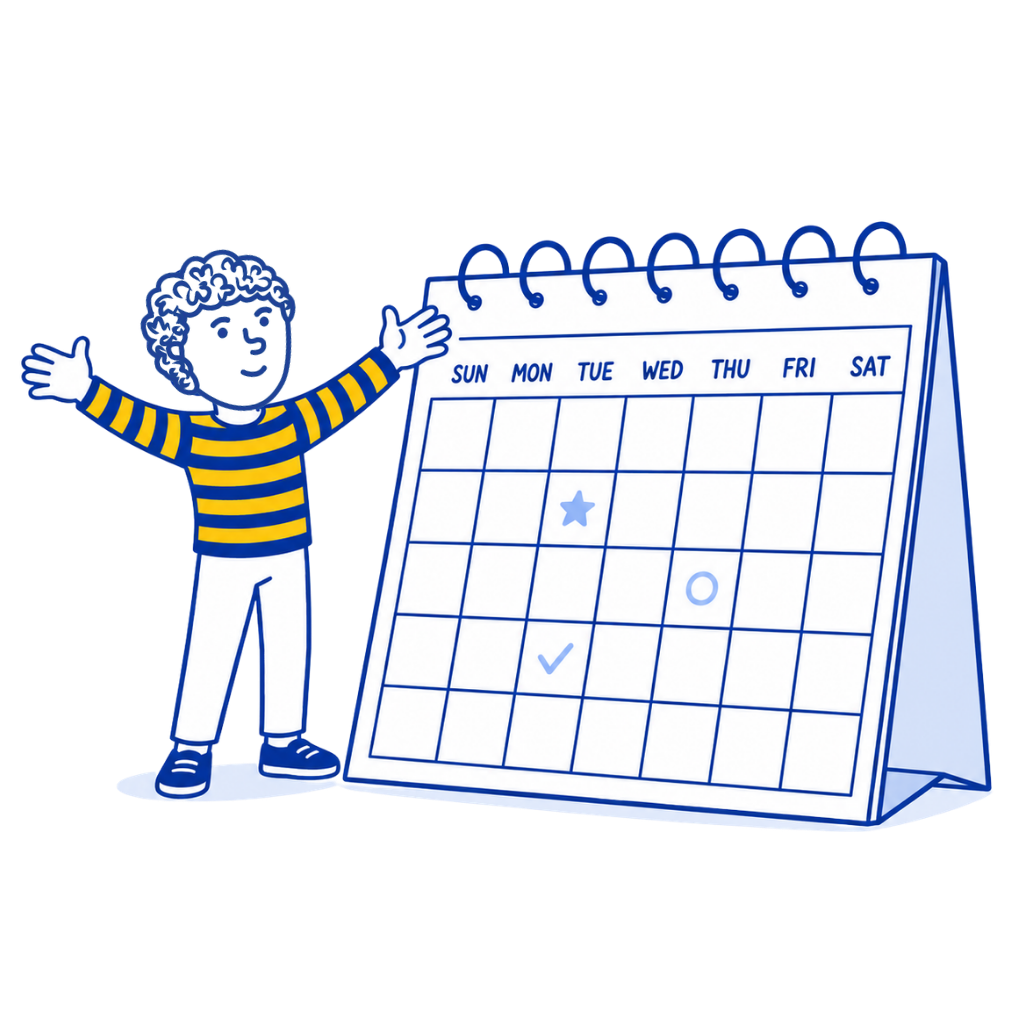
Table of Contents
Ever wonder how your competitor landed that PR coverage so quickly?
Chances are, they used a content calendar and were planning way in advance.
And although it’s important to stay flexible for tactics like reactive PR, planning is still essential in any PR strategy.
In this post, we’ll walk you through setting up your own PR calendar to help you get the most coverage possible, and we’ll also share our interactive (and downloadable) calendar with over 650 verified events globally that all teams should use.
Interactive PR Calendar for 2026-27
We’ve built an interactive PR calendar featuring over 650 verified key events and holidays across various industries in the US and the UK.
It defaults to the current month, but you can use filters to adjust. (Learn how we built it.)
But a calendar is nothing without understanding how to use it.
Using and Managing Our PR Calendar
This PR calendar is designed to save you time and help you plan smarter campaigns.
Here’s how to get the most out of it:
Filter by region
Use the US, UK, and Global buttons to narrow the calendar to the dates most relevant to your audience.
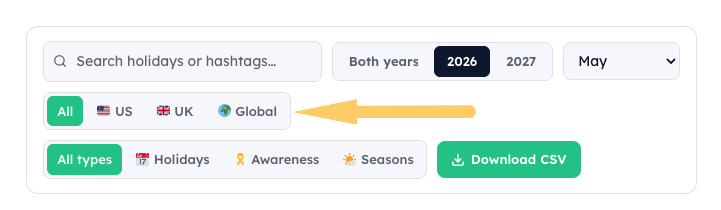
If you’re running a campaign for a UK brand, filter to UK and Global to remove US-specific days that won’t resonate.
Filter by type
The calendar includes three types of entries: Holidays, Awareness Months, and Seasons.
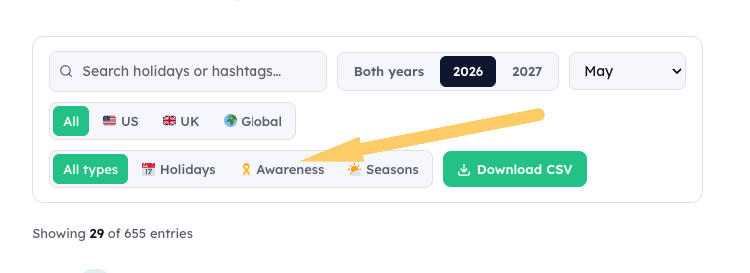
If you’re a health brand, switch to Awareness Months to instantly see every relevant observance.
If you’re planning seasonal content, switch to Seasons to see when allergy season starts, when back-to-school kicks off, or when holiday shopping season begins.
Filter by month
The calendar defaults to the current month, so you can immediately see what’s coming up.
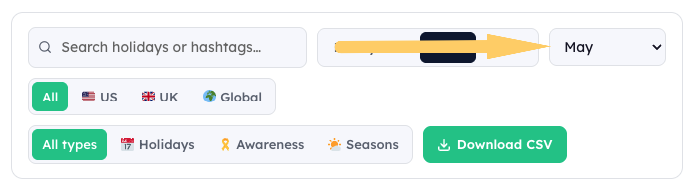
Switch to a future month to start planning ahead, which is exactly what good PR requires (even if you have a reactive element).
Search by keyword
Type any topic into the search bar: “mental health,” “food,” “dog,” “cancer,” and the calendar instantly filters to matching entries.
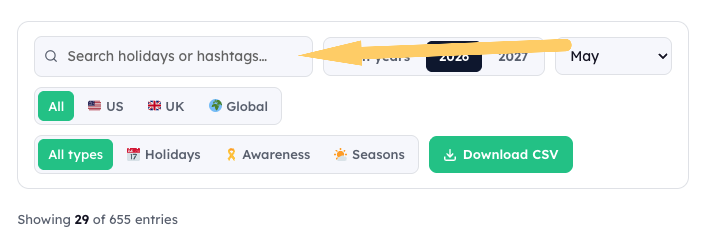
This is the fastest way to find every date relevant to your brand or client.
Download the CSV
Every filtered view is downloadable.
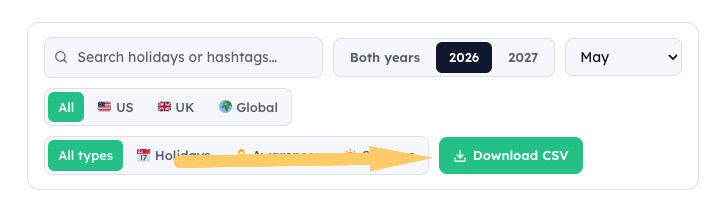
Set your filters first, then hit Download CSV to get a clean spreadsheet of exactly the dates you need.
Drop it straight into your editorial calendar or outreach planning tool.
How Far in Advance Should You Pitch for Each PR Calendar Date?
Knowing that a date is coming isn’t enough; you need to pitch at the right time for each media type.
So, asking around and based on my own experience, here’s a quick guide to how far in advance you should pitch:
| Outlet Type | Typical Lead Time |
|---|---|
| National Print Magazines | 4–6 months out |
| Regional Print Magazines & Newspapers | 2–3 months out |
| National Online Publications | 1–2 months out |
| TV Morning Shows | 2 weeks–2 months out |
| Blogs, Podcasts & Niche Outlets | 1–4 weeks out |
Here is a little more info on each:
National print magazines – 4-6 months out
National print magazines, like Entrepreneur, may plan issues 4-6 months in advance of publication.
(So if you’re targeting a Valentine’s Day feature in a national magazine, you should be pitching in August.)
If you’re pitching a product, you should send it 6 months in advance to ensure they have time to review it as well.
Regional print magazines and newspapers – 2-3 months out
Regional print magazines and newspapers, like The Daily Mail, plan about 2 months ahead of publication, sometimes three.
National online publications – 1-2 months out
Some national online pubs plan about 1 month out, sometimes two.
TV morning shows – 2 weeks-2 months out
TV morning shows at the national level have a lead time of two weeks to two months.
Allow yourself a week or two if it’s a feature that can be pre-planned, rather than a live news item.
Blogs, podcasts, and niche outlets – 1-4 weeks out
Blogs are kind of a free-for-all. Some need more time than others.
I’ve found that with the BuzzStream podcast, about one month is great, but some news items come up quickly, so just one week can be more helpful.
Every Publication is Unique
Reminder that every publication is unique.
Some publications start holiday coverage earlier than others. So, it’s always important to keep an eye on when these posts go live on their website.
For instance, if I were pitching something Christmas-related to Parade, I would check Parade’s coverage from last year:
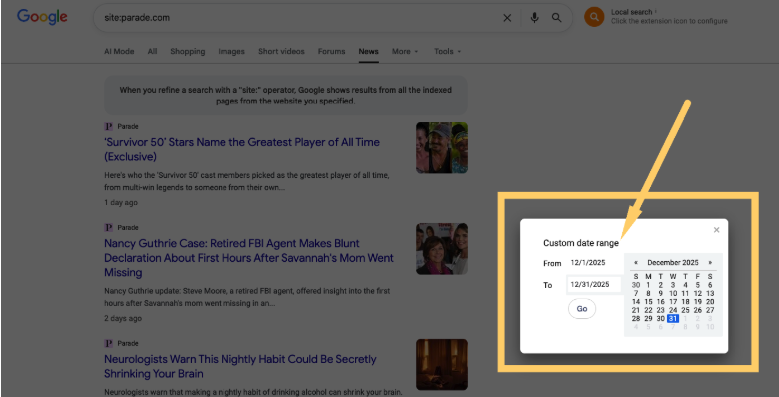
This should give you a sense for how early to start pitching specific targets.
When talking with PR expert Collin Czarnecki of Noble, he recommended leaning into the publishing cadence as well:
“A national magazine that publishes monthly operates very differently than a digital reporter at a local news station who’s filing multiple stories per day. The publication’s editorial cadence often tells you more about lead time than the outlet category itself.”
But there’s one more place to understand when to pitch: the journalist.
Focus on the Journalist
Furthermore, as with everything in PR, tailoring to a specific journalist is key.
Collin told me:
“Focus on the publishing cadence at each news outlet as well as the publishing cadence of the journalist you’re actually pitching.
A reporter publishing three stories per day may need only a few days’ notice, while a publication producing one major feature per month may be planning editorial coverage weeks or months in advance.
Let’s look at a seasonal campaign, for instance.
When I’m planning a seasonal campaign, I’ll often start by looking at last year’s coverage. When did the story publish? Who wrote it? Are they still at the publication? How frequently do they publish? Did the outlet cover that topic once, or revisit it throughout the season?
Those answers help determine not only when to pitch, but who to pitch.
If a reporter covered holiday shopping trends last November, summer travel in June, or tax season in March, there’s a good chance they’ll be interested in a fresh angle this year, especially if you can bring something new to the conversation through original data, year-over-year trends, expert commentary, or findings that challenge conventional wisdom.”
We cover some of this in our podcast conversation with Collin.
How to Build Your Own PR Calendar
To build your own calendar, you can use a spreadsheet like Google Sheets, or level up to a project management tool like Asana or Airtable.
Then comes the strategy.
Here are the steps I recommend if you are starting a brand new industry or client:
1. Map Out Key Dates and Opportunities
Start out with your key internal dates. These may be product launches or company milestones.
Then you expand into industry events, seasonal campaigns, and relevant awareness days.
For a lot of these awareness days, you can use a tool like the PR calendar above.
For industry events and conferences, you’ll want to do some Google searches to find events going on this year:
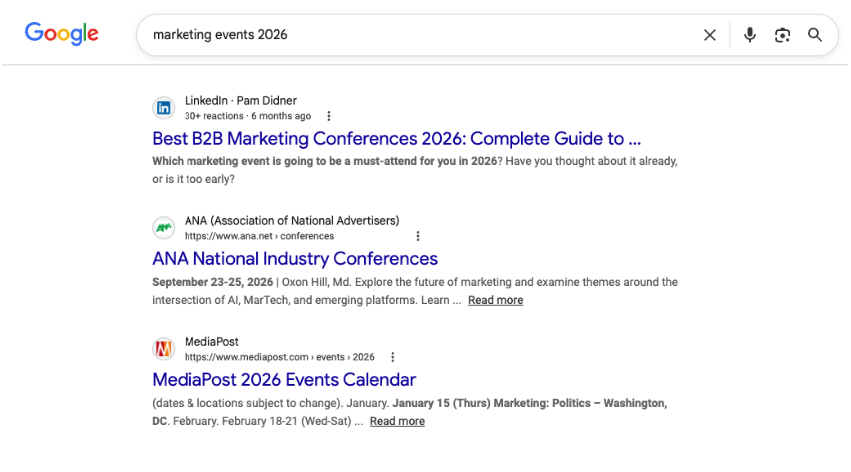
You can also find them in industry newsletters and on social media.
But not all events are newsworthy; next, we’ll brainstorm the digital PR angles and hooks.
2. Brainstorm Digital PR Angles
This is where the fun (and challenge) starts.
The best way to think of this is through the “why now” lens. When you pitch a story to a journalist, they are looking for the answer to “why is this important to me now?”
For events like industry conferences, you might want to schedule a product launch to demo the tool to conference attendees. (This was what we did for our ListIQ launch!)
For awareness month, you might want to launch a research study, like this one from the Kids Mental Health Foundation did for Mental Health Awareness Month (May), and got them coverage on WAFB.
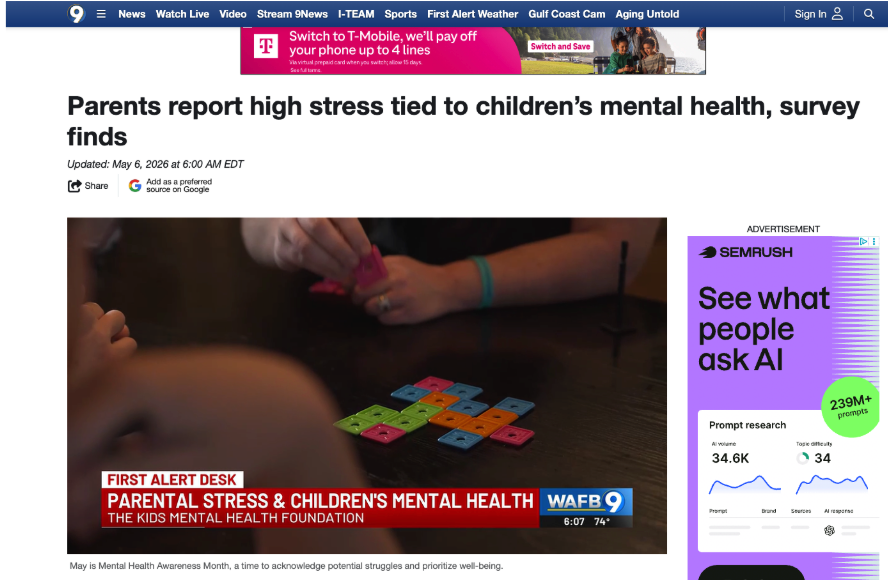
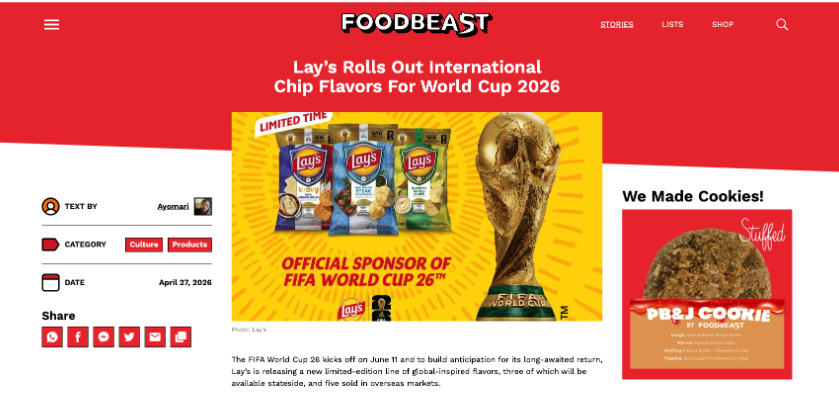
For major events, you could launch a product collaboration like this one from Lays for the World Cup:
These don’t always have to be fresh ideas, either. If you see an upcoming event, you might look for existing content to re-pitch with a new angle.
For example, Digital PR Manager with Digitaloft, Emilie Warner, told me they ran a research report into which areas of the US are most at risk of having a stroke for a client who supplies adjustable hospital beds for the elderly and disabled.
Although the campaign went out early in the year because May is Stroke Awareness Month, they planned to re-pitch it with a fresh media list, templates, and subject lines.
3. Assign Tasks and Deadlines
Then, as with every campaign, you’ll want to assign your tasks and deadlines.
My one big piece of advice here is to always give yourself longer than you think you need.
The more intricate the campaign, the more time you’ll need.
4. Update Consistently
Realistically, your calendar is going to change.
And as AI continues to accelerate everything, I’ve found it’s going faster and faster.
So, it’s important to do monthly check-ins with your strategies.
Not All PR Needs a Calendar, But It Always Helps to Have One
A well-managed PR calendar is the backbone of any successful digital PR strategy.
It keeps your team focused, your outreach timely, and your brand top of mind for journalists and influencers.
Ready to see the difference?
Dive into our interactive PR calendar above and start planning your next digital PR win—with the data and expert insights to back it up.
How We Built This PR Calendar
Most PR calendars are a static list in a PDF or a blog post you have to scroll through. We wanted to build something better — a fully interactive, filterable, and downloadable tool that actually saves time.
Here’s how we built and verified it: I used AI to gather holiday data from four primary sources: NationalToday.com, Brandwatch’s social media calendar, HeyOrca’s holiday calendar, and Iconosquare’s content calendar.
Each source was cross-referenced against the others, and any conflicts were resolved by checking the originating organization directly, whether that’s the UN, WHO, CDC, gov.uk, or the relevant charity or foundation.
For floating holidays, such as Easter, Thanksgiving, Mother’s Day, Father’s Day, UK Bank Holidays, and Cyber Monday, that don’t fall on the same date every year, we built an algorithm that calculates the correct date for each year using standard calendar rules.
These are the same methods used by timeanddate.com and federalpay.org.
Every floating date was verified individually for both 2026 and 2027.
One of the biggest problems I found with existing PR calendars is that they’re US- or UK-centric, depending on where you search. And since we know digital PR in the US and UK is very different, I thought we should split it.
So, we had AI audited every single awareness month against UK sources, including the NHS, British Heart Foundation, Cancer Research UK, Alzheimer’s Society, Stroke Association, and others.
For awareness months, we cross-referenced against the CDC, WHO, UN, and major UK health charities to ensure every entry is tied to a real, recognized campaign with an official source.
Beyond astronomical seasons, we added cultural and industry seasons that PR teams actually plan around, like allergy season, flu season, hurricane season, back to school, holiday shopping season, tax season, and more, all with their “official” start dates sourced from NOAA, the CDC, the IRS, and the NRF.
See an error? Email me and let me know!

 Check out the BuzzStream Podcast