 End-to-end outreach workflow



Table of Contents
- Brand mentions may matter to AI visibility for a specific, technical reason — not just because “PR is generally good for you.”
- Core updates have gotten too tangled to fully roll back anymore, which changes how much weight you should even give them.
- Programmatic SEO abuse doesn’t get you nuked in 12 weeks these days — it gets you a slow, multi-year bleed.
- The “secrets” people in this industry guard hardest are usually tricks, not strategy.
There’s a lot of change happening in the industry.
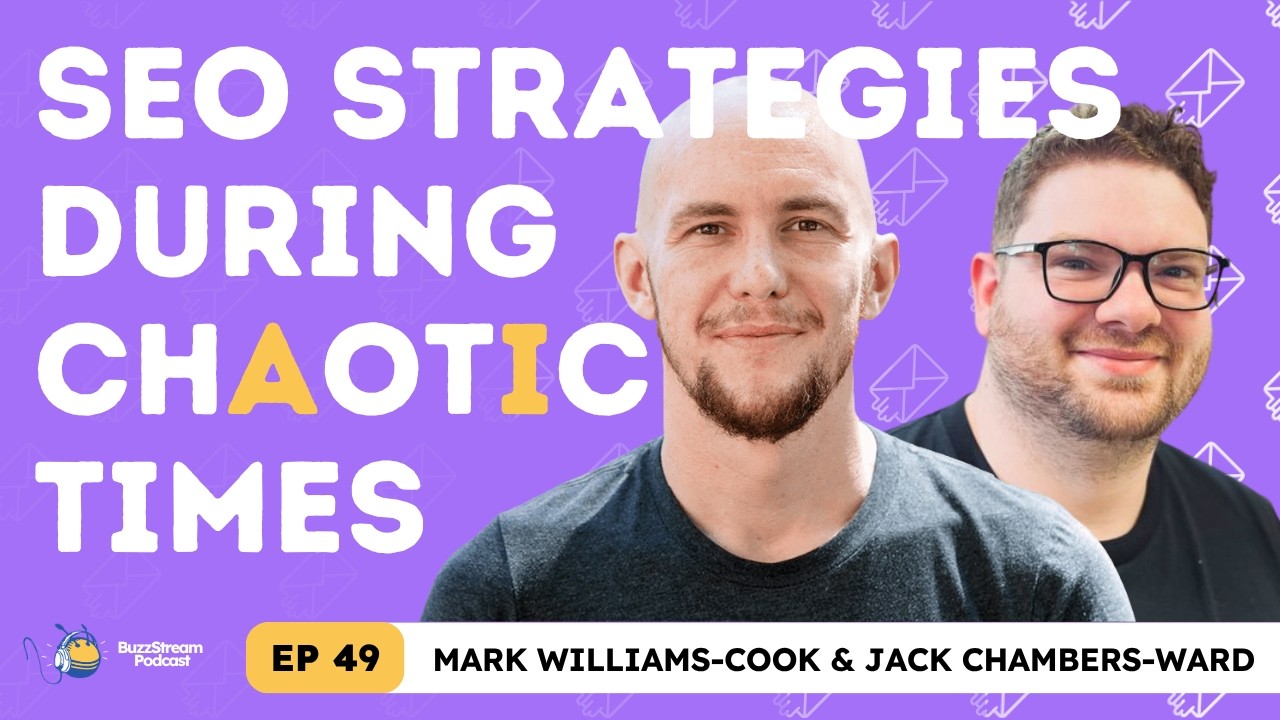
To get a sense of what’s happening and what we can do about it, I wanted to chat with Mark Williams-Cook and Jack Chambers-Ward from Candour for this podcast.
Given their combined experience as an SEO agency (Candour), crafting a very successful weekly SEO newsletter (Core Updates), and producing a fantastic podcast (Search With Candour), I feel like I was able to tap into a wealth of knowledge.
They are also running their (first-ever) one-day SEO conference: SearchNorwichXL on September 24, 2026!
Our convo went places I didn’t expect: query fan-outs, why Google’s own engineers can’t fully roll back a core update anymore, why they’d rather someone cheat hard and fast than sit in the grey area, and why they give away almost all of the knowledge they can for free.
I walked away with a newfound sense of direction and some extra confidence that some of the stuff I’ve been telling people to do is what other smart people (Mark and Jack) are doing.
If you’re unclear on where to go right now with your strategies, take a listen.
Below is a slightly edited transcription:
Icebreaker: How important is it to have hobbies outside of work?
Jack: Not really intentional — I think that’s just how my ADHD brain works. I’m constantly chasing some new thing to try, do, or a new hobby to give up on in three months.
But things like podcasting directly led to me joining Candour, which is very cool — it was a real full-circle moment when I gave my BrightonSEO talk last year and used a lot of examples from my experience as a content creator.
I think anything creative — even outside your day job, filming videos, making podcasts, writing — gives you a different perspective. If I weren’t doing those things, I wouldn’t be able to say “we saw a big traffic boost from this” with the same perspective.
But beyond that, I think it’s healthy not to dedicate yourself completely to work. Mark does a lot of boxing — he actually helped me train for an MMA fight last year.
Keeping yourself physically and mentally healthy is a big part of it for me too.
Vince: That’s fantastic. What about you, Mark?
Mark: I like doing things I’m naturally bad at. The computer side of things was how I spent a lot of my youth, so that comes naturally to me.
How I actually got into diving was — I took a career break after leaving an agency where I was a director, and decided to move to Egypt and become a scuba diving instructor, just because it was something completely different: a different culture, a different language, and a job that went from knowledge-based to physically showing people how to do things.
You learn a lot when you’re completely out of your comfort zone doing something new, and a lot of it is transferable.
Same with boxing — the first time I tried it I thought, “wow, this is really difficult and terrifying, so I’m going to keep doing this.” Good timing for a black eye, actually — I had a bout this past weekend.
I’ve been training six years now, five times a week, and I am very mid at it after dedicating thousands of hours. But I enjoy getting out of my comfort zone and trying new things — and I tend to stick with them.
Jack finds something, does it for a while, and moves on; I’m the opposite — once it’s my thing, I grind at it until I’m good. Or mid.
How do you decide what’s important to highlight amid all the news we’re inundated with?
Mark: Core Updates came about because I was trying to make the newsletter I wanted to receive.
The problem I had was that some existing news sources and newsletters had so much in them — I didn’t have time, and I’d get frustrated reading something like “Google’s testing a new font” and think, “I don’t care; it doesn’t change what I’m doing.”
So when I talked to Jack about working on this together, I basically said: pick things where, once you know it, you might actually do something differently in your job.
That’s why we rarely cover interesting-but-inconsequential articles, and rarely cover tools — it’s more “here’s a data study that shows this” or “here’s this new feature.”
Most weeks that’s still five, six, seven, even ten items.
When we started I worried there’d be nothing some weeks — which is also fine. I don’t want a newsletter that fills space with filler just to seem consistent. Even in how I talked to Jack about writing the summaries, I told him: never more than three lines per item in the email.
Ideally I don’t want people to have to click through to find out what the information actually is — it’s the opposite of clickbait, the opposite of the “there’s this really important thing you need to know, click here” approach that, say, Google Discover encourages. Just tell them the thing — give them the number, the study, the conclusion — and they can read more if they want, but don’t make them work for it.
Jack: We’ve gotten compliments on that.
I remember one week we genuinely only had two or three pieces of news — usually it’s eight to ten — and the note underneath, which I think Mark wrote, was something like “nothing of note this week, so that’s all you get — enjoy the extra five minutes of your Monday.”
Someone replied saying they appreciated that we didn’t just pad it out with fluff for the sake of it — which I think is true of so much newsletter, content, and podcast output.
There’s a lot of fluff out there.
If you can streamline it down to the most important, impactful stuff — like Mark said — that’s a job well done.
Vince: Right.
Jack: Just tell them the thing, give them the number, the study, the conclusion, and let them read more if they like — but don’t make them work.
Vince: I feel like Stephen, our CMO, is really good at pushing me on that with our own content — asking “do we need this? Are we just adding it for SEO’s sake? Is this something people can’t already get from AI?” In the short term the clickbaity, SEO-optimized approach might get you more gains, but long term, if you’re thinking about building recognition and trust with readers, that’s what does it. I really prefer that approach.
Vince: Let’s get into some of the bigger topics for our listeners — digital PR, link building, and SEO more broadly. Things are moving fast with AI, new studies come out constantly, someone publishes a citation study, I’ve done the same thing — everyone’s trying to parse through it all.
Is digital PR important for showing up in AI? Why or why not?
Jack, why don’t you take it first.
Jack: Yeah — I think you’re right that there’s been a big conversation about unlinked mentions, similar to the conversation SEO has already been having around clicks versus impressions. Has the value of that changed with the growth of AI search and LLMs?
You’re right that studies from places like Ahrefs show brand mentions do matter — and it’s not just linked mentions; even a no-follow mention is still relevant to the conversation happening online about your brand.
We see this with our own clients here at Candour — we do digital PR, and we’re a BuzzStream customer ourselves.
I don’t know that anything’s fundamentally changed so much as people are realizing the value of digital PR and understanding it’s not literally just link building — it’s the broader picture of what people are saying about you and your brand across the internet.
Vince: Anything to add, Mark?
Mark: Loads.
If we work backwards — I was talking to Jack earlier about ChatGPT 5.4’s query fan-outs, which specifically do site searches for known brands connected to a topic.
We know the fan-out queries across these LLM systems are generated by the LLMs themselves, so it makes sense that consistent co-occurrence of brand names alongside specific products or services is what connects them at a token-probability level — which is different from “entities” as we’ve traditionally understood them in SEO.
So what’s changed, from an AI standpoint, is that link placement itself is less important than it used to be — but it’s still important for a few reasons.
First, links are literally how training data is gathered — the major LLM providers are buying up link-graph data because it informs which sources they weight more heavily in pre-training (they’ll trust Wikipedia more than some random blog, for instance).
Links are also still massively important for traditional search, which underpins a lot of what’s happening in AI — any retrieval-augmented step is pulling from traditional search results.
Some of the studies I’ve seen on this are a little flawed — they’ll run a query in ChatGPT, note that only two of the resulting sites are in Google’s top 20, and stop there — without looking at which sites are ranking for the actual fan-out queries being generated, which is often quite different.
So I’d say digital PR is more important than ever in terms of being mentioned in as many places as possible, because visibility is no longer about your single website ranking numerically higher — it’s about appearing across the hundreds of sites being fetched for all these fan-out queries, since the fan-out isn’t drawing from one site, it’s summarizing chunks pulled from many.
So there’s a whole extra branch of digital PR beyond “get into the big newspapers” — it’s also “which specific sites are being fetched around this topic, and how do we appear on those.” It’s certainly something we’ve been ramping up. Digital PR has always been a big lever to pull for visibility.
Vince: It’s interesting — Jack, you explained it from the brand-building angle, which resonates with a lot of clients, and Mark, you went technical, into the backend mechanics of tokens and getting your brand mentioned alongside the keywords you want to be known for.
I’m curious about query fan-outs specifically — I get asked about this a lot.
If you’re working backwards from prompts to understand where information typically gets pulled from, but the fan-outs aren’t always the same — different sites every time you search — how do people reconcile that?
When working strategically, are you just looking for duplicate sites across runs, patterns at scale? Is that the practical solution?
Should people build GEO strategies from prompts or from commonly occurring citations?
Mark: Worth mentioning first — an interesting point on the concept of “brand” itself.
To me, what people mean by “brand” is becoming what’s actually stored in these AI systems and what they can tell people about you. F
ifty years ago your brand was the billboard slogan you repeated endlessly.
Then everyone got hyper-connected online, so before buying from an unfamiliar brand, you’d check review sites, forums, Trustpilot — that became the brand.
It doesn’t matter if you say “my cars are super reliable” if everyone on Reddit is saying theirs broke down in two months — your brand is what’s being said about you, not what you’re saying about yourself.
Now we have systems summarizing huge swathes of the web that people can just ask directly, so I think that footprint is the brand.
When people are clutching their internal brand documents — mission, vision, all that — unless you’re actually living that and it’s reflected out there, it’s just a wish list.
To your actual question about fan-outs: yes, since the LLM generates its own fan-out queries, by definition they’re non-deterministic, so you can’t say “these are always the exact queries.”
A couple of things help.
One is sideloading personas — when trying to understand how people prompt these systems, we’ll describe a persona and ask the LLM what that kind of person might ask, which narrows and stabilizes the type of fan-out you get.
You can demonstrate this simply: ask ChatGPT for a vegan recipe, then ask for running shoe recommendations, and it’ll recommend leather-free vegan shoe brands because it remembers what you told it about yourself — the fan-out shifts accordingly.
Also, because fan-outs happen within search engines, there’s some underlying stability — you’ll get slightly different sites, but the engine understands they’re semantically serving the same intent, so it’s directional rather than a fixed list.
An example from one of our own tools: we were researching “best SEO agency UK,” and the fan-out queries were specifically searching for agencies shortlisted for or named in awards — which was frustrating, because we don’t enter awards.
I didn’t know that before doing the research, but strategically, if I want to consistently appear in “best SEO agency UK” type queries, the LLM has essentially determined that a non-biased way to answer that is to search things like “The Drum Awards 2026” or “European Search Awards shortlist.”
That’s the strategy that follows.
That’s the kind of information that matters in AI search — like other analytics, it’s not a precise science; it’s directional.
Vince: This is why I like talking to people like you who are actually doing the work, not just thought-leading from the sidelines — you’ve got concrete evidence.
Jack, as a podcast host talking to all these different guests — do you feel like people in the industry are generally on the same page with all this, or is it all over the place?
Do people understand the value of digital PR/links?
Jack: Generally, I think people land on a similar line to what we’ve been discussing about the value of digital PR and the state of link building.
I do think there’s still a lot of room for strategic thinking industry-wide, as Mark said.
I’m pretty selective with guests — I turn down a lot of the “hey, my CEO would love to be on your podcast” cold pitches.
‘m like — then have him email me himself, be an adult about it, it drives me crazy.
At some point I started getting pitches like “hey, my news story could be featured in Core Updates” and I thought — hold on, now I’m the publisher?
I’ve gone from writing content to being the guy other people pitch to get published. I’ve turned the industry on its head in my own head, somehow.
But generally, talking to a new guest most weeks on Search With Candour, you do notice overarching industry themes over time.
In 2024 it was “SEO shouldn’t be a silo” — every other episode someone would say they’d learned from talking to the PPC team, or started talking to the link-building team. In 2025 it was all “brand, brand, brand.”
We’ve just finished recording Q1 of 2026 and there isn’t a clear theme yet.
The guests aren’t talking to each other, but you get these reflections of the broader industry once you’ve had fifty-plus conversations a year on mic.
Do you get something similar with guests on this show, Vince?
Vince: Yeah — in the PR space especially, I try to get a mix of traditional and digital PR people, and UK versus US, since that’s roughly where our customers are. UK and US tend to be pretty aligned, though the tactics differ.
Everyone’s talking about this stuff in similar ways, but it’s interesting — traditional PR people tend to be well behind when it comes to connecting PR to the bottom line; they speak in more abstract terms.
Some agencies are like that too.
That’s part of why I like asking whether everyone’s on the same page — because I think some people spout generalities without the data to back it up, or when you dig into the data it’s citing something that’s citing something that’s citing the original claim, and none of it actually holds up.
It’s tough sometimes to decide whether to push on that, to understand where people are really getting their claims from — because I think that’s such an important part of where the industry is right now.
I actually like that we’re getting all these studies, even if we’re not quite at the point where we can draw firm conclusions from them — things are moving so fast.
Mark, to your earlier point about the “best SEO agency” fan-out favoring awards — maybe that’s deliberate, because Google/the LLM providers noticed SEOs gaming best-of listicles, so they built the algorithm to route around them toward some third-party source they can trust more.
But what happens if that gets exploited too? You could sink time into a strategy like that only to have the rug pulled in a couple of months.
How do LLMs avoid exploitative tactics like listicles, etc?
Mark: We’ve actually discussed that. The interesting thing is that the way LLMs work on token probability makes it almost impossible for providers to hard-code specific rules against a particular tactic, because fundamentally these are just very sophisticated next-token predictors.
I always find it funny when these system prompts leak — for anyone who doesn’t know, think of a system prompt like what a coach tells an athlete right before they go out onto the field: fresh in memory, more likely to be obeyed.
A lot of the guardrails in how these chatbots behave come from the system prompt pushed in alongside the user’s query — things like “don’t repeat the user’s question back to them,” “don’t give advice that could be harmful,” “don’t use twelve exclamation marks in a row.”
It’s essentially begging the model to remember to check certain things.
So it’s genuinely hard for LLMs to explicitly target something specific like listicles — which is why I suspect there’s a more generic instruction along the lines of, if asked to rank things, try to favor verifiable third-party sources.
And there are always ways around this.
I think it’s generally handled further downstream by the search engine itself, which still has more hard rules.
We noticed Google’s AI Mode now sometimes shows a warning on “best of” listicle-style results saying this type of content can be self-promotional — I think that’s because by the point the LLM has surfaced the content, it can’t retroactively suppress it, but it can flag it for the user.
The other point: things like awards are fundamentally different from listicles as a strategy, because critically, if search engines or LLM systems didn’t exist, you wouldn’t be writing self-serving listicles — but you would still be entering awards, probably more of them.
That’s why I think tactics like that survive recurring updates: there’s no reason to penalize people entering awards, because they’re a genuine signal of a credible company.
That’s my litmus test for whether something will last.
Vince: I mean, you could make the same case for some listicles — there are ones worth appearing on.
The difference is spamming the entire web, building tools that find every listicle and auto-email outreach requests to get listed.
Mark: Exactly — I was talking about the ones people write and host on their own site, where they conveniently put themselves at number one.
When I write “best SEO agency” and put Candour first, or you write “best digital PR tools” and BuzzStream is number one — come on.
Vince: [laughs] Right. Okay — I want to get into a few specific news items I pulled from your recent newsletters.
First: core updates — the name of your newsletter, and also something that seems to come out more often than it used to.
How closely should SEOs be paying attention to core updates?
Jack: It depends on the strategies and tactics you’re using.
I think it matters what you’re doing in terms of the black-hat-versus-white-hat spectrum.
On your earlier question about whether people tend to agree — I live in my own fairly white-hat SEO bubble; I’ve never really dipped into black-hat work. That ties into long-term-strategy thinking: adhering to guidelines, following best practices.
A lot of people get caught out by core updates when they’re chasing a quick buck and hoping to get out before Google catches on.
With our clients — whether it’s digital PR or SEO — we’re thinking long-term, so when a core update lands, unless something unusual happens, you’re not affected much.
You never fully know what will happen — we’ve had “helpful content”-style events hit unexpectedly, like the recent listicle-related shakeup wasn’t even part of a formally named core update.
And you’re right that Google’s confirmed we’re getting more, more-nuanced core updates now.
People used to talk about “pre-Penguin” like a defined era — now it’s “the March 2026 core update,” fine, what’s next, “the June 2026 core update” — nobody actually remembers most of them individually.
Vince: Yeah, they’re not even really being named anymore.
Jack: Right — the one everyone still remembers is the September 2024 helpful content update, because that’s the one that wiped out a lot of content sites. I bring it up on the podcast enough that I remember the exact date.
Google engineers have talked about how it used to be the case that if something went really wrong, they could just roll it back.
Now, with things like AI Mode layered in, everything’s so intertwined you can’t roll back one piece of a core update without unpicking a huge mess elsewhere.
It sometimes feels like a runaway train with no engineer left who fully understands it — in theory there are people who could stop it, but nobody knows the entire intricacy of the algorithm anymore.
That’s a little scary, but I also think it means core updates aren’t quite as dramatically impactful as they were five or ten years ago, in terms of wholesale rewriting the value of a given tactic.
For me, long-term strategy is what lets you survive.
We do get inbound from people who’ve lost traffic — including some who came to us specifically because of the recent listicle situation, asking if we can help them recover.
So it still happens, even to sites doing mostly good work — there’s wiggle room now, I think — but mostly you protect yourself by doing good work and not being too self-promotional or full of yourself.
Vince: This might be the wrong read on my part, but — do you think Google’s so invested in AI now, in competing with ChatGPT, that the actual SERP and things like fighting spam have effectively taken a back seat?
That instead of one big, clearly-defined fix, we’re getting a string of smaller tweaks because that’s really all the current focus allows for?
Or am I barking up the wrong tree, Mark?
Is Google chasing ChatGPT and thus behind on fighting spammy tactics?
Mark: I don’t think Google’s behind from a technology standpoint chasing ChatGPT — Google invented the transformer architecture ChatGPT is built on, and they had LLMs before anyone.
When I spoke with Gary Illyes about it, he basically said they expected people to be upset about them essentially reusing publisher content to generate answers — and they were surprised how much backlash and how many lawsuits followed, because the general public was so enthralled when GPT-2 and GPT-3 first came out generating fluent paragraphs.
I think Google was behind on turning this into a viable business, not the underlying tech — because they had this extraordinary, hundreds-of-millions-a-month cash cow in Google Ads, and no incentive to rock that boat.
It’s much harder to shift to a conversational interface and still monetize it the same way.
So I don’t think they were holding the tech back for lack of ability — they were holding it back because every quarter meant record ad profits, and “just trust us, broad match, raise your budget” kept working.
On spam-fighting specifically: I think that’s always a priority, because spam actively costs them money — they want good search results because that’s what keeps people choosing Google over alternatives, and then they can serve them ads.
On black-hat versus white-hat: I don’t personally think black-hat is really “SEO” at all — you’re not optimizing for the system, you’re gaming it, which is a bit like saying “I’ll play chess properly” versus “I’ll just cheat.”
Nothing against people doing that, as long as it’s legal, but Google’s pretty effective at catching it — it’s rarely, in my experience, something core updates specifically target, because they’re already handling it separately.
Black-hat tactics I’ve seen tend to work for six or seven months before getting nuked, by which point the operator’s already made their money.
I gave a talk in Sofia recently showing casino sites pulling 10,000–20,000 visitors a month within 48 hours of going live, using cross-canonical tricks on old, previously-penalized domains — it really works, Google’s systems just take a while to catch up.
What I think core updates do target is the stuff in the middle — grey-hat, if you want to call it that.
Programmatic SEO is a good example — that’s what’s been getting hit lately.
We’ve seen big, recognizable SaaS companies lose 30–40% of their traffic because they spent the last year churning out thousands of “us versus competitor X” pages with essentially no human oversight, built purely for search.
Not only do they lose the traffic on those specific pages, there’s a wider suppression effect where Google seems to decide “90% of this site’s content looks self-promotional and low-quality, so I’ll trust less of what’s here” — the same way you’d become skeptical of everything someone says once you catch them lying repeatedly.
So to your original question — what should people actually action off a core update?
Nothing specific, really, because Google doesn’t tell you what changed, and even internally they may not have a fully articulated answer either — you can’t say “go fix the links” with confidence.
What changes, I think, is the expected value of different strategies over time. Fifteen years ago I was spending tens of thousands of pounds a month buying links and making clients a lot of money, and everyone was happy.
I wouldn’t do that now — the expected value has dropped given how Google’s evolved. It’s more profitable now, if you’re a real brand, to follow the guidelines. My advice to people is: if you’re going to cheat, cheat hard and fast — take everything and run.
Don’t sit in that grey middle ground of “we’re kind of breaking the rules but it’ll probably be fine,” because programmatic SEO abuse won’t wipe you out in twelve weeks, but it will eventually catch up, and recovery can take a couple of years — which ends up being less profitable than just doing things properly and building cumulatively.
That’s really what’s changed with core updates: the underlying economics of what the best strategy actually is.
Vince: I once commented on a Reddit thread about a programmatic SEO plan someone described, using AI to churn out content — I said I thought Google would eventually catch that. His reply was, “you keep thinking that way, and we’ll keep making tons of money.” Two different mindsets, and it really depends on what kind of company you want to be. When clients come to you having lost traffic — do they already know they were cutting corners, or is it more often a case of “we were just following what we saw on LinkedIn”? We see something similar on the digital PR side — people email ten thousand journalists and get flagged by their email provider, then come to us asking what they should be doing instead.
How much awareness is there among clients, versus us being deep in the weeds of white/grey/black hat?
Jack: Sometimes they know exactly why — one of our first questions if someone comes to us with a traffic drop is, “do you know why this happened?”
It’s a bit like “you know why I called you into my office.”
Sometimes, yes — they’ve been burned by a previous agency doing sloppy work: buying links they thought was digital PR, which then affected their domain reputation, or running programmatic content they didn’t have real oversight over.
People are getting more educated, but you’re right that it’s hard for me to step outside my own bubble — I cover the news every week, do a podcast every week, I’m constantly having these conversations.
Then I’ll talk to my partner, my parents, my sister, and my dad will ask “what’s an LLM?” and we’re starting from zero.
It really depends on how much industry experience the client has.
Something we try to do in an initial audit — even for clients not coming to us mid-crisis — is educate them as we go: what’s working, what isn’t, any significant trends in Search Console or GA4 over the past year or so.
We’ll review content, backlinks, and technical health, and quite a few times we’ll turn up something like undisclosed parasite SEO — someone else piggybacking on their domain doing exactly the kind of casino-site stuff Mark mentioned earlier, that the client had no idea was happening.
That’s an interesting conversation — “there’s a lot going on here you didn’t know was broken, and here’s why.”
But honestly, that’s what keeps us in business — if everyone already knew exactly what was going on, they wouldn’t need an agency.
Vince: That actually leads into something I wanted to ask. I remember the backstory — Mark, you brought Jack on to run the podcast — and there’s this tension: educating clients makes them better clients and easier to work with, but if people know everything, do they even need you?
I’d love to hear your thinking on thought leadership — a newsletter or podcast that shares tactics and insight.
A lot of people hold back for fear of giving away the “secret sauce.”
Are there things you two hold back on, or times it matters to? Or is it mostly an open-book, the-more-we-share-the-better-the-industry-is approach?
Is it better for our industry to share tactics and knowledge?
Mark, why don’t you go first.
Mark: It’s kind of in our name — Candour, being frank and open.
I’ve pretty much always shared everything.
As soon as someone starts talking about “secrets,” I get suspicious — there are very few genuine secrets in this industry, and when you do find them, they’re usually tricks that fall into grey-hat or black-hat territory, which generally aren’t things that hold up as good long-term value anyway.
This is coming from someone who found an actual Google exploit a couple of years ago that surfaced real internal metrics Google uses for sites and queries.
While there were things you could lean into with that information, it didn’t strategically change what we were doing.
We got a bunch of inquiries afterward along the lines of “how do we optimize for site quality score?” and I’d ask — why do you want to know that?
What would you actually do with it?
You don’t know how it’s used.
It’s a bit like people being scared someone will steal their brilliant business idea — no, they won’t, not because the idea isn’t good, but because there’s so much value in execution.
I did some independent iOS game development years ago, and in that community there was always someone saying “I’ve got a great idea, I just need someone to do the design and programming” — as if that’s not the actual work.
It’s very true of SEO — I could explain exactly how we run technical audits, how we do competitor research, what metrics we think matter, and I do this all the time. Finding a team that can execute that competently and consistently, with information that’s constantly changing, and translating it into strategy, is much harder than it sounds.
So I’m not really precious about sharing — the one exception is a handful of internal tools we’ve built that give us a slight efficiency edge; I’ve explained on stage how we built them and what they do, I just won’t hand over the dev time itself for free.
But take the idea and run with it if you want — there’s more benefit in people knowing we came up with something than in trying to closely guard it.
You’re right, Vince, that it makes for better clients.
The reason I started my “unsolicited SEO tips” back in 2019 was that we were getting a lot of small companies asking for SEO help with almost no budget — like, “I’ve got $500 a month, can you do all my SEO?”
I felt bad, because there were people out there who’d take that money and do the most damaging, low-quality work imaginable.
I started with the intent of pointing out things I saw that were clearly wrong, and it evolved into just consistently sharing what I think is the correct thing to be doing, from a genuinely generous point of view.
If people follow that, they make better decisions, grow faster, and might eventually move up to working with proper SEO help — freelance or agency, whoever that ends up being.
Jack: That’s a really interesting point about educating a client early, even before they’re a client.
Down the line we regularly get inquiries from people saying “I’ve been reading Mark’s SEO tips for years” or “I’ve been listening to the podcast” or “reading your newsletter” — you build that relationship through free content without even realizing it.
I talked about this in my BrightonSEO talk too — that’s how you build an initial audience and get people invested in you as a brand or creator.
You can’t just show up and start charging five grand for something with zero case studies or track record behind it — get the work done first, prove yourself, then charge for it.
I think being open and sharing knowledge is a genuinely great part of this industry, and part of why it works so well.
People often assume podcasting is trivial — “oh, you just talk?” — and I’m like, go on then, set up the cameras, get the mic levels right, figure out whether you need a noise gate, noise reduction, EQ, which platform you’re uploading to.
There’s so much involved in even the smallest piece of it, and execution really is everything — whether that’s a new hire, a new agency partner, or a client working with an agency.
Even Also Asked started that way — it began as an internal tool Mark and the team used for content strategy, and we realized it was something the wider industry could actually use.
We’re constantly building tools — our innovation lead here at Candour, along with a couple of developers, are working on internal tools now that might eventually go external if the business case is there.
There’s real value in sharing your knowledge without literally doing the work for people.
What’s Search Norwich XL?
Jack: It’s coming up on the 24th of September, 2026 — the culmination of a few years of work. Mark started with Search & Orange, smaller meetups going back to around 2019 — a long-running, every-other-month meetup with some great speakers.
A couple of years ago we thought, maybe we could do something bigger — a one-day conference.
That’s Search Norwich XL. We’ve got a nearly 300-capacity theatre here in Norwich, twelve fantastic speakers, and a range of topics — everything from how Google’s index actually works, with Adam Gent, to multimodal search with Miriam Ross plus a panel on the future of search and SEO.
It really feels like the culmination of a lot of community-building we’ve been doing over the last few years.
Tickets are on sale now — you can find them and get more details on where to go.
Jack & Mark: Thanks a lot, Vince. Cheers.

 Check out the BuzzStream Podcast