 End-to-end outreach workflow



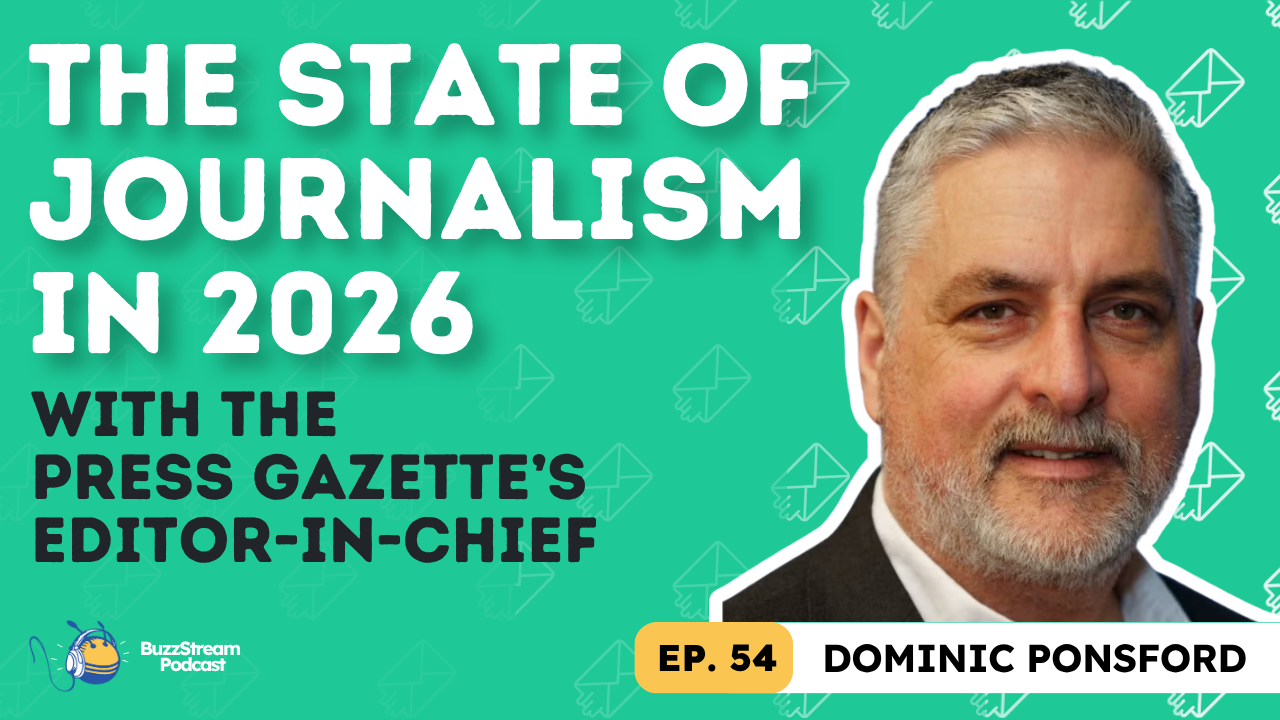
Table of Contents
- Publishers now capture only a couple of percent of UK digital ad revenue.
- Fully AI-fabricated “experts” are getting quoted ed in hundreds of mainstream news articles.
- DMCA takedown requests are being weaponized to remove legitimate journalism.
- Local journalism employment in the UK’s largest publishers has fallen to roughly a quarter of its 2007 levels.
Alright, so this one’s a big one for me.
For this episode, I brought on Dominic Ponsford, editor-in-chief of Press Gazette, which is one of the best publications reporting on where journalism is headed.
The Press Gazette has been following and writing stories about the state of journalism consistently, from the battle between Google and publishers to journalist layoffs to AI-generated “experts.”
I ask him point blank at the end: is PR in trouble here? His answer surprised me a bit, and I think it’s one you’ll want to hear if you’re doing this work day to day.
As always — like, subscribe, share it with someone on your team who’d get something out of it.
Let’s get into it.

Below is a slightly edited transcript:
Is anything happening right now genuinely new, or have we been through crises like this before?
I’ve been editor of Press Gazette, on and off, for over 20 years, and really since 2008 things have been fairly bumpy.
2022 was probably the one good year — we bounced back from the pandemic and everything felt buoyant, like we were in the sunlit uplands of recovery.
But apart from that, it’s always felt turbulent. In 2008 we had the financial crash and lost all the classified advertising. Since then it’s been wave after wave — smartphones, broadband, social media. All disruptive.
But over the last few months, I’ve started to think we might be entering a genuinely new era. It’s a new era in the sense that ChatGPT and the other tools are just so convenient — they offer a great user experience.
If I need to fix something on my car, I used to read articles, watch YouTube videos, and dig through content.
Now I can just ask ChatGPT and it’s done that work for me. It’s a much better user experience for a lot of information needs. So I think we’re in an era where we need a completely different model — one that isn’t built on the old bargain of “we send you clicks.” Now it’s closer to: we’re sending someone information, they’re making money from that, and they need to pay us for it.
Do publishers actually have a chance against AI?
Individually, you can see why people sign these deals — in the short term it’s a sensible move for that publisher.
But collectively, I don’t think these one-off deals do the industry any good long-term.
Do publishers have a chance?
Yes, of course.
These platforms — Google, Facebook, and especially the LLMs — would be far less interesting places to spend time without professionally produced content. They depend on publishers for a spine of verified, day-to-day facts about the world, whatever they say publicly.
That’s not going to change; it’s essential.
We’re still a long way from figuring out how that translates into something sustainable for both publishers and platforms — but the platforms do have a vested interest in publishers surviving, even if it’s not something that keeps them up at night. It probably should be.
Is Google biting the hand that feeds it, and is what they’re doing for publishers actually enough?
I do a lot of research on Google’s revenue share of the UK publishing/advertising market, along with Meta and TikTok — together, they basically are the media now in the UK in terms of online advertising.
Publishers are a tiny fraction of total ad revenue now — maybe a couple of percent, compared to something like 40% when I started.
Is that Google’s fault specifically?
Would someone else have done the same thing in their position?
I don’t know.
But they have the revenue that used to pay for thousands of journalists’ salaries, and those journalists don’t have jobs anymore because that money now goes to Google instead of to small and medium advertisers who used to fund local papers directly.
Google does distribute more money to publishers than people realize — through things like the News Showcase deals from a few years back, which are nominally payments for content appearing in a product called News Showcase.
I don’t think anyone actually visits News Showcase to read the news; it’s largely a manufactured product that lets Google hand publishers some money so publishers don’t sue them, and so regulatory pressure gets kicked a bit further down the road. But it’s nothing compared to what Google extracts from the ad market overall.
Is there a way for newsrooms to use AI properly, without sacrificing journalistic integrity?
Pretty much everyone’s using AI in some form. We surveyed about 200 of our readers on exactly this.
When it comes to using AI to produce finished, published articles, a very small share admit to doing that — maybe around 4%. Most usage is for research, headline ideas, transcribing interviews, editing, and visualizations — streamlining editorial workflows rather than replacing writing outright.
I don’t think there’s anything truly game-changing happening yet in terms of how publishers use AI day to day.
The genuinely game-changing piece — which a group called the Sport Coalition, with a lot of UK publishers involved, is working on — is figuring out how to control and license bot access: tracking usage and building a payments protocol for it.
That’s doable in principle, but the hard part is that publishers would collectively need to be willing to say “we’ll switch off access entirely if you don’t engage with us on payment,” which is genuinely difficult — you risk blocking a lot of legitimate, beneficial bot traffic along with the bad actors.
What are the legal differences between the UK/EU and the US on this, and why is there more litigation coming out in publishers’ favor in the UK?
It’s a fairly similar landscape in that copyright sits at the heart of it, and it’s still untested ground in the US too — plenty of open claims over what can even be copyrighted when it comes to news and facts. In the EU, UK, and US alike, there are big exemptions for tech companies — different specific laws, but they amount to the same idea: tech platforms are treated like a utility, similar to a phone company transmitting calls, and therefore not liable for what passes through them.
We’d argue about that all day, but once a platform starts writing its own AI answers, it’s arguably jumped from transmitting content to creating it — a different legal category entirely.
One interesting development in the UK, which hasn’t gotten much coverage, is a small group of independent publishers using contract law — rather than copyright law — to go after tech giants.
That’s likely possible in the US too, since contract law goes back to Roman law, essentially the foundation of legal systems generally.
These publishers changed their website terms and conditions to say scraping and reusing their content without permission breaches the contract, with a stated penalty — something like £500 (roughly $800) per article.
They’re taking these cases through small claims courts: not arguing copyright, just “you broke this contract, pay the stated fee.”
That’s the kind of case a local judge can settle in a low-cost hearing. It’s a new front, and potentially quite disruptive — a multi-billion dollar tech company facing thousands of small claims adds up.
Is the clash between journalists and publishers over AI rewrites and summaries — the kind causing walkouts in the US — happening in the UK too?
Not much of that in the UK that I’m aware of.
What UK freelance journalists get genuinely annoyed about is having their work licensed to AI companies without permission being sought — the same issue exists for staff writers, but freelancers actually retain more copyright ownership over their own work in the UK.
So when a publisher licenses that work to an AI company and gets paid, and the AI company then turns it into something not always accurate, it doesn’t reflect well on the original author — who also doesn’t see any of that money.
It’s untested ground.
In Germany and parts of Europe, I understand some publisher licensing deals have actually included extra compensation for the journalists involved, which sounds like a reasonable model.
Is journalism employment actually shrinking globally, or is this more of a UK-specific story?
It is hard to track — journalism is a small enough profession that survey sample sizes get very small, so it’s hard to extrapolate reliably.
But if you look at the three biggest local newspaper publishers in the UK, which together control more than half that market, they now employ roughly 20–25% of the journalists they did in 2007.
We use 2007 as a baseline because, believe it or not, the mid-2000s was actually the high-water mark for print profitability — circulation was already declining, but the print process was highly automated and the advertising market was still huge.
But it’s patchy.
The Financial Times and the Times of London have built genuinely successful subscription products and are arguably more profitable now than in the mid-2000s — they shed unprofitable print circulation and replaced it with profitable digital subscriptions. And there’s a whole new landscape of smaller news businesses — individual Substacks, niche data products, and so on.
So it’s hard to generalize, but for what most people mean by “local journalism,” it’s roughly a quarter the size it was 20 years ago.
What are publishers actually doing to fight declining traffic and revenue from AI?
There’s a lot going on, and some of it is genuinely positive, because the Google-search era didn’t always encourage great journalism — a lot of people made money simply rewriting the day’s trending stories a hundred slightly different ways, which didn’t really add to the sum of human knowledge.
I think there’s a real shift toward quality — specifically, toward things that can’t be replicated by an LLM: longer, more discursive investigative work with real analysis and color, since an LLM can only ever give you an aggregation of what’s already known. More commentary, more personality.
Newsletters are a big trend — a direct, personality-led relationship with the reader that you can’t get elsewhere.
Everyone’s also leaning hard into social-first, creator-led video. I do worry that’s partly just tomorrow’s problem — you’re still renting an audience from platforms that are friendly today but won’t necessarily stay that way.
It doesn’t always foster the best journalism either, since that model runs on ad placements and brand partnerships — a McDonald’s-sponsored piece isn’t going to encourage tough investigative reporting on the meat industry — but it is happening, even at mainstream outlets.
To Google’s credit, YouTube specifically does seem to be a genuinely fruitful place to launch new journalism products right now — the algorithm helps channels grow quickly.
The Daily Express in the UK, an older-style paper whose print edition probably won’t be around much longer, launched a YouTube show that’s now arguably the most popular YouTube show produced by any UK newspaper, built from nothing in about a year.
Events are another strong area, especially for anyone in a specialist or B2B market — Press Gazette does very well with events, because it’s genuinely hard to convene the right people in one room, and having a daily or weekly relationship with your audience as a publisher makes that possible.
And paywalls are growing significantly in the UK — almost every major publisher has one now.
Is there a tension between news as entertainment and news as a force for pushing the world forward?
There’s always been a role for the frothier end of journalism — the stuff that adds to what you might call the gaiety of the nation.
Publishers will often say that lighter content helps cross-subsidize the more serious work, and there’s probably some truth to that. I think you can actually do both well — everything you publish should offer some kind of revelation, even celebrity coverage.
Why shouldn’t we look a little harder at incredibly well-paid public figures instead of just letting them write their own press release and having everyone repeat it, which is often what they’d prefer?
If you look at how journalists think about themselves and the industry, there’s still a strong sense of mission.
Most people become journalists because, on some level, they want to be Clark Kent — take on the bad guys, change something, and have some fun doing it. Publishers are happiest talking about the moments where they really moved the needle and held someone to account, more than they’re happy talking about the P&L.
There’s rarely anything more compelling than a publisher laying out a series of true, well-documented facts that are deeply uncomfortable for someone to read — and they can prove every word.
Look at when the Wall Street Journal published that unsettling birthday card Donald Trump reportedly sent Jeffrey Epstein, complete with a poem and a doodle. You read something like that and think: they spent months verifying every detail before running it — and then they got sued for tens of millions over it. That’s the kind of story publishers are genuinely proud to talk about, more than quarterly numbers.
Can you walk us through the Press Gazette’s investigation into fake AI-generated “experts” being quoted across UK media?
It started about a year ago with a freelance journalist we work with, Rob Waugh.
He uses journalist-request platforms — online marketplaces where journalists post questions and PR people submit quotes on behalf of sources, which lets a freelancer quickly gather quotes for a feature.
He noticed some people on these platforms answering incredibly wide-ranging questions almost instantly — faster than seemed humanly possible. Our first assumption was that they were using AI to draft the answers.
But digging further, we found that these frequently quoted “experts” weren’t just using AI — they were themselves entirely fabricated by AI. They didn’t exist.
The first one we investigated was “Barbara Santini” — a supposedly Oxford-educated psychologist and relationship expert who turned out to be one of the most widely quoted psychotherapists in UK media. Her only real online presence, in terms of bios and citations, traced back to a sex-toy retailer’s website, where she was also listed as the resident psychotherapist.
After going back and forth on it — including a WhatsApp exchange with “Barbara” herself, whoever that actually was — we published that we didn’t believe she existed and that the quotes attributed to her across hundreds of articles in major UK outlets were fabricated.
A year later, “Barbara” hasn’t given a quote to anyone else, and she hasn’t sued me for saying she doesn’t exist. Since then we’ve found dozens more examples and built a dossier of more than a thousand published articles involving fabricated experts.
The people behind it are largely SEO operators — on the fringes of legitimate SEO, and real SEO professionals tend not to want to be associated with them — who treat expert mentions and backlinks in reputable outlets as a technical solution to a ranking problem, usually for sites in categories that struggle to earn links legitimately, like online casinos or adult products.
There’s a whole cottage industry generating fake AI expert content, packaging it up for journalists chasing quotes to fill SEO-driven content — and until we started digging, publishers largely had no idea, and were genuinely embarrassed once they realized what had happened.
Google actually took down some of your reporting on this — what happened?
That’s a whole separate issue. Under the US DMCA, essentially anyone can file a copyright complaint about anything online, and Google’s default response seems to be to just take it down — an automated process with little real vetting.
It’s a remarkably easy way to get almost anything removed from the web if you don’t like it.
We published a couple of stories about a company called Clickout Media — one of several “parasite SEO” operators that buy up websites with high domain authority (sometimes former legitimate news sites) and use that authority to publish content promoting online casinos, often fairly disreputable ones, frequently written by AI rather than human journalists.
Our stories exposing this got hit with DMCA takedown notices and were pulled.
When we complained directly to Google, the stories were restored — ours were only down for a few days, though I’ve heard of others staying down for weeks, sometimes at real cost to fight the takedown. It’s an increasingly used tactic, and frankly, a fairly absurd system.
Is the PR industry in trouble, given shrinking publishers, shrinking traffic, and the rise of agentic AI?
Bringing it all together — the core problem is facts getting disaggregated from journalism and fed into this generic AI “soup.” It’s easy to worry that both journalists and PRs are threatened by that.
But everything I’m seeing, and my strong intuition, is that people actually want more human content now, not less — they’re deeply suspicious of AI-generated content, and they’re good at spotting it. Even kids can spot it almost instantly, and they don’t like it.
It’s been a long time since I went to a website purely “for the facts of the day” — I go because I like specific writers, a particular point of view, the overall package and presentation. I don’t think that changes, but it raises the bar: it has to be genuinely better.
PR needs to lean into its humanity too, and pull back from the spray-and-pray approach that’s become common simply because it’s technically easy — a database of thousands of journalists and a personalized-merge-field email blast.
I don’t think it actually works. It reminds me of those stories about people who say they’ve applied to 10,000 jobs and can’t understand why they’re still unemployed — send two or three well-targeted applications and put real work into them, and you’ll likely get further.
It’s the same with PR: get to know the journalists and the publications, find the right story, send a genuinely tailored pitch, and build trust with the reporters who matter in your specific market. Don’t pile it high and sell it cheap.
I’d also say B2B and niche publications are often the most valuable placements — more than chasing a Financial Times or New York Times hit for its own sake.
You want to be in front of the people who actually care about your specific subject, and there’s a newsletter for basically every niche now, often genuinely well read. There’s actually a lot of scope to get the word out.
Good PR remains important — it’s a bit like freelance journalism now: in the valley of the blind, the one-eyed man is king.
The relatively few PR people who genuinely bother to build relationships with journalists and think carefully about tailored pitches do exceptionally well.


 Check out the BuzzStream Podcast