 End-to-end outreach workflow



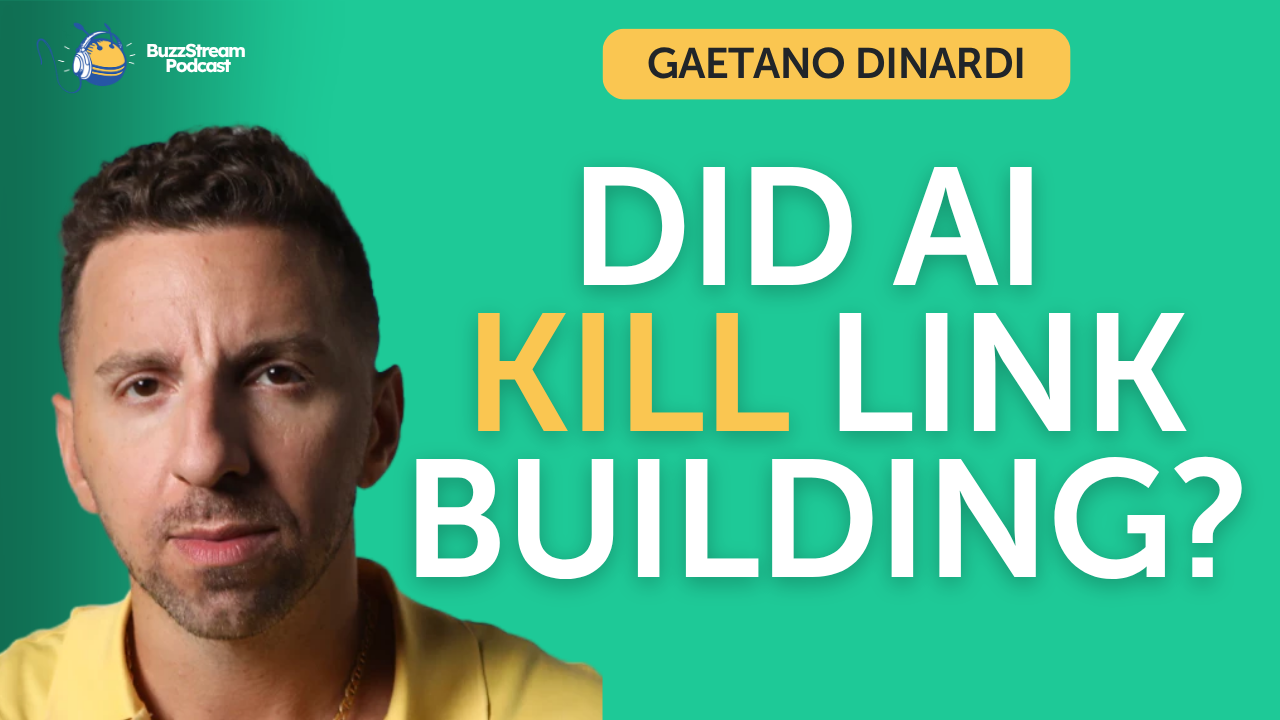
Table of Contents
- You can’t brute-force your way into a category with links if you don’t belong.
- Citation rate is the new domain authority (but that’s different than recommendation rate).
- Judge links with common sense, not SEO metrics: real business, real brand, aligned traffic geography, and users who can actually complete tasks.
- Reverse-engineer the sources of influence for your category beyond backlinks.
- We’re in the dark SEO era, so more organic performance shows up as branded and direct traffic.
Most link building still runs on domain authority: the higher the DA, the higher the price.
Gaetano DiNardi says AI has completely changed the game.
If you don’t know Gaetano, he is a B2B SaaS marketing advisor who has worked with some of the largest SaaS brands, including SEMrush, Gong, and Cognism, among many others. He also has a fantastic newsletter full of marketing advice.
I invited him on to talk about an article he wrote for Search Engine Land titled “Why the traditional link building model no longer works for AI search,” where he argues the link-building model no longer works.
In this episode, we get into how link vendors price and sell links, the common-sense rubric Gaetano uses to judge a link, why citations aren’t the same as recommendations, what to do instead of buying links, and why he thinks we’re in the “dark SEO” era.
Let’s get into it.

Below is a slightly edited transcript:
What prompted you to write your Search Engine Land article?
Gaetano DiNardi: I’ll be honest. I used to work with a lot of link building vendors, a lot of link building companies, and what you could call lone wolf link building consultants.
That was their living, their bread and butter: building links for companies. As AI search unraveled, the demand for those services has gotten lower and lower and lower.
In the golden days, a lot of these people seemed to be doing pretty okay. Well, the demand for their services has gone down, so they’ve been following up with me. “Hey, just checking in. Do you need any work? Do you have any clients that are interested in building links?”
My answer to all of these guys is, look, nobody wants to do it.
The clients are just not interested in building links. That made me think about why that might be.
I thought about my own experience reviewing link inserts on a spreadsheet, this hand-to-hand combat style.
Every vendor really has the same process.
Nobody’s innovated anything. It’s still stuck on that domain authority model: the higher the domain authority, the higher the cost of the link.
Nobody seems to understand business context and relevance anymore.
Dude, the game has completely changed. You don’t need batches and batches of random links anymore to be successful.
You probably just need to be part of the higher-influence sources out there. But those are generally harder to crack, and there are fewer of them. So maybe we’ll just start with that. That’s really what prompted it for me.
Are links still important, or is it the brute-force, quantity-over-quality approach that no longer works?
Gaetano DiNardi: Let’s dissect the industrial complex model, if you want to call it that. It’s mass outreach.
These link vendors have certain publications in their back pocket that they can just go to for more links, and they negotiate fees.
Somebody commented on my post, “Weren’t you just buying links this whole time?”
And that gets into a gray area.
If you’re the client and you contract a link building service provider, you’re paying the provider a monthly agency fee.
What they’re doing behind the scenes, and they’re not really telling you about this, is negotiating payments under the table with the editors of these sites.
So technically, you are buying links indirectly without knowing it.
Or maybe you do know it, but it’s not spoken. A lot of these agencies have an agency management fee, and on top of that, you pay the cost of each individual link.
They frame it as the effort required to get the link: it’s harder to get domain authority 90 links, so you’ve got to pay more for those.
But really, what that means is a higher markup. That’s just the reality. I don’t know if you want to dissect this part a little bit.
Vince Nero: No, I mean, we’ve done a lot of digging. I was able to get access to a database of something like twenty thousand links, a marketplace, and I did a lot of digging into exactly what you’re saying. You can see the price go up as the quality goes up.
Typically, as you were saying, domain authority is the main score they use.
Sometimes they use traffic, as you also say in the article. So I looked at traffic and domain authority, and at the percentage of the marketplace that meets a quality bar. Say, above 20,000 visits per month or something, and DA above 80 or something. It was like 2% of this marketplace that exists in that range.
And the prices are upwards of 6K, or even higher, sometimes 10K for certain sites.
How do you measure relevance and authority for lower-tier links, and are they even worth getting in the AI era?
Gaetano DiNardi: If we zoom out, links are still important, because you do need a certain level of authority to even clear competitive thresholds.
The reason I see this play out over and over again is that I see examples of very strong domains that publish very strong content, with no links at all, and they’ll show up in AI search for the category recommendation.
They’ll even rank in traditional Google search.
I keep seeing examples where content and internal links, plus existing brand authority, are really enough to carry most SaaS brands now. I think that makes the case for low-level link building.
As you say, John’s random cooking blog dot com.
I think that’s a tough narrative now for link vendors, this idea that you need diversity of links, that you need some of those low-tier ones.
That argument is getting harder to make today, because you just don’t know how to quantify the impact of something like that.
The criteria I tend to use are actually more common-sense criteria.
In fact, Cyrus Shepard, you know him for sure, came out with the five criteria of sites that Google is rewarding right now.
I stick to that as my rubric rather than any sort of SEO metric.
So it’s common-sense things. Is this a real business? If content is the product, it’s generally not good.
If I’m working in B2B SaaS, I only want links from other SaaS, for the most part, or from things that are a real business.
I don’t want a content mill site giving me links. So that’s one.
The other thing is, does it have some kind of brand at all? Most of the sites you get links from through vendors have no brand.
It’s just contentpublisherxyz.com. So right off the bat, content is the product and there’s no brand.
Two big hits.
The next thing is, does the traffic geography align with the client?
In most cases, you’re going to see the Philippines, India, places like that being the majority of where the traffic is coming from for those referring domains. Again, just no alignment.
Then it’s things like user task completion.
Can somebody go to this site and complete what they want to do? Generally, the answer is going to be no.
For example, an ROI calculator: instead of a real ROI calculator, it’s just “here are some steps on how you can manually calculate the ROI.” So you’re failing over and over and over again.
Then you see the other telltale signs, like outgoing commercial anchor text to “best solar panels,” and then on the same page it’s “best credit cards,” and then it’s “best LMS software.”
Those are the kinds of red flags, and most of them are just common sense.
If all of that is wiped away, and the site just has really low authority, but it’s a real company, it’s a real brand, they’re not doing anything spammy, and somebody can actually buy a product, those are the kinds of things I look for in a link that I think is good, rather than SEO metrics.
How do you know how many quality links you need, and are you benchmarking against competitors?
Gaetano DiNardi: Generally, I am doing some of that.
But more often, what I’m doing is looking at what sources are actually influencing AI outcomes.
Here’s a perfect example. Use a category like “best insider risk management platforms.”
This is not even about links so much anymore, because when you look at that, there’s a Gartner category page that’s influencing the majority of the outcomes.
And your brand profile is associated with a different Gartner category, and you don’t have reviews for that Gartner category for insider risk.
Now it’s very obvious what we need to do as a company. It’s not to pound backlinks to our insider risk management solutions page. That’s not going to get us where we need to go.
What we need to do instead is shift our brand profile to align with the correct Gartner category.
Then we need to mobilize a review strategy within the company that’s going to get us higher up on that review listing, where you have all these blue chips that have been dominant, like Varonis, Microsoft Purview, Proofpoint, Forcepoint.
All these companies have been pounding, not links, reviews. And they’re real, credible reviews.
That’s a more strategic change in how marketers should think about attacking categories.
In the old days, it was a no-brainer: we’ve got to pound links, and that’s it. Who can we work with that can get us links to our “best insider risk top ten” page?
Now it’s like, that’s not going to work, because Gartner is the main source of influence.
Are you using AI prompt tracking as your main goal instead of organic or direct traffic?
Gaetano DiNardi: I would say I’m using a blend of both.
I’m not discrediting traditional search and doing only AI, GEO, or AEO tracking. I’m trying not to over-index on one thing.
I believe a blended approach makes a lot of sense, partly because I think certain LLM platforms don’t have good enough spam filtering yet.
Also, blending how your brand shows up across all the platforms into one number is going to be misleading. You’re going to see different outcomes for ChatGPT versus Claude.
For example, I don’t even track certain LLMs, by the way. I don’t track…
Vince Nero: Same.
Gaetano DiNardi: Copilot, Meta AI, Grok, I don’t track those.
In many cases, I won’t even track Perplexity, just because it seems to be a mirror of Google search and I don’t find it very credible.
So I really stick to the Google properties, Claude, and ChatGPT. Generally, those are what’s driving the most referral traffic to the client sites, and I like to align with that because it gives me insight into where the adoption currently is.
If I ever did have a client where, say, Microsoft Copilot was driving 80% of the referral traffic, then obviously I would track it.
But that’s just not the case.
To answer your question, I’m not over-indexing on one thing. I’m not just looking at traditional SEO or too much AEO.
I’m trying to blend it all together to get a holistic picture of what we need to do for this category. I think that gives you the best possible vision into what needs to happen.
How does link building connect to AI exposure, and does ranking higher in search mean showing up more in AI?
Gaetano DiNardi: There’s so much nuance to this, but here’s what I’ve ultimately landed on.
Let’s say your brand belongs in a category, and you know that it does, but you don’t have enough visibility there because you’re being outmuscled by competitors who are really good at traditional SEO.
In that case, it makes sense to leverage some traditional SEO efforts to grow your ranking, because I believe that can definitely impact your AI output.
However, I’ve seen other cases where you don’t really belong in a category, but you’re pounding an “X best” list page with backlinks because you think, “All right, all we need to do is rank number one in traditional search, and that’s going to lead to AI brand recommendations.”
Unfortunately, that is the biggest difference today, and it’s a big wake-up call for people who have been in SEO for a long time.
You can brute-force your way to the top of a traditional SERP and be number one for an “X best” search.
But if the AI believes you don’t belong there, it will take all the content off your page, recommend every other competitor, and you’ll get the citation.
That will show up in any AEO tracking tool you’re using: “Our citation rate is going up.”
But if you’re not getting the brand recommendation, who cares? That’s a big disconnect.
You have to think more strategically about the category. That’s the difference.
You can’t bulldoze your way into a category where you don’t really belong with traditional SEO efforts.
That’s why link building could ultimately be a waste of time. If you pound backlinks to a page in a category where you don’t belong, yeah, you’ll get the SEO ranking, but you’ll probably never get the AI recommendation.
What is “credible context,” and how are brands building it?
Gaetano DiNardi: I’ve seen many examples where companies have done very simple techniques that have helped them grow their link profile and become more credible for a topic. For example, getting their executive team interviewed on relevant podcasts and then linking to their content pages in the show notes.
I’ve actually seen that strategy alone be the difference maker between getting AI visibility and not getting so much AI visibility.
That was one problem I came across with one of my clients. We were doing great content, but the competitors in our space were thinking more strategically about distribution. We were just creating content and moving on, creating content and moving on.
But they were creating content and then circulating it into the media activities they were doing.
Something as simple as that can be a difference maker.
I also think there’s a role for affiliate partnerships.
It depends on what space you’re in, but there can be some influential sources in your niche that maybe you’re not paying attention to, or maybe you forgot about.
In many cases, I’ve seen Business.com, PCMag, and some of the Black and White Zebra properties, like People Managing People dot com.
Your classic affiliate sites.
It’s probably worth looking into how much influence those have in your SERPs. If you’re not doing any sort of co-marketing with them, or even something as simple as bidding to be on their PPC listings, maybe that’s something you need to tap into.
Those are the big things that come to mind. I’m sure there’s more, but that’s what I think about when it comes to credible context.
What’s to stop someone from scaling out a million guest posts packed with the keywords they want AI to associate with them?
Gaetano DiNardi: The way you presented that is very honest.
It’s the idea that you’re going to try and brute-force it.
You’re going to do low-tier blogs where you can create this word cloud of things around your brand.
You can do a lot of cheap guest posts saying, “My unknown startup is just as good a leading revenue platform as Demandbase, Gong, HubSpot, and Salesforce.”
You can flood the internet with stuff like that.
And yes, that technically does count as co-occurrence, entity co-occurrence, but it’s not credible co-occurrence. It’s not credible consensus.
That goes back to what we talked about regarding how you know whether something is quality or not.
This is the problem with GEO vendors.
Let me put it to you like this. Traditional link builders relied on domain authority.
The equivalent of that in the GEO world is citation rate. GEO vendors are relying on citation rate the way traditional link builders relied on domain authority. Citation rate is the be-all, end-all. The glory metric.
Now, these random low-tier guest blogs that you’re using to try and create this co-occurrence, because the spam filters are not quite up to snuff on the Claude, Perplexity, and Copilot systems, low-tier content is going to have a high citation rate for a category. It just is, because they don’t know how to filter that out yet.
So on the surface, it’s going to look like it’s working: “Look, we increased our citation rate.”
But the reality is you’re not going to see your recommendation rate going up.
You’re just not going to see that, because those low-tier sources are not the things that are actually driving the recommendation influence.
So sure, you can waste a lot of time trying to do this co-occurrence thing, stuffing your brand name in with all the things you want to be associated with in the guest posts.
But if they’re low tier, it’s just not going to work.
Vince Nero: Again, Gaetano, this is why I really love listening to you.
For instance, with GEO now, your focus is recommendation rate. I know a lot of brands out there are just chasing mentions and citations. I think citations are probably the closest thing to links for people.
Which is probably why link builders have tried to swap in citation rate as that metric.
But the idea of not only getting mentioned, but getting recommended. There’s a difference between “Hey, use Gong” or “use Product B” versus “These are some options out there,” and it just lists a bunch of them. Those are two very different types of recommendations. I love that.
What should people be doing instead of buying links?
Gaetano DiNardi: I think it goes back to that idea of reverse-engineering the sources of influence for your category.
Start with the commercial prompts, the commercial questions, and try to create a mind map.
Out of all the commercial queries in this topic or category, there’s probably going to be a select number of sources that have an overweight level of influence.
What does it take to be on those? Is it possible to recreate some of that?
I think you’ve got to take it on a category-by-category, reverse-engineering basis.
Sometimes the outcome of that could be, all right, we need to do more co-marketing with non-competing SaaS.
There’s other SaaS out there that is talking about this topic, and maybe they have an influential page.
Maybe we can do some co-marketing with a company that’s not a direct competitor.
Maybe it’s YouTube.
I see that coming, and that’s directly within your control as a brand.
You can just go and build YouTube content that is relevant to that category and relevant to that search intent, and you don’t need to worry about any other companies to do that.
You can just do that yourself. So sometimes it’s just evolving your content style into different modes. I think YouTube is highly slept on.
I’ve actually been piloting this with clients myself.
We’re getting brand recommendations from the YouTube videos we’re building, which I’ve never seen before. We don’t have a content page for it, we just have a YouTube video, and the YouTube video is driving the AI brand recommendation, which I’ve never seen.
Vince Nero: Are these informational videos, like how to do whatever?
Gaetano DiNardi: No, no, no. These are things like “best solutions for detecting shadow AI at your company,” or “what to look for in a shadow AI detection platform.” Stuff like that.
Vince Nero: So, bottom-funnel questions that people would have. Got it. I love that.
Gaetano DiNardi: Another style could be “the one platform out there you’ve never heard of that’s going to detect shadow AI at your company,” or “one platform you haven’t seen before that’s going to prevent data exfiltration on ChatGPT.”
Vince Nero: Clickbait it up a little bit there.
Gaetano DiNardi: Yeah, yeah. You know how some of these old-school blogs were like, “Seven shadow AI detection tools. You won’t believe number four.” We’re playing around with different styles, but we’re finding that the more straightforward content on YouTube is actually working really well.
It just comes down to reverse-engineering the results, seeing what has influence, and figuring out how you can crack your way into that.
Is there anything we haven’t covered that listeners should know?
Gaetano DiNardi: The biggest takeaway, really, outside of link building as a tactic, is the big picture of all this.
The big picture is that it’s moving to this dark SEO funnel. We’re in the dark SEO era, where the attribution systems are gone. You’re not going to see conversions happening on SEO content. You’ll see some, but not to the degree it was years ago.
The reason is, if you think about the vendor shortlisting process through an AI search tool, you’re going to get a list of vendors.
Then probably what’s going to happen from there is a branded search or a comparative search through Google.
So Google is not really the discovery engine anymore. It’s more like the validation engine. We need to go and verify the things ChatGPT told us, so we search that in Google.
Then the conversion happens on the website much later, when the buyer is already much more informed, based on research that’s been done through Google and AI search. Generally, I see the most conversions happening through the main site pages: the home page, the pricing page, the demo request page.
So this whole idea of SEO conversion rates is, I think, going down the toilet, because that whole system is breaking apart. That’s probably the big takeaway. Link building is somewhat part of all that, because you still have to pay attention to traditional SEO, and now we’re trying to reverse-engineer the sources that have AI influence.
But at the end of the day, when you’re dealing with executives and talking about the channel performance of organic search, so much more of it is going to go to branded and direct because of this breakage in the whole system.
Vince Nero: I love that. Let me see how I can sum this up. We are entering an era of dark SEO, but if you are focusing on the bottom line, and the bigger picture of what you’re doing and how it fits in, I think the future will be bright.
Gaetano DiNardi: Yeah, exactly. That brings up other challenges too, because other things influence brand and direct search. Let’s say you have a big annual company event. That’s going to drive a lot of brand search. Or let’s say you ran a really clever ad campaign, or you did some PR, a brand activation at South by Southwest, or airport ads. Any one of these things can drive a lot of brand and direct.
So you might get some pushback like, “Well, how do we know it was AI SEO? It was probably this other thing we did.” I guess you’ve got to just try and use common sense.
I agree that marketers shouldn’t over-rely on that story either. Don’t try and say everything is due to AI SEO. You don’t want to falsely claim credit for AI SEO on every good thing that happens. But you also don’t want to use it as a cop-out. You don’t want to blame every bad thing that happens on “AI Overviews sabotaged us.”
That’s another takeaway: marketers have to go a step deeper on the narrative of what’s happening. You want to be truthful, transparent, and real about the challenges you’re facing in search, while recognizing that other things could be driving brand and direct, where it’s not really AI SEO that can take full credit.

 Check out the BuzzStream Podcast