
 End-to-end outreach workflow



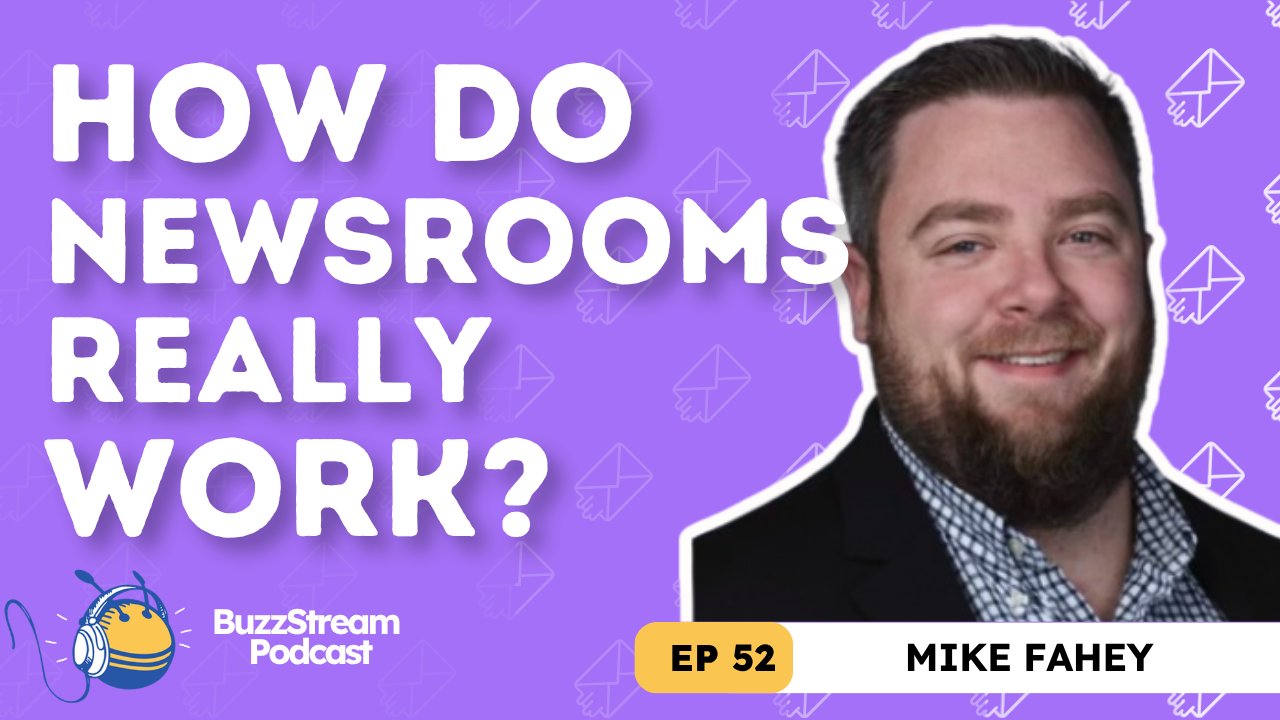
Table of Contents
- Pitch timing has to match a reporter’s actual shift — morning, day-side, and night-side reporters cover fundamentally different types of stories.
- A five-hour investment building a precise, well-researched media list pays off every time you reuse it, so it’s worth the upfront effort.
- Newsrooms are shrinking while output demands rise, meaning reporters and producers have less bandwidth for nuanced or uncoordinated pitches.
- A strong pitch needs a genuine timing hook — an anniversary, holiday, or breaking-news tie-in — to create real urgency for a journalist.
- Data and survey pitches are losing credibility as AI floods newsrooms with studies, making a strong human story or quote often easier to place than data alone.
Mike Fahey is the founder of Fahey Communications, but before starting his own agency, Mike worked as a news director and producer at newsrooms in Boston and Baltimore (and won four Emmys along the way!).
So, he now has sat on both sides of the pitch: as the reporter deciding what makes it air, and now as the PR pro trying to get his clients there.
In this episode, he helped walk me through how newsrooms are actually structured, how to build your media lists for them, and how the pressures of AI are making things harder than ever.
Buckle up for this one; lots of great info.

Here’s a slightly edited transcript.
What were you just getting interviewed for on Fox News?
Vince Nero: You’re coming off a Fox News interview this morning, and putting out client fires right before this. You’re a busy guy. What were you on Fox News for?
Mike Fahey: This morning at 5:30, I was on Fox News talking about President Trump’s trip to China.
A week ago, I was on Fox News at 11:30 p.m. talking about Blake Lively and Justin Baldoni. That’s one of the things I’ve always held fast to in my career in PR: news happens at all times. You just have to know who you’re pitching, and when, to get results.
A lot of people think no one’s watching news at night — but people are watching at 5:30 in the morning too.
And I’ll toot my own horn: I did well enough this morning that they asked me back again tomorrow. I’m both a night owl and a morning person when I need to be. I’m nimble, and I make it work.
Vince Nero: That’s right.
Mike Fahey: Actually, I’m getting a call right now from a news outlet in Pennsylvania. You never know when they’re going to call, or what they’ll want.
Vince Nero: Hey, if you need to take it —
Mike Fahey: No, we’re on a podcast. They can wait — I haven’t pitched them today, so I’m not even sure what they want.
But it just goes to show you: one o’clock on a Thursday, you never know who’s going to call.
Vince Nero: I appreciate you making the time.
As I mentioned in the intro, I think there’s a big difference between pitching for TV and pitching for a digital article, and you’ve held roles — news director, producer — that give you a great understanding of how this works. Let’s start at the beginning: can you break down the structure of a newsroom?
What’s the structure of a newsroom?
Mike Fahey: Let’s take any newsroom.
This is always interesting to me, because people spend so little effort really understanding it.
They think you can just type in “reporter” or “editor,” hit spray-and-pray, and see who responds. That’s not going to get you the results you want, because every newsroom has different titles, different hierarchies, different structures. A newspaper newsroom looks a lot different than a TV newsroom.
On the surface, in a TV newsroom you have your assignment desk.
I look at them as gatekeepers — they’re the hub of knowledge, listening to scanners, monitoring the internet and email, answering the phones, and setting the agenda for the day.
That’s the centralized hub where anyone can see what’s happening in real time — breaking news, press releases, content, the schedule of events. Your assignment editor is the person who’s going to get your story to the masses if you can’t reach the reporter directly.
Beyond that, most news organizations run several planning meetings throughout the day.
If you’re a general assignment reporter, you’re pitching your story for the day around 9 or 9:30 a.m. Not enough PR work goes into reaching reporters before they pitch their own story.
If you’re sending a pitch at 11:30 every morning, your conversion rate suffers — because by then the reporter is three hours into their day, and you’re asking them to completely switch direction.
You also need to understand the difference between a morning reporter, a day-side reporter, and a night-side reporter — terms that carry through no matter the news organization.
A morning reporter is coming in at 3 a.m.
Not a lot of morning reporters are doing enterprise reporting.
That work mostly comes from reporters who arrive between 9 and 10 — that’s when officials are ready to speak, when press conferences happen, when reporters have the bandwidth for those stories.
A night-side reporter, coming in around 2 or 3 p.m., is covering the day’s news and breaking news.
If I have a strong, self-contained, feel-good feature story, I’ll try to pitch someone starting at 3 p.m., hoping to get it into the 6 p.m. news — “one-stop shopping,” as we call it.
But the bigger point is: there has to be strategy behind your pitching, or you’ll keep coming up short.
Vince Nero: For a lot of people, a reporter’s title doesn’t specify whether they’re a “daytime” or “nighttime” reporter.
Is it worth telling people to just look at when a reporter’s stories publish, as an indicator of what they cover?
How do you tell if they are a daytime or nighttime reporter?
Mike Fahey: That’s exactly what I used to do, and honestly I’d probably still do it today.
I’d wake up, especially if I had a good day-side story, watch all the local news stations in a market, see who was reporting on what, and then reach out: “Hey, I see you’re on a fire — if you have bandwidth, here’s a good feature story this week.” That takes a lot of time and effort.
One thing we don’t talk about enough in PR is triaging.
There’s always a moment when a client needs a hit — to keep a contract, because the story matters, whatever the reason.
In those moments, you have to find creative ways to get on a reporter’s radar.
When building media lists, I’ll search for terms like “night side” or “morning” — because that might not be in someone’s title, but it could be in their bio.
Obviously the game has changed with remote work — PR pros can now work markets they couldn’t reach before.
But if you’re going to integrate yourself into a market, you have to think like a reporter.
You need to understand the fabric and DNA of that media market to pitch it well.
Vince Nero: My brother runs a movie podcast, and he gets pitched everything under the sun related to tech or movies — very broad keyword matching.
I talk a lot about how that’s not enough. Bio-matching alone doesn’t capture the real fit.
What else do you look at besides bio and title when building a media list?
Mike Fahey: I’m a bit of a psychopath about this — I look very deeply into it.
My media lists are intense.
I look at past coverage; the number of things I throw into the mix is wild.
But here’s the thing people don’t talk about: if I spend five hours building the best possible media list, I get to reuse it over and over.
That research pays off repeatedly.
When I started in PR, I didn’t know any of the tools yet, so I did it manually — who’s reporting on this, who’s the morning anchor.
Now we have better tools, but I still do creative searches for people who’ve covered similar topics in the past — I’m a heavy user of exact-match search with quotation marks.
Then I go back through and cut out anyone I know wouldn’t actually cover it.
There’s discernment across every step.
I keep an important media list of producers, especially cable news booking producers.
But the bigger message today is: it’s a race.
Reporters and producers are more taxed than ever. You have to hand them the story on a silver platter the moment they’re looking for it.
Also — just because no one responded doesn’t mean they weren’t interested.
I get hits on day three, week three, month three, when I least expect it, because the pitch was easy to find later.
We shouldn’t just be indexing for AI — we should be indexing for inboxes, so people can find your clients after the fact.
Not long ago I got an email a year and a half after I’d pitched a story, from an LA Times reporter asking for an update.
It genuinely wasn’t that great a story to begin with — I wasn’t expecting a follow-up at all.
Vince Nero: I love that idea of optimizing for the inbox — journalists have told me they search their inbox the way you’d search Google, looking for an expert on a topic.
Can you help me understand how pitching for cable news/TV differs from pitching a written, digital article?
What’s the difference between pitching for TV vs a written digital article?
Mike Fahey: I think it’s similar in some ways — proof of performance matters for both, maybe more than I’ve given it credit for lately.
If you’re putting someone on TV or having them speak on camera, a good reporter or producer wants to see clips first.
It’s almost like you need a sizzle reel of your client’s best sound bites.
Early in my career, before a couple of big placements on Good Morning America and the Today Show, the first question back was always: do you have clips?
Is that a disqualifier if someone’s new to the game and doesn’t have clips yet?
Mike Fahey: No — everyone has to start somewhere.
It’s a bigger hill to climb, and you probably can’t jump straight to GMA or Today with zero track record, but that doesn’t mean you can’t try, or do some media training first.
The tier-one wins I get are honestly kind of a miracle — a mix of a good pitch, the right timing, and dumb luck.
One of the biggest hits of my career — I didn’t even know it had aired until the next morning, when their medical EP emailed to tell me.
It would’ve been nice to know while it was happening!
And on top of that, they didn’t use the client’s name on air — so they gave me a “make good” in the web story instead, which is still on my social media today.
I wouldn’t call that pitch “blind” — there were probably 75 steps that went into it before it ever went out.
It just feels blind sometimes because you’re not sure anyone’s actually going to see it.
Vince Nero: Let’s tease out some of those steps.
A lot of digital PR people struggle with matching the right time to the right person — relying on media databases, manual research, matching based on what a reporter has already covered.
A lot of what we do is pitch things like survey data — “X% of Americans say…” I saw one today about a Dave & Buster’s survey: roughly half of Americans say they’re not having fun anymore.
How do you find the right reporter for something like that?
How do you pitch a survey?
Mike Fahey: Great example — earlier this year I did survey pitching for a client around seniors struggling to retire in a particular state.
They handed me the pitch and said “get us hits” without giving me a media list, so I had to build the strategy myself.
First move: if my state ranks 25th out of 50, it’s probably not newsworthy on its own — so I take the best and worst, top five and bottom five nationally.
Time zones matter too.
Sending a West Coast reporter a pitch that lands in their inbox at 5 a.m. their time is a mistake, unless you have a specific reason for doing it deliberately.
We should be making deliberate decisions about how we pitch, because we want deliberate outcomes for our clients.
Then there’s the question of who to actually target — every member of a news org, or specifically writers and digital content producers?
Is this an on-air story or an online story?
I always try to build relationships with web producers I can return to later with, “I’ve got another good one for online.”
One challenge in PR is figuring out who still writes what used to be called listicles — now more often “generational” stories: “the top things Gen X thinks about money” instead of “five things to buy this summer.”
I remember writing nightly teases about seasonal buying guides years ago, and before that, slideshow-driven content designed purely to generate page views.
I once spent months building an Instagram viral video strategy for a news station, trying to get content from Premiere onto a phone to upload — this was almost 10 years ago, modeling ourselves after Daily Mail’s digital operation, which was a losing battle for a TV station.
Now editing happens right on the phone.
Vince Nero: That’s a good transition — newsrooms are changing, and one big trend, at least in the UK, has been layoffs. Are you seeing the same shrinking journalist pool here in the US?
Is the journalist pool shrinking here in the US?
Mike Fahey: Absolutely — and it’s not just shrinking, reporters are greener and more overloaded than ever.
Layoffs, buyouts — it’s a real concern.
Reporters who used to turn one story a day are now turning two or three.
A digital producer at a major outlet might be putting out 20–30 articles a day.
So a pitch that requires nuance or extra coordination is going to have a hard time landing.
I’m 40 — in college, everyone said broadcast news would disappear entirely for digital.
Twenty years later, that hasn’t fully happened, though there’s a version of that truth.
Web teams tend to be the greenest teams — often straight out of college, because it’s cheap to hire several junior producers under one overseeing editor for the price of one seasoned person.
That creates a real lack of oversight.
These are people with access to publish directly to major newsroom websites, often without real fact-checking.
I once worked on a feature about a business whose name was misspelled 37 times throughout a tier-one outlet’s story — by a very seasoned reporter, not a green one.
Broadcast news often has no real copy editing; you’re lucky if a digital EP even glances at it.
The margin for error today is bigger than it’s ever been.
Vince Nero: With journalists under more pressure to produce, how much of their output comes from outside pitches versus their own ideas or standard assignment-desk coverage?
How much output comes from outside pitches vs assignment-desks?
Mike Fahey: Reporters can pitch their own ideas, and if the idea is strong enough, it gets through — but it has to be bulletproof. That said, the breaking news cycle usually trumps everything, especially in “if it bleeds, it leads” markets.
Boston, where I worked for almost a decade, doesn’t have much enterprise reporting on broadcast — the climate is driven by breaking news: car crashes, house fires.
I think there was a bit of a content reckoning during COVID where audiences wanted more substantive stories, but if you look at any Boston TV station’s website today, they mostly look the same: breaking news, court cases, fires, shootings. In a top-10 market that doesn’t prioritize enterprise reporting, you’re facing an uphill battle.
Vince Nero: Segueing into another question — is it possible to make any company or brand newsworthy?
Mike Fahey: I think so, if you do it right. Here’s an example from last week: I don’t do much hospitality work, but I helped open a new restaurant. Boston doesn’t cover restaurant openings — there’s a new one every day. But this client — like family to me after five years — named the restaurant after his great-grandmother. He caught his mom’s emotional reaction on video when she found out. I always tell clients: think like a producer. That wasn’t just a nice video — it was the story. I released it on Mother’s Day, and it ran on every station in Boston.
I’ve also launched political campaigns tied to specific anniversaries to generate coverage.
If you Google the most highly covered congressional candidacy announcement in West Virginia state history, you’ll find that client — I launched his Senate campaign announcement on January 6th, deliberately, and it drew exclusives and massive coverage.
I don’t talk about that client much anymore since our politics have diverged, so I won’t name him — but strategically, you have to think: what’s the news angle here? In PR we call it newsjacking, and it has to become part of your DNA with clients.
Vince Nero: Is having a timely hook the key to most pitches — something that makes it make sense for the journalist to run with it?
How important is urgency?
Mike Fahey: Yes — it needs urgency, and it needs to suggest that if they don’t run the story, someone else will.
I’ll admit to some gamesmanship here: in a follow-up email I might say, “Several stations have called looking to set up an interview — let me know if you’d like to join in,” when in reality no one has called yet.
But if they think their competitors are moving, they may show up too.
What’s easier to get covered these days — a client interview or quote placement, versus a data-driven survey or study?
Mike Fahey: Getting a client placed through a quote is easier than getting coverage from data alone.
In 2026, with AI, anyone can produce a new study every 30 seconds, often contradicting last week’s.
I think survey-driven PR is damaging the credibility of studies generally.
That’s not to say data isn’t a useful tool — I’ve suggested it to clients I couldn’t otherwise break through for — but it comes down to point of difference: is this genuinely novel data, something shocking enough on its own to justify coverage?
You also have to be honest with clients about whether they actually have what it takes to get — and sustain — coverage.
I had a client last November, during the SNAP benefits crisis, who claimed to run a virtual food pantry helping people who’d lost food stamp benefits.
I got them booked on GMA, local Boston stations, even some national hits — but the interviews kept getting pulled before airing.
It turned out there was no actual food being delivered; it was essentially a fabrication, and producers eventually caught on during vetting.
I should have done more due diligence up front.
I can’t guarantee results, but I can guarantee that a client needs to be able to stand behind what I get them.
Vince Nero: That kind of thing happens in digital PR and SEO too — when the substance doesn’t hold up to the pitch.
Before we close, Mike — you mentioned being press secretary for a presidential candidate.
Is that the same person as the Senate campaign you mentioned?
Can you tell us about being a press secretary of a presidential campaign?
Mike Fahey: The Senate campaign in West Virginia came right before this one.
I saw a job posting looking for someone to help launch a presidential campaign, and having just run a big successful campaign, I figured I could do it.
That’s how I ended up working with Steve Laffey.
Steve is like family to me — we exchange Christmas cards, and I see him when he’s in town.
It’s a bit surreal looking back on how fast that all moved.
It was an incredible experience to be on the campaign trail during a genuinely wild election cycle, as a moderate, registered-independent former journalist from the Northeast.
I’m actually working on a book about that experience right now — there’s an outline, chapters, it’s coming together, just need to find a publisher.
People assume that because I’m from Boston I must be very liberal, but I’m quite moderate — I spent 15 years as a journalist following facts, not party lines, and I still don’t really “see” party affiliation, just politicians and stories.
Vince Nero: I imagine you see news opportunities everywhere. What’s that like in your head — are you constantly looking for ways to tie your clients into the news?
Are you constantly looking for ways to tie your clients into news?
Mike Fahey: Constantly.
When I started my career in sports, I’d watch Red Sox games listening for sound bites I could use at work the next day — my brain still works that way.
If I watch the first 20 minutes of the Today Show, I could probably map six stories to six different clients.
For newsjacking specifically, I get news alerts on my phone all day.
Right now I have a big client in Florida, so any alert with “Florida” in it stops me — I vet it immediately and move if it’s relevant.
If a pitch goes out even 20 minutes after news breaks, the reporter’s often already found their expert.
That’s why having pre-built, ready-to-go media lists matters so much — it’s the same discernment behind those “75 steps” I mentioned earlier.
Sometimes I have to move so fast that a political pitch ends up going to a sports producer by mistake — my blanket apology to reporters everywhere for that one.
Vince Nero: That always-on nature of the job is fascinating.
Any tips for people in this industry on managing work-life balance and burnout?
Mike Fahey: A CEO I used to work with had a pizza analogy: you can’t eat the whole pizza.
You can’t fully unplug in PR — there’s always a client fire or an opportunity — so you have to choose your moments to detach.
I might keep my phone on me at all times but also give myself an extra hour in the morning to do laundry and catch up on life.
I have a habit of coming into the office late at night — 8 to 11 p.m. — with a show on, talking to friends, but getting even 25% of that time genuinely productive puts me far ahead for the next day.
One nice thing about running your own company is that hard work actually lets you get ahead — something that’s harder to feel in a newsroom job.
I’ll schedule pitches at 11 p.m. to go out automatically throughout the next day; no one’s the wiser, and it buys me real flexibility.
Anything you want to leave listeners with — anything we didn’t cover today?
Mike Fahey: At the end of the day, I call myself the Steph Curry of PR — take big shots.
Worst case, they hit delete.
That’s not a license to send a reporter 75 pitches a day — practice some restraint — but as Wayne Gretzky said, you miss 100% of the shots you don’t take.
So take the shot.
I’m always gun-shy about pitching the New York Times — the “white whale.”
Reporters there write back more often than you’d think, even when they’re not going to cover the story.
It’s rare, but when it happens, I still get a little thrill seeing their name in my inbox.
And even a “thanks, but no” from the New York Times is worth reporting back to a client as a small win.
Where can people find you if they want to learn more about what you’re doing?
Mike Fahey: I’m working on that book — it’s the culmination of that election cycle, and it’s a real work in progress with an outline and chapters already done; just need to find a publisher. I think the experience I’ve had in media is too important not to share.
I’m always on social media — Instagram under my name, Michael E. Fahey. People underestimate how much personal social media functions as their real newsfeed these days — I’m more likely to click through someone’s Instagram than open a news app.
The biggest advice I give every client: it’s not just about getting the hit, it’s about the amplification afterward. PR is a symphony of amplification — if you’re not playing every instrument, the song doesn’t land.


 Check out the BuzzStream Podcast