 End-to-end outreach workflow



Table of Contents
- AI platforms rarely cite the same sources: 76.1% of citations appear on only one platform, and just 0.8% overlap across Google AI Mode, Gemini, AI Overviews, and ChatGPT.
- Citation behavior varies dramatically across platforms, with even Google’s own AI products showing only moderate overlap in the sources they cite.
- Wikipedia is the strongest point of consensus, accounting for 35% of the citations shared by all four platforms, especially for company and brand identity queries.
- Most cited URLs are unique and content-driven, with blog and informational pages making up the vast majority of cross-platform citations.
It’s becoming increasingly clear that all AI platforms operate differently.
Even some of those within the same family, like Google’s AI Mode, Gemini, and AI Overviews, offer wildly different answers, brand mentions, and citations.
So, the short answer to the question this post asks: “Do AI platforms cite the same websites?” should be an obvious no, but the scale of the divergence is larger than I expected.
In a previous study, we examined how AI citations differ across prompts.
For this study, to understand how different these citations were, we studied overlaps from a 30,000-citation analysis across 595 prompts on Google AI Mode, Gemini, AI Overviews, and OpenAI ChatGPT using Jaccard similarity.
(Basically, Jaccard similarity is a statistical metric used to measure how similar two sets of data are. You divide the number of elements they have in common by the total number of unique elements.)
Here’s what we found:
Most Citations Are Platform-Exclusive
Across 595 prompts, 76.1% of citations were unique to a single platform.
Conversely, only 184 citations (or 0.8%) overlap across all four platforms.
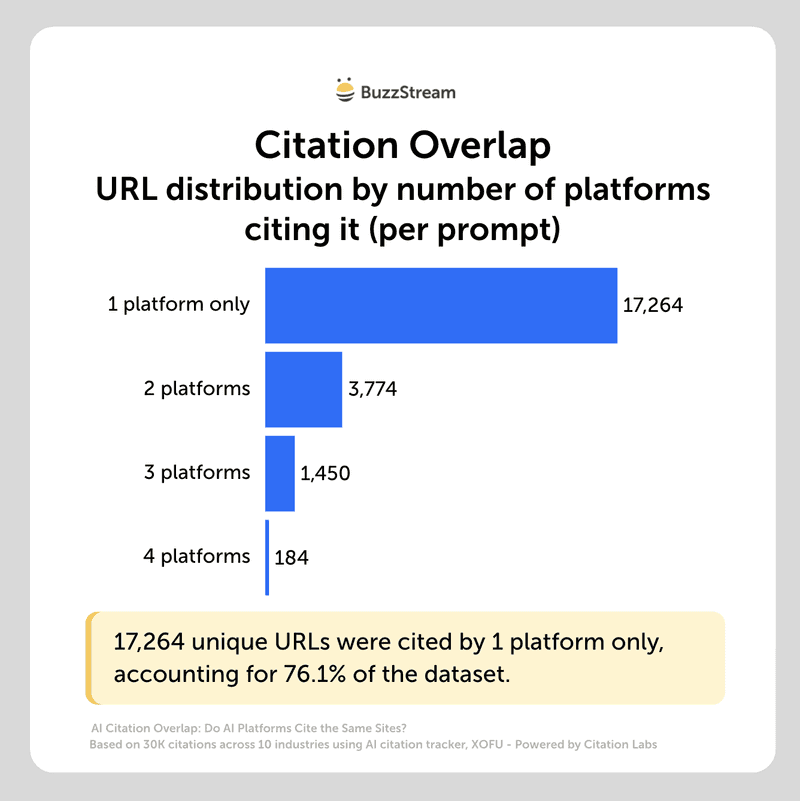
When looking at unique URLs across the entire dataset (regardless of prompt), 65.8% of the 16,764 unique URLs appear only once.
96% of those identical citations came from pages I categorized as blog/content pages, meaning they weren’t news, social, or any type of transactional content.
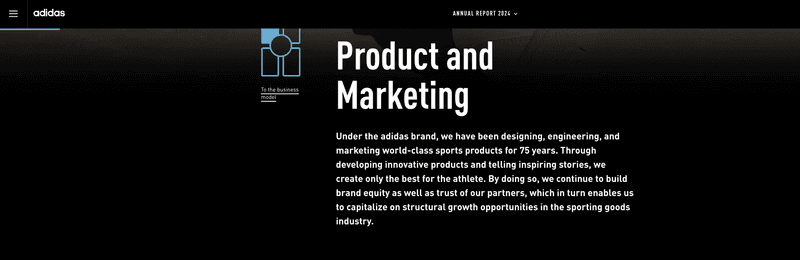
For instance, when we asked “What products or services does Adidas offer?”, all four platforms cited Adidas’ 2024 Annual Report:
But let’s look next at how the different platforms differ.
Google’s AI Clusters Together, But Not That Tightly
The strongest overlap is between Google AI Overview and Google AI Mode, with a Jaccard similarity of 37.4%.
Surprisingly, the three Google platforms don’t overlap much.
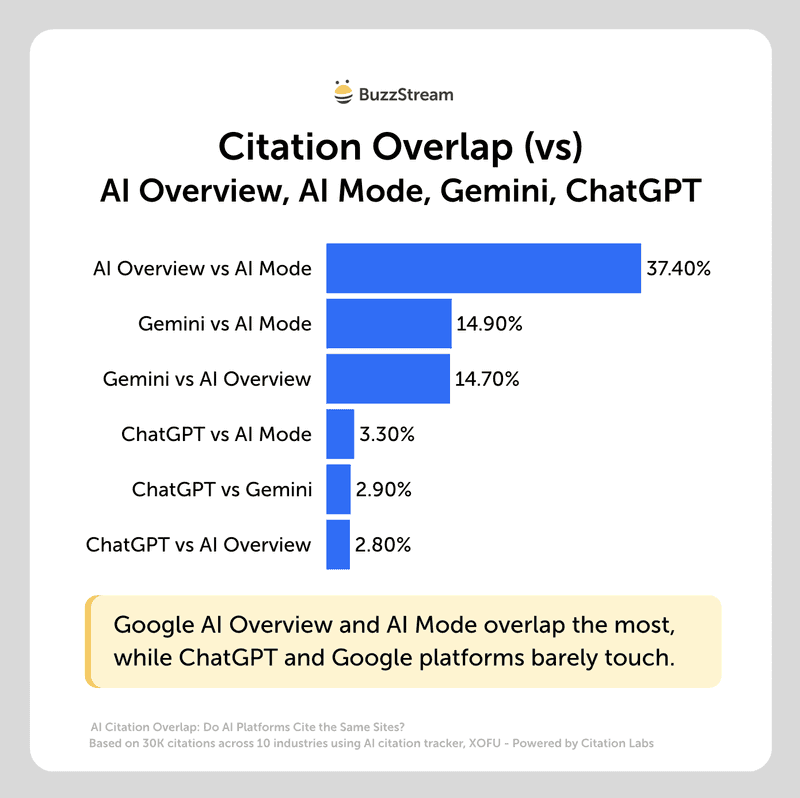
Then, as you can see, ChatGPT barely overlaps with Google properties at all.
When They Do Agree, Wikipedia is the Main Source of Consensus
Of the 184 URL–prompt pairs cited by all 4 platforms, 65 (35%) involve Wikipedia.
Almost every “What does [company] do?” and “What is [brand] known for?” prompt in my study returns the brand’s Wikipedia page.
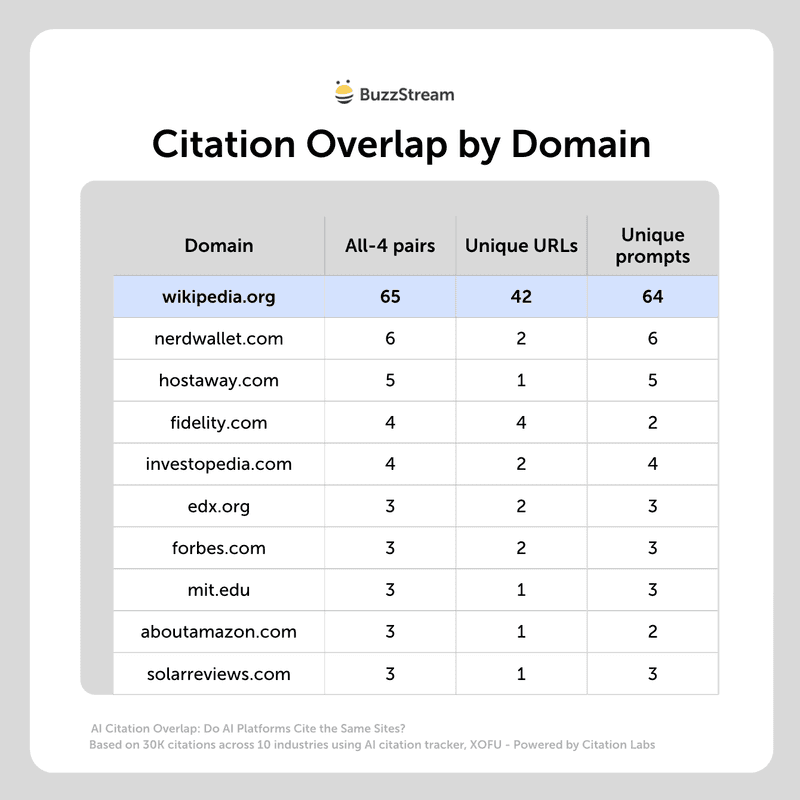
It appears to be the single source all four AI systems reliably converge on for questions about brand awareness and company identity.
But does that mean you should run out and try to get a Wikipedia profile created?
Probably not; Wikipedia made up just 3.8% of all 30,000 citations in the dataset, which is one domain out of 5,587 unique domains cited across the study.
(Not to mention the fact that Wikipedia is notoriously difficult to game.)
What Does This All Tell Us?
If you are trying to build citations based on most-cited domain lists, you are chasing the wrong thing.
What gets cited depends almost entirely on the platform (and the prompt, which we covered extensively in our previous study).
The best way to show up in AI is to build a consistent set of messages and a brand identity across the web to ensure your brand is measured.

 Check out the BuzzStream Podcast