 End-to-end outreach workflow



Table of Contents
- Digital PR isn’t a direct line into AI answers.
- Aim for mentions, not citations.
- Brand is a qualifier for news coverage.
- Siege’s rough baseline for a traditional news fit is 20,000+ monthly searches for the brand, plus a pain point that’s both deep and wide.
- Stress test every asset: could this data go on a sales page?
- Qualify citation targets by real reach, not citation counts.
Ross Hudgens, CEO and founder of Siege Media is back on the BuzzStream Podcast for a second time.
Ross was my boss at Siege, and I consider him one of the most influential figures in my career.
He’s also a published author now.
His new book, Generative Engine Optimization: The Definitive Guide to AI SEO, hits the shelves Oct. 12.
In this episode, we discuss all the digital PR sections: how media placements actually feed AI answers, mentions vs. citations, the pain point matrix, best X lists, citation targeting, syndication, and what Ross has changed his mind on. Our first conversation focused on product-led PR, which we touch on a bit in our podcast.
Let’s get into it.

Below is a slightly edited transcript:
What’s changed about Siege Media’s approach to digital PR, and why?
Ross Hudgens: When we originally paused digital PR, I think it was a little bit of an extreme move looking back, which is why we added it back. The tension I felt was that we were doing a lot of low-impact outreach. That’s what we stopped doing.
There was still room for high-impact, high-leverage outreach, mentions, and brand building.
Even in the post where we announced that change, we still talked about the value of high-leverage digital PR. So that’s the piece we re-added.
We did not add back the mid-tier outreach. We still look for high-influence publishers that maybe aren’t technically news publishers.
That hasn’t changed. But it’s a more limited sample.
It’s not blasting out to hundreds of people. It’s more targeted relationship building with a group of 20 to 40.
We’ve also taken some of that transition with us.
Previously, we talked a lot about organic link building and organic link assets, and I think you can merge those concepts.
We can build a digital PR asset with survey data or proprietary data, and then we should repurpose that data across all our content and also supportive content that can rank and drive organic links too.
There’s still a lot of high-value outreach out there.
There’s a lot of discussion about the decline of web publishing, news publishers’ traffic going down, and fewer of them being around. That’s true. It’s definitely getting painful out there.
But I think the right way to do it is to think about it as a holistic package.
That’s how we’re thinking about it now: not an isolated asset, but “here’s a campaign, and here are all the things that tie to this asset.”
What’s the through line from a media placement to an AI answer?
Ross Hudgens: It depends on how you’re describing it. Some people may define digital PR as getting a best X placement.
That is 100% getting you into the AI answers that matter.
If you’re creating an asset that’s a data study and report, which is top-funnel thought leadership, I think it will be cited as a data point.
Then, indirectly, it can lift your bottom-funnel pages, which will then get mentioned more often. That’s the cycle, rather than thinking digital PR as a concept will get you a lot of value and mentions on its own.
Of course, data points surfacing in LLMs is great, because they’ll actually link to data.
That’s additional visibility, brand awareness, brand building. All good things.
But I don’t think raw overall citation growth for your website is as important as the increase on transactional terms.
So that’s how we think about it.
You’re contributing to that. The data can also drive freshness on other assets.
You can add it to posts relevant to a certain question or category, or wherever that proprietary data set applies, and those will get surfaced more often. Maybe that includes a bottom-funnel asset that gets a direct AI visibility increase.
So it’s both direct and indirect: direct on top funnel, indirect on bottom funnel, and in some ways direct through the side leverage of that data.
Should you be aiming for citations or mentions within an AI answer?
Ross Hudgens: Mentions. There can be some value to citations for data-seeking queries, because you’re probably going to get clicked more often.
An example I give in the book is “how much does digital PR cost?”
There are a ton of references to the ranges people spend on digital PR, and every single reference has a citation. It doesn’t explicitly mention you, but maybe BuzzStream is cited as one of those articles.
You’re probably going to get a click a decent amount for a transactional, bottom-funnel search.
But the click-through on citations is abysmal from what I’ve seen.
So in that case, by all means, if your citation is influencing the mention, that’s great. I don’t think a top-funnel digital PR asset is doing that, though.
I think that’s where the misguidedness is.
If anyone is selling “Pepsi showed up a hundred more times unlinked, and therefore I’m getting mentioned as the best soda more often,” and those mentions aren’t on a best soda article, I just don’t think that’s happening.
I think that’s kind of pie in the sky.
What do you mean by digital PR being an “accelerant” for brands, and does that mean small brands can’t use it?
Ross Hudgens: It’s a good question.
As we’ve reintroduced this service more heavily and evaluated what has and hasn’t worked over the years, one of the qualifying factors is undoubtedly brand.
These newsrooms are shrinking, and reporters’ hides are essentially on the line for what they cover and what they don’t.
Their reaction is going to be to go to people they trust and people they know their readers will trust.
As a byproduct, one of our rough baselines is: does the brand have above 20,000 searches a month?
This is not an absolute rule.
But for traditional news, I think it’s a nice threshold. The reporter maybe knows you, and an average consumer maybe knows you. It’s a decent qualifier for whether you might be a fit.
Of course, there are exceptions. Let’s say Andreessen Horowitz invested a hundred million in Adams, which is that new Uber spin-off company. Maybe that already has 20,000 searches a month, but there may be exceptions where you’re probably going to get there eventually. As long as you have that credibility piece, which is kind of the undercurrent, I think that’s an important component.
There’s also a naming discussion. Even we call it digital PR on the B2B side, where there are quality mid-tier publishers you’re reaching out to, but not necessarily traditional news. I still think the value of a data asset for a niche B2B company is real. We’re calling that research reports more often.
But are we pitching that to CNN? No, I don’t think that’s a good use of time. Where we’re going instead, and I think there’s going to be more of this, is reaching out to influencers. Even paid distribution of these assets, maybe on LinkedIn, to get the word out that way.
It’s just a divergence in who we’re reaching out to. B2B is a little more social influencers. B2C is still more that news segment. And brand awareness all the way through is a critical check.
Vince Nero: So does this mean a startup in the construction space isn’t going to get any value out of digital PR? Or is it just different strategies?
Ross Hudgens: Probably different strategies. Traditional PR is definitely still valuable.
One of the things I talk about in the book, and I don’t know how much this overlaps with you and BuzzStream, is a traditional PR strategy that I think makes a ton of sense for GEO: trying to win awards, leveraging them on your site, and doing a press release about the award. Something like “best in G2 for outreach software.”
Putting that on your website makes it easy for LLMs to find. I’m also seeing those press releases in LLMs a decent percentage of the time. So it’s a nice cycle. Run a Claude workflow to monitor the awards you should apply for.
You may know this, Vince: at Siege, we never really applied for awards because I felt like we didn’t need to. I still haven’t done that, but maybe we’ll start considering it.
Vince Nero: I feel like the award thing is huge in the UK. Another thing I’ve seen, especially if you’re a local business, is local sponsorships getting you mentioned in local news. Say a local plumber sponsors a race.
A thing I’ve seen a lot is law firms sponsoring Ubers. On July 4th, a law firm will sponsor all Ubers at night to curb drunk driving. That’s the connection to the brand, and they get coverage from local pubs. So I think there are ways to do this where you’re not doing huge research reports. You don’t have to go all in. There are still smaller ways.
How does the pain point matrix work?
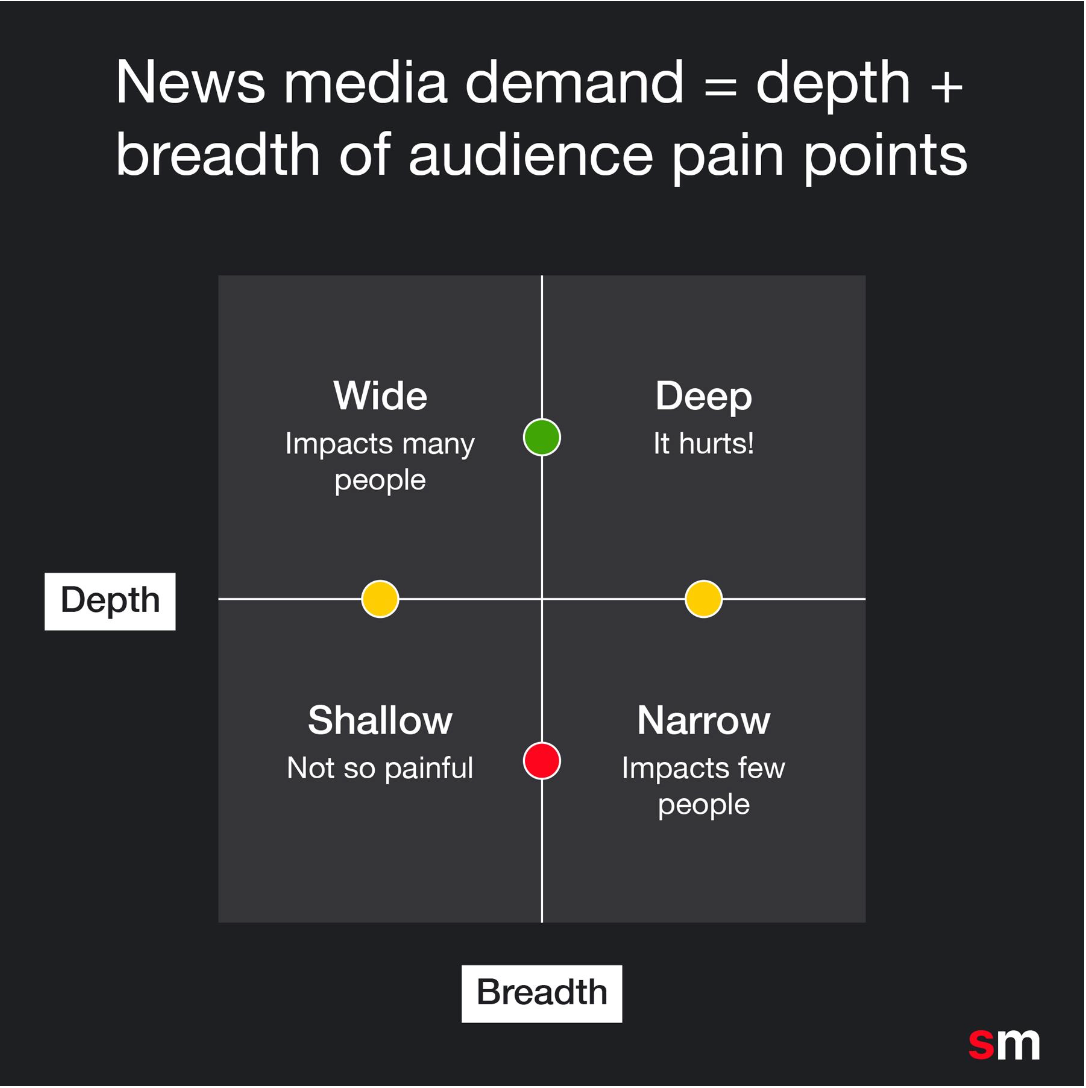
Ross Hudgens: It’s not super straightforward, but the graphic will help. It’s essentially how deep your pain point is and how wide it is.
Is it a painful problem?
That’s the depth. Is it shallow or deep?
The spread is how many people it impacts. For a digital PR fit, you need a painful problem that impacts a lot of people.
This goes to the B2B conversation. A lot of B2B industries are relatively narrow.
They don’t impact very many people, and because of that, they’re not going to be interesting to the media.
No offense, but it comes to mind because I’m talking to you, Vince: outreach software may not resonate with CNN. Our work probably, well, maybe AI search could resonate. Who knows? Maybe I don’t know what I’m talking about.
But something more niche may not be the best fit.
How do you know if you’ve stepped too far outside your core audience?
Ross Hudgens: It’s a good question.
We use this more to evaluate client fit than topic-by-topic fit, although it definitely applies to topic fit as well. We try to stress test it in that moment.
Things like small business funding or loans, or just the pain of running a small business, are wide and deep.
Another example: I don’t have a stapler.
That maybe impacts a lot of people, but it’s not a very deep problem.
It’s pretty shallow.
So Staples maybe can do traditional PR.
Actually, that’s not the best example, since they obviously sell other things.
But you get what I’m saying. Boring products may not resonate because they’re not tied to a painful problem.
Vince Nero: I guess it’s all relative to the client and the industry. I always use construction because that was an industry we had for a while when I was at Siege.
It’s a tough industry and a boring industry, but you can get coverage in that particular niche.
You’re just not able to spread it out and get CNN coverage.
Although I feel like we did, it wasn’t directly related to the brand.
We did “Can you recognize this city skyline?” and the connection was cities, buildings, construction.
It’s two points away. It gets a little further away.
So the question comes back to: how does this relevancy play into AI and recommendations? That should be the guide.
Ross Hudgens: Hugely, honestly.
I look back at some of that work and I’m not amazingly proud of it, for that exact reason.
It’s not product-led enough.
That probably wasn’t generating sales for them. I don’t think they pivoted their whole business model because of our digital PR assets.
That client is a decent example.
We went topically connected, but we weren’t actually speaking to the ICP.
If you speak to the ICP, that’s where the data gets useful everywhere.
But an asset on how skyscrapers get made isn’t a data study, and you couldn’t reuse it much across their sales pages.
That’s typically the stress test: could this go on a sales page?
Should digital PR be judged on links and coverage, or on the bottom line?
Ross Hudgens: An additional metric we’ve been adding is: do our digital PR assets have an above-average engagement rate and pages per session?
Just traditional blog metrics.
If we can’t point to that, we probably created an off-brand thing.
If people aren’t sticking around and clicking around, that’s a sign.
Yes, conversions may still be challenging for digital PR.
Hopefully we can get multi-touch attribution set up to connect some of that.
But if you can’t, you’d ideally report on engagement and show this asset is better than your average asset, hopefully significantly better.
If you can’t do that, you’re probably pretty challenged.
And those days, Vince, of a hundred links to an off-topic asset, which maybe could carry outsized weight, are pretty challenging.
Even hearing you say that, I realized how easy it is for an AI model today to look at a set of links and know, “This is not actually about construction software, so let me ignore this link.”
That seems so easy for the intelligence of these models now.
Of course, the only pushback is that at scale, they may do a faster version.
But that seems like a pretty delicate thing to feel confident about and hang your hat on.
How does expert commentary play into GEO and AI exposure?
Ross Hudgens: It’s good to get executive commentary in front of the right people, and it undoubtedly has value.
I think it’s a pure brand play. The link mentions from it are valuable, of course. The direct effect on GEO, I’m not so certain.
From my point of view, it’s an overall halo effect and an indirect thing.
Vince Nero: So a good version would be highly relevant and maybe speak to a pain point.
Ross Hudgens: In an ideal world, and this is what we’re doing more of compared to before, when we were sending a hundred one-off asset emails.
Yes, we’d have relationships in there.
But now, given the finite landscape and the finite relationships we have, maybe we have 40 tight-fit reporters we can reach out to.
Through a one- or two-year campaign, we should reach out to each of those people many different times, maybe once a month.
In that context, we can volunteer our thought leader at the company to be part of the conversation.
Hopefully they’re both covering our assets and using us as a conversation piece in their own stories.
That should be a natural byproduct of relationship building.
HARO and Qwoted, sure.
Transparently, I haven’t been as deep on that recently.
I’ve just seen very varied quality in what you get out of it. I know it’s getting really saturated with AI responses, so the competition for that inbox is partially why you need to be so relationship-driven.
It’s going to be very hard to get that first bite of attention.
Vince Nero: For sure. It feels like the smart agencies and digital PR people are proactively reaching out to journalists to build those relationships: “I’m an expert in this space,” or “Here’s an expert in this space.
If you ever need commentary, here’s the person.”
I’ve also heard of people saying, “This interest rate decision is coming down the pipe tomorrow. Here’s my expert, who’s prepared to talk on this topic, this topic, or this topic, depending on the outcome.” It’s circumventing some of those noisier platforms. But my overall question was the through line to AI, and it sounds like your takeaway is that it’s more of a halo effect.
Ross Hudgens: I would say halo effect. It’s a positive thing to do for sure, but I don’t know about a direct effect, besides data studies.
Should you build “best X” lists on your own site?
Ross Hudgens: We still recommend that, a little less than we did before.
Now we’re saying if you have a landing page, don’t do the equivalent roundup on your own site.
We’re also saying it’s primarily a B2B motion.
You need to see people like you there.
That’s normally the situation, which means you’re not trying to cannibalize yourself.
This often means you have a long-tail version.
An example I give: we have GEO all over our site.
Our landing page is optimized for GEO.
AEO has the same meaning, of course, but we don’t see overlap on the SERP.
We could create a best AEO agencies page, because having an AEO page and then a GEO page would be weird, in my opinion.
So a roundup there may be fruitful. That’s the first step.
But let’s assume we have fewer of those done ourselves.
Hopefully we rank for our first-party pages, but if we don’t, you need to work with third parties.
It’s a dependent question, but it comes down to the PR component and your audience.
I’ve heard it defined most frequently as performance PR.
Some people just call it digital PR. It’s about who you’re talking to.
I think it’s most attractive when you can offer an affiliate link so they get residual referral income. So it’s essentially an affiliate motion.
In some industries, they may call it influencer marketing, where you’re reaching out to an influencer who’s present on YouTube.
YouTube is such a huge citation source right now.
You have someone impactful in e-commerce, et cetera, create a best X roundup for you.
You don’t really need the residual there, because it’s going to be so small.
People generally don’t click links off YouTube videos. It’s abysmally low.
Most of them are going to ask for money up front.
They may ask for four to six thousand for a best X video that features you.
You want to do that at relative scale.
If you have an e-commerce site, you sometimes have 200-plus SKUs, so you could work with a breadth of publishers who are looking to monetize.
These are often different people at the organization.
You build relationships with them and rinse and repeat that motion.
Ideally, you see some credibility that they already have these lists, and you reach out to them.
A lot of the social motion is an upfront, one-time payment.
If they have a website, it’s a residual payment. So you just have to have the program set up.
If you’re niche, you don’t necessarily need that.
At Siege, we’re not going to have a traditional affiliate program because our sales cycles are so long.
But there’s still an audience. There are influencers and YouTubers who could create a best outreach software video. Because of that, that motion could be worthwhile to influence LLMs.
Where’s the line between using best X lists and abusing them?
Ross Hudgens: Our recent recommendation, if our first year was the year-one understanding of AI, this is year two.
You have your citation breakdown of the kinds of sites you see.
A lot of B2B will see a lot of first-party sites there.
The v1 look is to just do what that says.
If it says 60% of the citations are websites like mine creating listicles, the natural incentive for everybody is to go create a listicle. But what I think is the 2.0 understanding is that it’s not destiny.
LLMs, I think, want third-party opinions. They just don’t exist in many industries. So we can force that hand by spinning up that motion.
We may need to incentivize people with some cash to partially do that, but we can reach out to YouTubers and affiliates.
Maybe we have a stronger-than-average affiliate program that pays above market, where previously publishers weren’t interested, and now we can just outsize pay.
Because the value to our pipeline is so large, and you can often be the only one they list as part of your contractual negotiations, it could be worthwhile to pay a lot of money to someone who’s influential.
Maybe it’s just one source in that market that’s really authoritative as a credible third party.
It could definitely be worth getting that link.
Vince Nero: I feel like the AI software does a good job of simulating what users want.
To your point, when you see the scales tip to one side, either the data’s not there or they just haven’t fixed it yet. They haven’t honed it to the point where it takes third-party recommendations into account, but it will. So I view most of these things as a flash in the pan.
I think that’s something you’ve always been really good at: long-term thinking and a more consumer-based thought process, rather than jumping at the next shiny thing.
Ross Hudgens: I think that’s reflected a lot in citations.
You’ll see citations and everyone will try to go after them.
I’ve seen that in the third-party landscape too.
People want sites that have a lot of citations in their market, but the problem with a lot of them is they have absolutely no traffic.
So one aspect of that future-minded mindset is asking where the influence is in your market.
You can often measure that by actual traffic to those URLs using Ahrefs, MCP servers, and the like. And of course YouTube: what’s the actual reach on their LinkedIn posts and YouTube videos?
Even if the direct citation isn’t huge, I think the long-term value is big.
Reddit is a good example.
Last time I checked, if you search “CRM software,” it’s a Reddit post ranking number one.
Maybe that’s lower in ChatGPT, but who cares? Very obviously, that’s going to impact people.
Other lists are going to get built partially off that Reddit thread, in my opinion anyway.
How should you qualify the sites that show up as top citations for your prompts?
Ross Hudgens: It’s multi-tiered, and to your point, you can go wrong at each tier.
First, pick prompts that have search volume, and use search volume as a proxy.
It’s not technically prompt volume, but if someone searches, say, “project management software” X times on Google, that’s a pretty good indication someone will use a small variation of that exact three-word phrase in an LLM.
So if we track a prompt for “what is the best project management software,” that’s a reasonable assumption.
The first part is: did we create prompts actually tied to clear demand?
The second layer is: am I tracking the right models, the ones that actually influence that audience?
What we’ve been saying recently is you shouldn’t track Perplexity at all.
It’s a default in a lot of tools because it started out relatively influential, but it’s dropping off.
It’s less than 1%. You should be tracking the Google models, ChatGPT, and Claude if you’re in B2B.
Those are influential for overall visibility.
So once you’ve picked the right models and the right prompts, you’re going to get the right citations, hypothetically.
Now we’re finally at the layer you asked about. We can look at those citations and question their long-term nature.
What we do there is look at the actual traffic to those same URLs in Ahrefs.
Depending on the URL and the type of thing it is, it may be enduring. An affiliate editorial listing tends to be more enduring.
A YouTube video probably isn’t, but we can check view counts.
We can check the reach of a LinkedIn post.
Those may indicate which choices have value for us.
Our stress test right now is: if we’re telling a client to spend 10,000 on a placement, it had better have true traffic.
Otherwise, we’re purely doing it for citations, and that’s pretty tenuous in duration. There have been some studies on that as well, showing they’re pretty short-lived.
What’s your take on syndication and its influence on AI?
Ross Hudgens: The same brand things are true.
I don’t think it’s a fit for niche B2B.
People could click a button because they feel like it is, but I think it’s hard to find niche B2B publications. For sure, if you can talk to one publisher, like a Construction Weekly, and get them to syndicate your article every time, do that.
That’s probably a smart thing.
I think it has value for brands right now.
We do it.
But I’m concerned about the long term.
All these publishers are getting hit.
There are fewer and fewer publishers over time, and their websites are getting less and less visibility with actual users seeing these articles. So there are generally fewer eyeballs per syndication, and the true value goes down.
It’s basically a lot of newsrooms making up for the lack of editorial teams.
At some point, that also means their websites stop getting frequented.
If they stop getting frequented, the sites start being less valued.
Then, of course, the remaining business model is a paywall. Hopefully it’s good for visibility, but obviously it’s not super great for search right now.
Vince Nero: I think the other thought with syndication is that you get it out there, other people see it and potentially write about it, and that can feed into the brand awareness layer.
For what it’s worth, we did a big study on news citations, and syndicated content made up 0.09% of all the citations or something.
So I don’t think it’s something where you do it and expect to show up all the time. But that makes a lot of sense.
Ross Hudgens: It’s a distribution lever, though.
We’re doing it if it can be done at a reasonable price, it’s part of your strategy, and it’s enduring.
It could potentially be useful for some sites, especially B2C.
But I think it’s something we’ll need to keep checking in on, especially as it gets more popular.
There’s this rub: more people are syndicating because it’s harder and harder to get mentions, so it’s getting saturated, and fewer people are probably reading the actual articles.
That has some not-so-great outcomes at some point.
Vince Nero: I think that’s the whole reason there’s the new Forbes executive column, or whatever it is.
These sites roll out paid sections where you can write whatever you want. I forget what they call it. You know what I’m talking about?
Ross Hudgens: Yeah, I saw the Inc. 5000 has a leadership forum. I was just talking to them about the book a little bit.
What changed your mind while writing the book, and what would you invest more or less in today?
Ross Hudgens: The award motion is one I think every company should do.
We’re not always doing that ourselves versus recommending it, because sometimes the award motion and the press release side is an internal motion.
So I think that’s big.
In terms of writing the book changing my mind: repurposing data across content, which we call the data flywheel, is a little pre-book, but still very true overall.
But we’re going more influencer and social.
That’s something I’m thinking about a lot lately for digital PR: paid distribution with people who actually have reach.
As the true editorial web declines, something has to grow.
I’m seeing LinkedIn grow in visibility right now. I
think they’re finally solving the AI slop problem.
You can block people who aren’t connected to you from commenting, and I think that helps a ton.
If everyone does that, I think we’ll finally have pretty good content on LinkedIn, and then we’ll see Google reward it.
I think other networks will most likely follow suit.
If we have a dead open web, the slack has to get picked up somewhere else.
So as PR practitioners, if we start leveraging those networks proactively, even if we’re a little early right now, I think we’ll be on time when it really starts being valued.
When does the book come out, and where can people buy it?
Ross Hudgens: October 12th is when we’ll officially have hard copies available.
You may be able to find digital copies, TBD, by the time you listen to this.
Find it on Amazon by searching “Generative Engine Optimization” or “Ross Hudgens.”
In our top nav, in the Learn dropdown, we also have a /geo/book URL with more detail on what’s included, the case studies, and lots of places to buy it.
Links to buy:


 Check out the BuzzStream Podcast