
 End-to-end outreach workflow




Table of Contents
- 1–2-year-old domains averaged 21.6% open rates
- 5–6 year old domains averaged 34.9%
- Established agencies performed no better than brand-new solo senders on young domains
- A young custom domain (under 3 years) actually opens worse than Gmail
- Even with identical, fully-configured authentication, young domains still underperformed old ones
There’s no shortage of advice on how to improve email open rates: better write better subject lines, smarter send times, more personalization.
Most of it focuses on the email itself.
But there’s a lot of technical information that can impact opens. (Ever hear of SPF, DKIM, and DMARC?)
A question I get a lot is around domain age.
Does sending from a brand new email address really impact email engagement?
So I decided to look at that by analyzing send data across 1,785 BuzzStream domains and 14.3 million emails to see if and how domain age influences open rate performance.
In this post, I’ll walk through what we found, how we ran the analysis, and what it might mean for your outreach setup.
One note on custom domains vs Gmail before we get started:
Everything in the domain age sections below is based on custom domains. Free providers like Gmail don’t have a domain age that’s remotely meaningful for our purposes (but more on that later).
If we’d left Gmail mixed in (which is by far the largest sending domain used by BuzzStream accounts), its 2004 WHOIS registration date would skew everything.
How does domain age impact email open rates?
From 1- 2 years to 3- 4 years, the open rate jumps from 21.6% to 29.6%, an increase of about 8 percentage points for older domains (a 37% relative increase).
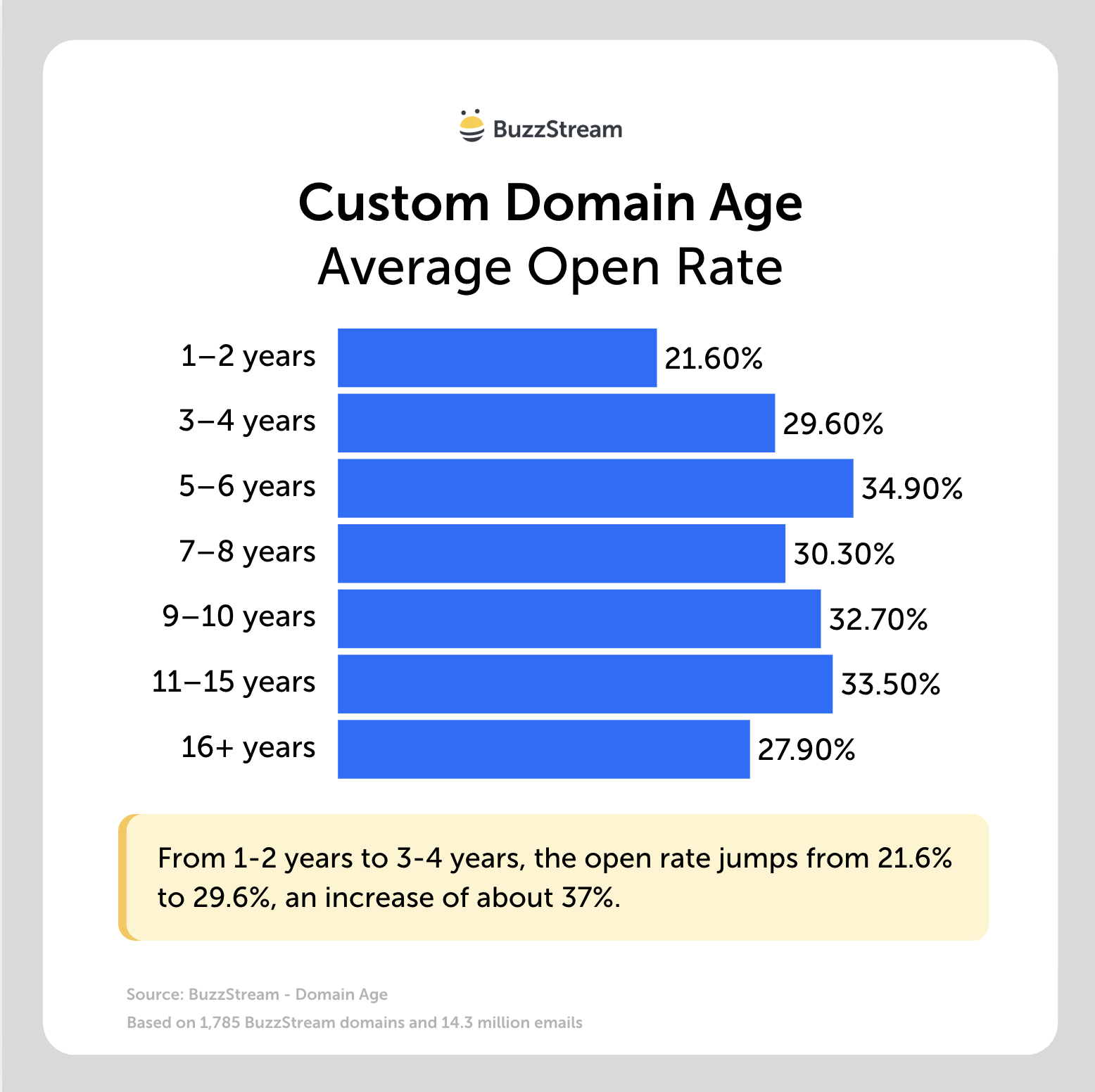
The open rate varies in subsequent years but never drops below 27%.
Here is a look at the domain age table format:
| Domain age | Open rate |
|---|---|
| 1–2 years | 21.6% |
| 3–4 years | 29.6% |
| 5–6 years | 34.9% |
| 7–8 years | 30.3% |
| 9–10 years | 32.7% |
| 11–15 years | 33.5% |
| 16+ years | 27.9% |
Interestingly, the oldest domains (16+ years) dipped slightly to 27.9%.
My guess is that very old domains tend to belong to larger, more established organizations with more people sending, opening up the potential for poor email practices from time to time, dragging down sender reputation. (But that’s me speculating, not something I can confirm with this data.)
Note: Before you grab the pitchforks, yes, Apple Mail Privacy Protection (AMPP) inflates email open rates. That’s why I’m not focused on the exact percentages here. I’m comparing how different groups of senders perform relative to one another.
My first reaction was: maybe this has nothing to do with domains.
Maybe people using newer domains are simply worse at outreach.
I’ve been on tons of customer calls where new link builders and digital PRs are making really obvious mistakes in subject lines and email targeting.
So I wanted to see if I could rule that out by looking at the same metrics, comparing seasoned agency professionals with the newbies.
Can a seasoned agency get better results with a young domain?
Seasoned agencies performed no better than brand-new, solo senders in our test.
Both had open rates of 25.3% across 95 domains (technically, 25.297% vs 25.268%).

This tells me the difference isn’t simply sender experience.
But what else can we rule out?
As you may or may not know, email authentication plays a big role in outreach.
Google and Yahoo announced strict requirements for bulk senders in late 2024, and Microsoft later announced similar requirements.
In a previous study, I found that domains without SPF, DKIM, and DMARC had open rates 74% lower than fully authenticated domains. That raised an obvious question: was domain age simply acting as a proxy for authentication?
So, next I wanted to see if this pattern held for authenticated vs. non-authenticated.
Does email authentication affect open rates when considering domain age?
Even among fully authenticated domains, the newest domains averaged just 17.9% opens, compared with 27.9% for domains older than 16 years.

I isolated two age groups with enough domains to trust the comparison: the newest (1-2 years) and the oldest (16+ years).
So, I feel better about ruling out authentication as the hidden explanation in the same way I ruled out sender experience.
Curious where your own domain stands? Check your SPF, DKIM, and DMARC setup with our free checker.
Email Deliverability Checker
One last thing I can check with my data is whether the new free email providers (Gmail) have better or worse open rates than custom domains.
Does domain age impact free email providers like Gmail?
A new custom domain under 3 years old performs lower (21.2%) than custom domains over 3 years old (31.1%) and free providers like Gmail (30%).

Here it is in table format:
| Provider type | Open rate |
|---|---|
| Free providers (Gmail, etc.) | 30.0% |
| Custom domains — under 3 years | 21.2% |
| Custom domains — 3+ years | 31.1% |
Even though established custom domains and Gmail accounts produced nearly identical open rates, it’s worth reiterating that free email providers like Gmail don’t really have a domain age.
They do, but it’s meaningless for our purposes.
What carries more weight are other metrics, such as sender behavior, engagement, and spam rate.
Why might domain age matter?
Domain age appears to be part of the broader sender reputation picture.
As with Google’s search algorithm, inbox providers don’t publish their ranking algorithms, so we can’t say whether domain age is used directly.
A more likely explanation is that older domains have simply had more time to build a positive sending history.
Here’s a visual:

Think of it like a credit score. Missing payments quickly hurt your reputation, but building trust takes time.
Google’s own documentation confirms that reputation is built gradually from sending behavior over time, not evaluated all at once.
Email reputation appears to work similarly, with domain age serving as a useful proxy for accumulated trust.
What does all of this mean for you?
None of this proves domain age directly causes higher open rates.
This is correlational data, and I can’t rule out every possible confounding factor.
What I can say is this: domain age remained associated with higher open rates even after I compared experienced and inexperienced senders, authenticated and unauthenticated domains, and free email providers versus custom domains.
Not sure how old your own sending domain is? Our free domain age checker will tell you — and show you where you land against the benchmarks in this study.
Domain Age Checker
So, if you’re launching outreach from a brand-new domain, don’t panic if your early open rates aren’t where you want them to be.
Proper authentication, good targeting, and consistent sending still matter, but it’s going to take some time to build a sender reputation.
Avoid mass spray and pray email outreach and really focus in on emailing the right people and trying to develop relationships.
If you follow that as your email outreach mantra, you will stack the deck in your favor.
Methodology
I pulled domain-level send data from BuzzStream covering approximately June 2025–June 2026 — open rate and send volume for 1,785 unique sending domains and 14.3 million emails sent. Unknown email providers were excluded.
For each custom domain, I used WHOIS registration data to calculate domain age, bucketed into: under 1 year, 1–2 years, 3–4 years, 5–6 years, 7–8 years, 9–10 years, 11–15 years, and 16+ years.
To test whether low open rates on younger domains reflected the domains’ ages themselves or simply less-experienced senders, I linked each domain to its BuzzStream account and split young domains by account tenure and sending patterns.
I ran a similar test for authentication. I compared open rates within the two age groups large enough to trust — 1–2 years and 16+ years — restricted to domains with all three records fully configured.
Finally, to check whether the free-vs-custom comparison held up once domain age was accounted for, I split custom domains into two groups — under 3 years old and 3 years or older — and compared each against the free provider category (Gmail, Yahoo, and similar) separately, rather than treating “custom domains” as one uniform group.
All rates are weighted by send volume. I also re-ran the analysis at multiple minimum send-volume thresholds — 100, 250, 500, and 1,000 emails per domain — to confirm the patterns weren’t driven by outliers. They held across every threshold.



 Check out the BuzzStream Podcast