Which Prompt Types Get the Most AI Citations? (New Study) - BuzzStream Check out ListIQ, our new AI-driven media list building product [Learn more](/listIQ)
[BuzzStream](https://www.buzzstream.com/ "BuzzStream")- Products
- [Newsletter](/newsletter)
- Resources
- [Get Started](/plans-pricing)
-
- [ListIQ](https://www.buzzstream.com/listiq/)
- [Research](https://www.buzzstream.com/outreach/research/)
- [Email](https://www.buzzstream.com/outreach/connect/)
- [Manage](https://www.buzzstream.com/outreach/manage/)
- [Report](https://www.buzzstream.com/outreach/report/)
- [Public Relations](https://www.buzzstream.com/outreach/public-relations/)
- [SEO Link Building](https://www.buzzstream.com/outreach/link-building/)
- [Content Promotion](https://www.buzzstream.com/outreach/content-promotion/)
- [Partner Recruitment](https://www.buzzstream.com/outreach/partner-recruitment/)
- [Plans and Pricing](https://www.buzzstream.com/plans-pricing/)
- [Pricing](https://www.buzzstream.com/listiq/pricing/)
- [Outreach](https://www.buzzstream.com/outreach/)
- [About Us](https://www.buzzstream.com/about/)
- [Getting Started](https://www.buzzstream.com/help/)
- [Try it Free](https://www.buzzstream.com/try-it-free/)
- [Watch Video](https://www.buzzstream.com/watch-video/)
- [Login](https://app.buzzstream.com/login)
- [BuzzStream Blog](https://www.buzzstream.com/blog/)
- [BuzzStream Podcast](/blog/category/podcasts/)
- [Newsletter](/newsletter)
- [Research](https://www.buzzstream.com/outreach/research/)
- [Email](https://www.buzzstream.com/outreach/connect/)
- [Manage](https://www.buzzstream.com/outreach/manage/)
- [Report](https://www.buzzstream.com/outreach/report/)
- [Public Relations](https://www.buzzstream.com/outreach/public-relations/)
- [SEO Link Building](https://www.buzzstream.com/outreach/link-building/)
- [Content Promotion](https://www.buzzstream.com/outreach/content-promotion/)
- [Partner Recruitment](https://www.buzzstream.com/outreach/partner-recruitment/)
- [BuzzStream Blog](https://www.buzzstream.com/blog/)
- [BuzzStream Podcast](/blog/category/podcasts/)
- [Try Outreach Free](/plans-pricing)
- [Download ListIQ](https://chromewebstore.google.com/detail/buzzstream-listiq/hcehackmbmpennfpdfjidbnbbgejjkif)
- [AI-Powered Media ListsNEW](/listIQ)
- [ End-to-end outreach workflow](/)
- [   ](/listiq)
- [Pricing](https://www.buzzstream.com/listiq/pricing/)
- [Help](https://help.buzzstream.com/en/collections/10251032-buzzstream-listiq)
- [Download from Chrome Store](https://chromewebstore.google.com/detail/buzzstream-listiq/hcehackmbmpennfpdfjidbnbbgejjkif)
- [   ](/outreach/research)
- [Plans and Pricing](https://www.buzzstream.com/plans-pricing/)
- Features
- Use Cases
[Home](https://www.buzzstream.com/) / [BuzzStream Blog](https://www.buzzstream.com/blog/) / Which Prompt Types Get the Most AI Citations? (New Study)
# Which Prompt Types Get the Most AI Citations? (New Study)
###### 
By: [Vince Nero](https://www.buzzstream.com/blog/author/vincenero/ "Posts by Vince Nero") • [AI](https://www.buzzstream.com/blog/category/ai/ "View all posts in AI") • [Research and Data Studies](https://www.buzzstream.com/blog/category/research-data-study/ "View all posts in Research and Data Studies")
Last Updated: June 10, 2026

Table of Contents
- **Prompt type has a major impact on AI citation behavior**.
- **ChatGPT cites the most sources**, averaging 18.2 citations per query.
- **Informational/exploratory prompts generate the most citations**, averaging 23.3 citations per prompt.
- **Evaluative prompts** show the **highest cross-platform agreement.**
Our [citation overlap study](https://www.buzzstream.com/blog/ai-citation-overlap/) looked at 30,000 citations across four AI platforms.
One finding deserved its own post: how prompt type influences the number of citations.
When we broke the data down by how questions were phrased, the citation behavior changed dramatically.
It’s not just which sources were cited, but how many, and how much the platforms agreed with each other.
For some quick background, we categorized our prompts into three types:
- **Brand Awareness** – “What does \[company\] do?” / “What is \[brand\] known for?”
- **Evaluative** – “Is X better than Y?” / “X vs Y: which should I choose?”
- **Informational** – “What’s driving \[industry trend\]?” / “Why is \[thing\] happening?”
Although this is a short post, it’s integral to understanding how these AI mechanisms work behind the scenes.
Here’s what the data showed:
## AI platforms average 12.6 citations
Based on our dataset, **AI receives an average of 12.6 citations per prompt.**
I’m starting here to give you a baseline and because, as you’ll see, this changes based on the prompts and platforms.
## ChatGPT cites the most sources per prompt, regardless of prompt type
ChatGPT has 18.2 citations per query, about 43% more than Google’s AI Overviews, AI Mode, and Gemini.
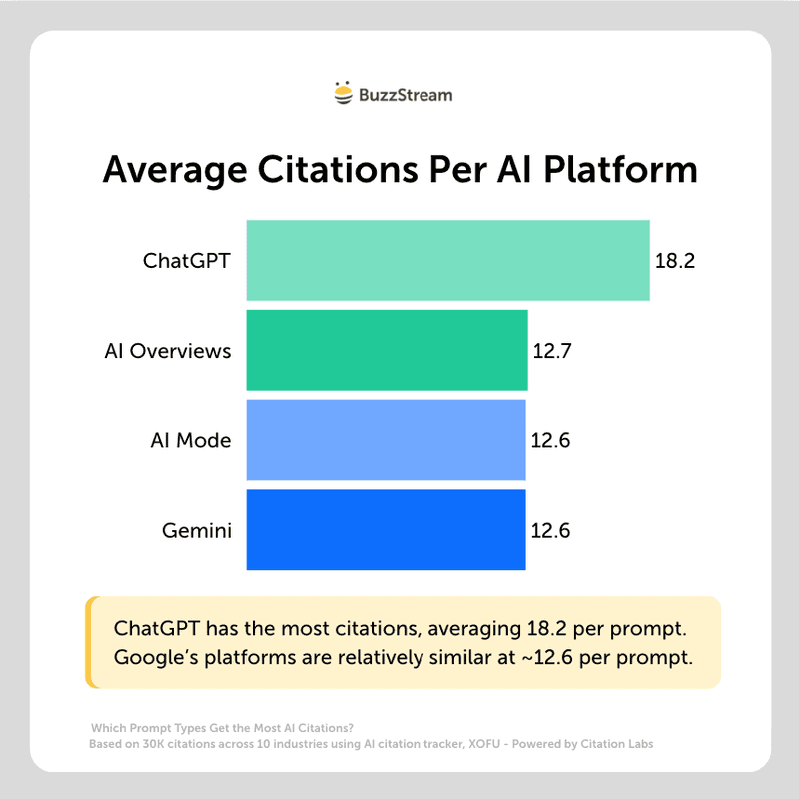
From other studies I’ve seen, such as this one from [SERanking](https://seranking.com/blog/chatgpt-vs-perplexity-vs-google-vs-bing-comparison-research/), the number of citations correlates with text length, and ChatGPT appears to provide longer answers on average.
But the real focus of this post is the impact of the prompt type.
Because, regardless of platform, you’ll soon see that the kind of question you ask drastically influences the number of citations.
So, let’s look at that next.
## Exploratory Prompts Generate Nearly 3x More Citations
Informational/exploratory prompts get 23.3 citations per prompt.
The dataset was designed to include 10,000 citations per prompt type, with equal representation.
But when you look at citations per prompt, the gap is significant.
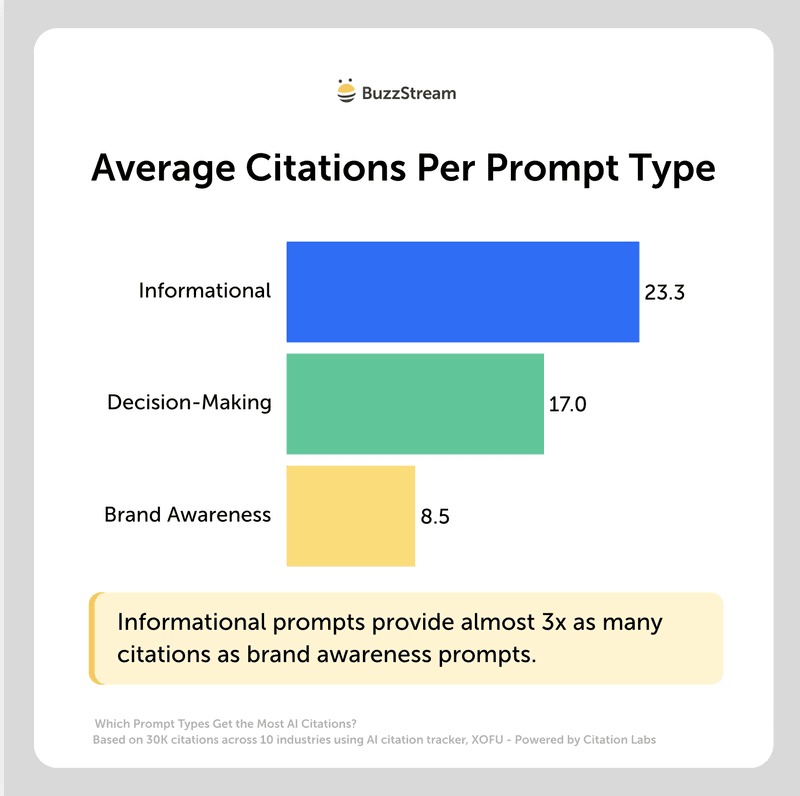
Exploratory/informational questions, which are open-ended queries about trends, causes, and market dynamics, generated about three times as many citations.
The reason is probably more straightforward than you think.
“What’s driving consolidation among healthcare providers?” has no single canonical answer, so platforms pull from a wide range of sources: market research, news coverage, academic papers, industry associations.
But a query like “What does Hilton do as a company?” draws quick conclusions from Wikipedia, the brand’s About page, and maybe one third-party source.
## Evaluative Prompts Have the Highest Cross-Platform Agreement
Evaluative, decision-making questions get the [most citation overlap](https://www.buzzstream.com/blog/ai-citation-overlap/), at 0.93% Jaccard similarity (1 is the most similar and zero is no similarity at all).
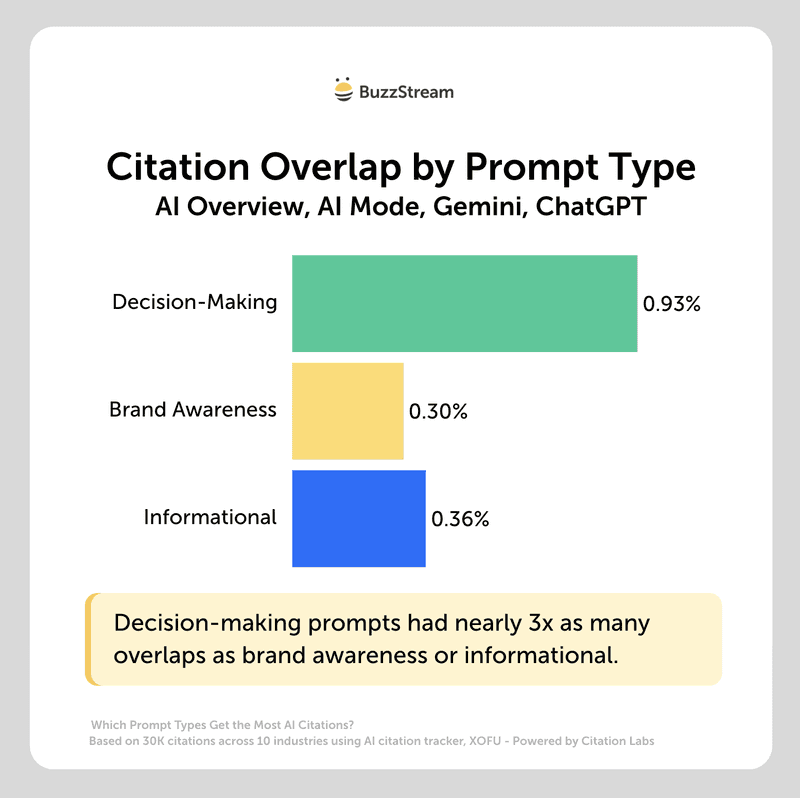
The all-4 rate for evaluative prompts (0.93%) is nearly 3x higher than for brand awareness or exploratory prompts.
For example, when prompted “”Airbnb vs Booking.com: which is the better option?” all four platforms cited this [Hostaway](https://www.hostaway.com/blog/airbnb-vs-booking-com-or-the-key-hosting-differences/) content:
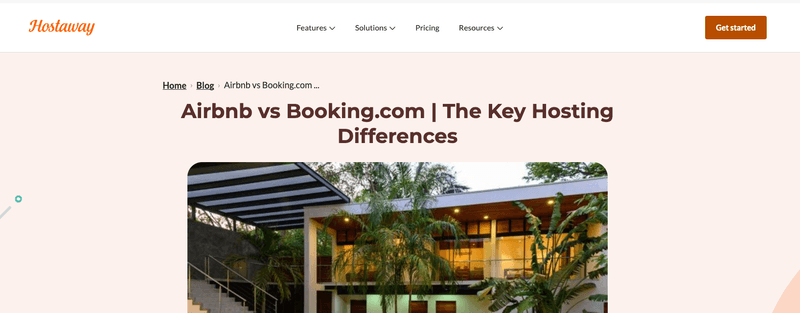
One article.
All four platforms.
Every rephrasing of the same question.
If your brand is involved in a common comparison and you’re not well-represented in the article that’s functioning as the canonical AI answer, you’re losing evaluative citations across all four platforms simultaneously.
Last, let’s see how prompt types differ across AI platforms.
## ChatGPT still cites the most content per prompt type
For exploratory prompts, ChatGPT averages 36.2 citations per prompt versus 20.8 for all three Google platforms.
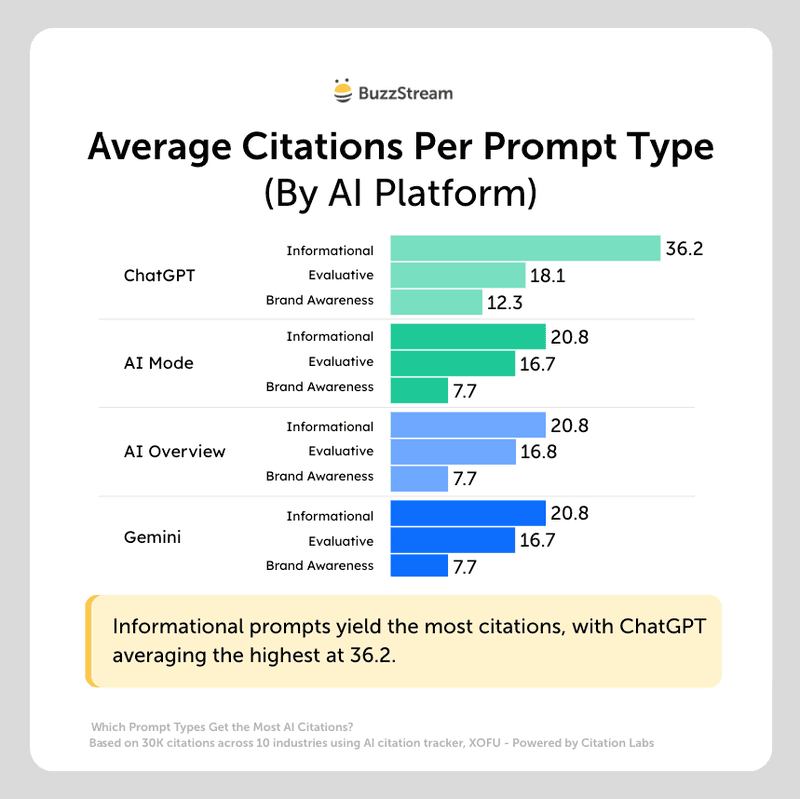
On brand awareness prompts, it averages 12.3 citations per prompt versus 7.7 citations.
Notably, all three Google platforms are nearly identical across every prompt type, suggesting again that they’re constrained by a similar output format.
## What This Means for Us
There are two ways to look at this:
### More citations, more exposure
The more citation slots, the more likely you are to win a spot.
In that case, you’d be optimizing for ChatGPT and more top-of-funnel informational queries.
But, just *getting citations doesn’t mean you will get a click*. In those cases, citations may turn into vanity metrics.
### Fewer citations, more likelihood of a click
If we flip it and look at the narrow queries with fewer citations, you may have a higher chance of getting a click.
In that case, you’d want to focus on optimizing for Google platforms and brand awareness and decision-making bottom-funnel queries.
Want to learn more?
Check out our [full AI citation study](https://www.buzzstream.com/blog/ai-citation-prompt-type-study/).
## Methodology
*Based on 30,000 citations across 595 prompts on ChatGPT, Google Gemini, Google AI Overview, and Google AI Mode, spanning 10 industries. Data collected using [XOFU](https://www.xofu.com), powered by [Citation Labs](https://www.citationlabs.com).*

## Vince Nero
Vince is the Director of Content Marketing at Buzzstream. He thinks content marketers should solve for users, not just Google. He also loves finding creative content online. His previous work includes content marketing agency Siege Media for six years, Homebuyer.com, and The Grit Group. Outside of work, you can catch Vince running, playing with his 2 kids, enjoying some video games, or watching Phillies baseball.
More Posts by [Vince Nero](https://www.buzzstream.com/blog/author/vincenero/ "Posts by Vince Nero")
Website: [](https://www.twitter.com/vincethenero "Follow me on Twitter")[](https://www.linkedin.com/in/vinnero/ "Follow me on LinkedIn")
##### Share this Post
[Follow us on X](http://www.twitter.com/buzzstream) [](https://www.google.com/preferences/source?q=buzzstream.com)1. ## Get the latest buzz delivered to your inbox
Subscribe
Leave this field empty if you're human:
5. Check out the BuzzStream Podcast[listen now](/blog/category/podcasts/)[](https://podcasts.apple.com/us/podcast/buzzstream-podcast/id1737236314)[ ](https://open.spotify.com/show/1DYD9IdKbALuWtlCs1IJVI)
## Continue Reading
Here are some related posts we think you might enjoy:
1. [ 
**How Many Journalists Are There in the UK? (2026 Edition)**September 2, 2026](https://www.buzzstream.com/blog/journalists-in-uk/ "How Many Journalists Are There in the UK? (2026 Edition)")
2. [ 
**How Many Journalists Are There in the US? (2026 Edition)**August 19, 2026](https://www.buzzstream.com/blog/journalists-jobs-in-the-us/ "How Many Journalists Are There in the US? (2026 Edition)")
3. [ 
**How to Phrase Your Subject Line to Get Opens \[New Data Study\]**August 5, 2026](https://www.buzzstream.com/blog/subject-line-phrasing-study/ "How to Phrase Your Subject Line to Get Opens [New Data Study]")
4. [ 
**Does Domain Age Affect Email Open Rates? Here’s What Our Data Shows**July 22, 2026](https://www.buzzstream.com/blog/domain-age-study/ "Does Domain Age Affect Email Open Rates? Here’s What Our Data Shows")
5. [ 
**How AI-Generated Summaries Are Impacting Your PR Outreach \[Webinar\]**July 1, 2026](https://www.buzzstream.com/blog/ai-generated-summaries-webinar/ "How AI-Generated Summaries Are Impacting Your PR Outreach [Webinar]")
6. [ 
**50 AI Statistics Digital PR and SEO Should Know (2026)**June 30, 2026](https://www.buzzstream.com/blog/ai-statistics/ "50 AI Statistics Digital PR and SEO Should Know (2026)")
1. - [Product](#)
- [About Us](https://www.buzzstream.com/about/)
- [Help Center](https://help.buzzstream.com)
- [Getting Started](https://www.buzzstream.com/plans-pricing/)
- [BuzzStream API](https://api.buzzstream.com)
- [Resources](#)
- [BuzzStream Reviews and Testimonials](https://www.buzzstream.com/reviews/)
- [Case Studies](/blog/category/case-studies/)
- [BuzzStream Blog](https://www.buzzstream.com/blog/)
- [BuzzStream Podcast](/blog/category/podcasts/)
2. [](https://www.linkedin.com/company/buzzstream/)[](https://x.com/buzzstream)[](https://www.facebook.com/p/BuzzStream-100067074183772/)[](https://www.youtube.com/user/buzzstream)
[Terms of Use](https://www.buzzstream.com/terms-of-use)[API Use Policy](/api-use-policy)[Privacy Policy](https://www.buzzstream.com/privacy-policy)[Google API Disclosure Policy](/google-api-disclosure-policy)
© 2008- BuzzStream
#### The BuzzStream Blog
- [How Many Journalists Are There in the US? (2026 Edition)](https://www.buzzstream.com/blog/journalists-jobs-in-the-us/ "Permanent Link to “”")
- [The State of the Journalism Industry in 2026 with Dominic Ponsford (Press Gazette)](https://www.buzzstream.com/blog/dominic-ponsford-podcast/ "Permanent Link to “”")
- [Personalization in AI Results with Garrett Sussman (iPullRank)](https://www.buzzstream.com/blog/personalization-ai-podcast/ "Permanent Link to “”")
[Read our blog](/blog)
3. SearchSearch
Last Updated on June 10, 2026 by [Vince Nero](https://www.buzzstream.com)
