 End-to-end outreach workflow



Table of Contents
- AI is far more likely to mention a brand than cite that brand’s website.
- Only 23.1% of brand mentions include a citation, so mentions and citations should be tracked separately.
- ChatGPT cites fewer URLs than Google’s AI products, but it is much more likely to name the brands it cites.
- Single-brand prompts produce the strongest overlap between mentions and citations.
- Open-ended category prompts are the hardest place to earn both a brand mention and a citation.
The rise of AI-generated answers has created a new kind of visibility question: do we want AI mentions or citations?
In many cases, the answer is both, but how your brand is surfaced by AI varies from case to case.
Understanding just how different AI cites vs mentions a brand can help us get closer to answering why they do what they do.
This study used Xofu to track 12,000 AI responses across Google AI Mode, Google AI Overview, Google Gemini, and GPT‑5.4‑mini, covering approximately 200 brands across 10 industries and three prompt types.
Here’s what we found about how AI platforms cite and mention brands.
How it works:
This study is based on two metrics that I think define the relationship between mentions and citations in AI answers.
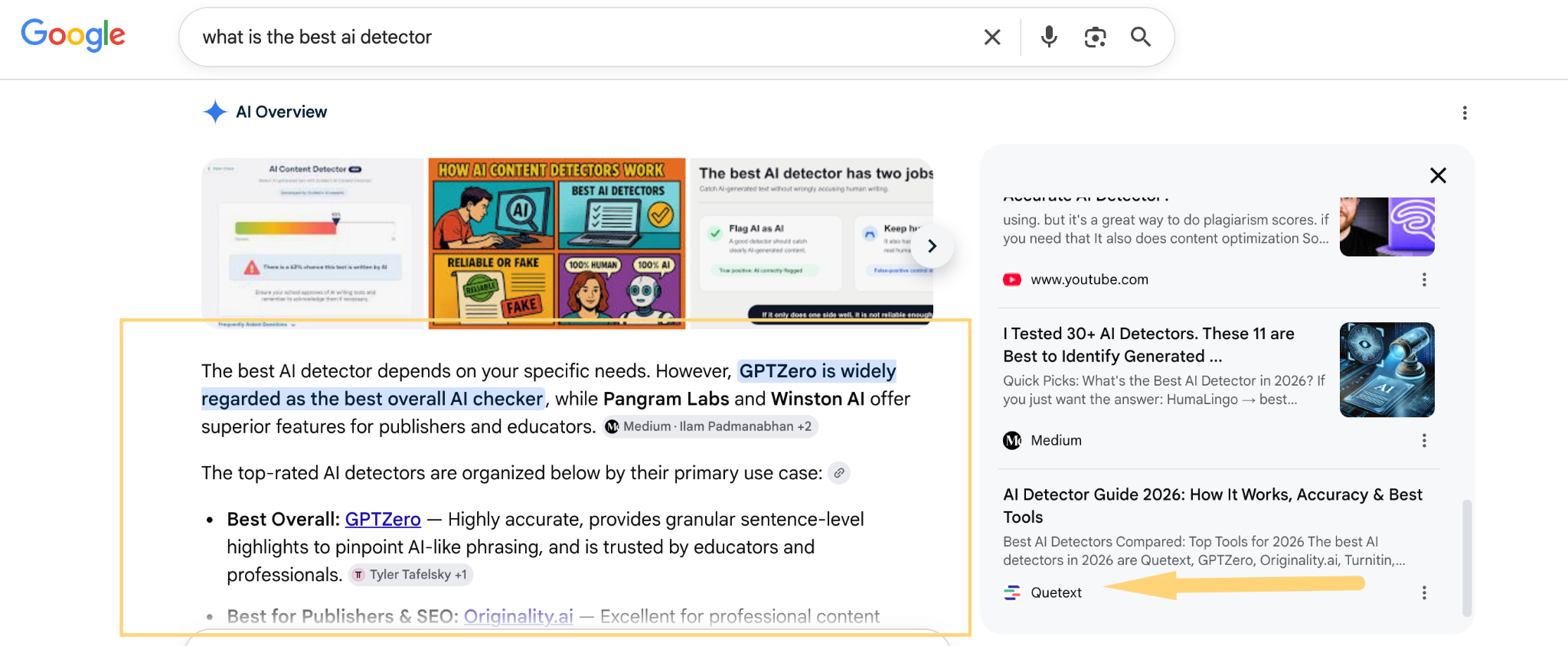
1. Of every time a tracked brand was mentioned in a response, how often did that same response also cite the brand’s domain?

2. Of every time a brand domain was cited, how often did the response also name the brand?
And onto the takeaways:
Only 1 in 4 mentions come with a citation
23.1% of brand mentions are also backed by a citation in the same response.
On the flip side, 69.9% of citations also include the brand’s name in the response text.
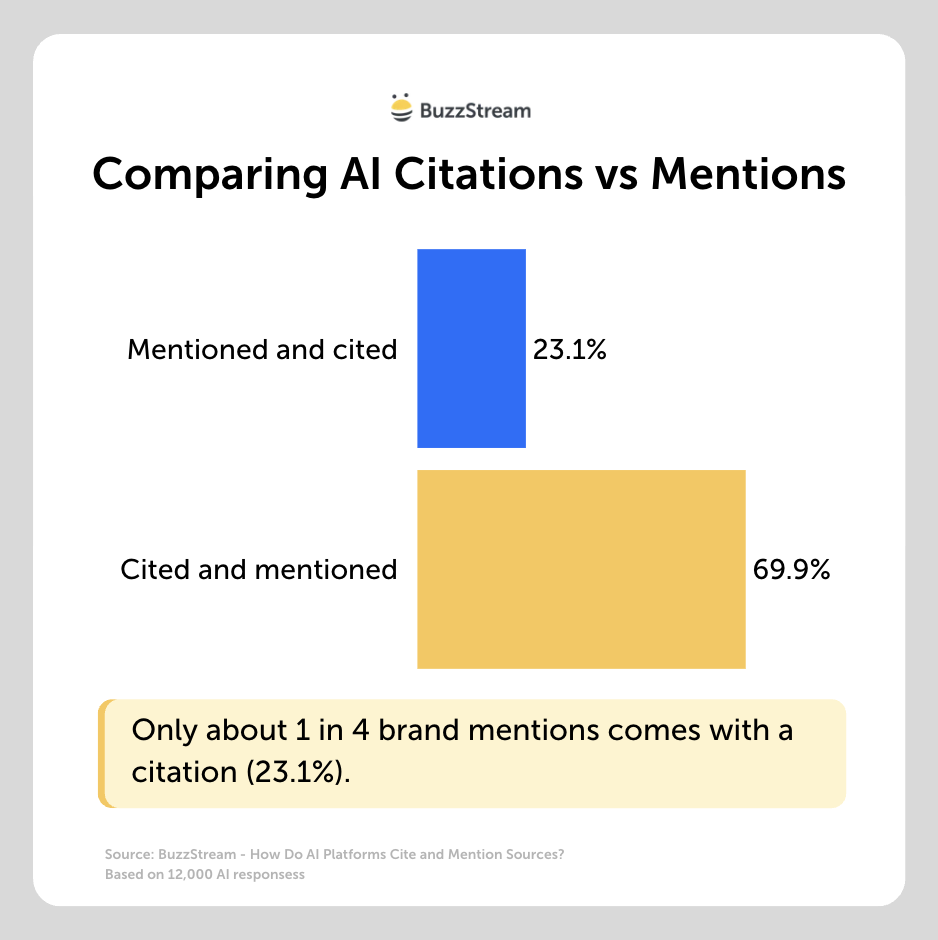
Basically, AI names brands far more than it uses their content in the citations.
Expert Opinions
Mentions and citations are two different AI visibility signals.

Founder, Citation Labs
A mention with no citation indicates memory from training data. A citation indicates that the model needed more evidence and is typically retrieving that evidence live.
Not all mentions or citations are endorsements, though. The model can name you as the thing to avoid.
This study tracks two signals, but the full picture we use in client work includes more: what the model reads but doesn’t cite, whether it recommends or merely lists you, and sentiment.
Track them all separately so you can work them separately.
Why the gap?
There are numerous reasons for this, but at its heart, it depends on how AI chooses citations.
Typically, AI uses citations to essentially “back up” its answer.
But to be included in citations, a brand must first have content that AI deems worthy of citation.
In our previous study on AI citations, we examined the types of content AI platforms tend to use in citations and found that the majority was blog and on-site content.
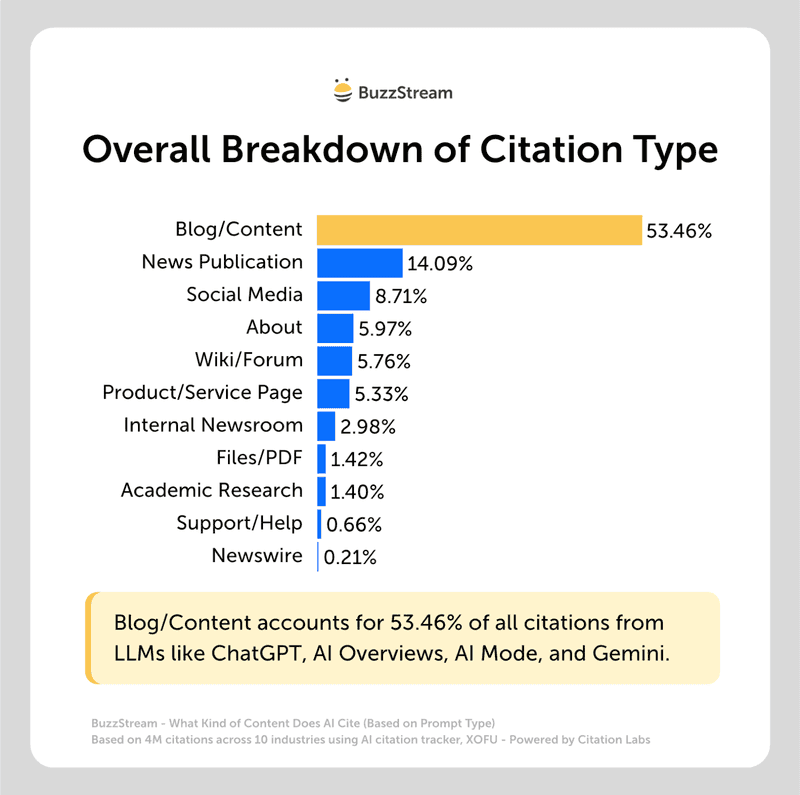
An even larger majority was earned content, not owned content.
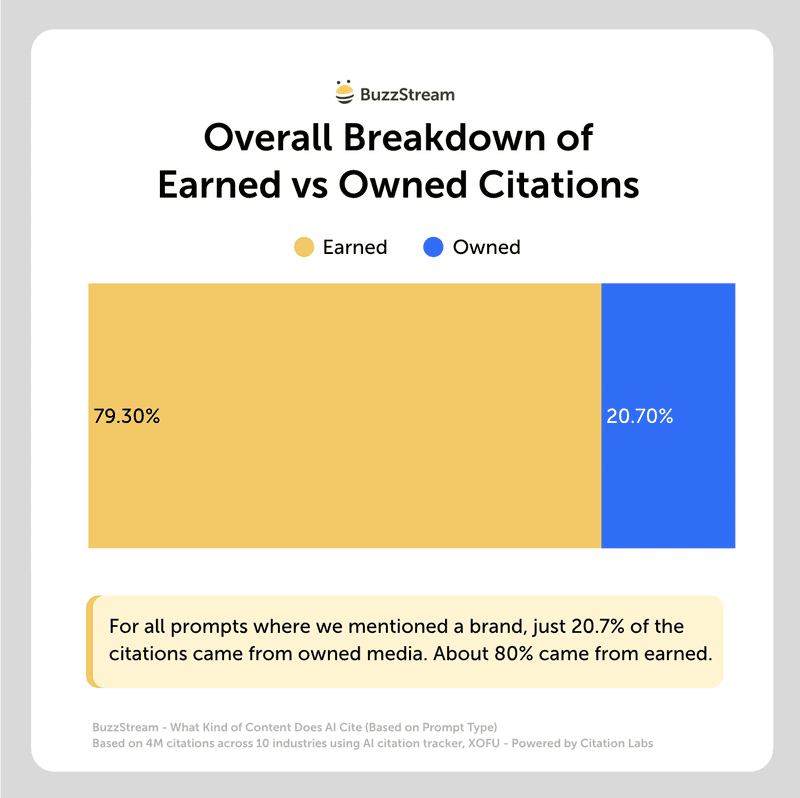
So, while having your own content can get you some citations, most come from third-party sources.
Expert Opinions
Earned media is often the gateway to AI visibility.
Founder, Citation Labs
In this study, 80% of citations live on other people’s websites, though you should absolutely run your own tests in your market.
Earned media in this study is the gateway to visibility. Getting coverage, link placements, brand mentions, and surrounding context on the cited pages or domains feeds directly into the evidence a model hands a buyer.
Eager to get your site into that other 20%?
You have to earn it with genuine expertise content: what you learn from support logs, implementation failures, the field, and SMEs answering the questions buyers actually get stuck on.
ChatGPT tends to cite and mention the most
ChatGPT 5.4 mini cites brands it mentions at the highest rate (28.3%) as compared to Google’s ~22%.
ChatGPT is also far more likely to name a brand when it cites one (92.7% vs ~68%).
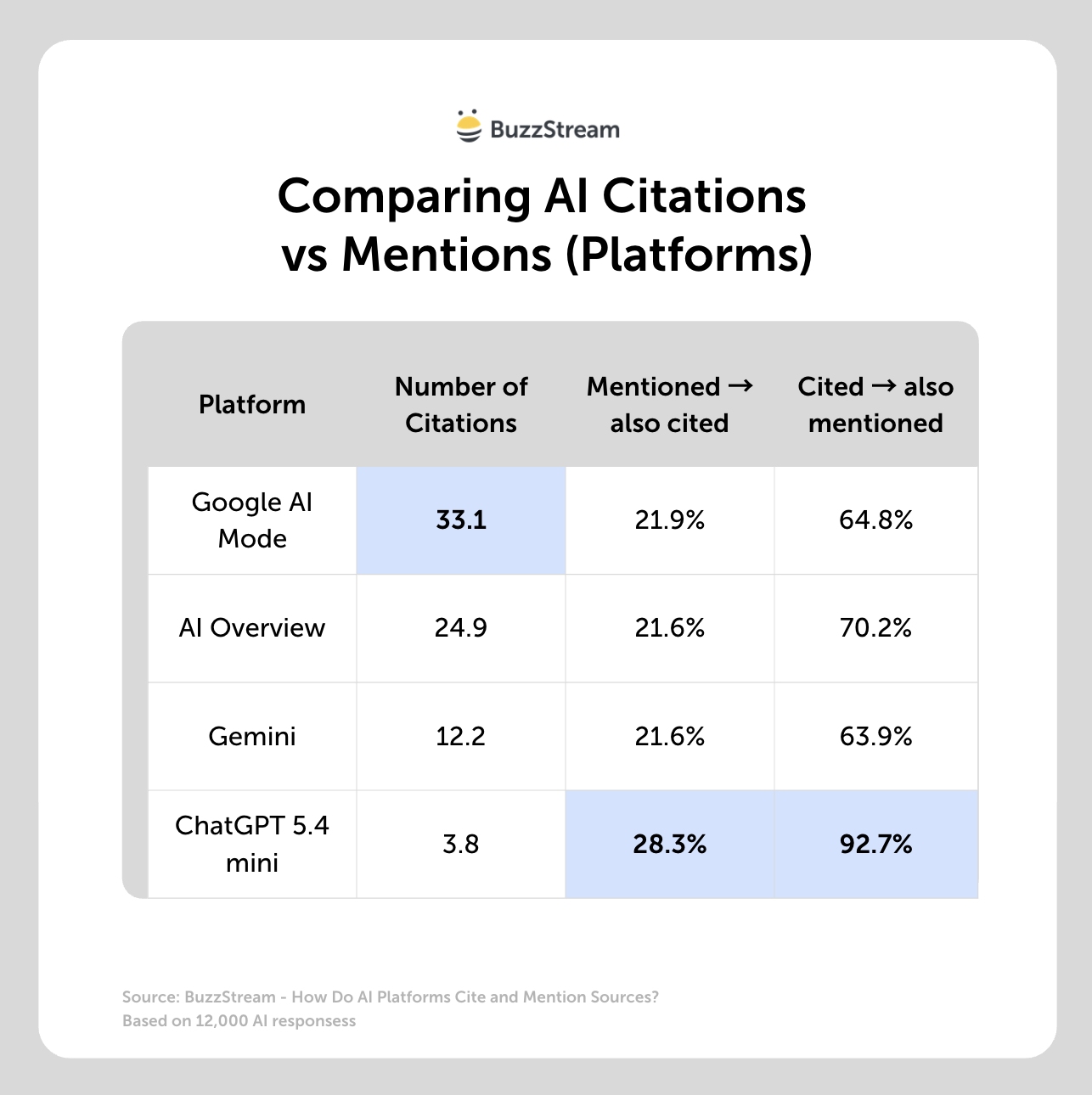
Here is how AI cites and mentions brands based on the platform they use, in table format:
| Platform | Number of Citations | Mentioned → also cited | Cited → also mentioned |
|---|---|---|---|
| Google AI Mode | 33.1 | 21.9% | 64.8% |
| Google AI Overview | 24.9 | 21.6% | 70.2% |
| Google Gemini | 12.2 | 21.6% | 63.9% |
| GPT-5.4-mini | 3.8 | 28.3% | 92.7% |
As you can see, the difference in the sheer number of citations explains much of the cited-without-mention gap on Google’s platform.
AI Mode cites an average of 33 URLs per response, while ChatGPT cites 3.8 per response and tends to reference them explicitly.
Single brand queries mention what they cite (and vice versa)
When a brand is the direct subject of a query, like “what does Asana do?”, 39% of its mentions also include a citation.
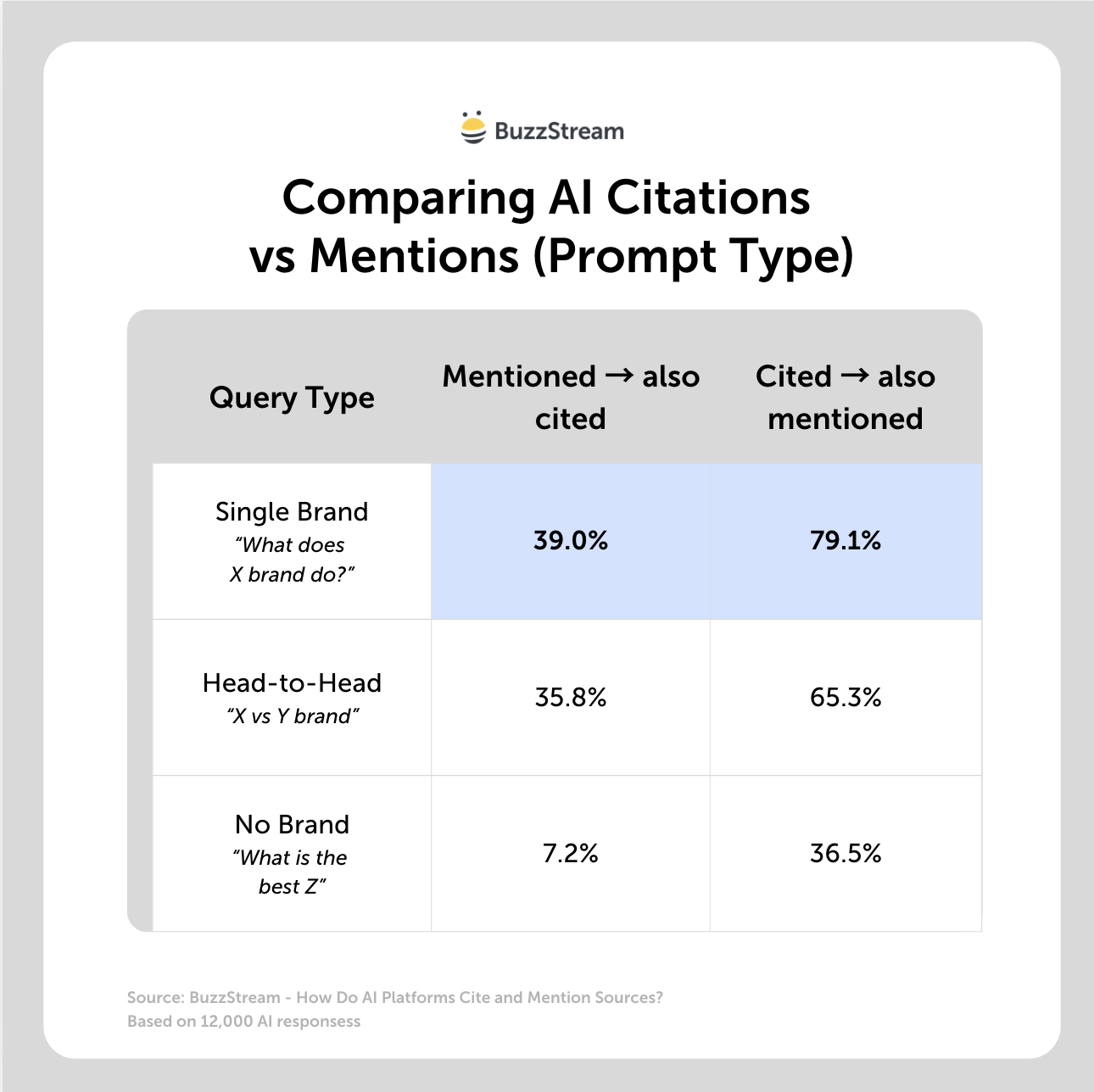
Here is how AI cites and mentions brands based on prompt type in table format:
| Prompt Type | Mentioned → also cited | Cited → also mentioned |
|---|---|---|
| Single brand (“Is Asana good?”) | 39.0% | 79.1% |
| Head-to-head (“Asana vs Monday.com”) | 35.8% | 65.3% |
| List/category (“Best project management tools”) | 7.2% | 36.5% |
For head-to-head comparison queries, like “what is better, asana or monday.com?”, there is a drop to 35.8%, likely because comparison responses cite additional context sources that don’t get named in the text.
But the stark difference comes when a brand isn’t used in a query, like “What is the best project management tool.”
In those instances, only 7.2% of those mentions are backed by a citation.
As we saw in our previous study, prompt type drastically changes the types of citations AI produces, and we can see that in play here.
The further down the funnel a user gets, the more likely you are to get a mention or citation.
Expert Opinions
That 7.2% is where the buyer’s frame gets set.
Founder, Citation Labs
Step 1: Map the gap. Run your category’s no-brand prompts, like “what’s the best ___” or “how do I choose a ___.” Sort the results: are you mentioned but uncited, or completely absent?
Step 2: Harvest and sort the no-brand prompt citations. Sort them into three piles:
- Third-party editorial, like reviews, roundups, and comparison posts. These are your outreach targets.
- Competitor pages. These are your competitive intel for Step 4.
- Everything else, like Wikipedia, industry bodies, and Reddit. These are useful context.
Sorting by hand tells you what “citation-worthy” looks like to the model right now.
Step 3: Outreach. Pitch the cited third-party pages for a link, brand inclusion, and anchor context. This is citation optimization: movement up a list, reframing audience and outcome, and improving the evidence the model already uses.
Step 4: Study competitor pages getting cited instead of yours. They may be doing something your similar pages aren’t, such as comparison detail, implementation specifics, or constraint-aware guidance. Build pages that compete at that level.
Outreach gets you into the room fastest. Your own content is what keeps you there.
Healthcare earns coverage. Retail gets named without getting citations.
Healthcare brands are most likely to have their mentions backed by citations (34.5%) and most likely to be named when cited (82.8%).
Finance and energy follow.
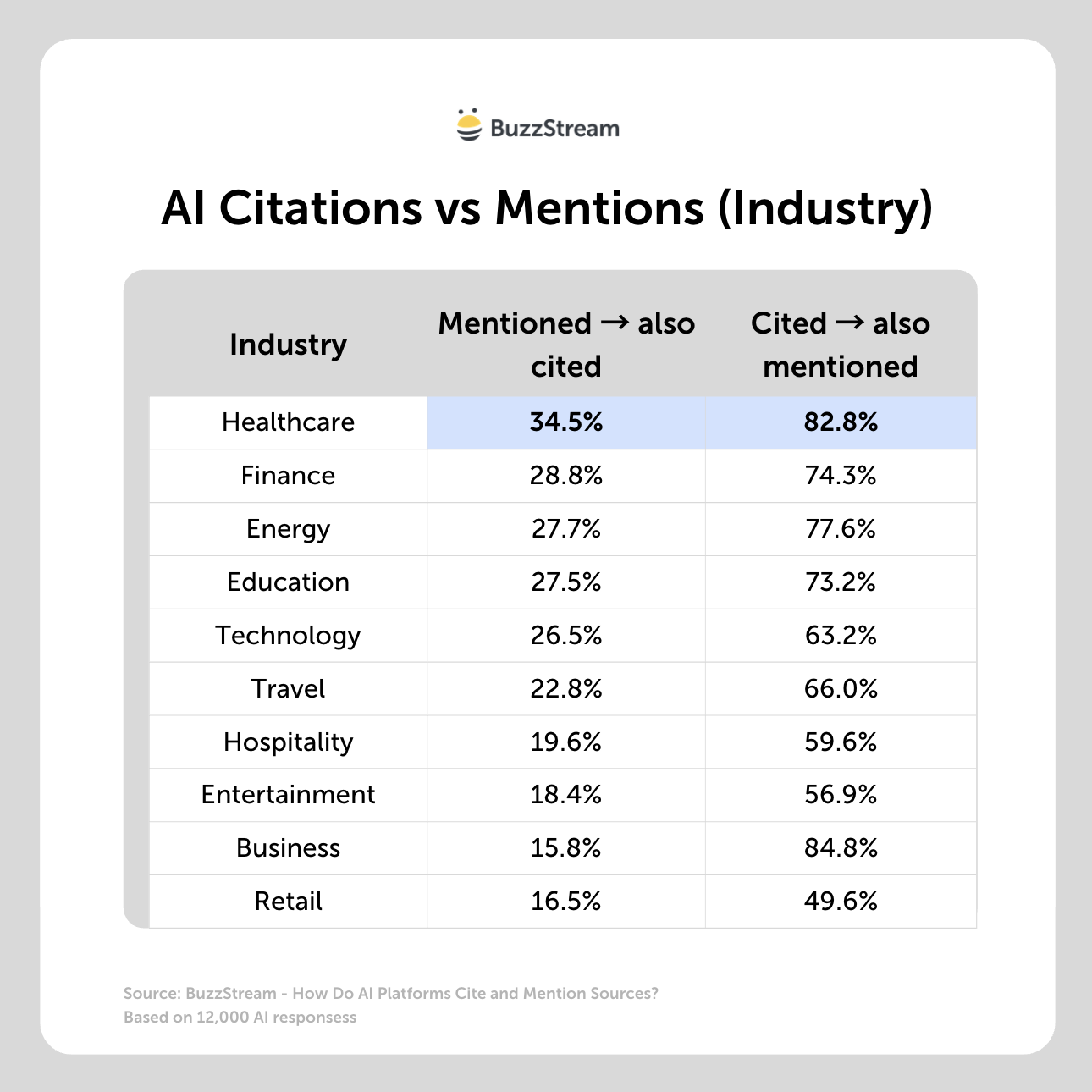
Here is how AI cites and mentions brands by industry in table format:
| Industry | Mentioned → also cited | Cited → also mentioned |
|---|---|---|
| Healthcare | 34.5% | 82.8% |
| Finance | 28.8% | 74.3% |
| Energy | 27.7% | 77.6% |
| Education | 27.5% | 73.2% |
| Technology | 26.5% | 63.2% |
| Travel | 22.8% | 66.0% |
| Hospitality | 19.6% | 59.6% |
| Entertainment | 18.4% | 56.9% |
| Business | 15.8% | 84.8% |
| Retail | 16.5% | 49.6% |
| Overall | 23.1% | 69.9% |
The potential reason healthcare and finance topped the list may help us better understand how AI platforms treat YMYL industries.
When prompted with a question that has a deeper impact on your life than something like retail, it seems that AI platforms are more careful in how they use citations.
What does this mean for PR and SEO?
I have a few takeaways from this study, and although the first is obvious, it’s worth repeating:
Mentions and Citations are Not the Same
A brand mention in AI is not the same as a citation, and the two should be tracked separately.
If 76.9% of brand mentions carry no citation, AI coverage of your brand is happening at a much higher rate than your domain is being sourced.
Missing Citations May Be an SEO/GEO problem
There are definitely nuances to this, but at the core, when a brand is mentioned but not cited, it may signal the brand doesn’t rank well enough for the queries AI uses to answer the question and/or isn’t visible enough for the brands.
To me, this is a problem that can be solved using SEO/GEO.
Understanding the query fan-outs these platforms use and structuring your content to answer them can give you a leg up here.
There’s also the importance of ensuring your content is visible to begin with, something we looked at in our study on robots.txt blocking AI bots.
Missing Mentions May Be More of a PR Problem
Conversely, when a brand is cited but not mentioned , it signals that the brand may not be discussed enough in the training data.
This is a problem that PR and link building can solve.
Getting your brand mentioned and linked by others can help reinforce entities and overall exposure in the training data.
If a User Knows Your Brand, You Will Get More AI Exposure
The last piece here is that when a user doesn’t include a brand in the prompt, you are way less likely to receive citations and mentions.
To me, this feels like a PR and brand-awareness problem that can be solved through digital PR.
If someone is looking for a CRM tool but doesn’t know where to start, they will ask an open-ended question like “what is the best CRM tool?”
But if someone already knows HubSpot is a CRM tool, they are further down the funnel and may therefore mention you in the prompt, where the likelihood of being cited or mentioned is higher.
Expert Opinions
Winning in AI means going one or two levels deeper.
Founder, Citation Labs
Nick Fox from Google said recently that the content that wins in AI goes “one or two levels deeper.”
Here’s what deeper means: deep enough to answer the specific questions of the specific person who can say no to a purchase decision, at the precise moment they’re asking chat.
I just presented on an approach to this at SMX. You can watch the presentation here once it’s live.
Or you can check out our Decision Architecture guide. It’s dense, so upload it into Claude and use it to map your champion’s decision committee to help steer content.
Methodology:
12,000 AI responses were collected via Xofu across Google AI Mode, Google AI Overview, Google Gemini, and GPT-5.4-mini (3,000 per platform).
Prompts spanned 10 industries and three types: single brand, head-to-head comparison, and list/category. Approximately 200 brands were tracked across ~2,967 unique prompts. Citation data covers 221,946 URLs; 47,550 resolved to tracked brand domains.
“Mentioned → also cited” is measured at the brand-mention level: for each brand named in a response, whether that brand’s domain was also cited in the same response.
“Cited → also mentioned” is measured at the brand-citation level: for each brand domain cited, whether the brand name appeared in the response text.
All figures use join-verified matching across citation and response tables.
You can find all of the data here.

 Check out the BuzzStream Podcast