 End-to-end outreach workflow



Table of Contents
- AI citations are wildly fragmented, and prompt type drives citation patterns more than any other domain.
- Informational prompts pull nearly 3x more citations than brand awareness queries
- ChatGPT cites far more sources than any Google platform.
- Reddit, the most-cited site, accounted for just 3.49% of citations, so no one site truly rules AI citations.
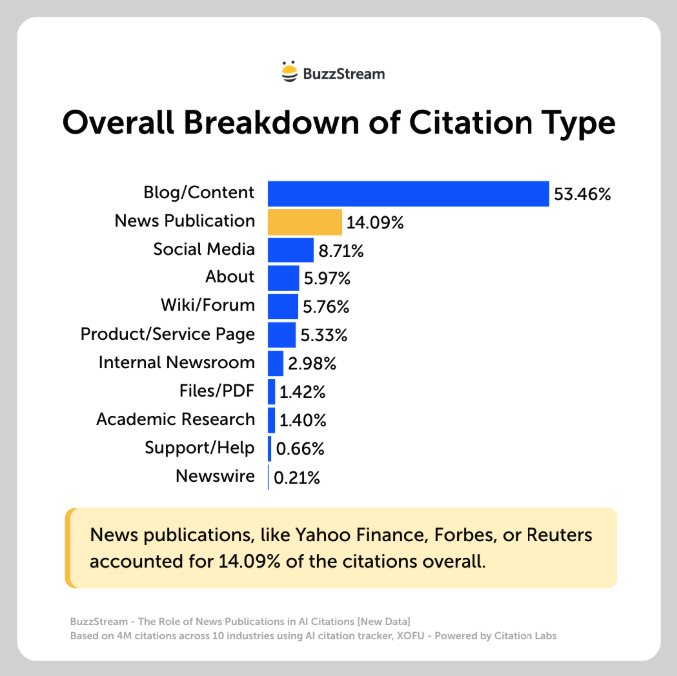
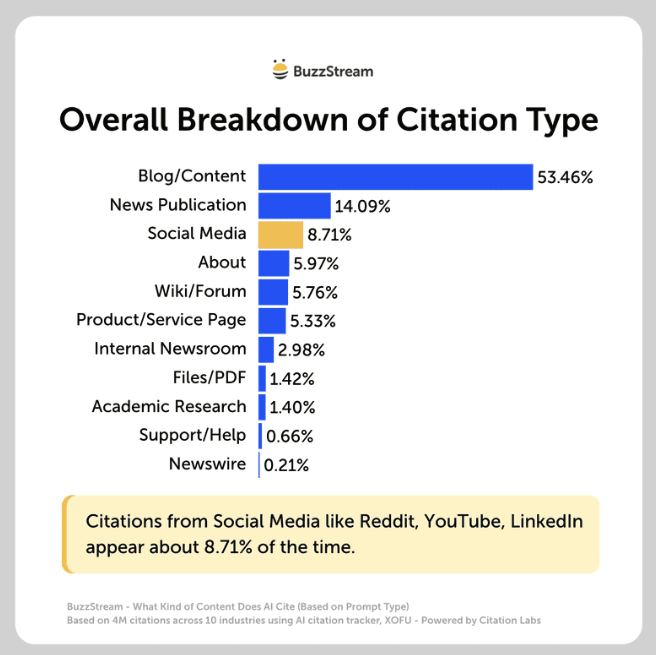
- Blog/content makes up 53.46% of all citations, with news at 14.09% and social at 8.71%.
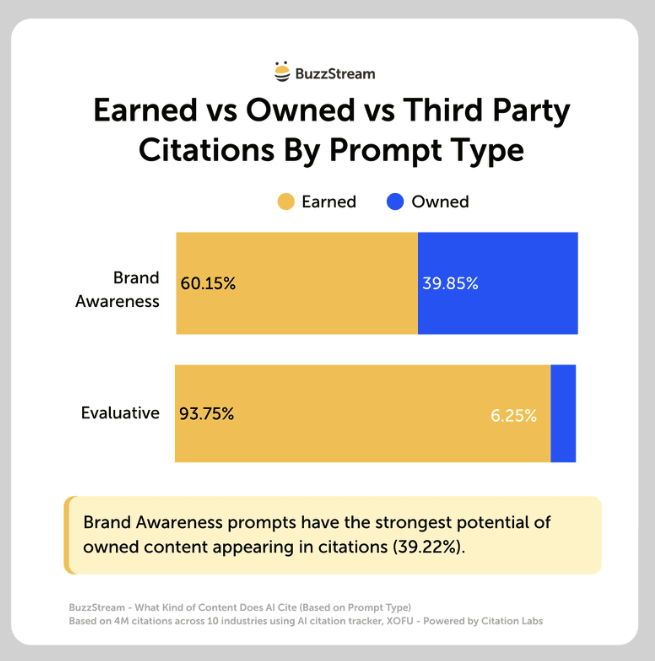
- About 40% of brand awareness citations come from owned content.
- Just 1% of Google users clicked a link in an AI summary.
- AI sends visitors to broken links 2.87x more often than Google Search.
Everyone wants to know how to show up in AI. But before you can build a strategy, you need to understand how AI citations and mentions actually work, and the data tells a far more nuanced story than “get into listicles.”
Over the past several months, BuzzStream has run a series of studies using an AI citation tracker, Xofu, analyzing millions of AI citations across ChatGPT, Google AI Mode, Google AI Overviews, and Gemini, alongside survey data on how Americans actually use AI for news.
Like our digital PR statistics, these are meant to guide your strategy and ground your thinking in data rather than hype.
So, below is everything I’ve learned about AI citations, mentions, and visibility in 2026.
AI Citation Overlap Stats
1. Across 595 prompts, 76.1% of citations were unique to a single platform. (BuzzStream)
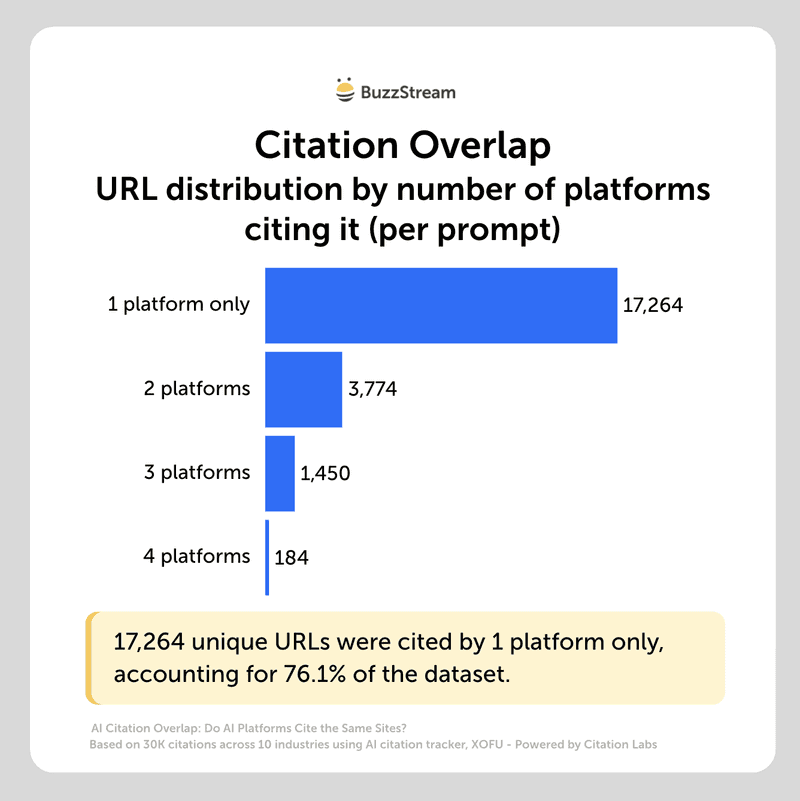
2. Only 184 citations (0.8%) overlapped across ChatGPT, Gemini, AI Overviews, and AI Mode. (BuzzStream)
3. Looking at unique URLs across the entire dataset, 65.8% of the 16,764 unique URLs appeared only once. (BuzzStream)
The takeaway here is blunt: if you’re building citation strategies off “most-cited domain” lists, you’re chasing the wrong thing.
What gets cited depends almost entirely on the platform and the prompt.
4. The strongest overlap between any two platforms is Google AI Overview and Google AI Mode, at a 37.4% Jaccard similarity. (BuzzStream)
Even within Google’s own family of products, the three platforms don’t overlap as much as you’d expect, and ChatGPT barely overlaps with Google properties at all.
This was surprising within the Google ecosystem, but it just goes to show you that these tools operate very differently.
5. Wikipedia is the main site that all four platforms agree on; it’s involved in 35% of the URL–prompt pairs cited by all four. (BuzzStream)
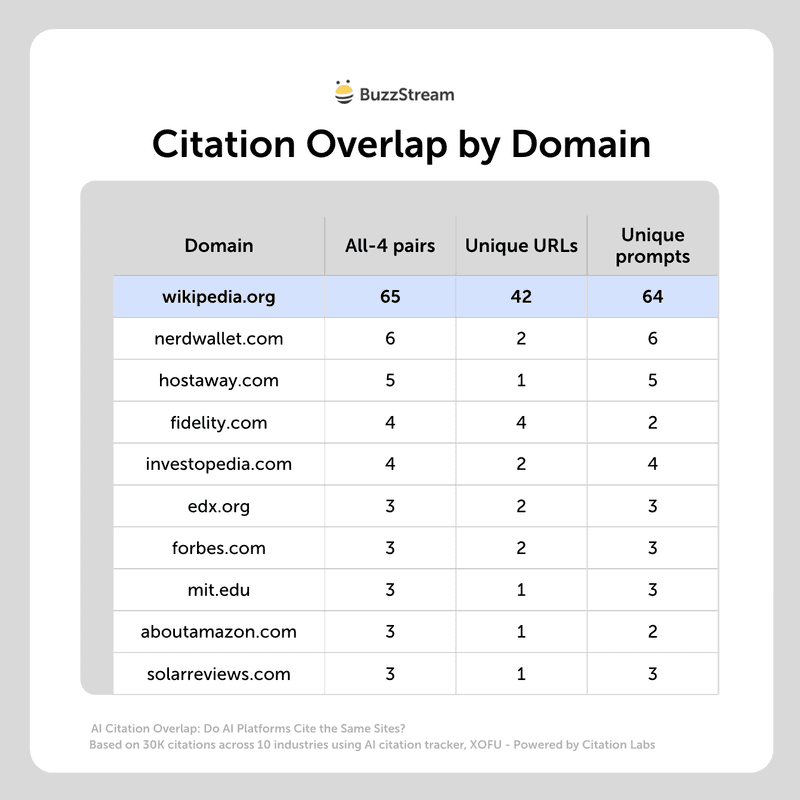
6. But Wikipedia made up just 3.8% of all 30,000 citations in the dataset. (BuzzStream)
So no, you probably shouldn’t run out and try to create a Wikipedia profile just because it’s the most-cited (it’s notoriously difficult to game, anyway, and will probably waste your time).
AI Prompt Type Changes Everything
In our studies, we categorized prompts into three types: brand awareness (“What does [company] do?”), evaluative (“Is X better than Y?”), and informational (“What’s driving [trend]?”).
The differences were dramatic.
7. AI platforms cite 12.6 sources per prompt on average. (BuzzStream)
8. ChatGPT cites 18.2 per query, the most sources per prompt, and about 43% more than Google’s AI Overviews, AI Mode, and Gemini. (BuzzStream)
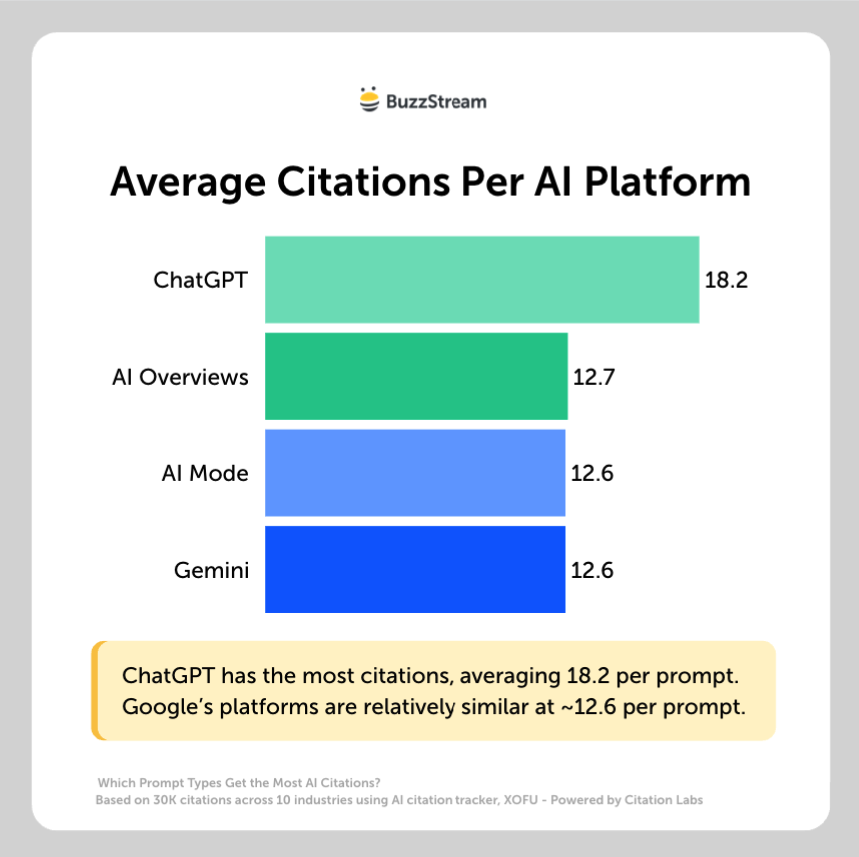
This aligns with other research suggesting that citation counts correlate with answer length, and that ChatGPT tends to give longer answers.
9. Informational/exploratory prompts generate about 3x more citations, or 23.3 per prompt. (BuzzStream)
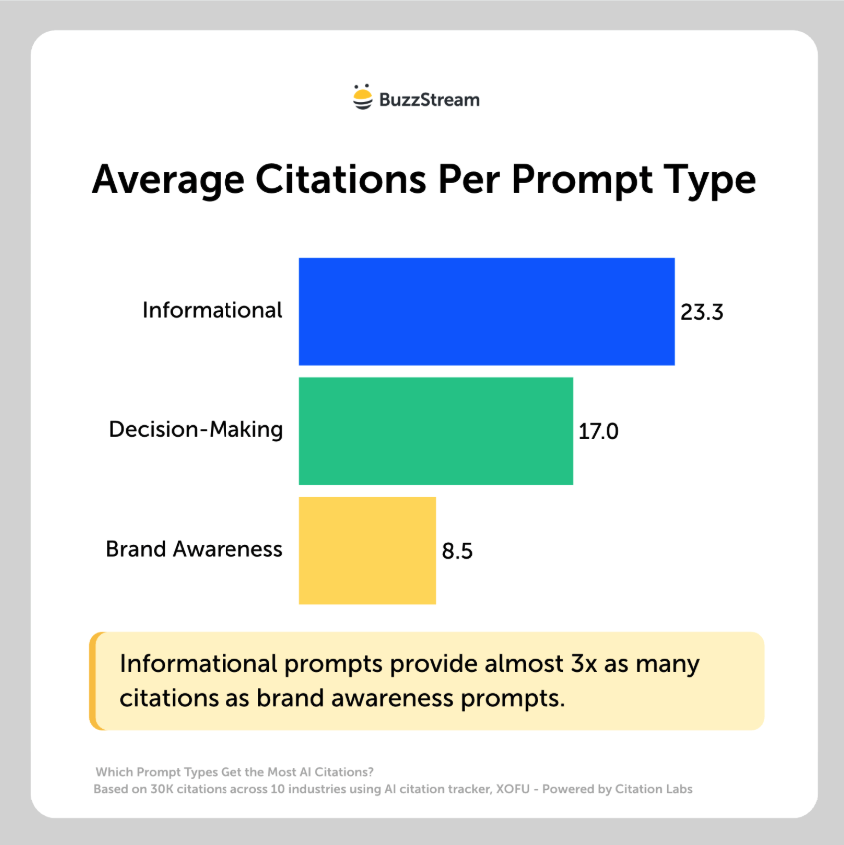
In general, I’ve found that AI models human behavior when searching.
For most questions, I typically want a few sources to back up the claims.
When the question has no single canonical answer, such as “What’s driving consolidation among healthcare providers?”, platforms draw on market research, news, academic papers, and industry associations.
“What does Hilton do?” draws quick conclusions from Wikipedia and a brand’s About page.
10. Evaluative, decision-making prompts have the highest cross-platform agreement. (BuzzStream)

For comparison prompts, all four platforms often converge on a single article.
If your brand is in a common comparison and you’re not represented in that article, you’re losing evaluative citations across all four platforms at once.
11. ChatGPT averages 36.2 citations per prompt on exploratory prompts, versus 20.8 for Google’s three platforms. (BuzzStream)
12. ChatGPT averages 12.3 citations on brand awareness prompts, versus 7.7 for Google. (BuzzStream)
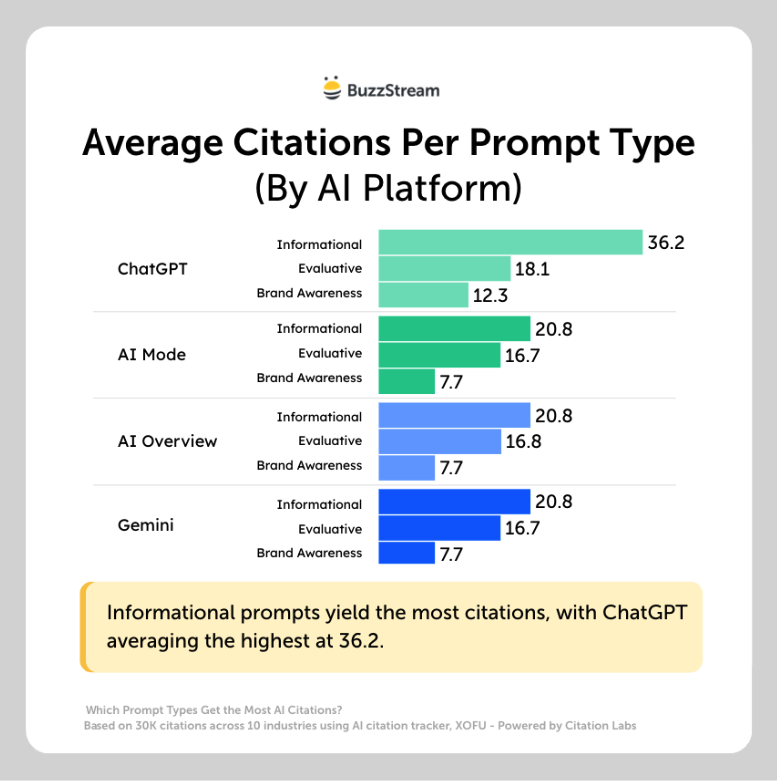
Notably, the three Google platforms are nearly identical across every prompt type, suggesting they’re constrained by a similar output format.
What Kind of Content Gets Cited by AI
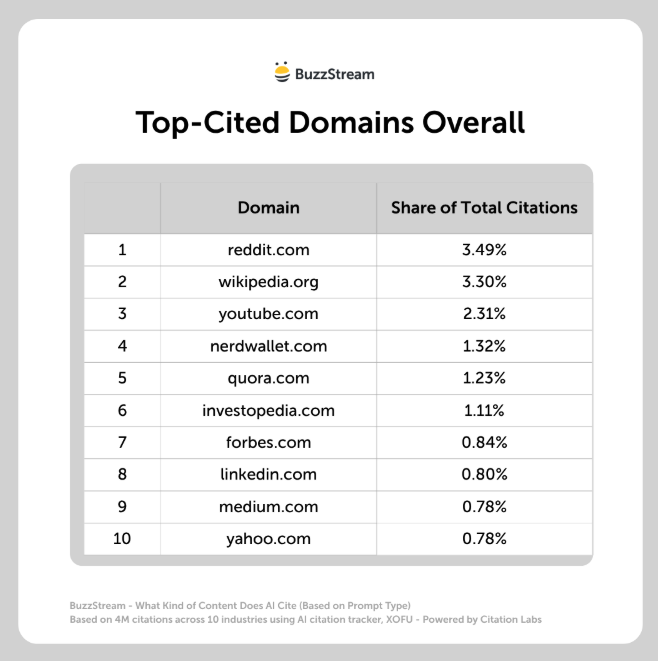
13. No single site dominates AI citations, and Reddit leads at just 3.49% of a 4-million-citation dataset. (BuzzStream)
14. Blog/content is the most-cited content type, making up 53.46% of all citations. (BuzzStream).
15. Within blog/content, comparative content is the most cited at 26.92%, followed by market analysis/insights (23.06%) and definition/explainer content (20.57%). (BuzzStream)
But before you flood the zone with comparison content: the evaluative prompts in this study were exclusively head-to-head comparison queries, so it makes sense they over-index there.
16. For brand awareness queries, About pages and Product/Service pages combine for 35.13% of citations. (BuzzStream)

This means when users ask about a brand, AI shows content from the brand’s own site about a third of the time.
17. ChatGPT prefers a broader mix of content types than Google, spreading citations across Product/Service pages (24.56%), Internal Newsrooms (18.71%), About pages (9.15%), and Support/Help (7.72%). ( BuzzStream)
AI Statistics on News Citations
18. News publications account for 14.09% of all AI citations, making them the second-most-cited content type. (BuzzStream)
19. News citations appear most in evaluative prompts — about 18% of citations from those queries come from news. (BuzzStream)
20. News publications are the least likely to show up in brand awareness prompts, appearing in just 7.26% of those citations. (BuzzStream)

21. When comparing news/editorial stories against affiliate content, 81% of citations come from true news content. (BuzzStream)
Even on evaluative prompts, where you’d expect affiliate “best of” content to dominate, affiliate/review/list content was cited less than half the time (39.07%).
22. Syndicated news content shows up in just 6.2% of all news citations (0.9% of the entire dataset). (BuzzStream)
Major syndication networks like MSN and Yahoo don’t appear to be prioritized by AI search engines, which matters if you count syndicated placements as wins.
Does this mean syndication isn’t valuable?
No.
Syndication can lead to additional real coverage, referral traffic, and general brand awareness.
23. Local news sites account for just 0.18% of total news citations. (BuzzStream)
24. Press releases published through syndication channels account for just 0.32% of news citations and 0.04% of the entire dataset. (BuzzStream)
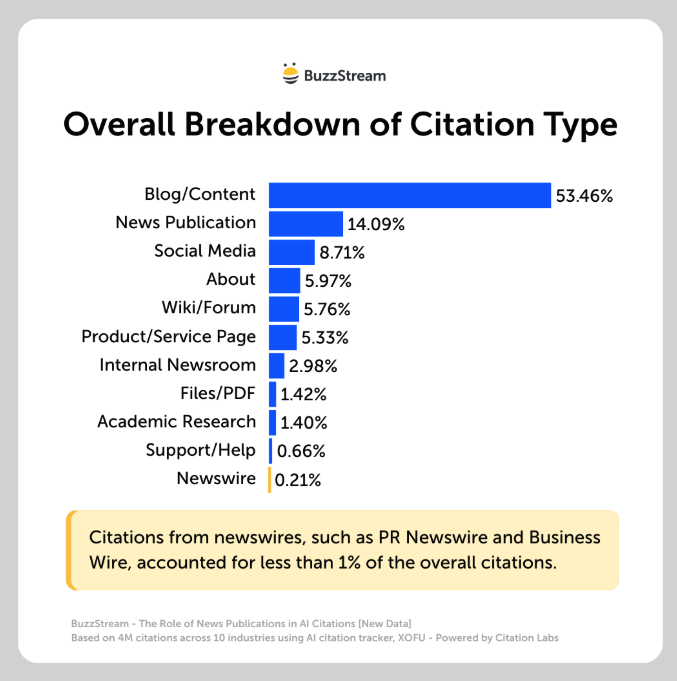
25. Direct citations from newswires (like PR Newswire) made up just 0.21% of the entire analysis. (BuzzStream)
So the idea that you can simply push a press release over a newswire and earn AI exposure doesn’t hold up in the data.
26. Internal press releases and newsroom content made up just 2.98% of citations overall, but on ChatGPT specifically, they jumped to 18.15%. (BuzzStream)
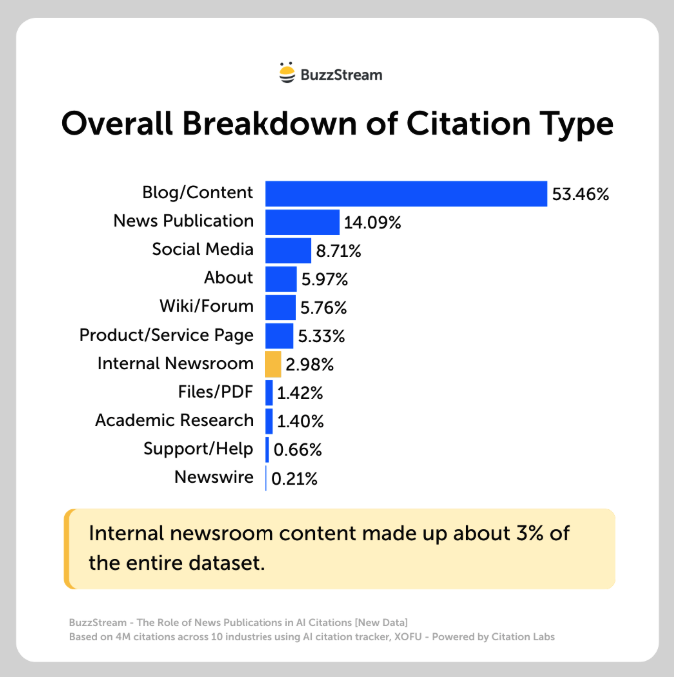
Internal newsrooms are an interesting strategy worth considering if ChatGPT exposure is your goal.
27. Energy makes up 31% of news-publication citations, and Entertainment is second at 17.57%. (BuzzStream)
Social Media in AI
28. Social media appeared in 8.71% of citations, making it the third-most-cited type. (BuzzStream)
29. Reddit is the most-cited social platform at 39.87%, followed by YouTube (25.88%) and LinkedIn (8.96%). (BuzzStream)
Ross Simmonds broke down how Reddit visibility is key to AI citations in a further BuzzStream study.
He also joined us on our podcast to discuss ideas for increasing Reddit exposure.
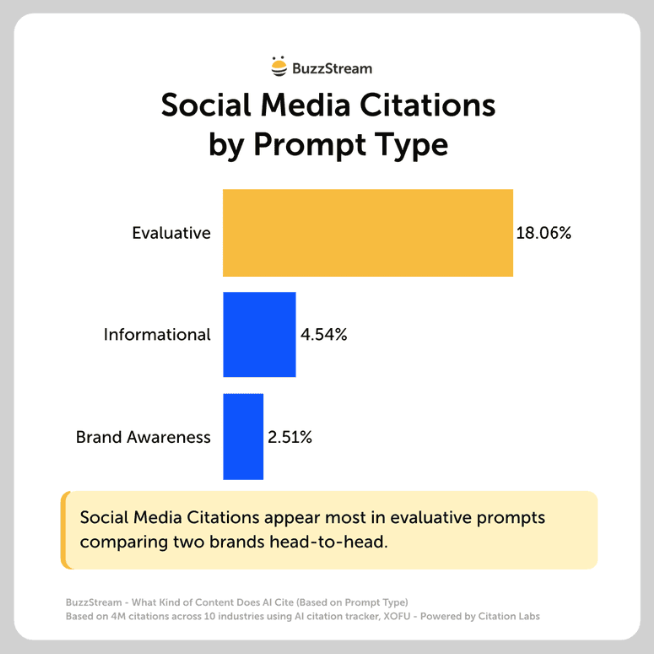
30. Social citations come mainly from evaluative, bottom-funnel prompts (18%), compared to 5% for informational and 2.5% for brand awareness prompts. (BuzzStream)
31. ChatGPT has little to no Reddit citations; instead, 60% of its social citations come from Facebook. (BuzzStream)
32. LinkedIn accounts for roughly all of the owned social citations, with a 37.27% owned-media share. (BuzzStream)
LinkedIn company profiles, like BuzzStream’s, are the primary owned social source for brand awareness queries, making your LinkedIn page a free space to influence how AI answers “What does [your company] do?”
Owned vs. Earned Content in AI
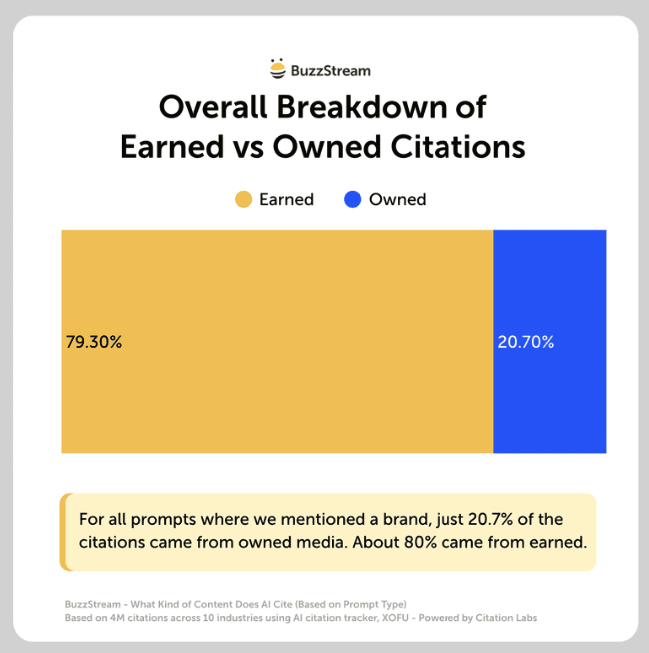
33. Earned media sources (news, social, wikis/forums) account for 47.70% of the dataset, but jump to about 80% once you exclude informational queries that don’t name brands. (BuzzStream)
34. About 40% of brand awareness citations come from owned content. (BuzzStream)
35. Earned content accounts for 93.75% of citations from evaluative queries, the hardest place to insert owned content. (BuzzStream)
36. ChatGPT is the most controllable platform: 68.9% of its citations come from owned content, compared to 35–41% on Google’s platforms. (BuzzStream)
If you want to influence how a platform presents your brand through your own content, ChatGPT is where owned content has the most leverage.
That said, ChatGPT has much lower usage than Google platforms according to First Page Sage research, so be sure to identify where your customers spend their time before going all-in on a single platform.
Traditional SEO Metrics vs. AI Citations
37. There is no meaningful correlation between traditional SEO metrics and AI citations. (BuzzStream)
Spearman correlations were all near zero or slightly negative:
- Domain Rating (−0.111)
- Domain Authority (−0.128)
- Referring Domains (−0.108)
- Organic Traffic (−0.089)
- Page Traffic (−0.017)
- Page Keywords (+0.002)
- Page Links (−0.095)
But this doesn’t mean SEO is irrelevant.
The reason is that LLMs pull from a retrieved set of documents based on query fan-out.
Lower-authority pages tend to rank better for these longer-tail queries despite weak traditional metrics.
That said, when we look at our citation data via Google Search Console’s AI impressions and compare them with overall search traffic, a strong correlation emerges.
38. There is a strong positive correlation (r = 0.79) between Google AI impressions and Google Search impressions.
- Raw Pearson r: 0.93
- Log Pearson r: 0.83
- Spearman r: 0.79
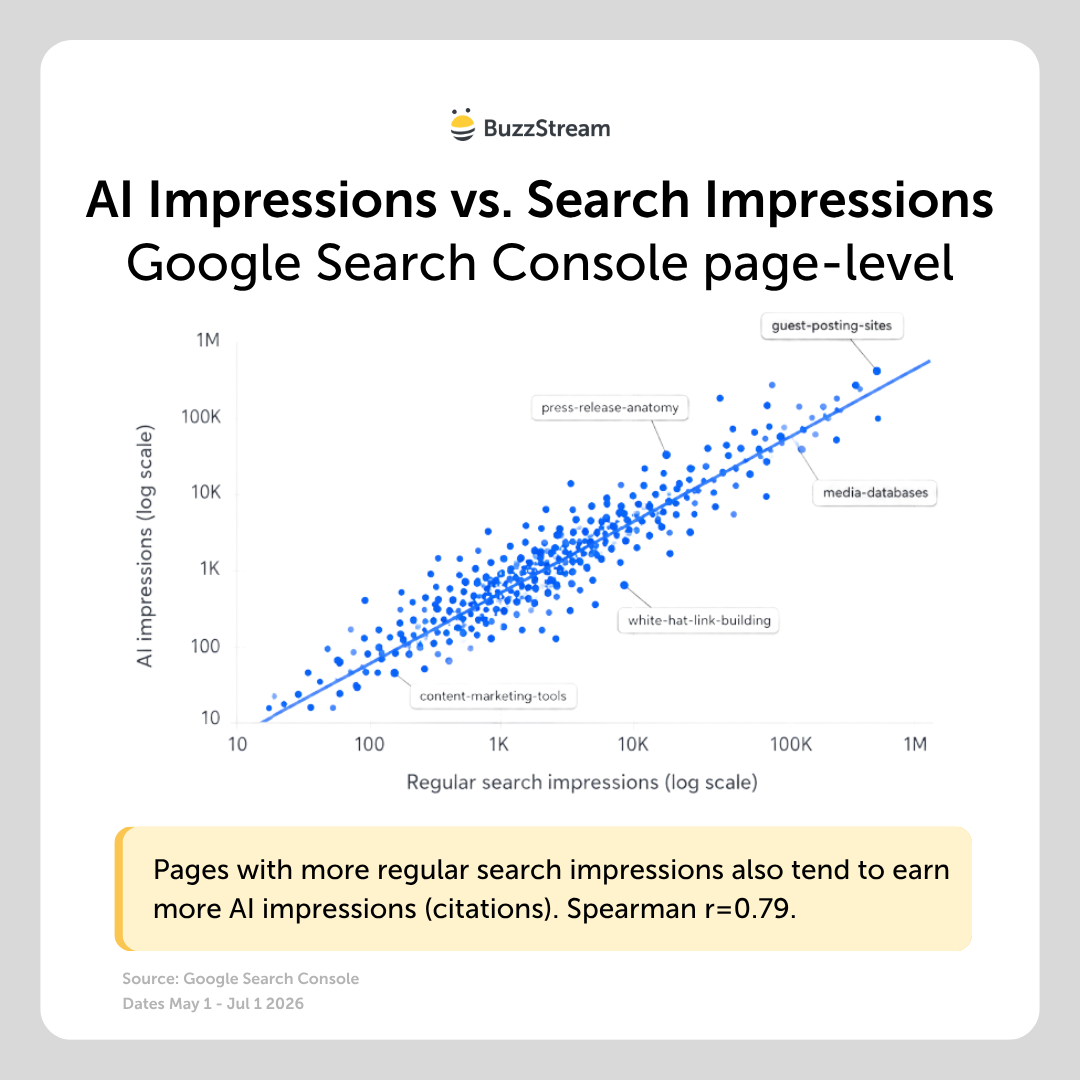
To me, this clearly tells us that SEO isn’t “dead”. You still need to show up in order to get a citation.
AI Citations vs. AI Mentions
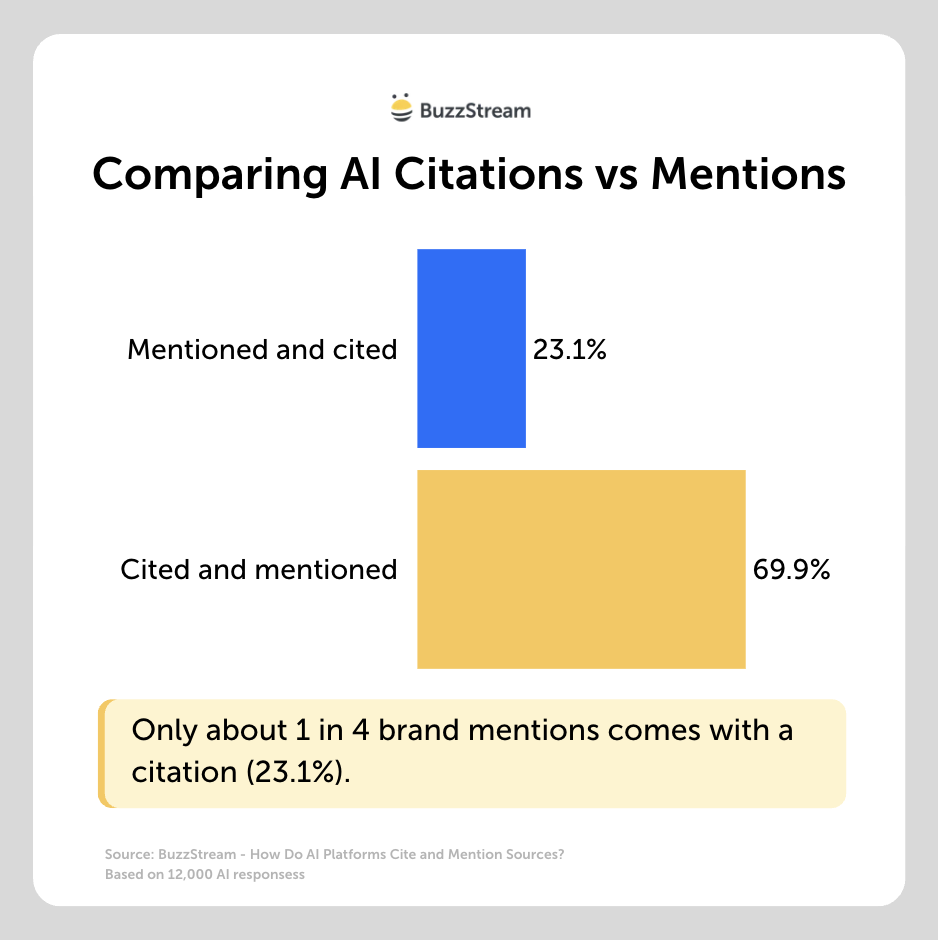
AI citations are source references that support an answer in real time; AI mentions are when a brand is named, with or without a link, based largely on training associations.
They’re triggered by different processes, and the gap between them is real.
39. In one study, only about 13% of brands were both cited and mentioned, which is the “ghost citation” problem that Kevin Indig outlined. (Growth Memo)
We also conducted our own study to understand the difference between citations and mentions.
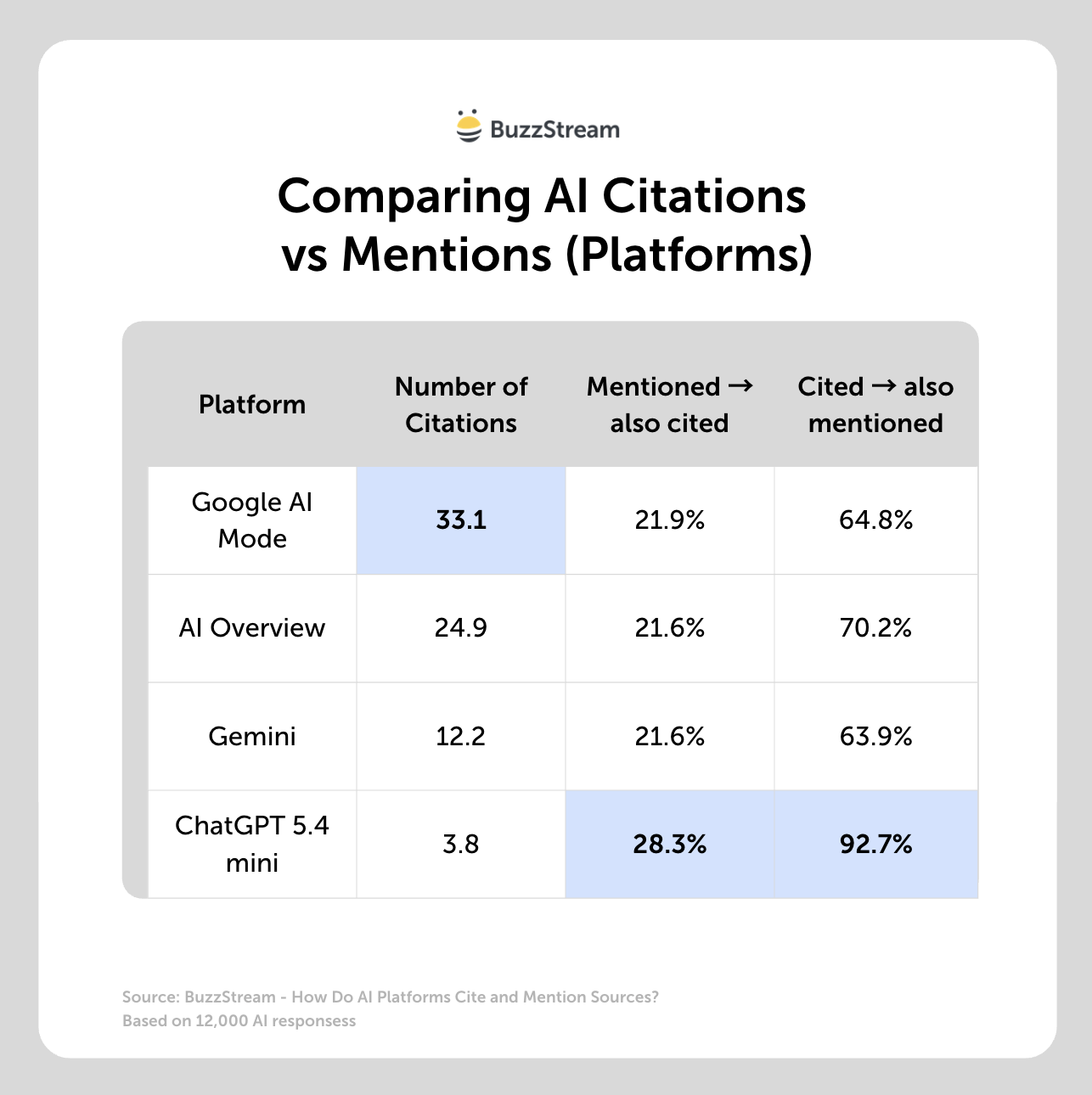
Across roughly 200 brands, 10 industries, and three prompt types in a separate 12,000-response study, the platform differences were stark:
40. Only about 1 in 4 brand mentions comes with a citation (23.1%). (BuzzStream)
41. ChatGPT cites brands that it mentions at the highest rate of 28.3% vs. ~22% from Google platforms. (BuzzStream)
This is even more striking than the “ghost citation” problem.
42. When a brand isn’t named in the query, the rate of mentions also earning a citation drops by nearly 82%. (BuzzStream)
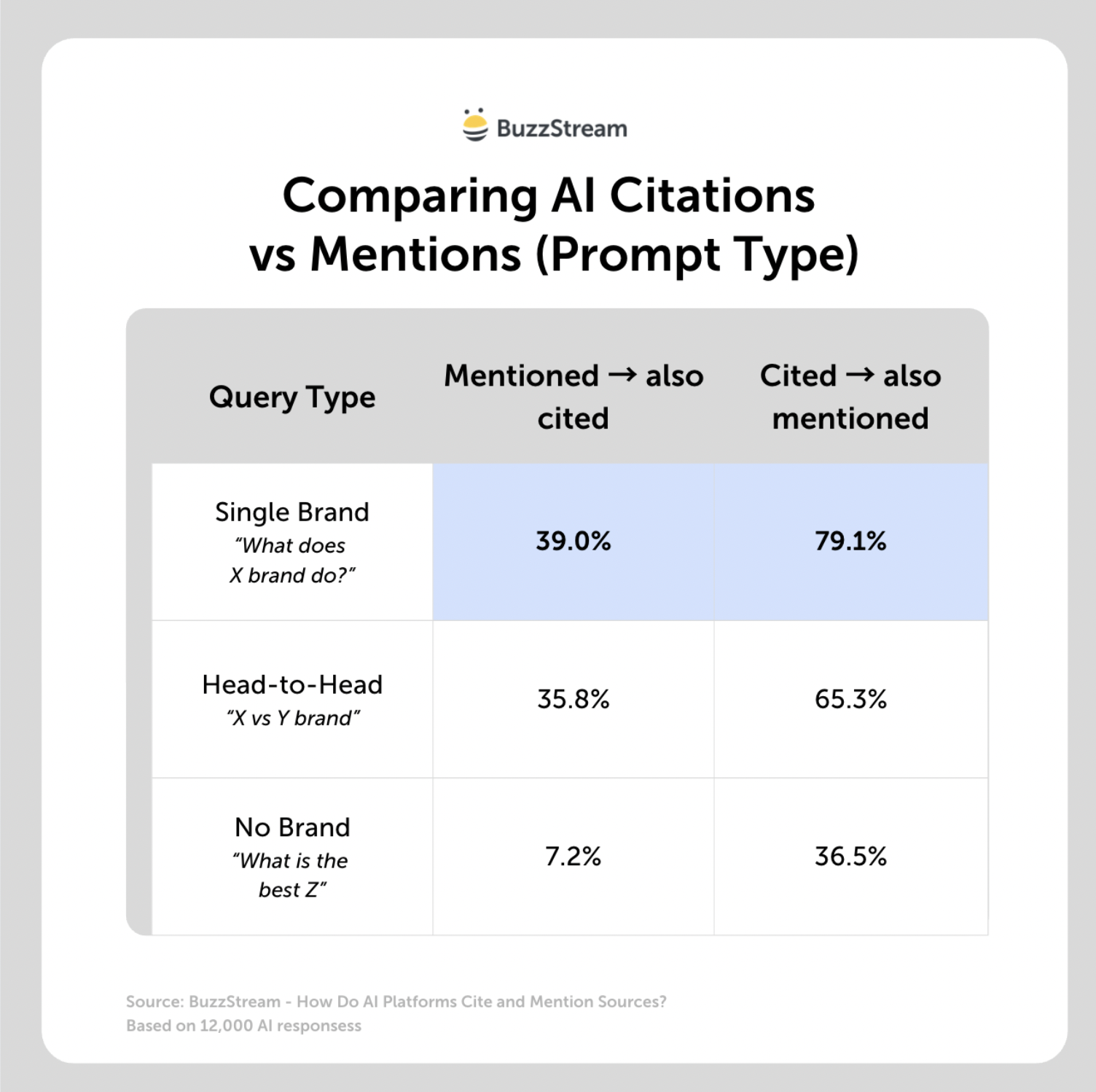
Looking at this data another way, the rate of citations that also earn a mention falls from 79.1% to 36.5%, a drop of about 54%.
Do People Actually Click AI Citations?
When we talk about AI citations in general, we also need to consider how frequently people click on them.
Although Google says it is sending a lot of traffic to sites with its AI content, the data show otherwise.
43. Pew Research found that just 1% of Google users clicked a link in the AI summary when it appeared on a page. (Pew Research)

44. AI sends visitors to broken links 2.87x more often than a typical Google Search. (Ahrefs)
45. 32.1% of Americans who get news from AI always or often click the cited links. (BuzzStream)
So click behavior likely depends heavily on the type of query and the information provided.
AI Publisher Partnerships and Blocking Crawlers
There are a few myths going around about partnerships and crawlers’ impact on AI citations.
46. Just 2.94% of news citations came from publishers with confirmed data partnerships with OpenAI or Google. (BuzzStream)
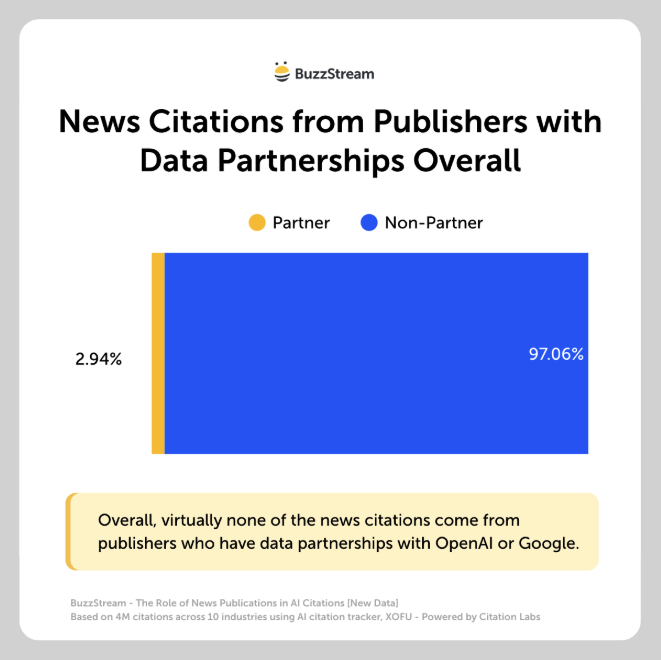
47. ChatGPT cites OpenAI partner publishers far more often (28.5%) than other platforms, though that’s largely because OpenAI partners with far more publishers, and those tend to be among the most widely cited outlets anyway. (BuzzStream)
48. Just 0.77% of citations from Gemini, AI Mode, or AI Overviews came from Google’s confirmed publishing partner, the Associated Press, and AP appeared in none of the Gemini results in the dataset. (BuzzStream)
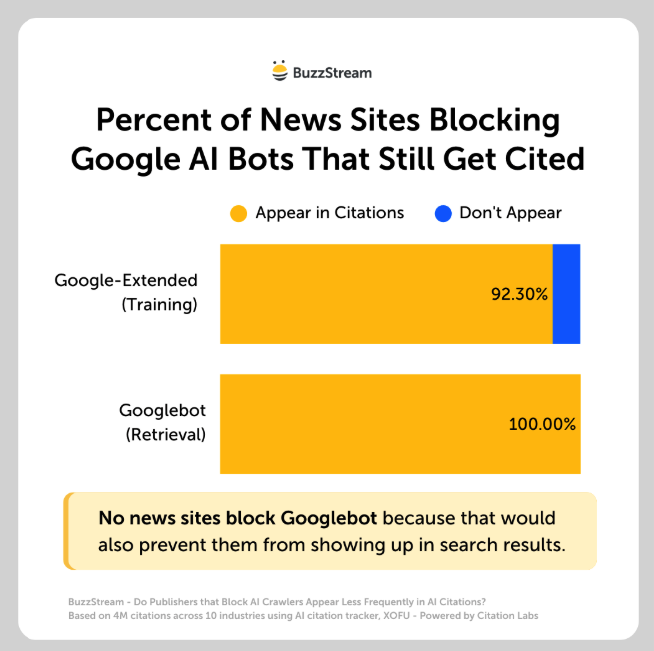
49. Roughly 95% of cited pages blocked GPTBot or Google-Extended, the bots used for model training. (BuzzStream)
50. About 70% of ChatGPT citations came from sites blocking ChatGPT-User or OAI-SearchBot, the bots that power live retrieval. (BuzzStream)
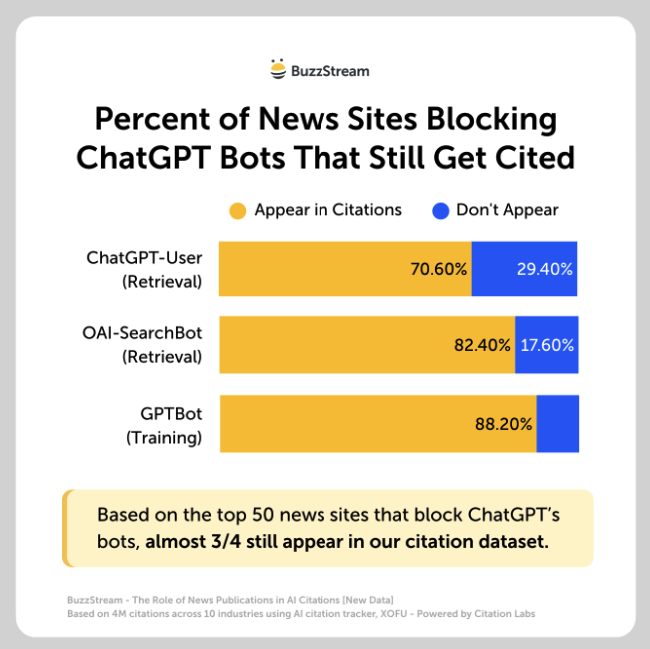
The clear lesson across both studies is that chasing partner sites or worrying about crawler blocks is mostly the wrong focus. Neither reliably predicts whether you’ll show up in AI.
Take All Statistics With a Grain of Salt
If there’s one theme running through all of this data, it’s that AI visibility is prompt- and platform-dependent and still poorly understood.
We don’t have the metric that explains exactly how and why LLMs decide to cite something, just correlated data, educated guesses, and potentially some insights from the Google Leak.
But a few practical truths hold up across every study for me:
1. Stop thinking in keywords and start mapping to prompts, because the question shapes the citations (and mentions).
2. You have real control over brand awareness queries through About pages, product pages, internal newsrooms, and your LinkedIn company profile (even if the majority of citations are from earned sources).
3. Citations aren’t everything. They’re clicked far less than people assume, but for me, I’d still rather my brand appear than a competitor’s.
Good luck!

 Check out the BuzzStream Podcast