 End-to-end outreach workflow



Table of Contents
- Landing a placement doesn’t prove it influenced AI, so avoid taking credit for outcomes you can’t trace.
- PR can support GEO four ways, from most to least direct: research citations, brand descriptions, backlinks, and brand recall.
- Original research tied to a buyer pain point earns the most useful citations, while merely related data doesn’t move the needle.
- Use the same brand descriptor (like “digital PR platform”) in pitches, releases, and boilerplate so third-party mentions reinforce how AI describes you.
- Pick one goal, baseline it first, track the same prompts per platform over time, and report placements separately from AI visibility changes.
We’ve all heard it: “PR is making a comeback!”
It is.
But I see a lot of PR pros saying you need PR for GEO because roughly 80% of AI citations come from earned media.
When I look at what counts as “earned,” I see third-party comparison posts, “best X” lists, and product reviews.
Getting included in those posts often involves product reviews, affiliate relationships, or listicle outreach.
That’s a different playbook from pitching journalists a story.
Even when you earn media coverage through a pitch, there’s a big leap between landing a placement and getting AI to recommend your brand.
So, instead of treating PR as a guaranteed way to influence AI, I’ll cover four ways PR can contribute to GEO, starting with the most direct pathways and working toward the more indirect.
What PR for GEO Actually Means
PR for GEO means using earned coverage and relevant third-party mentions to improve how your brand appears in AI-generated answers.
The big three that pros track are instances of your brand or research:
- getting cited
- getting mentioned
- appearing among recommended options
These outcomes vary wildly.
What’s more important from AI, citations or mentions?
When comparing AI citations vs. mentions, I believe a mention has much more direct value than a citation because people rarely click on citations.
Pew Research found that Google users who encountered an AI summary clicked on the link just 1% of the time.
That said, people still see citations, and that may be enough to help them trust a recommendation, so I don’t want to discount citations.
Ultimately, getting recommended in bottom-funnel queries is the main way to impact a business, but it’s not always PR’s main goal.
What PR for GEO is Not
For this post, I’m focusing on earning editorial coverage from news and industry publications.
I’m not covering affiliate placements, paid product inclusion, guest posting, or review-site management.
Those activities may matter for GEO, but they involve different strategies.
So, let’s break down the different ways PR can support GEO goals.
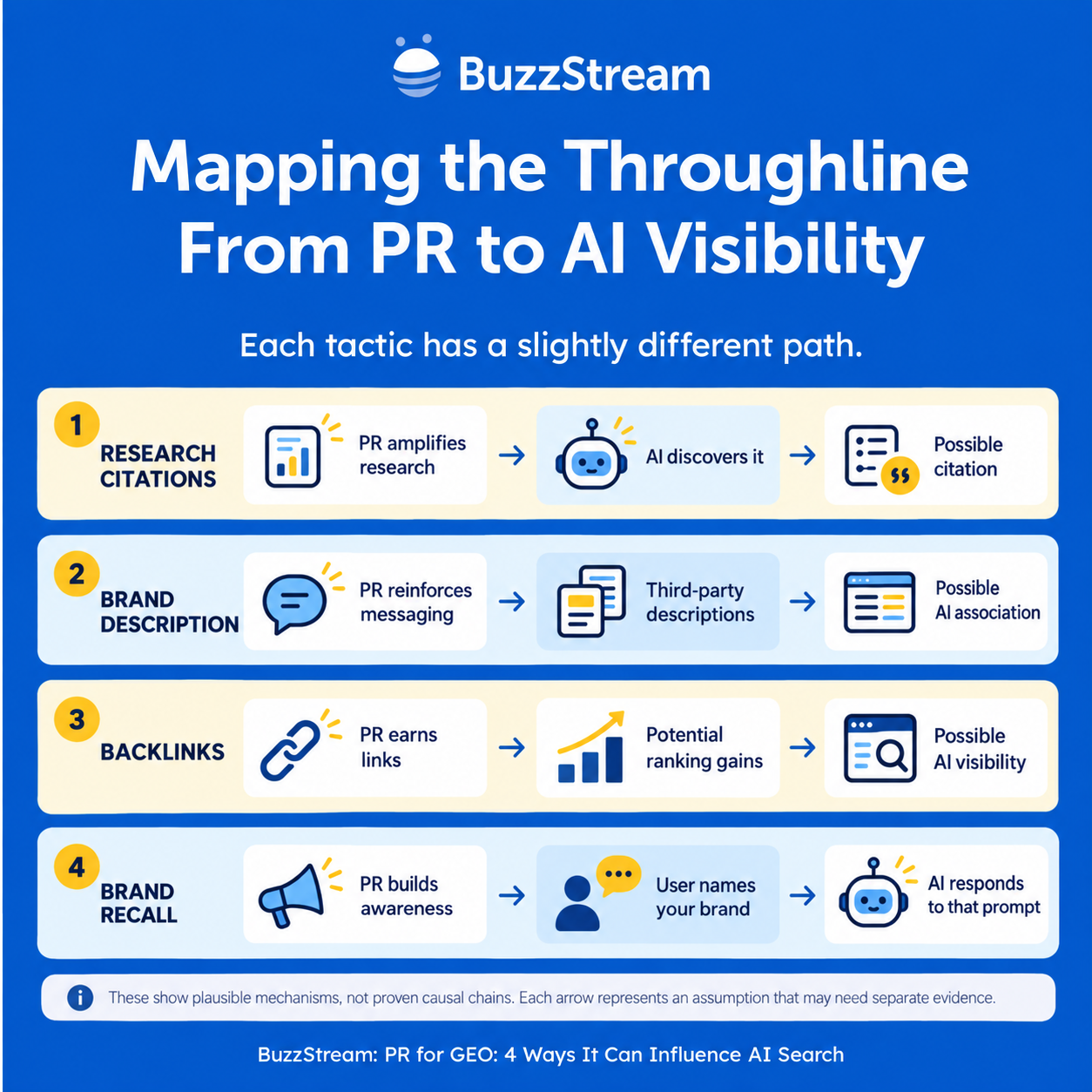
1. PR Can Put You in the Sources Behind AI Recommendations
What does it impact
Citations to your research, mostly on factual questions.
Where to look for success
Track prompts tied to your data topic and see if your study gets cited. Also watch for news articles linking to it, since those can feed back into AI answers.
Sometimes, AI provides sources behind its recommendations for factual searches.
However, just because you’re cited doesn’t mean you will be mentioned in an answer, and vice versa.
In our study of 12,000 AI responses covering about 200 brands, only 23.1% of brand mentions were accompanied by a citation to that brand’s domain in the same response.
Also, very few people click on citations, so why even bother?
They can generate backlinks (which, as you will see, can boost AI exposure) and give the user a data point to support a buying decision.
How to do it with PR?
In this scenario, I typically create data-driven pieces that answer a factual question a relevant news or industry publication may be asking.
The research itself can sometimes earn AI citations without PR, but media outreach can help it reach more publications, creating additional sources AI may encounter.
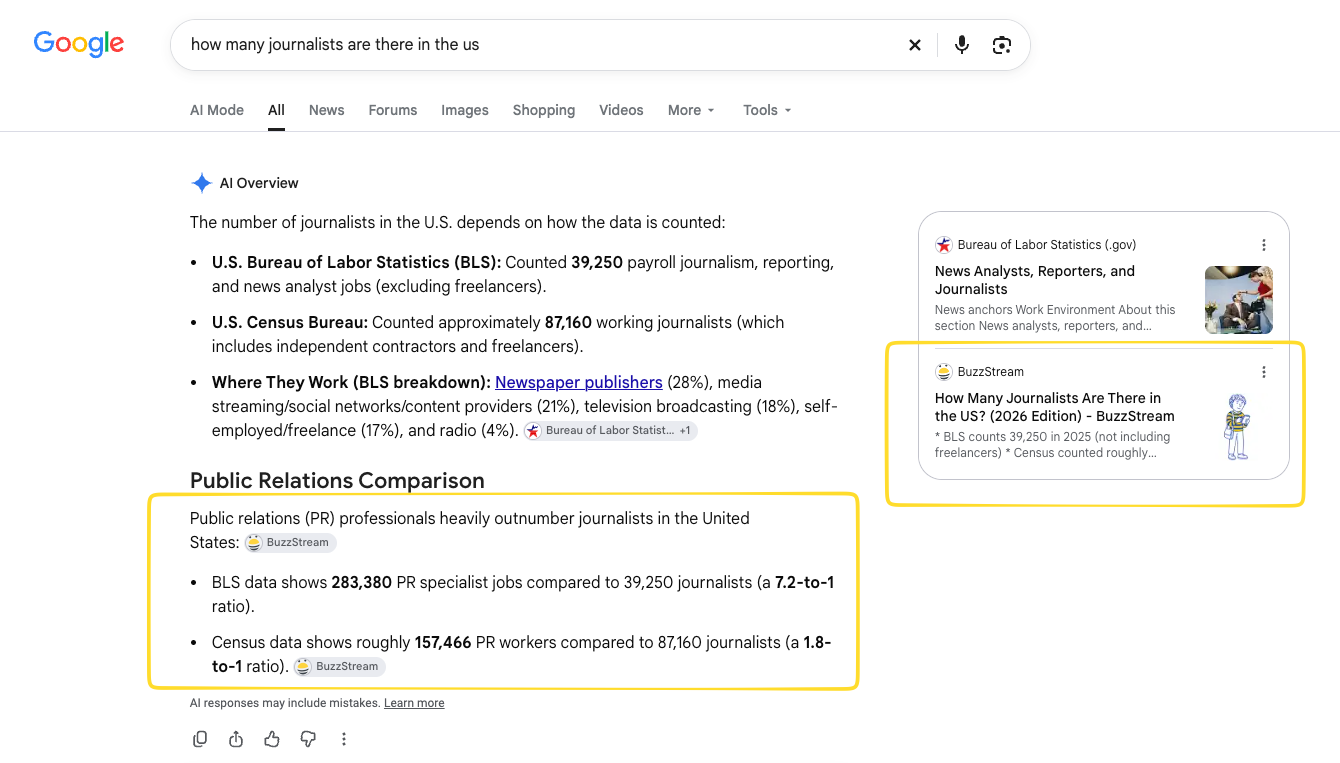
For instance, our piece on How Many Journalists Are There in the US gets cited by AI Overviews below:
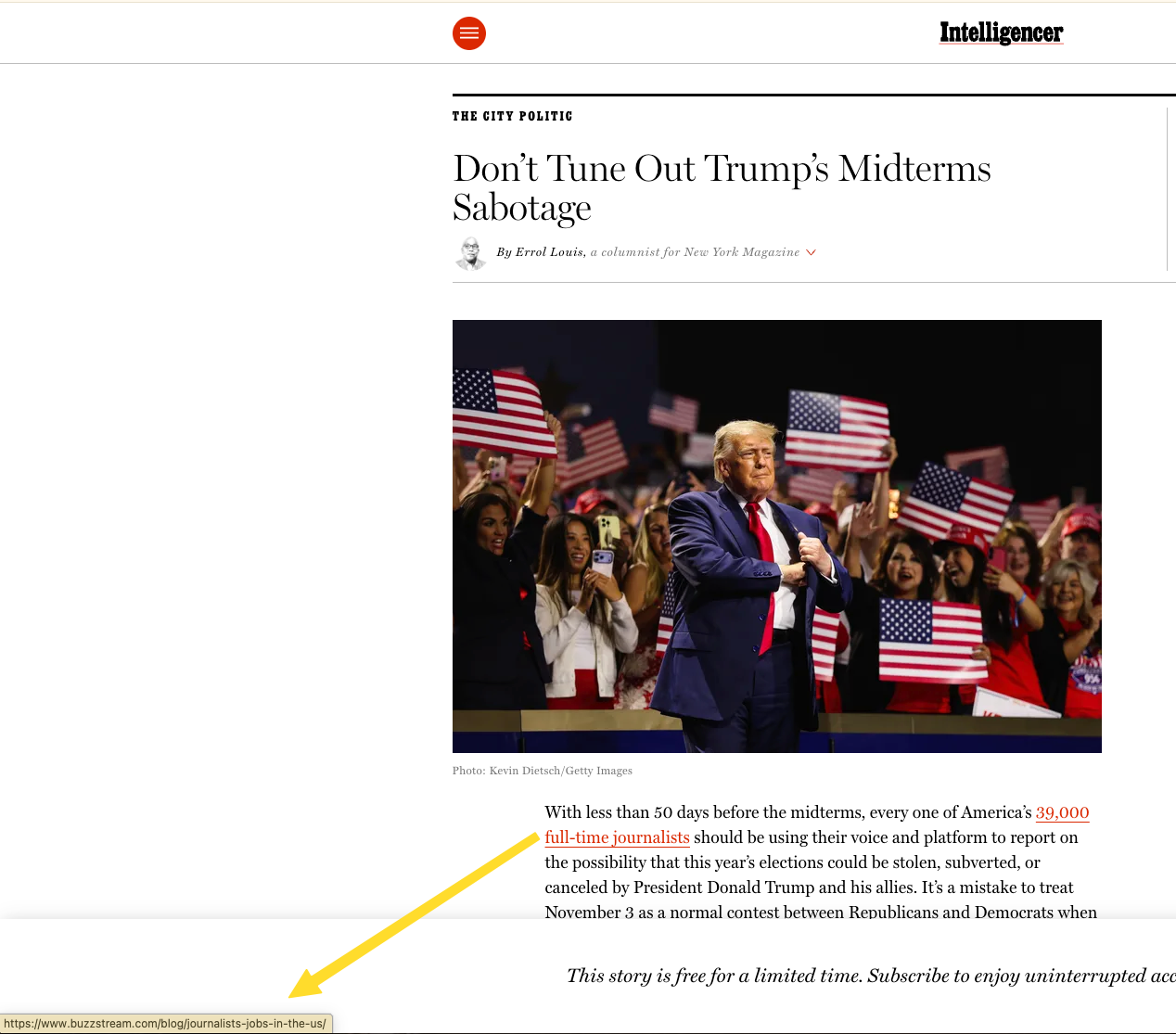
Then, if a journalist is looking for this data, they’re more likely to link to it as supporting data in a story.
For instance, I don’t know how this columnist at NYMag found our data, but that’s the through-line.
But getting cited as a source in an article won’t always move the needle.
The number of journalists in the US is topically related to BuzzStream, but buyers don’t necessarily search for it.
The solution is something Ross Hudgens talked about on our podcast: focus on a pain point in your business or industry that your brand solves, and build data around it.
For us, that’s what link building costs. Our link building pricing study found the average guest post link costs $461.
It’s one of the pages Google’s AI Overviews cite most often for BuzzStream. When someone asks “how much does link building cost?”, it shows up as a source:
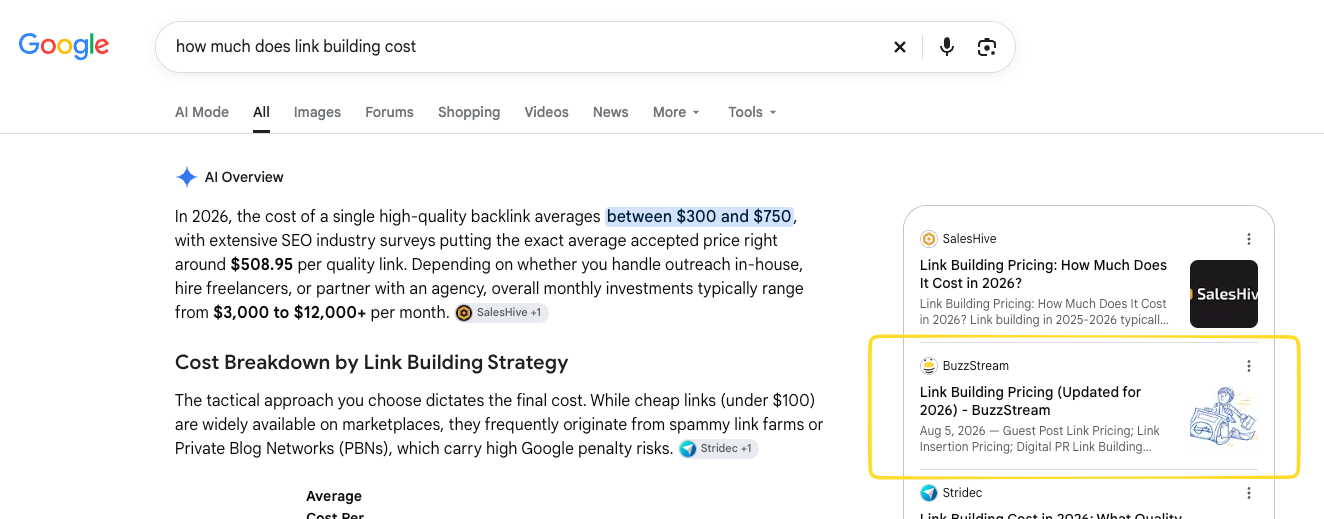
The person asking is shopping.
They’re deciding whether to pay for links or build the process in-house, and the page gives them the data they need and nudges them in the direction of BuzzStream if they decide to go in-house.
That’s closer to the problem a user is trying to solve.
Note: These examples show that original research can earn AI citations, but not whether media coverage caused those citations.
2. PR Helps Explain What Your Brand Is Known For
What does it impact
How AI describes your brand. The category it puts you in, who it says you’re for, and what it thinks you sell. Relevant media mentions, even without backlinks, may influence how AI understands and describes your brand.
Where to look for success
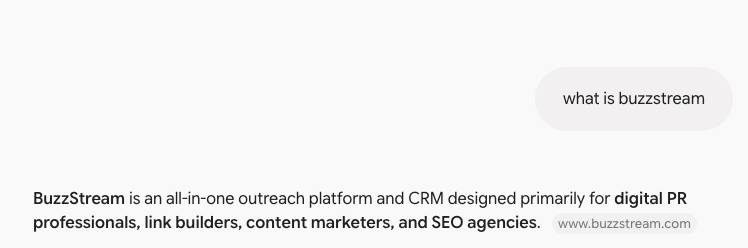
Prompts with your brand name in them, like “what does BuzzStream do?” Then check whether the answer uses the phrases you’ve been pushing, like “digital PR platform.”
PR can strengthen your brand messaging by repeatedly reinforcing the key terms and topics you want associated with your brand.
Consistently reinforcing the same brand messaging across the web gives AI systems more opportunities to encounter those descriptions and potentially associate them with your brand.
These can be large messages and ideas or small keyword phrases that you want LLMs to associate with your brand.
However, journalists may not even need to link to your website for the mention to have potential value (which is where most of the “PR is back!” sentiment comes from).
Ahrefs found that unlinked brand mentions correlate strongly with AI exposure.
If multiple relevant publications consistently describe BuzzStream as a “digital PR platform”, those mentions give AI systems more opportunities to encounter that association.
Tip: Relevance and context matter incredibly for these mentions. The surrounding words and passages also provide helpful context.
How to do it with PR?
Any time you pitch a brand to a journalist, refer to it the way you’d like AI to reference it.
Remember, at their core, LLMs are probability-based: the next word is chosen based on its probability relative to words before it.
So, you want to reinforce those word relationships with your brand.
You may be pitching a fresh piece of content, a news item, or even expert commentary at a journalist’s request.
Push it in your email pitch.
For example, when I refer to BuzzStream when pitching a journalist, I typically say “digital PR platform” or “digital PR tool”.
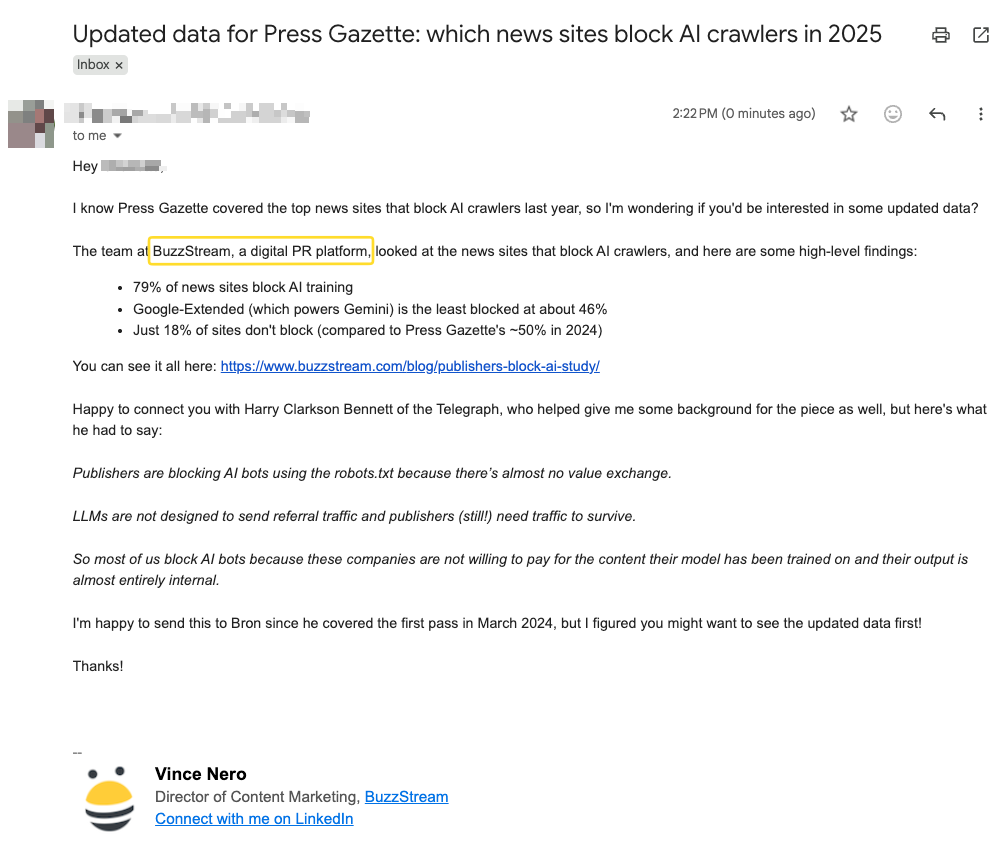
Then, when the journalist mentions BuzzStream, that keyword phrase is more likely to accompany my brand.
You can see it in this coverage I got on the Press Gazette:
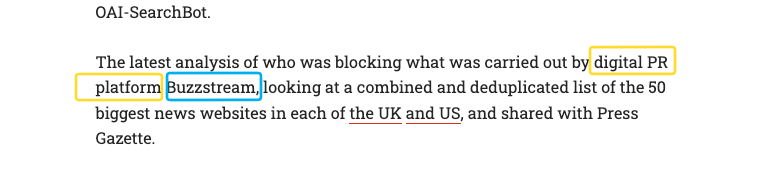
This, in turn, is more likely to help AI mention me in the way that I’d like (not quite there yet; this is a work in progress…)
Push it in your press release.
Based on our anatomy of a press release post, there are actually two places within a press release that you can reinforce your branding: the body of the release (preferably in the first sentence or two) and then in the boilerplate.
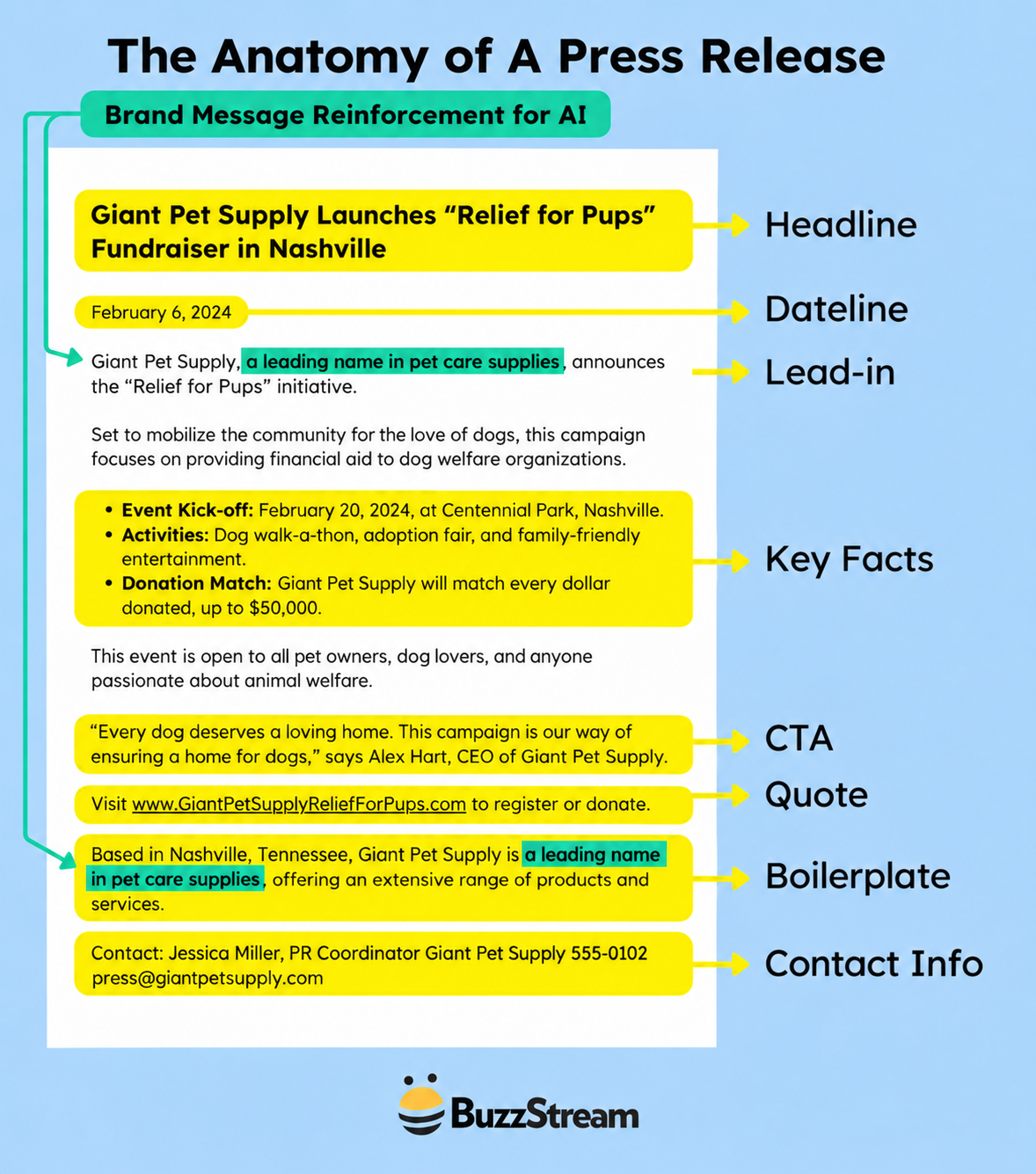
Then, when a journalist writes about you, they are more likely to use the same phrases.
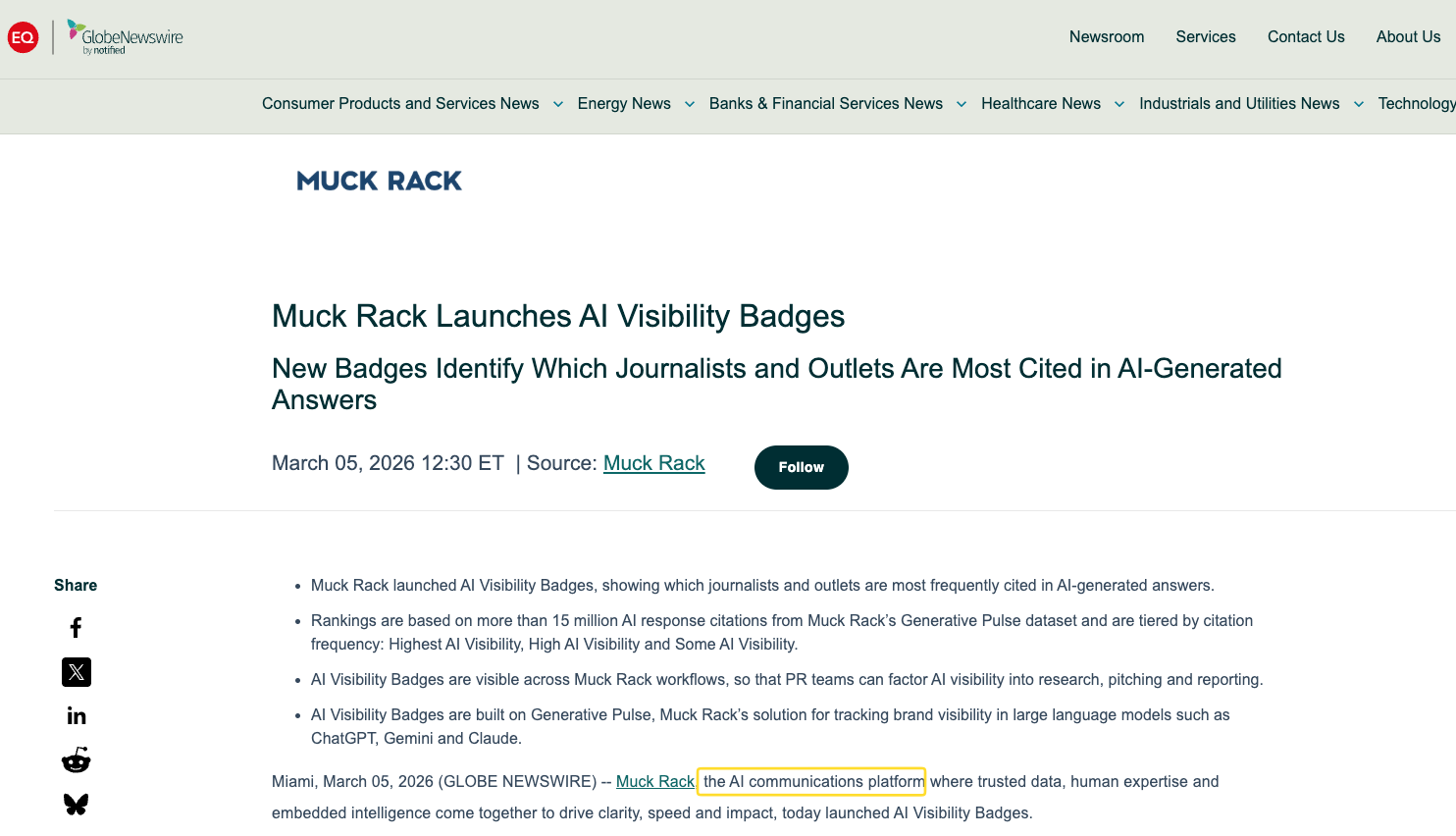
For instance, here is a press release from Muck Rack where they refer to themselves as an AI communications platform:
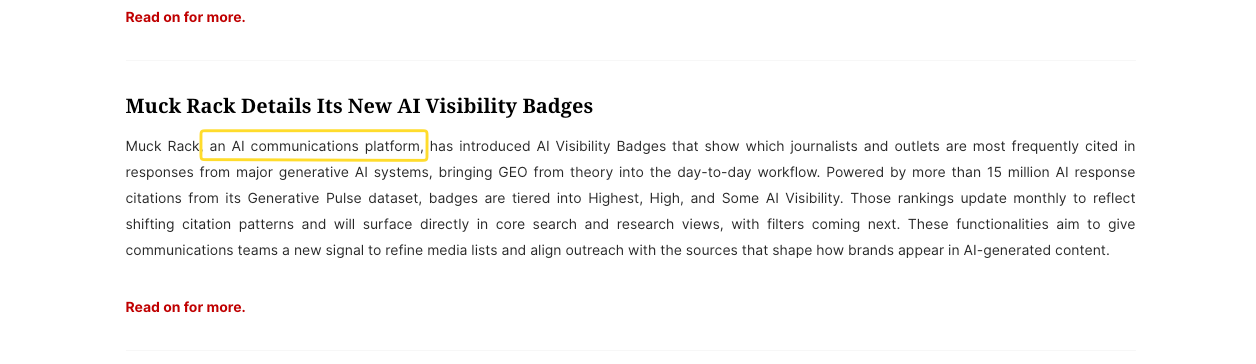
Then, a roundup post on Solutions Review referred to them with the same phrasing:
Publishing the press release alone doesn’t guarantee AI visibility.
The idea is that the release reaches the journalist and earns media coverage that can influence AI.
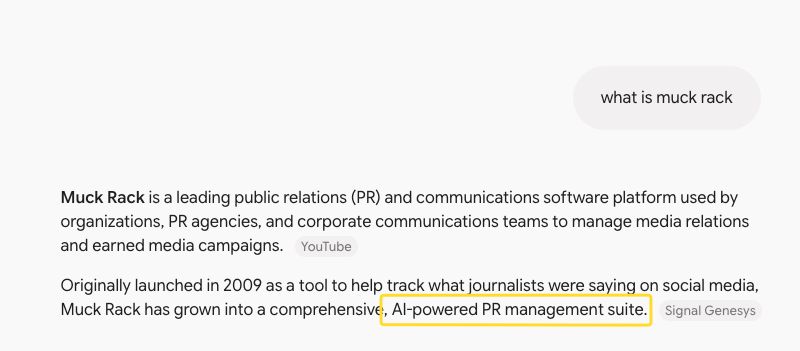
When I look at Gemini, I still see Muck Rack as a “leading publications and communications software platform.” Still, it’s also mentioned as an “AI-powered PR management suite” (though the source isn’t from that Solutions Review article).
So, again, it’s not a guarantee, and realistically, it takes more than one press release, one link, or one news mention to change how these AI platforms view you.
The goal is to build more consistent third-party references that AI systems can draw on when describing your brand.
Tip: When you write these keywords, focus on the value, rather than a salesy positioning statement like, “Brand X is the leading provider.” Journalists don’t like to give away free advertising.
3. PR Can Bring in Links, Which Still Support AI Search
What does it impact
Backlinks may support search rankings, creating opportunities for AI systems to discover your content.
Where to look for success
Track new referring domains alongside search rankings and AI citations.
Links remain relevant to GEO because search remains part of how some AI answers find information.
But it’s a wobbly through-line.
- Backlinks still correlate positively with Google rankings, according to Ahrefs’ study of one million SERPs.
- Pages that rank across more related fan-out queries are more likely to be cited in Google’s AI Overviews, according to Surfer research cited by Ahrefs.
So, relevant links can support search visibility, creating opportunities to be found during that research.
How to do it with PR?
The best way to build links through PR is still by sharing valuable information with journalists.
According to Cision’s 2026 State of the Media and our 2026 State of Digital PR report, journalists want data and research most from PR pros.
So, what does that look like in practice?
Proprietary Data Tied to Trending News
Suppose you have proprietary data that you can tie to an ongoing trend; pitch it. This is essentially a type of newsjacking.
When the Netflix show Squid Game was trending, sneaker site Sole Supplier shared a stat with journalists showing their slip-on Vans (similar to the ones worn in the show) saw a 7,800% spike in sales!
This stat was then covered (and linked to) by Variety, among others.
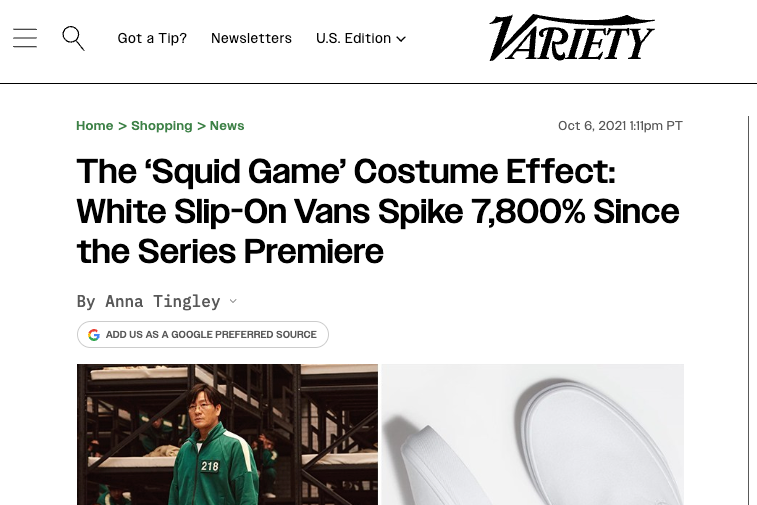
These backlinks may help Sole Supplier rank better in search, which could improve its chances of being discovered during an AI search.
But there’s no guarantee that links will translate into more AI mentions or citations.
This doesn’t have to be internal sales data, though; survey data can also give journalists fresh insights.
Recurring Trends Reports Based on Proprietary Data
These can be incredibly useful, especially if you repeat them YOY. These are best done with proprietary data.
For instance, PODS’ Moving Trends analyzes customer data to find where they are moving.
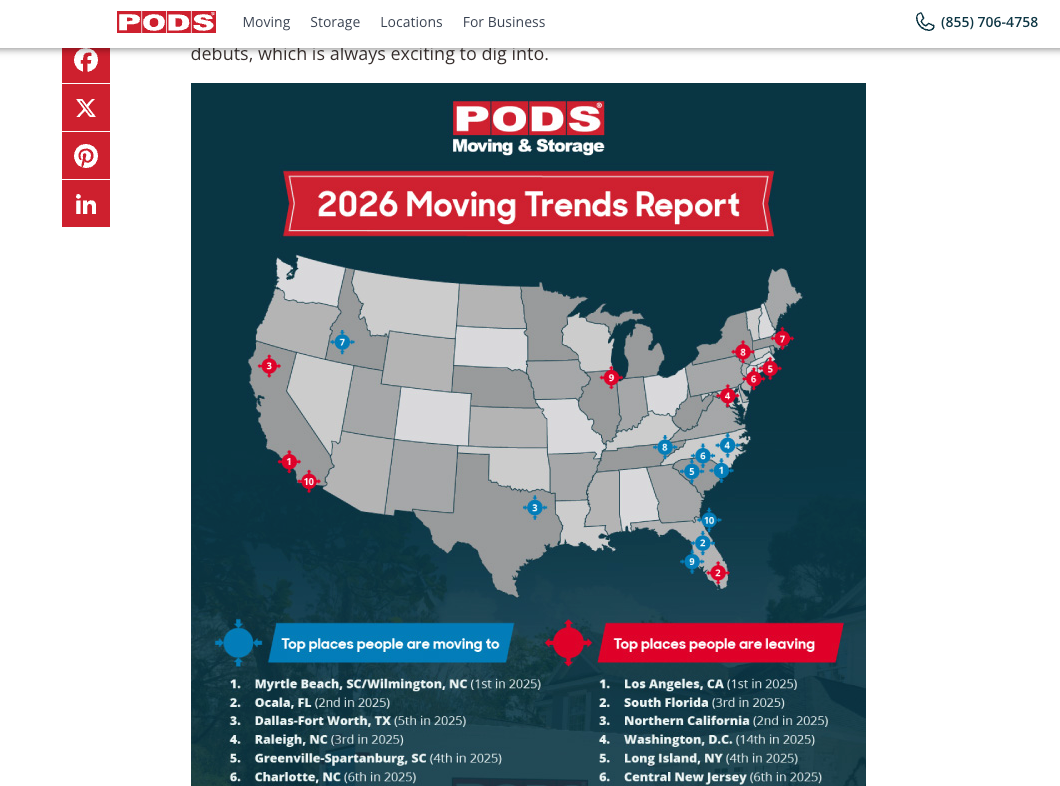
Or Yelp/Lyft’s Best Cities for Foodies based on their own proprietary data:
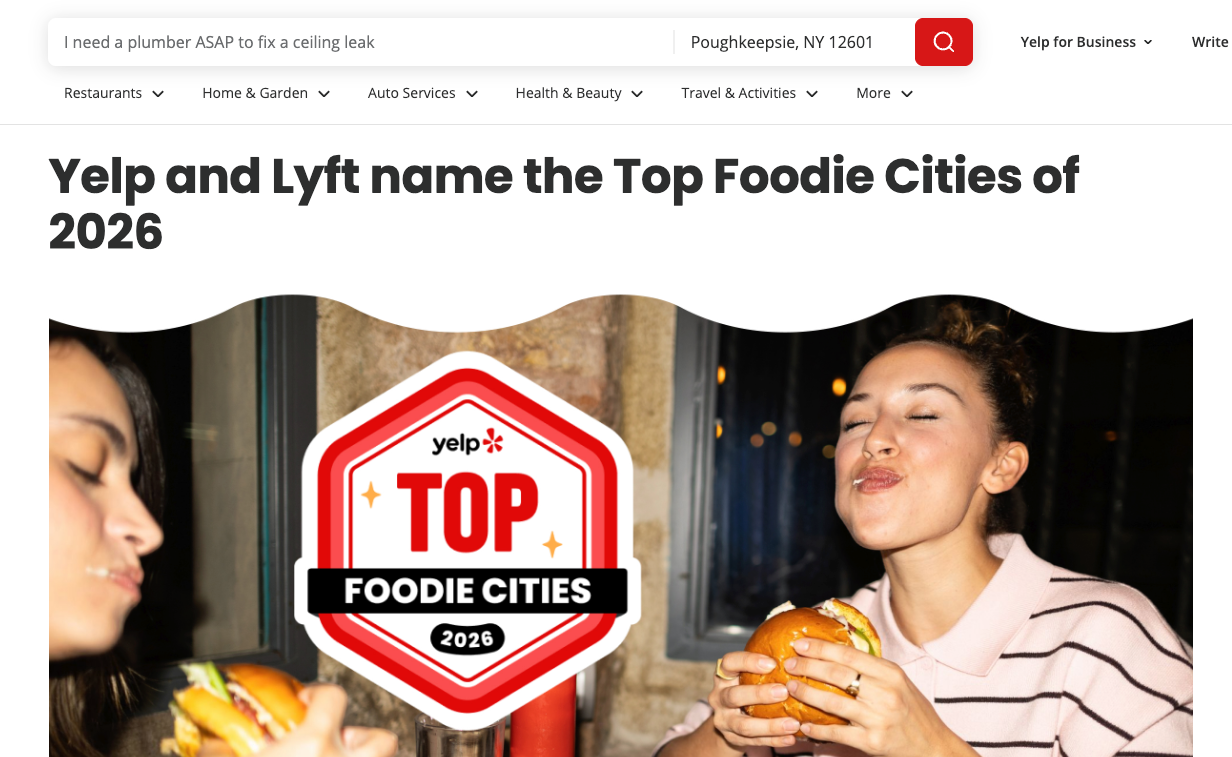
This generated links from local news sites and foodie news.
These links may support search rankings, potentially increasing opportunities for AI systems to discover the content.
Survey Data that Tells an Emotional (and Timely) Story
Healthy Paws Pet Insurance and Money.com put out a study showing how people would go into debt to save a pet.
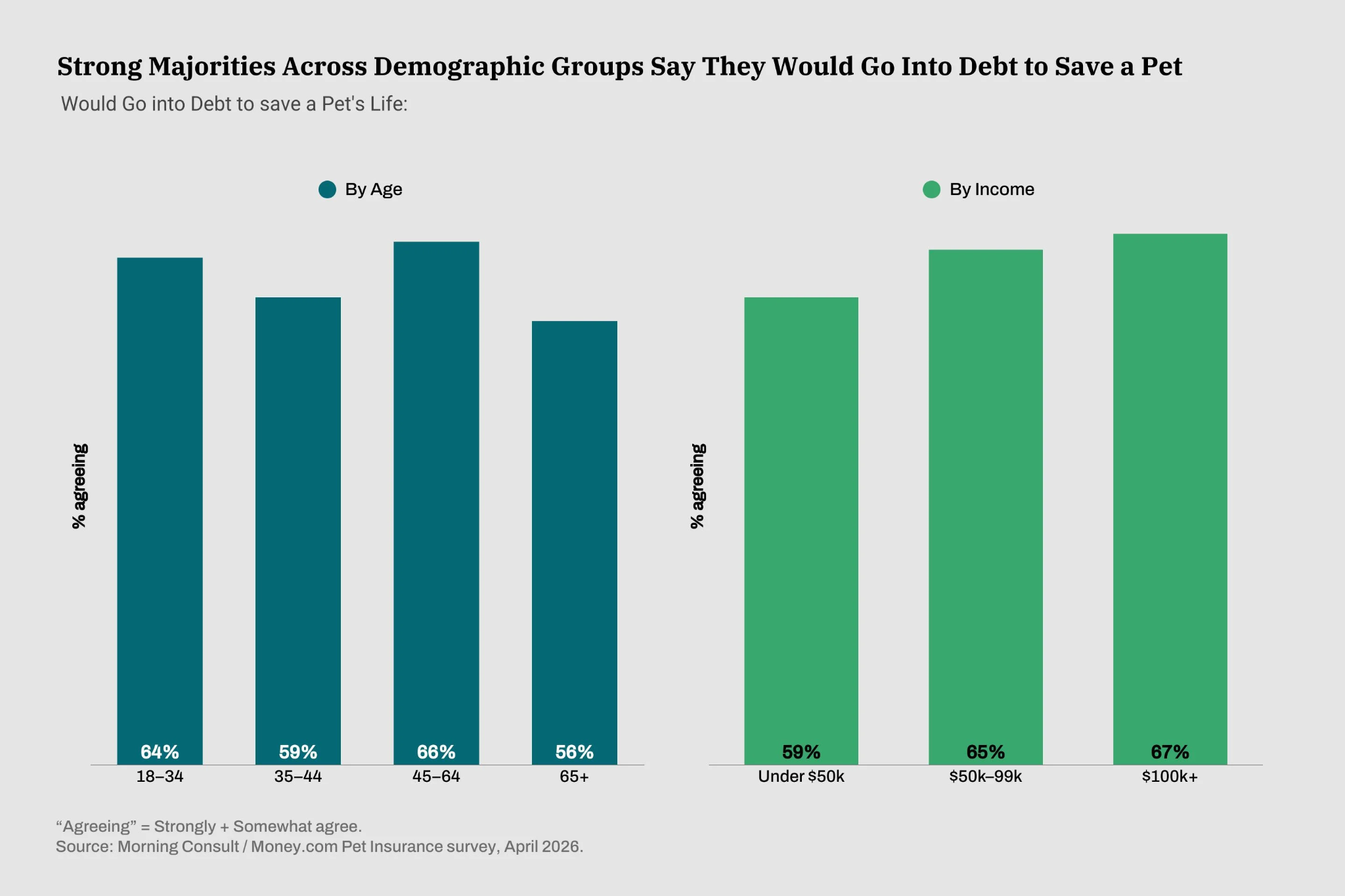
This can not only earn backlinks that help rankings and potentially drive more AI exposure, but also provide relevant data bits you can use in marketing.
The fear is “What if my pet needs care I can’t afford?”
That naturally puts readers in the market for pet insurance.
4. PR Can Make Your Brand Top of Mind
What does it impact
Whether people search for you by name. It doesn’t change the AI directly, but it changes the prompt, and named-brand prompts get way more mentions and citations.
Where to look for success
Look at branded search volume, direct traffic, and “how did you hear about us” answers.
PR campaigns can put your brand top of mind when a user is buying.
Lily Ray had a good way to think of it in our podcast conversation:
“How do you start the conversation in your industry so that everyone wants to come to you?”
This “brand recall” idea matters because AI mentions and cites brands differently when you name them in the query.
Based on our research, searches where the brand is named, “what does BuzzStream do?” are much more likely to get mentions and citations than a prompt without a brand, “what is the best digital PR tool?”.
Kind of obvious, but true nonetheless.
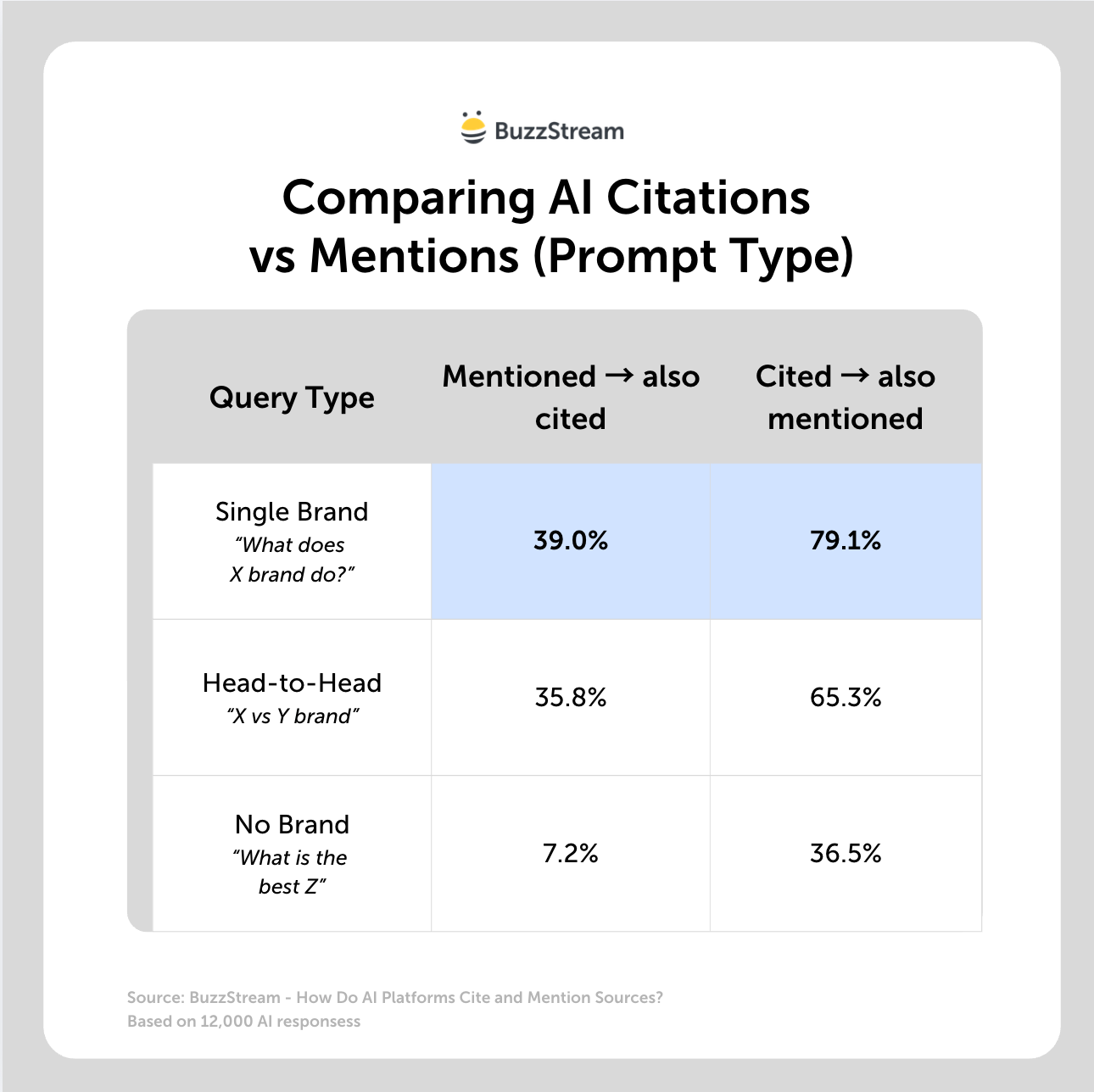
So, a campaign that helps users remember your brand when they go to buy doesn’t necessarily influence the AI, but it may influence how a user searches.
How to do it with PR?
This one is much broader and can range from website campaigns to outdoor billboards.
Unlike the other three tactics, this one doesn’t necessarily change AI’s answers. It’s about changing the questions people ask.
Daye, a gynecological health and sustainable period care brand, wanted to get people talking about discharge.
After their survey found that a quarter of women risk their health by being too embarrassed to discuss changes with their GP, they decided to feature a 13-foot inflatable pair of pink underwear on the streets of Manchester to normalize talking about it.
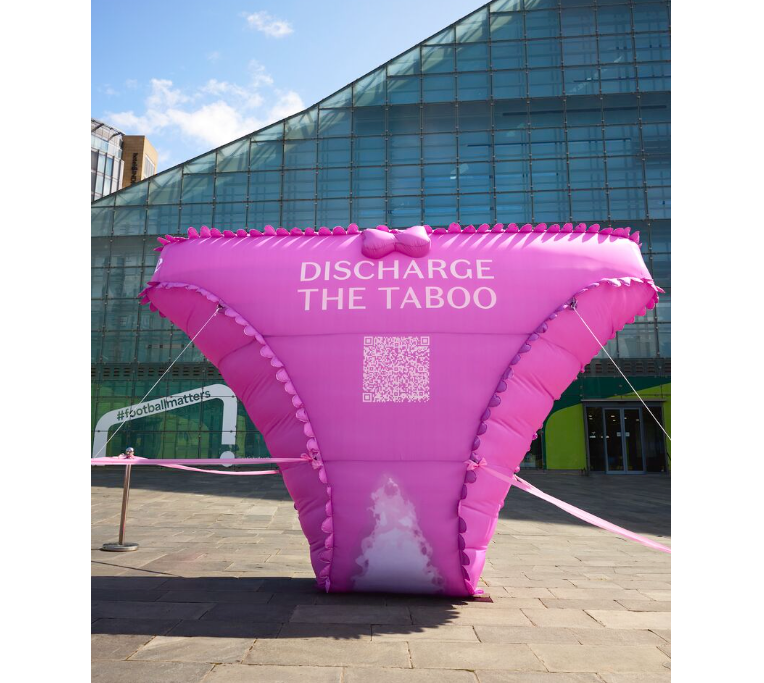
This ties into their health-focused brand mission and values, and they also sell a home-screening system for those uncomfortable or anxious about a doctor’s visit.
Then, when users search for these same health issues, they might search something like “How does Daye help with discharge?”
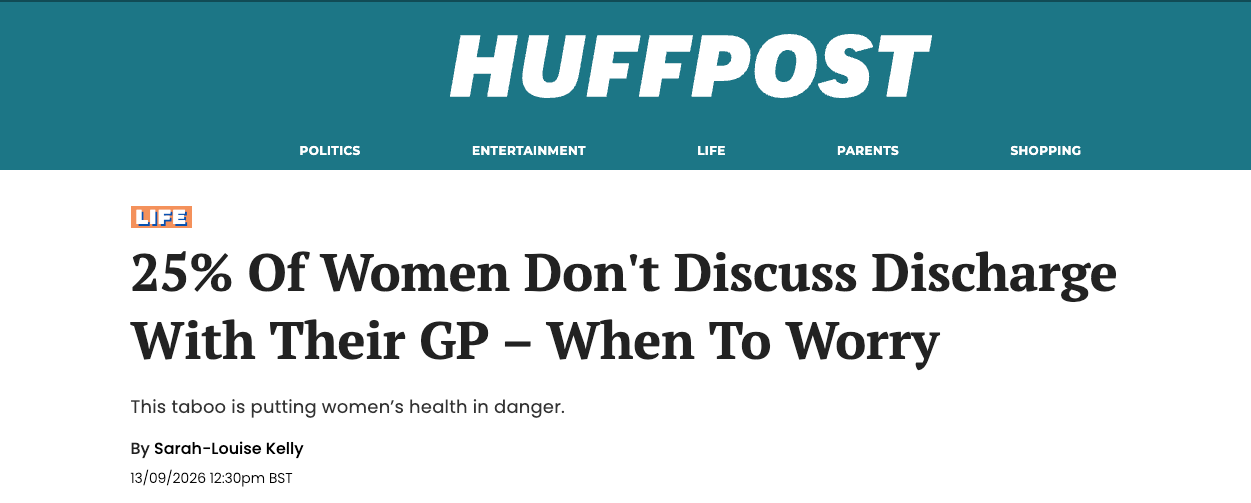
This was an in-person activation, but it still has its bones in digital PR because it generated coverage from online publications, like Huffington Post:
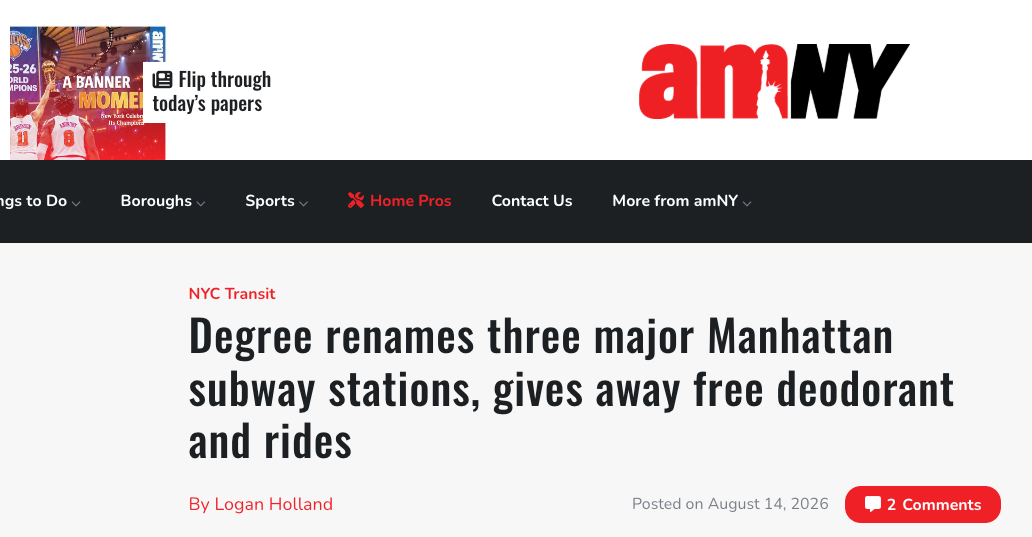
Another large campaign was when deodorant brand Degree “renamed” subway stops during an incredibly hot week (if you’ve never been in the NYC subway in the summer, it’s like a sauna:

When people think of being hot and sweaty, Degree wants them to think of itself.
So instead of searching “what is the best deodorant for sweaty men,” they search “Why is Degree a good deodorant for men?”
Although this was another in-person experience, it also got online coverage from AMNY, bringing it back into the digital PR bucket:
However, it doesn’t always have to be a big outdoor activation or billboard campaign.
One example I recommend for smaller, local brands is sponsored Uber rides.
This Safe Ride Home Program from Farah and Farah, a personal injury attorney firm in the Florida and Atlanta area, got local news coverage from WTSP Tampa Bay News:
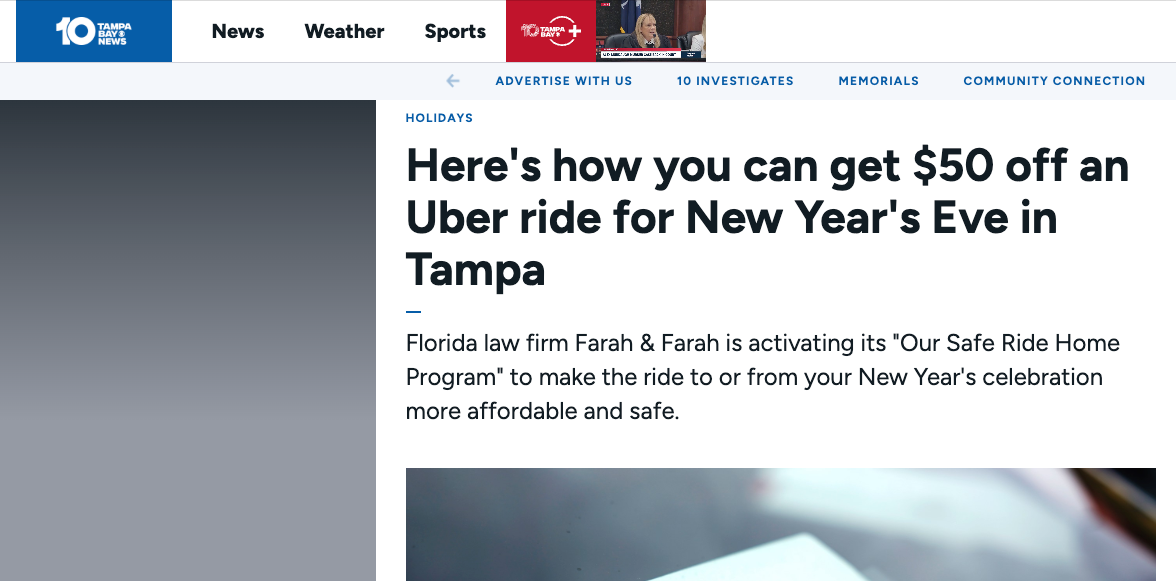
It offers a valuable service while keeping their brand top of mind when someone searches.
Then, if people in the Tampa or Atlanta area find themselves in a tricky legal situation, they might remember Farah & Farah’s free Uber and contact the firm first.
This is why it’s so important to keep your campaigns relevant to your customers and your service offering.
If Farah & Farah were a sports attorney, this campaign doesn’t make much sense.
Or if the campaign were free jet ski rides during the Fourth of July, the connection would be weaker.
(Again, I’m using these cases to illustrate potential outcomes, but I don’t have evidence these examples caused users to search differently.)
Tip : In my podcast conversation with Ross Hudgens, he told me that digital PR often works best as an accelerant for brands with existing awareness. He uses roughly 20,000 monthly branded searches as a benchmark for brands considering national news outreach, although it’s not a hard rule.
How to Judge Your Progress
When measuring PR for GEO, always start with what you’re trying to influence.
Never start with a PR campaign and figure out its GEO value afterward.
The real value of PR depends on the types of sources appearing for the prompts that matter.
Otherwise, it’s easy to collect a pile of placements, decide afterward what they supposedly achieved, and then shape the narrative around that.
Get baselines before you start.
Always understand where you are starting. Use tools like Ahrefs, Semrush, Peec AI, Profound, or Xofu to track your current citation and AI visibility metrics.
Track prompts that match your goals.
If you are looking to measure brand sentiment, you’ll want a different set of prompts than if you are looking to see if your proprietary research is getting cited by AI.
Also, repeat the same prompts over time rather than judging success from a single answer.
You are also going to see different citation sets that change over time. One Profound study found 40–60% of cited domains were different when comparing months.
What that tells me is you need to look for consistency across the same prompt set for several weeks to months, and even then it’s not guaranteed.
Track each platform separately.
ChatGPT, Google, and others perform very differently.
For instance, our research found that ChatGPT was much less likely to surface Reddit than others.
You will rarely be able to isolate PR completely.
Content changes, product updates, competitors, and platform changes can all affect your campaign results.
Look for directional changes and use these as a guide.
Report the coverage and links your team earned separately from changes in AI visibility those placements may have helped influence.
So, What Can PR Do For GEO?
PR can help get your research cited by AI, reinforce how AI describes your brand through relevant media mentions, earn backlinks that may support search visibility, and build awareness that influences what people ask AI.
But each pathway involves a different degree of uncertainty.
None guarantees your brand will be mentioned, cited, or recommended.
Some statements are more theoretical, and I couldn’t find good examples or data for them, but they make sense in practice.
For instance, I believe PR is great for reputation management and rewriting a narrative.
But don’t expect it to work magic; PR can’t fix a broken product.
Nor can it guarantee a citation, a mention, or a spot on some “top-cited” list.
News is a small slice of what AI cites, and the sources it does cite shift constantly.
Pick the one thing you’re trying to move, whether that’s how AI describes you or whether your research gets cited.
Get a baseline, then measure that.

 Check out the BuzzStream Podcast