
 End-to-end outreach workflow




Table of Contents
- Lead with the finding, not your brand — “[Study] 2 in 5 Remote Workers Have Never Met Their Manager in Person,” not “New Remote Worker Study from BrandX.”
- Tag it — “[Exclusive] Sleep Debt Costs the Average Worker 11 Days a Year” outperforms a curiosity-gap tease.
- Use a real number, not a vague claim — “Nurses Could Save $9,000 on an EV,” not “rising costs.”
- Name the place first — “Bristol Named UK’s Best City for Eating Out,” not a national framing that buries the city.
- Personalize based on previous work — “Interview: Ex-Bank of England Economist Says Rate Cuts Are ‘Priced In Too Early'” only works if that journalist hasn’t already moved past that story.
Journalist attention is at an all-time premium.
Inboxes are overloaded, US journalist numbers are dwindling (and in the UK), and PR pros are still spraying and praying for coverage.
Luckily, I have the data to help you find your way.
We started with media pitch examples, and in this post, I’ll focus on subject line examples based on our research of millions of campaigns.
In this post, I’ve recreated subject line examples for the most common types of media pitches modeled on real BuzzStream campaigns.
How to Write a Subject Line, Broadly
We have a full post on writing subject lines, which I highly recommend checking out.
Below is the TL;DR version (or just skip down to the examples).
1. Choose a relevant angle
If there’s one thing to take away from this piece, it’s that there is really no such thing as one perfect subject line for every journalist.
Relevance consistently stands out as what journalists care about most, according to Muck Rack and Cision’s annual journalist surveys.
To choose an angle that’s most relevant from your pitch that makes the most sense for a journalist, you need to research that journalist.
Find their past 5-10 articles, and you’ll get a sense of the angles and even the structure of how they like to write headlines.
2. Share the story in the first few words
Our data on subject line phrasing shows how important it is to front-load information for a journalist.
Most importantly, a subject line needs to share the most important facts, stats, or other information that immediately shows a relevant story.
We found that simply telling a journalist is better than clickbaiting or teasing a story idea.
(You’ll see more of what that means in the examples.)
When we broke down where to put key information, we found that words 1-3 get a 46% open rate, compared with later in the subject line (words 7+), where the open rate dropped to 38%.
This may be because email platforms truncate subject lines.
The Gmail mobile app shows fewer characters than the Outlook browser, and so on.
(Read more about subject line length limits.)
3. Get specific
Another takeaway from one of our studies is the fact that concrete email subject lines performed better than vague ones.
Use concrete numbers and stats wherever you can to help paint a picture.
4. Tag it
Another trick of the trade, backed by data from our original subject line study, is tagging a subject line with identifiers like [DATA] or [EXPERT].
These act as signposts and pattern interrupts in a crowded inbox.
Leading with brackets performed the best, followed by trailing brackets.
Of the brackets we tested, [EXCLUSIVE] performed best.
5. Format it
A few other formatting-related takeaways from our studies can help you mold your subject line to perfection.
Stick to a reading level of 10th grade and up
Although many marketing best practices suggest aiming for lower reading comprehension levels, our data showed journalists can handle the challenge.
Use title case
We found that title case got better opens and replies than sentence case.
Although it feels a bit email-markety (is that a word?), it may just be another way to pattern interrupt.
Stick to 9-13 words
Although we mentioned email subject lines getting cut off, longer subject lines still seem to perform better.
This may be because the longer subject lines have more detail, but it’s tough to say.
I think the main takeaways are to front-load the most important stuff and then make sure every word is necessary to add relevance and story.
Next, let’s look at what all of this looks like in practice.
1. Survey Study Examples
[Study] 2 in 5 Remote Workers Have Never Met Their Manager in Person
[Exclusive] Sleep Debt Costs the Average Worker 11 Days a Year
Study Finds Over Half of AI Health Answers Contain an Error
Surveys are one of the most commonly used content types in digital PR, according to our State of Digital PR report. They should focus on the key findings.
Why They Work
Here’s why the above examples work:
A clearly stated story
The main survey finding, which is the main story, is stated clearly in all examples as succinctly as possible. Avoid a general pitch like “New Remote Worker Study from BrandX”.
Concrete numbers
“2 in 5” and “over half” simplify clunky percentages rather than something like “AI Answers Health-Related Questions Incorrectly 54% of the Time”.
Then “11 days per year” paints a concrete picture that a journalist can lock onto.
2. Data / Research Report Examples
Students Face a £180 “Broadband Penalty” in Their First Term
[Data Study] Rural Homes Pay 34% More for Half the Speed
Nurses Could Save $9,000 on an EV – Most Don’t Know They Qualify
The second most-common kind of media pitch is the data-backed study. And, according to Muck Rack, it’s something journalists really want these days.
For them to really stand out, they need to focus on the key findings.
Why They Work
Here’s why these examples work:
Relevance
Each subject line above names a group a journalist writes about.
“Students,” “rural homes,” “nurses” would stand out to anyone who covers these beats.
Concrete numbers
$9,000 is a specific stat, not something vague like “rising costs”.
3. City / Regional Index Examples
Bristol Named UK’s Best City for Eating Out
[New Study] Leeds Ranks No. 2 for Cycling Safety
Sheffield Is the UK’s 3rd Most Pedestrian-Friendly City, New Data Shows
I’ve broken out the city index study as its own type of subject line, even though it is technically also a data/research piece because it requires some specific structure.
The key is naming a location and rank.
Why They Work
Here’s why the above examples work:
Place is the first word
Localizing a national study is the single biggest lever I’ve seen in this category.
We’ve seen the same study, same bracket, same week open far better when the city was named in the subject line than when it ran nationally.
Specific vs clickbait
None of these subject lines bury the lede with a general pitch like “Study reveals the UK’s best and worst cities for cycling.”
Remember, the idea isn’t to bait the journalist into clicking; it is to lock their eyes on a perfect fit.
4. Reactive Commentary Examples
Expert Urges Households to Act Now as Hosepipe Ban Starts Tonight
Searches for “Loud Budgeting” Surge 212% Today — Financial Expert Explains Why
Heatwave Triggers 140% Jump in Water Filter Sales Yesterday Says Expert
With reactive commentary, the focus is always on breaking news.
I like this approach because it answers the “Why now” question I always challenge PR pros to answer when pitching journalists.
Why They Work
Here’s why the above examples work well:
Lead with the news, not the expert
The front-loading rule has some nuance in reactive pitching. In all three, the news is the true focus, so a subject line like “Expert available to comment on the current water situation” would underperform.
Why now gets answered
“Tonight,” “Yesterday,” and “Today” all add urgency.
5. Proactive Expert Comment Examples
[Expert Available] Impact of Tomorrow’s Fed Funds Rate Decisions
Four Mistakes Homeowners Make When Buying Solar, According to an Expert
Property Expert Explains How to Avoid Being Gazumped Before 2027 Reforms
Since these pitches are based on upcoming events, they should still focus on the news—not the expert you are pitching.
Why They Work
Here’s why the above examples worked:
Provide context
Instead of focusing on the expert, they focus on the upcoming news. A generic pitch like “Interview opportunity with our home security expert” doesn’t give them enough context to understand why you’re pitching them.
Posed as article titles
Think of these as article titles, because that is a great way to show what the reader will get out of it rather than focusing on the expert.
6. Seasonal or Awareness Examples
Summer “Tanmaxxing” shows Gen Z Using Sunbeds as Trend Surges
5 Ways to Avoid Holiday Party Clogged Toilets from HVAC Expert
1 in 10 Oscar Winners Are Nepo Babies since 1986
I wanted to break out seasonal or social media-type awareness days/weeks/months because they do require a few specific features, like the season/date/awareness moment, the angle, and a figure of some sort.
If you’re ever unclear on where to find those awareness days/weeks/months, check out our PR Calendar.
(Worth noting that seasonal pitches are the most crowded slot in the calendar, so there’s going to be a lot of competition.)
Why They Work
Here’s why the above examples stood out:
Season/Trend/Event is front-loaded
Summer, Holiday, Oscars are all front-loaded “events” that help the subject line stand out in a crowded inbox.
Concrete Numbers
Specifics like “5 ways” and “1 in 10” make the story easy to grasp and can set you apart from everyone else pitching.
7. Expert Interview / Access Offer Examples
Interview: Former England Captain on VAR, Retirement and the Next Manager
Interview: Ex-Bank of England Economist Says Rate Cuts Are “Priced In Too Early”
Exclusive Interview Opportunity: [Olympic Medallist]
Muck Rack’s State of Journalism 2026 said that 58% of journalists agreed that PR pros should offer exclusive interview access to relevant sources. I expect that to increase as more and more fake experts get caught up in the AI slopfest of 2026.
These subject lines are probably the most straightforward of our bunch because you just need to summarize who they are and hint at what they can provide.
Why They Work
Here’s why I liked these examples:
Interview is in the label
Calling it an “interview” is the most straightforward way to “tag” your subject line and help journalists know what you are offering.
Who they are
Sharing specifics about your expert helps the journalist decide immediately, instead of something like “Exciting interview opportunity with a leading industry figure.”
Remember, we are providing concrete information, not clickbait.
8. Product Launch or Announcement Examples
[Press Release] Northfield Filters Announces Partnership With TapWorks
Brightway Launches Back-to-School Bundle for Under £25
[Store Opening] Meridian Opens First UK Store as Sales Climb 40%
For the most part, product announcement subject lines are very close to the target headline itself. However, they require a mix of specifics and brevity.
Don’t include so much information that it’s overwhelming, but include enough concrete detail to stand out.
Why They Work
Here’s what the above examples do well:
Tags work
A tag helps stand out in the inbox and tells them what to expect in the email. Some trade publications may only care about openings and announcements. So tagging can quickly show them your email is relevant.
Specifics
For the examples above, the “£25” and “40%” are part of the news for the announcement or launch.
Including them in the subject line makes it more concrete and newsworthy than saying “Brightway Launches Back-to-School Bundle.”
This leaves the journalist wondering, “How much?” or “Why should I care?”
9. Product Review, Sample & Roundup Examples
[SAMPLE AVAILABLE] Cooling Mattress Topper That’s Still Cool at 3am
First Look: Iconic Launches New Coffee Machine
SAMPLE: New Artificial Christmas Tree Under £50 Available 1st Dec.
Last but not least is the subject line for product reviews. This is where PR starts to blur in with marketing emails.
I still get trial request pitches with subject lines like “Would you like to try our new product?” instead of telling me what the product is.
The idea with these subject lines is to quickly provide specifics.
Why They Work
Here’s what I liked:
Tells them what it is
These subject lines give enough specific information about the product, rather than teasing it. “New Artificial Christmas Tree Under £50 Available 1st Dec.” provides meaningful specifics as compared to something like “New Artificial Christmas Tree”.
Tagging makes it stand out
At this point I sound like a broken record, but tagging makes a difference—especially for journalists whose job it is to cover or review new products.
However, the product must be relevant to the person you are reaching out to, which brings us to my conclusion…
Relevancy Should Always Lead the Way
Even if you’ve captured all of the correct formatting, your subject line still needs to be relevant to the journalist you are contacting.
I urge you to use the examples above as a guide.
They show why the components and specifics of a subject line can change open rates based on the type of outreach, but identifying the journalist type is up to you.
In my framework called F.I.T., I walk through how important it is to consider format, industry, and timing when pitching journalists.
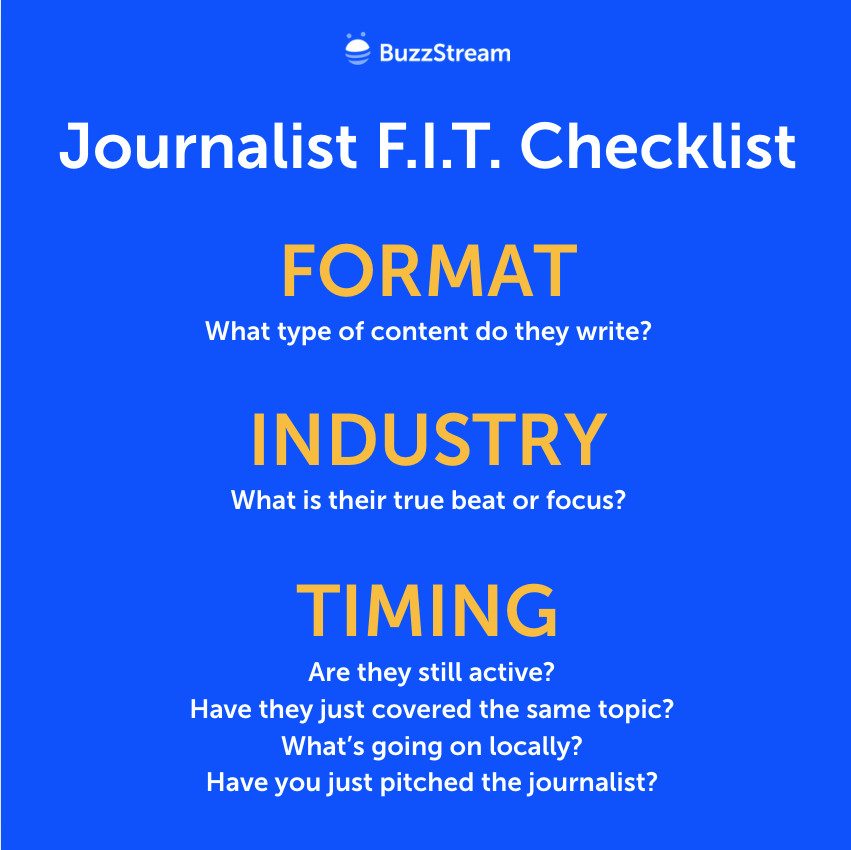
Some journalists cover only tech product review listicles, while others write op-ed columns about tech.
They both exist as journalists in the tech industry in a media database, but the outreach strategy, including subject line crafting, is very different.
Timing is also crucial.
If a journalist just covered a piece on rate cuts being priced too early, then the expert interview subject line example I provided: “Interview: Ex-Bank of England Economist Says Rate Cuts Are ‘Priced In Too Early'”, doesn’t make any sense.
In that case, you might want to take a fresh angle or pitch a different expert.
This is why personalizing a subject line for each journalist, albeit time-consuming, remains the key differentiator for success in 2026 and beyond.


 Check out the BuzzStream Podcast